
+++ The next era of BMW will begin in September with the arrival of the first Neue Klasse electric car: the iX3. Confirmed to be revealed at the Munich motor show ahead of sales starting early next year, the SUV (which I’ve already driven in prototype form) marks major milestones for BMW, as it introduces advanced underpinnings and a design that will be adopted across the rest of the brand. It will go up against the forthcoming electric Mercedes GLC; a car that will also be revealed at Munich. The pair will fight for a foothold in Europe’s most hotly contested new car segment in a bid to increase EV sales in the face of tightening emissions regulations. The new iX3 will be followed soon after by an electric 3-Series saloon, although a date for this unveiling has yet to be confirmed. Previewed last year by the bold Neue Klasse Vision X concept, the second-generation iX3 will be sold alongside the current, fourth-generation petrol X3 and sit on the all-new Neue Klasse architecture. As a result, the new iX3 will have slimmer batteries, more efficient motors and clever technology that BMW claims will be a “quantum leap forward” from today’s electric offerings. The size of its nickel-manganese-cobalt pack (which features new cylindrical cells) has yet to be disclosed, but BMW said the iX3 will offer a range of 800 km; 335 km more than the first-generation iX3. That would make the new iX3 Britain’s longest-range EV, going even farther than the new Mercedes-Benz CLA EQ saloon, which currently tops the charts at 772 km. An 800V electrical architecture will mean the iX3’s battery will also be able to charge at up to 400 kW, enabling a 350 km top-up in just 10 minutes from suitable chargers. 2 powertrains will be available when the iX3 arrives in the Netherlands early next year: a single-motor, rear-wheel-drive one and a dual-motor, four-wheel drive one that can deliver up to 408 hp. The second-generation iX3 also receives a new computing system that is 10 times faster than the network of chips in current BMWs. In addition, to maximise interior space within this set-up and to keep vehicle height as low as possible to aid aerodynamics, BMW will unusually bolt the front seats directly to the pack; another first for the firm. Visually, the new iX3 will draw on the original Neue Klasse models from the 1960s and return to small kidney grilles rather than the bolder, more expansive front ends that adorn the likes of the iX. The double-kidney grille will divide a large, gloss black panel on the iX3’s front end; similar in style to the Vizor found on Opel cars. The panel is likely to conceal the sensors and cameras required by the latest generation of driver assistance systems. The rest of the car will feature a boxier, more chiselled look than today’s models, with angled lights front and rear, plus a rear light bar. The reinvention continues inside the iX3, which will be the first car to employ BMW’s new iDrive X system. Previewed earlier this year, this comprises a large, sloped central infotainment screen, above which a head-up display spans the entire width of the dashboard. Traditional buttons are out, with BMW claiming the new set-up allows it to offer more complex and varied options, which can be updated over the air during the car’s life. In place of buttons are toolbars and customisable widgets on the touchscreen, as well as voice control that is said to be more intuitive than today’s set-up. The steering wheel has been redeveloped as well. Its design moves from three spokes to four but it retains haptic buttons for important functions such as cruise control. Christian Bauer, BMW vice-president of user interface design, told earlier this year: “Our slogan is ‘eyes on the road and hands on the wheel’, which means everything has to be in a perfect situation”. +++
+++ The values of some used DIESEL cars are actually increasing despite the fading appeal of the powertrain in the new car market, say leading vehicle valuation experts. In the first half of 2025 the decline, in the decline that can be traced to 2017, fewer new diesels were registered. This continues amid the fallout from the Dieselgate scandal and concerns about future vehicle taxation and emissions penalties. Diesel’s days appear numbered. Only a few car makers still produce diesel models, among them Audi, BMW, JLR and Mercedes. Other types of cars, such as petrol, hybrid and battery-electric vehicles, are experiencing rising demand. For most diesel models, this is reflected in increased rates of depreciation, but, bucking this trend, some have actually increased in value over what they were worth a year ago. Explaining the figures, Dylan Setterfield, head of forecast strategy at Cap HPI, said: “There is still demand for diesel in the used market from both consumers and dealers, with fuel economy continuing to be a significant factor for high-mileage drivers. “New diesel car volumes have been decreasing for some time and this is translating into reduced used car volumes. We expect these reductions to be partially offset by the ongoing reduction in consumer demand and that prices will behave similarly to petrol car prices in the next few years”. However, the market is experiencing wild valuation extremes and some models are instead depreciating at higher than expected rates compared with what they were worth last year. Those suffering the biggest falls in value include the Ssangyong Korando. Setterfield said: “The Korando’s falls seem to have been caused by uncertainty and confusion in the marketplace as the brand transitioned from Ssangyong to KGM”. Fortunately, the bulk of the sector is actually quite stable, with the average 3-year-old diesel worth just 2.1% less than its equivalent 12 months ago. The equivalent figure for a petrol car is 1.3% less. At 12 months and 30,000 km, their positions are reversed, with the diesel worth 1.4% less and the petrol 1.6% less. Philip Nothard, insight director at Cox Automotive International, a vehicle auction and remarketing company, welcomed the return of stability to most areas of the diesel market. He said: “After the highs of the immediate post-Covid years, when even 2 to 4 year old diesels were worth 73% of their new price and ones less than a year old 98%, order is returning to the market. In 2023, diesel values fell at a steeper rate than petrol as sentiment shifted to the latter and, thanks to tax changes, to some extent also to EVs. “The fall in the sales of new diesels that year means that today, there are relatively few 3 year-old diesels on the road. Values are sliding but just about holding firm, with 2 to 4 year-old diesels currently worth around 51% of their new price compared with petrol cars at 58%. Electric cars are worth around 36%”. The shortage of used diesels and the stability of their values are reflected on dealer forecourts. Motorpoint Group CEO Mark Carpenter believes that although demand for diesels has fallen considerably, the declining number of new ones being produced means that used examples will soon be the only ones readily available to customers. However, he doesn’t expect that any future increase in demand for them will necessarily trigger a steep rise in their prices. He said: “While any uplift in demand for used diesel vehicles will have some impact on prices, with fewer new diesel cars on the road, used diesel stock will continue to get older, reducing its appeal for motorists wanting a nearly new car”. +++
+++ The BMW Group just released its earnings report for the first half of 2025, and unlike Audi, the luxury automaker is on track to meet its targets for the year. That’s significant in a year where US tariff duties have wrecked havoc for European automakers. A large contributor to BMW’s resilient start to the year has been the performance of its high-performance M BRAND . Globally, nearly 106.000 M models have been sold in the first 6 months, the highest first-half sales ever for the performance division. Go back 25 years or so, and BMW’s line-up couldn’t be more different from what it is today. Back then, the only BMW SUV was the X5, turbocharged and electrified BMWs weren’t a thing, and most of its models still had clean, timeless designs. All that has changed, but what hasn’t is the enduring appeal of BMW’s M models. Compared to the first half of 2024, BMW M model sales have increased by 6.5% this year to achieve a new record. The brand said that models like the M3, M3 Touring (not sold in the USA), M5, and M5 Touring contributed significantly to 2025 sales. The continued success of the M5 wasn’t guaranteed, since the new one marked a massive change from older models. It’s now a plug-in hybrid monster that weighs as much as a large SUV, yet it still commands respect. It’s also pleasing to see a revival of performance wagons at BMW M, while key ingredients like a manual transmission, rear-wheel drive, and an inline 6-cylinder engine remain present in the M3. According to Mercedes-Benz’s interim report, the manufacturer sold 68.202 AMG models for the first half of 2025, a year-on-year increase of 7%, but not enough to match BMW M. BMW as a whole is also outselling Mercedes when taking into account all cars and non-performance models in the United States. Other than M models, BMW electrified models grew at the same rate (+6.5%) in the first half. Of all BMW sales over this period, more than a quarter are electrified models, including both plug-in hybrids and fully electric models. “Our performance in the first half of 2025 once again underscores the robustness of our business model”, said Oliver Zipse, Chairman of the Board of BMW. “Our success today, as well as in the future, is based on three strong pillars: our global footprint, our strength in innovation, and our technology-neutral approach with highly attractive products”. With BMW planning to keep its powerful straight-sixes and V8s around, as well as the imminent arrival of the brand’s Neue Klasse models, the brand is doing what it can to please loyalists while also transitioning into a new era of design. +++
+++ MAZDA reported net loss of 42.104 billion yen or 66.79 yen per basic share for the first quarter, compared with net profit of 49.814 billion yen or 79.06 yen per basic share in the same quarter a year ago, primarily impacted by lower sales. Operating loss was 46.115 billion yen compared with operating income of 50.360 billion yen last year. Sales for the quarter declined 8.8% to 1.099.770 billion yen from 1.205.563 billion yen in the previous year. For the full year, the company expects sales to decline 2.4% to 4,900 billion yen. Net profit is expected to decrease 82.5% to 20 billion yen with EPS of 31.73 yen per share. +++
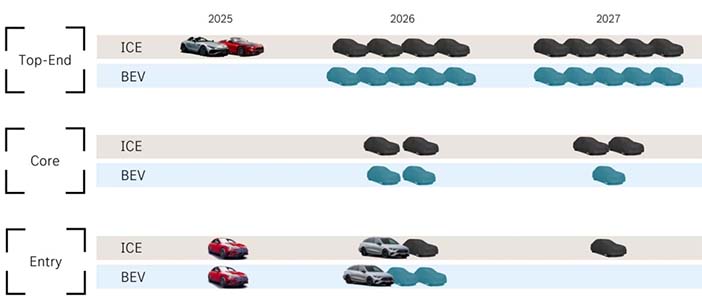
+++ MERCEDES isn’t in its best shape these days. Sales fell by three percent in 2024 compared to the previous year. 2025 isn’t great either, as demand declined by 6.2 percent in the first 6 months of the year versus the January–June 2024 interval. However, the 3-pointed star has reasons to be optimistic about what lies ahead. A flurry of models is planned for the next 2 years, covering all segments of the market. In an official document prepared for investors, Mercedes touts “the biggest product launch program in the history of Mercedes-Benz”. No fewer than 18 models are planned to hit the market next year, although two have already been unveiled. The recently revealed CLA Shooting Brake appears twice in the roadmap below because the German luxury automaker lists the petrol and electric versions separately. Let’s start from the bottom and move up to the top. There will be one new combustion-engine vehicle in the “Entry” segment next year, when Mercedes plans to launch two EVs. Chances are the models teased here are the next-generation GLA and GLB. The “Core” class pertains to the C-Class and GLC, presumably with mid-cycle facelifts for both gas models, joined by purely electric variants. For the “Top End,” Mercedes is plotting four gas/diesel vehicles and five EVs, including facelifts for the S-Class and EQS. The Stuttgart-based company has already promised a “major upgrade” for its traditional flagship, with CEO Ola Källenius saying they’ve “invested a lot more in the model update of the new combustion engine S-Class than we normally spend on a facelift”. 2027 will be nearly as busy, with one petrol car in the Entry class, 2 more in the Core segment and another 5 at the upper end of the line-up. On the EV side, there will be a Core model without a combustion engine, along with 5 zero-emission vehicles in the Top End. While the product roadmap is mostly about facelifts and next-gen cars, there will be additions to the line-up. Aside from the already revealed electric CLA/CLA Shooting Brake and the upcoming C-Class EV, Mercedes has confirmed plans for electric versions of the next-gen GLA and GLB. Additionally, it’s cooking up a “Little G” as a kid brother to the Geländewagen. Mercedes’ AMG sidekick is keeping busy as well, with its first bespoke EV products. The GT XX concept previews an electric super sedan, which will spawn an equivalent SUV. A new combustion engine is also in the works for enthusiasts who prefer a brawny V8. The large-displacement ICE is coming in 2027 and will be available until at least the middle of the next decade. One missing piece of the puzzle concerns the C 63’s future. AMG is adamant it won’t revert to a V8 for the sports sedan’s facelift, while reports state the C 63 and the lesser C 43 will both be dropped altogether in favour of a 6-cylinder C 53. It’s also unclear whether the CLE 63 Coupe / Cabriolet will indeed pack 8 cylinders under the hood. Mercedes fans should look forward to what the brand is planning, considering there will be something for everyone. A unified design language between ICE and EV models is also in the works, as Mercedes intends to ditch the super-slippery EQ cues, having come to grips with the reality that the aero-focused strategy isn’t paying off. +++
+++ NISSAN is considering using its Formula E team to develop prototype versions of hot EVs that could be used to help create future Nismo performance models. Tommaso Volpe, Nissan’s Formula E team boss, told Autocar there are internal talks about how the Paris-based squad can aid the Nismo division in the development of future road-going electric performance cars. The Japanese firm currently offers a warmed-up Nismo-badged version of the Ariya electric SUV, but company boss Ivan Espinosa previously told the firm had “exciting plans” for future sports cars, suggesting he wanted four or five halo models to top the line-up. While he stressed plans had not been agreed yet, Volpe said a proposal was under consideration for the squad to develop “some prototypes based on normal chassis that can help the Nismo division to enhance the performance of electric cars”. He added: “We have the Ariya Nismo now, which has no influence from Formula E, but we are considering a collaboration for future models. We could do a prototype version, then they could use that as a base to develop future products”. Any future test mule is likely to be based around the twin-motor all-wheel-drive running gear of a Formula E racer and would be focused on helping Nismo learn about optimising the efficiency of electric performance cars and refining traction management with all-wheel-drive powertrains. Notably, Formula E will introduce a new Gen4 technical package for the 2026/27 season. The regulations are set to feature powertrains with permanent all-wheel drive using a pair of motors to produce around 800 hp; up from the 476 hp of the current cars. Volpe said the technology transfer in Formula E to date has generally gone from road car to race car, citing lines of Leaf software code used in the programming of the race car powertrain. But he added that would switch with the new machines. “The development of the Gen4 cars will be when potential transfers will come from the racing cars to future road products, because the level of performance and efficiency will be pushed even more to the limit”, said Volpe. “Also, they will be all-wheel-drive. With the Ariya we have strong expertise of all-wheel-drive electric powertrains and controlling the grip on four wheels independently. There is a huge possibility of transfer with our future products. “The regulations of Gen4 have been written in an open dialogue with manufacturers, and one of the reasons all-wheel drive is there is because of a strong push by Nissan and some other manufacturers, because all-wheel drive is the trend for the core business in the future”. +++
+++ The UNITED KINGDOM registered 5% fewer cars in July than in the same month last year, as the EV market stalled while buyers awaited clarity on which electric cars will be eligible for new government grants. Some 140.000 new cars were registered last month, a dip that ended a 2-month period of growth, but the industry is optimistic that the announcement of new government- and manufacturer-backed discounts for EVs will accelerate uptake and drive an increase in sales, and it is now expected the UK will register 1.9 million cars in 2025. Growth in electric car sales slowed dramatically in July as customers waited to see which cars would be eligible for the government’s new Electric Car Grant (ECG), which will reduce the price of some sub-£37.000 EVs by either £1.500 or £3.750, according to various criteria. Registrations of pure-EVs were up 9.1% in July compared with the same month last year, to 29.825 units. That’s significantly down on the 34.6% uptick in demand recorded over the first half of 2025 and made it the second weakest month of the year so far for EV registrations after April, when changes to car tax rules “distorted the market”, according to the Society of Motor Manufacturers and Traders (SMMT). The SMMT says further clarity on the models eligible for the grant, expected over the coming weeks, will be crucial as EV sales are still lagging well behind the trajectory of the zero-emission vehicle (ZEV) mandate. Currently, battery-electric vehicles (BEVs) hold a 21.3% market share, which is well behind the 28% EV mix manufacturers must achieve in 2025, “demonstrating the importance of accelerating uptake over the remainder of the year”, said the SMMT. However, as consumers await further confirmation of which cars and manufacturers will attract the ECG; a decision that hinges largely on the emissions of the country of manufacture: many brands have already started to slash prices themselves in a bid to shift EVs. Alfa Romeo, MG, Volvo and Smart, for example, are among the makers who have applied £1.500 discounts to some of their sub-£37.000 EVs, while cars including the Leapmotor C10, Hyundai Inster and GWM Ora 03 are now available with up to £3.750 off. SMMT boss Mike Hawes said July’s figures lay bare “the new car market’s sensitivity to external factors and the pressing need for consumer certainty”. He added: “Confirming which models qualify for the new EV grant, alongside compelling manufacturer discounts on a huge choice of exciting new vehicles, should send a strong signal to buyers that now is the time to switch. That would mean increased demand for the rest of this year and into next, which is good news for the industry, car buyers and our environmental ambitions”. July’s EV decline is “expected to be temporary”, said the SMMT, forecasting that EVs will account for 23.8% of the UK’s forecasted 1.9 million new cars at the end of the year. Elsewhere, sales of hybrids were down 10%, diesel’s decline continued with another 7.9% drop (to just 8,000 cars in July) and there was a 14.7% decrease in sales of pure-petrol cars, which accounted for 66.271 sales. Nevertheless, pure-combustion powertrains still make up more than half of the new car market. Plug-in hybrids, meanwhile, are seeing something of a renaissance, with registrations up 33% to 17.489, giving them an eighth of the UK market, and setting them on course to likely overtake other hybrids in the coming months. There was a small uptick in business registrations, but as these accounted for fewer than 3.000 cars in July, it was far outweighed by 3.2% and 6.5% dips in private and fleet registrations, respectively. 8 months into the year, the Ford Puma continues to lead as the UK’s best-selling car. Should it maintain this position until the end of 2025, it will mark its second consecutive year as the top model in the UK. However, despite a strong start for the Puma, the broader new car market is experiencing fluctuations. The industry is still facing serious challenges, including uncertainty about government incentives. July 2025 saw the end of 2 months of growth for car sales, with 140.154 units registered, representing a drop of 5% year-on-year. That said, electric car sales increased by 9.7% year-on-year, up to 29.825 units. That number is expected to grow more rapidly in the coming months, as the government’s newly revised electric vehicle grant comes into effect. But which cars are currently the most popular in the UK, and can any of them get close to Ford’s crossover? The list of the top-10 best-selling cars of the year to date, based on SMMT data, contains: 1) Ford Puma – 30.764 units 2) Kia Sportage – 27.494 units 3) Nissan Qashqai – 24.529 units 4) Vauxhall Corsa – 22.196 units 5) Nissan Juke – 21.604 units 6) Volkswagen Golf – 18.974 units 7) MG HS – 17.793 units 8) Volkswagen Tiguan – 17.750 units 9) Peugeot 2008 – 17.605 units 10) Hyundai Tucson – 17.249 units. +++