
++ FORD boss Jim Farley has given the strongest hint yet that a forthcoming new SUV for Europe will take the Bronco name, outlining global ambitions for the fabled off-roader. As reported by Autointernationaal.nl, Ford is preparing to launch a chunky new SUV inspired by its iconic US-market 4×4 to serve as an indirect replacement for the Focus, which was last year retired after 27 years. The new American-flavoured crossover will be produced in Valencia, Spain, alongside the closely related Kuga. It will arrive in 2027, 6 years after Ford revived the Bronco after a 25-year-break to serve as a Jeep Wrangler rival. Since its return, the Bronco has been a huge sales hit, spawning multiple variants such as the more road-focused Bronco Sport and even an unrelated China-specific Bronco that’s offered with either an electric or range-extender (REx) powertrain. Speaking at the Detroit motor show, Farley said “the Bronco line-up is filling out globally, and I don’t think the media has caught onto that yet”, suggesting that the US 4×4’s name will also be used in Europe. He added: “We have great plans globally for Bronco”. Ford is planning to launch a string of REx and hybrid cars in the US market in the coming years, and Farley said that buyers “should expect a lot of exciting powertrains for Bronco”. However, he added that there are currently no plans to offer the Chinese-market Bronco New Energy in the US. It could be the first new car launched by Ford under the leadership of recently appointed Europe boss Jim Baumbick, under whom the company said it will look to “develop products relevant for European customers and drive faster, more efficient execution”. The new SUV is set to share the Kuga’s C2 platform and will likewise be offered with plug-in hybrid power, in line with Ford’s strategy to continue with combustion engines in Europe following lower than expected demand for EVs. No pure-electric version is currently understood to be in the pipeline. However, the SUV will be extensively differentiated from the Kuga by way of a completely bespoke design treatment that takes heavy inspiration from Ford’s US line-up, with the long-running Bronco 4×4 cited as a chief influence. Ford is leveraging its American heritage in the design of its new European-market models as part of a drive to emphasise its origins and better stand out from rivals new and old; a treatment first deployed on the Explorer, which features a similarly blocky, straight-edged silhouette to its larger US-market namesake. The new model, which is tipped to take the Bronco name, is likely to be a much more traditional ‘two-box’ SUV, compared with the Kuga, with upright proportions and a more rugged design that nods to the existing Bronco’s off-road ability. The US-market Bronco Sport gives a good idea of what to expect. Ford is employing a similar tactic to JLR, Mercedes-Benz and Toyota in channelling the spirit of its halo 4×4 for a more mainstream family crossover. Those marques will respectively launch downsized versions of the Defender, G-Class and Land Cruiser over the next 2 years. The new Bronco will be less premium-focused than the similarly conceived ‘Defender Sport’ and ‘Little G’, though, because it has a crucial role to play in Ford’s plan to rebuild its significantly diminished market share in Europe. Adding a new ICE-powered C-segment SUV will help Ford to compensate for the lacklustre commercial performance of the Capri and Explorer EVs. These 2 models have sold far slower than expected, prompting swingeing job cuts at the factory in Cologne, Germany, where they are built. To that end, it will be sized and priced to do battle in Europe’s most popular car segment, facing off with some of the region’s biggest-selling models, including the Volkswagen Tiguan, Kia Sportage and Hyundai Tucson. Other natural rivals include the freshly launched Jeep Compass, another 4×4-inspired electrified family crossover, and the Skoda Kodiaq. +++
+++ Last fall, GENERAL MOTORS announced plans to stop working on next-generation fuel cells for its Hydrotec brand. At the time, the company noted the “path to reaching a sustainable business in fuel cells is long and uncertain”. That’s an understatement and the automaker pointed out high costs and limited refueling infrastructure have hampered sales of hydrogen-powered vehicles. Speaking of which, the company noted there are more than 250.000 EV chargers in the United States, but just 61 hydrogen refuelling stations. Fast forward to today and Honda has decided to end production at their Fuel Cell System Manufacturing joint-venture with GM. Production will come to a halt before the end of the year and the decision came after “extensive discussions”. Honda didn’t elaborate, but the talks focused on the continuation of the Fuel Cell System Manufacturing business. These discussions ultimately resulted in an “agreement to discontinue production of fuel cell systems at FCSM”. The move comes roughly two years after commercial production began in January of 2024. The companies invested $85 million into the Brownstown, Michigan plant and the decision to end production appears to spell doom for the Honda CR-V e:FCEV. The fuel cell SUV was introduced in 2024 and is available for lease in California. It features a 17.7 kWh battery pack, a front-mounted motor, and a 4.3 kg hydrogen tank. This setup gives the Honda 176 hp and an range of 470 km. While GM has largely thrown in the towel on hydrogen fuel cells, Honda isn’t giving up. Quite the opposite as they’ve announced a next-generation fuel cell system that has been developed in-house. The company said they’ll use it to “further expand business opportunities in order to grow its hydrogen business as one of the new core businesses of Honda”. +++
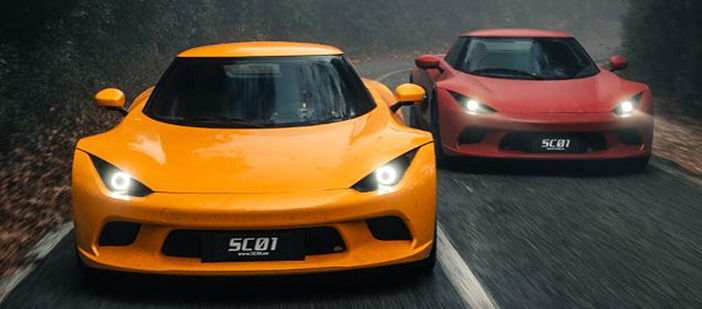
+++ Chinese brand JMEV ’s lightweight electric sports car, the SC01, will be sold in Europe. The new car, which appears to draw on the cheese-wedge styling of the Lancia Stratos, has been described by its maker as “the first electric sports car done properly”. SC01 Europe, the European business that is due to bring the car to market, said it has “no excess”, adding it wants “to prove that electric cars can still be raw and mechanical in feeling”. The product of a partnership between start-up Tianjin Gongjiangpai Auto Technology (TGAT) and established brands Xiaomi and JMEV, the SC01 was first unveiled in 2022 and recently entered production. It is slightly smaller than an Alpine A110 and employs a space-frame chassis with in-board push-rod dampers. It has a remarkably low kerb weight (for an EV) of 1.365k g. That is 40 kg lighter than the 6-cylinder Porsche Cayman GTS, and around 500 kg lighter than an equivalent MG Cyberster, the nearest competitor currently sold in Europe. The SC01 is powered by a pair of electric motors, with one mounted on each axle, which combine for a total output of 435 hp. This allows the SC01 to hit 100 kph from a standstill in 2.9 seconds, its maker claims. Range is quoted at 400 km, thanks to a 60 kWh battery pack mounted between the cockpit and rear axle, where one might expect the engine in a traditional midship sports car. Inside, the SC01 defies convention for Chinese cars, eschewing technology for a driver-focused set-up. This includes a single digital display (for instrumentation), physical climate controls and a traditional handbrake lever. The gear selection buttons and window switches are located on the small centre console between the driver and passenger. A launch date and price for the SC01 have yet to be announced, but a website has been published inviting buyers to join a “priority list” for an allocation. This website states that just 1.000 examples will be built for Europe “and will never be offered again” thereafter. European examples will be built in Italy and will cost around 60.000 euro. Depending on how quickly TGAT can build a factory and ready the SC01 for European homologation, it could beat several long-established brands in launching an electric sports car. Its closest rival, Lotus’ Type 135, remains several years away, as does Porsche’s electric Boxster and Cayman. Caterham, meanwhile, recently showed the first rolling prototype of its Project V at the Tokyo Auto Salon show. +++
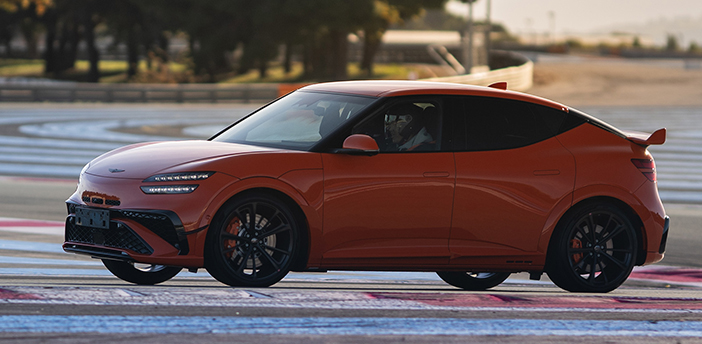
+++ For the launch of a new performance brand called MAGMA , it was freezing cold. That probably wasn’t a consideration when Genesis management planned the event, most likely imagining guests basking in Provençal sunshine as they gathered at Circuit Paul Ricard near Marseille late last year. But the track’s mile-long main straight is called Le Mistral for a reason: it’s named after a strong wind, which was carrying a chill air and even snow through the region. So a late decision was taken to move the event from a stage on the circuit itself into an aircraft hangar. It protected guests from the wind but not the cold: blankets and handwarmers were laid on initially, before a veritable eruption of orange, performance-honed Genesis models and concepts were paraded at dizzying speed. There were Magma versions of the G70 and G80 saloons, a coupé version of the GV80, a stunning G90 Wingback estate concept, the firm’s Le Mans hypercar and the ‘one more thing’ mic-drop arrival of the Magma GT concept. Technically this event’s purpose was to launch the GV60 Magma the 650 hp, Porsche-Macan-rivalling electric SUV that shares much of its underpinnings with the Hyundai Ioniq 5 N. But the gathering also marked 10 years of the Hyundai group’s premium brand itself and presented a chance for Hyundai boss José Muñoz and Genesis creative chief Luc Donckerwolke to lay out their manifesto for the next decade. The launch of Magma is key to plans to turn Genesis into what Donckerwolke calls a “luxury high-performance brand” over the coming decade. Every Genesis model whether petrol or electric will eventually be offered with a Magma variant, but the idea is for the brand’s hot credentials to flow into all cars. So why wait until now to launch Magma? “In the past 10 years we have achieved what other brands take decades to do”, says Donckerwolke. “We’ve done 100 years in 10 years. We could not have launched Magma earlier; we needed to earn it on the ground”. Those first 10 years have, by headline metrics, been a huge success: Genesis has shifted nearly 1.5 million cars globally, a number that Muñoz says has been achieved “faster than any luxury marque in history”. He adds: “This is remarkable: some people are talking about Tesla and some about Lexus, or other companies. And we said to ourselves: ‘Hey, how long did it take them to reach 1 million sales?” And yes, the answer is it took them longer than Genesis. Genesis currently has annual global sales of around 225.000; the goal is to hit 350.000 a year by 2035. That said, a challenge for Genesis is that the distribution of those sales has been extremely uneven: more than two-thirds have been in Korea, where domestic manufacturers still enjoy massive support. It’s doing reasonably well in the US and Canada but is less well established in Europe, partly because Genesis only launched here in 2021, and then only in selected countries. It has also had to pivot from original plans to go EV-only (it’s far from the only brand to have done that due to slowing EV sales growth) and switch from an online-only sales strategy to using dealerships. Even so, Donckerwolke says: “I would not consider Europe to be less successful. We have just started, and we originally planned to be a fully electric brand from 2025. But we had to adjust and, because of the Euro 7 rules, we have a limited portfolio. But we’ll bring new products to Europe and add new markets so we are just in development in Europe”. The goal is ambitious: Muñoz is aiming for Genesis to grow its European sales by 650% in the next 5 years. “We have a very bold plan”, he says, adding the region will get a “new strategy, new product, new technology, new distribution”. The Magma brand will be one key aspect of that new European approach, although Donckerwolke is quick to differentiate it from performance sub-brands such as Mercedes-AMG, Audi Sport and BMW M. “We are a young brand, and we have to appeal to customers”, he says. “If you are in an environment where people can choose between different brands, you have to have all the facets of the brand. You have to be luxurious, you have to be sporty, you have to be cool”. But if Genesis isn’t a ‘classic’ performance subbrand, what is it? “It’s high performance but not purely high performance”, says Donckerwolke. “We’re amplifying the products of Genesis so we decided not to make a sub-brand. Every model in the line-up will have Magma at the top of the range. Magma means performance and luxury refinement; we’re bringing these parameters together. We are just adding another level to the top of the existing one”. +++
++ MAZDA has reportedly delayed the launch of its first bespoke electric car until 2029, just months after mules of the SUV were spotted in the early stages of testing. The car was originally due to arrive next year, but the Japanese firm has instead decided to focus on new hybrid models and technology, local media has reported, likely in response to stagnating EV sales and the resulting uncertainty in the market. Mazda currently has no EVs on sale after it axed the MX-30 EV last year and its rotary-engined range-extender variant last week. The 6e is on sale now and the CX-6e is due at the end of the year, but neither is a bespoke proposition. Instead, they are both the result of a joint-venture with Chinese car maker Changan, which is why the now-delayed EV was seen as such an important vehicle for Mazda. The Japanese firm is one of the largest independent global car makers to not yet use a bespoke EV architecture for a production car. The delayed EV is a key part of a $10 billion push by Mazda to electrify its line-up over the coming years and will be the first car to sit on the firm’s bespoke EV platform. Before the delay was reported, Mazda chief technology officer Ryuichi Umeshita told last year that while the firm is investing in alternative ICE fuels and new types of hybrid powertrain (including a rotary-electric PHEV arrangement), it is working towards an inevitable pure-electric future and is committed to using bespoke EV architectures for its next-generation EVs. He said: “We’ve established our own electrification development team, which we call ‘E-Mazda’, and that team has been doing a great job. I’ve driven a prototype car already, which I would say is a real ‘jinba ittai’ car: our key concept of wellness between car and driver. It has very good driving dynamics. So we’re confident that our EV products will be real Mazda products”. Umeshita acknowledged that Mazda is behind rivals with regard to launching an EV platform but said the development of the MX-30 means “we do have a lot of good engineers, experienced engineers already, so I don’t think that we are behind the market because of that”. He stopped short of giving any clues to what types of models Mazda is working on and said a decision hasn’t yet been made on whether its first bespoke EV needs to be a high- or low-volume proposition. “It depends on the market and the regulations”, he said. “If the regulation requires a higher EV mix, it must be a volume car. If the regulation is eased, then we can ease the volume restraints”. Prototypes using the platform were spotted in November. At first glance, they could be mistaken for a CX-90, but the propositions are drastically shortened, which can be clearly seen by the distance between the front door’s leading cut-line and the front wheel well, revealing changes underneath. It is also trimmer than the CX-90, as evidenced by the wheels being swallowed by the arches. This change in size suggests Mazda’s first EV will be a 5-seater and could even be an electric equivalent to the CX-5, which would be plausible, given this is the brand’s best-selling model. Mazda recently announced plans to slash development costs and lead times for its first range of bespoke EVs, majoring on cost-effective simulation R&D work, AI development tools and partner-suppliers in a bid to reduce the expenditure. The firm said the move to a ‘lean asset strategy’ means it can do triple the amount of development with the same resources. +++
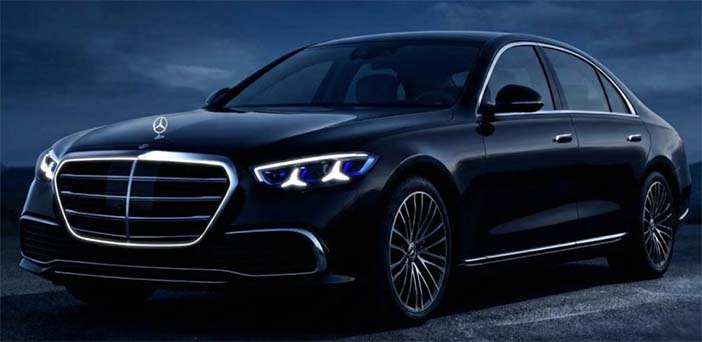
+++ CEOs and business tycoons everywhere should mark their calendars, because the facelifted MERCEDES S-Class will be unveiled on 29 January and the brand’s CEO is promising it will take “sophisticated, understated luxury to the next level”. More than 50 percent of the components on the S-Class (around 2.700) are either new or refined for the updated version. That includes the 3-pointed star on the bonnet, which CEO Ola Källenius has confirmed will be illuminated for the first time ever. The updated car’s grille will be larger than before too, and have a “new status-oriented, prestige type of look” flanked by new headlights that incorporate the company’s three-pointed star emblem, as do the new tail-lights. Inside, the new S-Class will also be the first to feature Mercedes’ new MB.OS operating system. It’s referred to as a “superbrain” for the car, designed to provide a more intuitive and personal experience for customers. It will power the MBUX infotainment set-up and we suspect some big new screens. Mercedes is also expanding the ‘Manufaktur Made to Measure’ personalisation options for S-Class customers, and Källenius promises the car is ready for Level 4 autonomous driving. “As a matter of fact, we are already running the first pilots on the streets. The sky is the limit here”, he said. “From the most sophisticated driving-assistance systems where you’re still in control, but the car helps you negotiate any situation, to the car literally driving itself”. Mercedes has made improvements to every powertrain in the S-Class line-up, with perhaps the biggest being a new flat-plane-crank V8 engine. This M 177 Evo unit will feature in the S 580 4Matic. The M 177 Evo will deliver 530 hp and 750 Nm of torque, with improved turbocharger housings and fuel injection system designed to make the V8 more responsive, refined and efficient, while mild-hybrid assistance allows for incredibly smooth start-stop functionality. A 6-cylinder petrol engine will be available in the S 450 4Matic and S 500 4Matic, which feature an ‘overtorque’ function to assist when accelerating hard or overtaking, and the plug-in hybrid S 580e that will be able to cover more than 100 km in EV mode. Meanwhile, the S 350d 4Matic and S 450d 4Matic will feature a 6-cylinder diesel that’s been developed to meet future emissions legislation and has the first electrically heated catalytic converter on a production car, to help clean harmful pollutants from the exhaust faster and more efficiently. Another advance is a new ‘Intelligent Damper Control’ function for the S-Class’s air-suspension system. This uses data collected from other Mercedes cars on the road to anticipate potholes, speed bumps or other imperfections, and will increase the damping to preserve the car’s luxurious ride comfort. +++
+++ A New 400 hp MITSUBISHI electric car Is coming, but it won’t be made by Nissan or Renault. Instead, it will be built by Foxconn. This shows Mitsubishi is open to unconventional partnerships as it rethinks its EV future. The new electric car is mainly targeted at Australia. Foxconn, the company that assembles iPhones, just launched the Bria EV in Taiwan. That’s the car Mitsubishi is expected to use as the base for its new electric hatchback in Australia. What’s not clear is if this Foxtron-based EV is also headed for North America, or if we’ll get something different. It looks like Mitsubishi is shaping its EV plans to fit each market, depending on what makes sense for cost, rules, and timing. If Mitsubishi keeps most of the Bria’s hardware, the specs are promising. Base models get a single rear motor with about 229 hp, good for a claimed 0-100 kph in 6.8 seconds. That’s already quicker than a lot of mainstream compact EVs. The real attention-grabber is the dual-motor, all-wheel-drive version. With about 400 hp, it’s said to do 0-100 kph in just 3.9 seconds, which puts it right in hot-hatch territory. Every version uses a 57.5 kWh lithium iron phosphate battery. Foxtron claims up to 460 km of range. All-wheel-drive versions will likely get a bit less. DC fast charging tops out at 134 kW, so you can go from 10 to 80 percent in about half an hour. The car is heavy for its class, at around 2.000 kilos, so getting the suspension and steering right will matter even more. The Bria looks a lot like Foxtron’s Model B concept, with clean lines, full-width lights, flush door handles, and aero details. Pininfarina did the styling, but Mitsubishi could add its own design cues; it’s not clear how much will change. Australia will reportedly see this EV in the second half of 2026. For the US and Canada, things are still up in the air. Mitsubishi hasn’t said if this Foxtron-based model is coming here, or if we’ll get a Nissan-based EV instead. Right now, the Bria-based car looks like just one piece of a bigger, still-changing EV plan. +++