
+++ ALFA ROMEO ’s turnaround bid is struggling for take-off, with holes blown in its new model rollout due to regulatory and commercial pressures. The new Stelvio and the successor to the Giulia are the biggest casualties: the all-new SUV was scheduled for launch in 2025, but it’s been pushed back for 2 years while Alfa Romeo re-engineers it completely. “We are changing our path because we were imagining Alfa Romeo’s future was electric-only, to respect the rules coming from Brussels”, Santo Ficili, the brand’s CEO, told during an exclusive conversation in Belgium. But with consumers not flocking to EVs in the numbers predicted, the US withdrawing electric car incentives and the EU diluting demands for the new car market to be totally electric by 2035, Alfa Romeo has been forced to rip up its plans. “We need to change everything”, explained Ficili. “We need to go from only-BEV to all the other powertrains. You can imagine what it means we need to change: to reinvent platforms, electronic architectures, connectivity of the car, not only for Alfa Romeo but all the Stellantis brands”. Ficili confirmed that this revamp included the STLA Large platform, the executive car-sized chassis bound for forthcoming big Alfas. It already underpins the electric Jeep Wagoneer S and the latest Dodge Charger muscle car, powered in the US by either twin electric motors for a maximum 680 hp or an inline 6-cylinder with up to 550 hp. Could Alfa Romeo use this ‘Hurricane’ petrol engine? “Let’s see”, said the boss. “We need to wait for the Capital Markets day, when our new group CEO, Antonio Filosa, will present the plan and not only for Alfa Romeo. Hold your breath!” But it’s almost certain that a twin-turbocharged straight-6 with 422 hp minimum would be too much of a risk to Alfa’s compliance with European emission targets, despite its swing towards compact, electrified SUVs to lower the fleet’s CO2 average. On this continent, expect big Alfas to embrace plug-in hybrid (PHEV) powertrains alongside electric power, although potential economies of scale have receded with Jeep and Chrysler dropping American PHEVs in favour of range-extender (REx) hybrids. A REx’s electric-biased driving experience doesn’t feel appropriate for a sports brand such as Alfa, again causing a headache as the Italian minnow struggles to build out its portfolio. The delay to the Stelvio and Giulia means a stay of execution for the existing, 10-year-old models, though only in maximum-attack, 520 hp Quadrifoglio trim in Europe. This fabulous twin-turbo-6 has been re-engineered to meet the latest engine regulations, a courtesy not extended to the 280 hp 2.0-litre turbo, which is bowing out in Europe. “We had imagined to close Giulia and Stelvio but we decided to go ahead until the end of 2027”, said Ficili. “There was an investment to respect the regulation, but now the car is okay”, Quadrifoglio orders will reopen in April 2026. “We are not crazy for volume”, the boss added. Alfa will seek to maximise revenues from these flagship old-timers instead, epitomised by the Giulia Luna Rossa limited edition. Restricted to just 10 units, the collaboration with the high-performance sailing team gets a carbon-fibre bodykit and revamped interior – for a 6-figure price. Cash from the flagships is critical when the heart of Alfa’s European range are the cheaper Junior and Tonale SUVs. Ficili claimed the Junior was running ahead of predictions with 60.000 orders since its launch in spring 2025. “And I’m quite satisfied with Tonale numbers: 100.000 units sold since 2022”, he added, with the facelifted model coming through. “I’m super positive about the commercial result we delivered in 2025: globally we were up 19 percent, with Europe climbing 29 percent. But we are suffering a bit in North America because of tariffs”, he concluded. All told, Alfa Romeo sold about 70.000 cars in 2025; still a drop in the ocean compared with BMW’s 2.16 million deliveries. +++
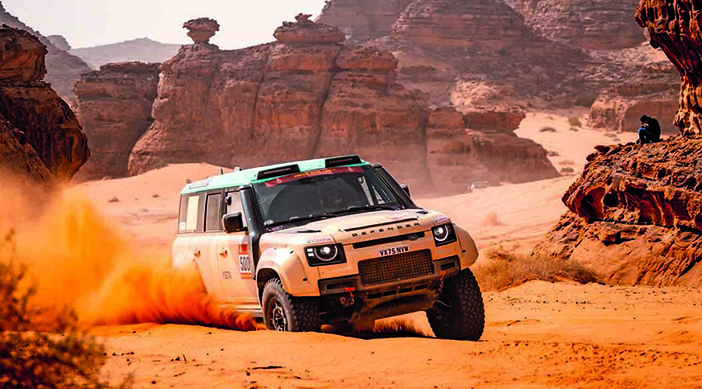
+++ DEFENDER Rally started its Dakar story with an immediate result, taking a debut victory in the production-based Stock category at the 2026 Dakar Rally. The win matters because Dakar is the sport’s harshest credibility test, and production-based entries have to balance speed with the reality of running hardware that stays closely tied to showroom vehicles. The winning crew, Rokas Baciuška and co-driver Oriol Vidal, secured the Stock class title in the Defender Dakar D7X-R after sealing the result on the final day with a Stage 13 win. They finished with a total time of 58 hours 09 minutes 45 seconds, and the team’s overall performance was consistently strong across the event. 2 other Defender entries also finished near the front of the Stock class, reinforcing that this was not a single lucky run but a coordinated factory-level effort. Defender’s Stock class challenger is based on the Defender OCTA architecture and uses a 4.4-liter twin-turbo V8, but it is adapted for rally-raid with key changes that focus on durability and off-road speed. The car is built from the same underlying structure as roadgoing Defenders, then upgraded with a wider track, increased ride height, suspension revisions, and enhanced cooling for sustained desert running. It is designed to prove that the Defender platform can survive Dakar punishment without being re-engineered into a purpose-built prototype. +++
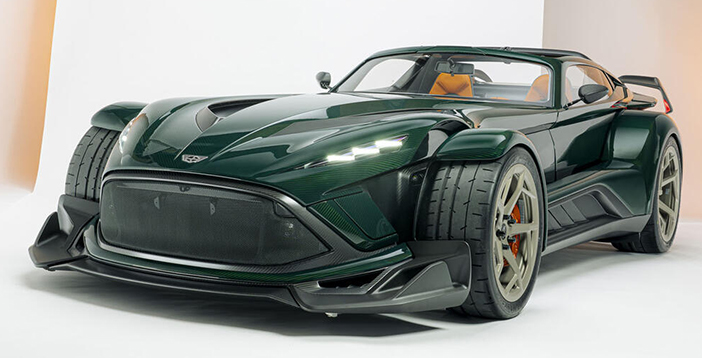
+++ The stripped-back, aero-focused P24 RS is the latest creation from DONKERVOORT , and it is the most powerful model in its 48-year history. As the follow-up to the F22 from 2022, the P24 RS is the firm’s 20th model and, while extreme, is billed as its most accessible car to drive yet. It could also be the first Donkervoort to be offered in a right-hand-drive configuration, although a decision has yet to be made. The 780 kg 2-seater is powered by a 3.5-litre V6 that was also used in the second-generation Ford GT. This new unit is the first Ford powerplant used by the Dutch firm since the 1995 D8 Cosworth; since then, all Donkervoorts have used Audi engines, with the most recent iterations drawing power from the German maker’s ubiquitous 5-cylinder unit. In this installation, the base V6 unit is unchanged but it gets new Donkervoort-made additions, such as turbos, a different intercooler, new software and 3D-printed exhaust extractors. In total the engine weighs less than 170 kg, a key reason for the car’s sub-tonne kerb weight. That powertrain is available in 3 stages of tune, from 400 hp to 600 hp, which at the top end is almost 100 hp more than the F22 produced. Uniquely for the road-going sports car segment, the peak power output is changeable on the fly via a dial within the cabin, in the same way as a traction control adjuster is used. CEO Denis Donkervoort told that this was part of “making the car as accessible as possible” so the car can be used (and enjoyed) in any condition, either on a track or on the road. Nonetheless, with maximum power selected and the full 800 Nm of torque on tap, this is still an extreme machine, as the P24 RS can hit 200 kph from rest in just 7.4 seconds. Although a 0-100 kph time is not quoted, it is likely to surpass the F22’s 2.5 seconds time. Top speed is 300 kph. Aided by extensive use of carbonfibre throughout, especially in the chassis (which, like most of the car’s components, has been created by the maker’s Ex-Core Technologies arm), the 2-seater offers a power-to-weight ratio of 766 hp per tonne, and Denis Donkervoort said: “That’s the part I’m most proud of”. The engine is the first V6 to be used in a production Donkervoort. Because it is more compact than the Audi 5-pot, it can be positioned more centrally in the car, enabling a better weight distribution. It also means a lighter 5-speed gearbox (one that happens to have longer ratios) can be fitted. Speaking about how different the Donkervoort is with a V6 supplying the power, Denis Donkervoort said: “We are still learning a lot. Every mile you drive, you gain experience. To make it simpler, in the GTO (of 2011-2021) and the F22 we had the Audi 5-cylinder. The difference with this V6 is 80 hp, but this 80 hp meant a different turbo, a different intercooler, different software, and already, between those models, the character of the engine is huge. It’s a new heart. It has its own character. “What I really like about our V6 is that we have put so much effort in throttle response and having no turbo lag, and that’s, of course, on a car that has a weight of 780 kg kilos and 600 hp is essential”. He added: “So we are learning a lot. And if you can put these learnings into a new model, again, that is, of course, unique and something very exciting”. The P24 RS majors on traditional, analogue driving appeal, with unassisted steering, no ABS and minimal driving aids (limited to the adjustable traction control and power output). With the full aero package fitted, it offers up to 90 kg of downforce at 250 kph. Denis Donkervoort said the firm’s ambition was to make the P24 RS its most extreme model to date while also fulfilling the brief that it could “be used on the streets” too. In pursuit of further accessibility, the car’s suspension stiffness and ride height are also fully adjustable. The car’s radical aero package can be fully removed easily too, something the brand says was influenced by Le Mans and Formula 1. “We have never seen that in any other car,” said Denis Donkervoort. A key reason for that is because just 5% of buyers use their car exclusively on track. Just 150 examples will be made, priced at 298.500 euro (tax not included), of which 50 are already accounted for. +++
+++ DS will look to do something “completely different” and “revolutionary” with the next-generation No 4, design chief Thierry Métroz has revealed. At the end of last year, the French premium brand unveiled the heavily refreshed DS 4, which itself ushered in a new look that was inspired by the radically different No 8 flagship. But, looking further ahead, Métroz said his team is already penning ideas for the next iteration of the car, which will probably arrive at the end of the decade, and the plan is to “reinvent everything”. “We are looking at something completely different”, he said. “We are working with Gilles Vidal (Stellantis’s new head of group design). We have great ambition on that car with a new form and language. We’d like to do something revolutionary”. Speaking about what form it will take, Métroz confirmed that while it will “stay in the segment”, the team is “looking at different proportions, looking at different silhouettes”. He added: “It will not be an SUV, and definitely not a regular hatchback. We are looking at very different proportions to express a different, brand new concept. It will be very aerodynamic”. +++
+++ GEELY is setting an unusually bold marker for the rest of the decade, with a stated goal of exceeding 6.5 million vehicle sales a year by 2030 and pushing into the top five automakers worldwide, as per Reuters. The plan also calls for revenue above RMB 1 trillion (143.614.000.000 dollar) annually and a line-up that tilts heavily toward electrification, a clear signal that Geely sees scale and new energy vehicles as the only way to compete Just as important is the mix shift, with new energy vehicles targeted to make up about 75 percent of total sales by the end of the decade. Geely is also aiming for overseas markets to account for more than one third of its total volume, which turns international expansion into a core requirement. Geely says the route to that volume runs through fewer architectures, shorter development cycles, and lower cost per model. The company is talking about world class new energy vehicle platforms that can span multiple vehicle sizes, and it is targeting more than a 30 percent reduction in overall cost per model while also cutting average research and development cycle time. This approach is designed to make product launches faster and manufacturing more efficient, which matters when price pressure is intense and buyers are comparing features and tech across a growing list of new brands. If Geely executes, the company is effectively betting that speed and cost discipline will create enough room to compete globally while keeping margins intact. Geely already has a wide footprint through its brands and partnerships, and its technology sharing strategy is part of how it expects to scale without reinventing everything for each badge. That model is increasingly visible in products tied to Geely’s ecosystem, and the broader implication is that Chinese automakers are no longer just exporting cars, they are exporting development speed and cost structure, which reinforces the idea that your next car could be Chinese. +++
+++ PORSCHE has been spied testing yet another new iteration of its Panamera, with more subtle updates in the works. This is part of the company’s plan of continual improvement for its combustion models, something that’ll be seen across both the Panamera and the current Cayenne. New elements include a redesigned front bumper. The rear bumper also will change and get some form of aerofoil, or another airflow-management feature. Porsche’s new all-electric Cayenne Turbo has movable aerofoils to help smooth the airflow off the back of the car; while mechanical items such as this are unlikely to reach the Panamera, fixed or more integrated versions could be on the cards. At the rear lights, another change could be in the works. On the current Panamera, the Porsche badge is mounted below the main light bar. The facelifted Panamera could follow the new Cayenne Electric by integrating illuminated Porsche script into the main light bar. Inside, the current Panamera features the same 12.3-inch touchscreen as pretty much all of Porsche’s 4-door models, but with the new Cayenne Electric featuring a more sophisticated curved display, the more expensive Panamera may well be in line for some upgraded tech. Given the inconsistency of model cycles at the moment, with many combustion cars on life-support, we could see these changes as soon as this year. +++
+++ A TESLA MODEL S has reportedly achieved the first zero-intervention Full Self-Driving (FSD) Cannonball Run. The journey began in Los Angeles and ended in New York, with the small team covering 3.081 miles in 58 hours and 22 minutes. For the uninitiated, the Cannonball Run originated in the early 1970s as a protest against newly imposed speed limits and heightened traffic enforcement in the U.S. In the Tesla world, the challenge became more relevant after CEO Elon Musk said the company would complete a coast-to-coast demonstration drive in 2017. That never happened (along with other pledges that later proved disappointing) but thanks to the team that recently completed the run, there is a clearer picture of what such a feat actually looks like. One of the team members said the video documenting the run “will be crazy”. The attempt was completed in snowy conditions (even during an active snowstorm) which typically has a negative impact on EV battery performance. Despite those challenges, the team maintained an average speed of just 102 kph (slower than previous attempts) while spending a total of 10 hours and 11 minutes stopped for charging, a hurdle drivers of gasoline-powered cars don’t have to deal with. What was interesting in the report, however, was that the Model S made multiple detours, including a 90-minute diversion after one team member was left behind. How that situation happened is remarkable in itself, but it reflected the group’s dedication, as they chose not to take control of the vehicle and instead let FSD handle the situation. With FSD still facing several well-documented issues (including some currently under investigation by the federal regulators) better and faster Cannonball Run results are expected as further updates roll out. It is also worth reiterating that FSD is classified as SAE Level 2 autonomy, meaning it still requires constant human supervision, something Tesla owners considering a similar challenge should keep in mind. +++
+++ The future might be electric, but in the short term VOLVO has no plans to isolate any customers not ready to make the switch to EVs. In conversation with Håkan Samuelsson, Volvo’s recently re-instated CEO, he told the brand will continue building hybrids “for as long as customers keep asking for them”. The existing models won’t just sit still, though, because all 3 of the brand’s existing ICE-powered SUVs will be upgraded, adopting the latest technology and design as seen on Volvo’s new all-electric models. This applies to the top-selling XC60 and XC90, both of which will be revamped far more substantially than in the recent tweaks that arrived last year. However, while Volvo has confirmed that it’ll collaborate more closely with parent Geely for its future hybrid models, it remains to be seen whether this pair (built on Volvo’s own SPA architecture) will continue on use these same underpinnings, or migrate onto a platform shared with Geely. What we do know is that these new models will feature a ‘Gen 2’ plug-in hybrid system, which will build on learnings from the car’s current systems, plus those being developed by Geely. This should see the battery sizes increase, so there’s less reliance on the ICE engine. While the new set-up won’t be specifically classified as a ‘range-extender’, Samuelsson did tell me: “the current plug-in hybrid system will eventually migrate to that type of system. What you see in the (China-only) XC70 is an example of what it will look like”. This should see EV ranges extend up to between 160-240 km, with more powerful electric motors driving the wheels. This switch to prioritising the electric drive could also see the current turbocharged 2.0-litre 4-cylinder swapped out for a more efficient option, potentially including features such as a ‘Millar’-cycle combustion system, smaller turbos and lower capacity. By not connecting the engine to the wheels, these powertrains can run in narrow efficiency zones because they only need to charge the batteries, rather than handling day-to-day driving. The smaller XC40 is the final piece in Volvo Europe’s hybrid plan, with Samuelsson saying: “We will keep the XC40 in the plan; it’s very important to us, and will be upgraded”. Because today’s XC40 is already on a co-developed SEA platform, the next generation will almost certainly use one of the group’s shared platforms. However, given its smaller footprint, I expect the hybrid elements to be less substantial, potentially remaining as a traditional plug-in set-up due to the tighter packaging constraints. In all cases, though, Volvo remains committed to doing as much of the engineering for its international models in Sweden as possible. “All non-Chinese-market models will continue to be developed right here in Sweden”, Samuelsson said. The company will use European talent to make sure these are true Volvos, regardless of where the technology has come from. When will we see these new models? With the new EX60 about to start production, we don’t expect to see anything new until later this year or next, but the XC40 is likely to be top of the list for a revamp. Considering that both XC90 and XC60 have been given recent updates (albeit relatively small ones) it’ll be at least 2 or 3 years before those appear. +++