
+++ CHINA moved on Thursday to curb a fierce price war among automakers that has caused massive losses for the industry, after passenger car sales dropped nearly 20% in January from the year before, the fastest pace in almost 2 years. The State Administration for Market Regulation released guidelines for manufacturers, dealers and parts suppliers aimed at preventing a race-to-the-bottom price war. They ban automakers from setting prices below the cost of production to “squeeze out competitors or monopolize the market.” Violators may face “significant legal risks”, the regulator warned. The rules also target deceptive pricing strategies and price fixing between parts suppliers and auto manufacturers. Passenger car sales in China fell 19.5% in January from a year earlier, according to the China Association of Automobile Manufacturers. That was the biggest percentage drop since February 2024. The 1.4 million passenger cars sold in January compared with 2.2 million units sold in December, CAAM said. Weakening demand reflects a reluctance of cash-strapped buyers to splash out on big purchases. Sales also have suffered from a cut in tax exemptions for EV purchases, coupled with uncertainties over whether trade-in subsidies for EV purchases will continue after some regions phased them out, auto analysts said. The aggressive price war in China’s auto sector has caused an estimated loss of 471 billion yuan ($68 billion) in output value across the whole industry in the past 3 years, Li Yanwei, a member of the China Automobile Dealers Association, wrote recently. Analysts expect domestic demand to dip this year. S&P has forecast sales of light vehicles, including passenger cars, in China will fall up to 3% in 2026. However, Chinese automakers are gaining ground in global markets. China’s exports of passenger cars jumped 49% year-on-year to 589.000 in January. “We don’t foresee a loss in momentum for the Chinese auto industry this year”, said Claire Yuan, director of corporate ratings for China autos at S&P Global Ratings. Chinese automakers such as BYD (the country’s largest and one that overtook Tesla as the world’s top electric vehicle maker) are targeting markets in Europe and Latin America as they confront intense competition in both prices and line-ups at home due to oversupply. Analysts at Citi expect China’s car exports could jump 19% this year driven by exports of electric vehicles and plug-in hybrids. BYD is targeting around 1.3 million of overseas car sales in 2026, up from the 1.05 million last year. Other major Chinese automakers have also set ambitious sales targets with a focus on exports. Last month, Canada agreed to cut its hefty 100% tariff on China-made EV imports in a move welcomed by Chinese carmakers. China also recently reached a deal with the European Union that could allow more of its EVs to enter the European market. Earlier this week, the European Commission accepted a request by the German auto group Volkswagen to exempt import tariffs for one of its China-built EV models under the Cupra brand (as long as those vehicles are sold at or above an agreed minimum import price) in a first of such exemptions. China’s commerce ministry said Thursday that it welcomed the move and that it hopes to see more such exemptions. +++
+++ The 2026 J.D. Power U.S. Vehicle DEPENDABILITY Study (VDS) is out. It ranks vehicles based on problems per 100 vehicles (PP100) after 3 years of ownership, covering key areas such as powertrain performance, infotainment systems, driver assistance tech and overall build quality. Drawing from real-world feedback from owners of 2023 model-year vehicles, the study provides a practical measure of how cars hold up once the initial ownership glow fades. For shoppers focused on long-term durability, strong resale value and minimized ownership headaches, these segment winners stand out as the most dependable in their respective classes. Below is a breakdown of each top-ranked model and what likely contributed to its performance on the list. Compact Car: Toyota Corolla (The Corolla remains a durability benchmark in the compact class. Its naturally aspirated engines, CVT refinement, and conservative update cycle minimize complexity. Toyota’s focus on incremental improvements rather than sweeping redesigns has helped the Corolla maintain consistently low problem counts and predictable maintenance costs). Midsize Car: Toyota Camry (The Camry’s continued success reflects its reliable platform and proven powertrain line-up, including both gasoline and hybrid variants. Strong build quality, straightforward ergonomics and restrained technology integration contribute to fewer reported issues over the three-year ownership window). Compact Premium Car: Lexus IS (The Lexus IS benefits from a well-established rear-wheel-drive architecture and Lexus’ disciplined engineering philosophy. By avoiding excessive feature proliferation and prioritizing refinement over rapid innovation, the IS delivers luxury performance with above-average long-term dependability). Small cross-over: Subaru Crosstrek (The Crosstrek’s symmetrical all-wheel-drive system and horizontally opposed engine layout have developed and improved significantly over successive generations. Owners report strong drivetrain durability and solid chassis robustness, key factors in its segment-leading reliability performance). Compact cross-over: Chevrolet Equinox (The Equinox is one of General Motors’ volume crossovers, but it hasn’t historically dominated dependability headlines. Compact cross-overs are brutally competitive in the U.S., often led by Japanese nameplates. For the Equinox to top the segment indicates meaningful quality control gains and possibly simplified powertrain strategies). Midsize cross-over: Nissan Murano (Nissan’s brand reputation in the U.S. has taken hits over the past decade, particularly surrounding CVT reliability concerns. The Murano leading its segment, especially given Nissan’s broader perception challenges might be a strong indicator of Nissan rebound). Upper Midsize SUV (Tie): Buick Enclave / Toyota 4Runner (The Buick Enclave leverages GM’s refined V6 architecture and focuses on comfort-oriented family usability, delivering consistent long-term performance. The Toyota 4Runner, in contrast, relies on body-on-frame construction and an extended production lifecycle. Its rugged mechanical simplicity continues to reward buyers prioritizing durability over cutting-edge tech). Small Premium SUV: Lexus UX (The UX combines Toyota-derived hybrid engineering with Lexus-level fit and finish. Its electrified system is built on a well-established architecture, reducing complexity-related risk and supporting strong long-term reliability outcomes). Compact Premium SUV: BMW X4 (Despite its performance-focused positioning, the BMW X4’s segment win is notable given the brand’s historical reputation for complex electronics and higher ownership costs. Built on solid turbocharged powertrains and a refined modular platform, its strong showing suggests BMW’s drivetrain standardization and improved engineering discipline are translating into measurable reliability gains. Midsize Premium SUV: Lexus GX (The GX pairs traditional ladder-frame construction with luxury appointments, offering a rare combination of rugged durability and upscale refinement. Its long lifecycle and proven V8 powertrain architecture contribute to its strong dependability standing). Upper Midsize Premium SUV: Cadillac XT6 (The XT6’s segment win suggests Cadillac’s recent quality control improvements and disciplined engineering approach are yielding tangible results. It may not carry the long-standing reliability reputation of Lexus, but this ranking indicates Cadillac is narrowing that gap in measurable, data-backed terms). Minivan: Toyota Sienna (Now exclusively hybrid, the Sienna blends fuel efficiency with Toyota’s established reliability record. Its electrified powertrain is based on a tried and tested system, helping maintain low problem rates in family-focused applications). According to the J.D. Power report, today’s reliability challenges are increasingly tied to software and premium-level complexity. Premium vehicles averaged 217 problems per 100 cars, widening the gap over mass market brands, while mobile phone integration, particularly Android Auto and Apple CarPlay, remains the top industry complaint for a third straight year. OTA updates have delivered mixed results, with most owners reporting little to no improvement. Electrified powertrains also post higher problem rates, with PHEVs the most problematic, followed by BEVs and hybrids, while gasoline-powered vehicles recorded the lowest problem score. As vehicles become more software-driven, electronic integration, and not mechanical hardware, is now the primary reliability hurdle, which may help explain why some unexpected models appear on this year’s most dependable list. +++
+++ Mercedes-Benz has filed a new trademark for the name GRAND TOP . While that may not seem like much of a big deal, it offers a glimpse of what the brand has in store for the future. Now, trademarks don’t always translate into production, but they’re a good indicator of future models nonetheless. The trademark filing was registered with the German Patent and Trademark Office on February 6, 2026. The question now is, what could it be? It has been suggested that the name could be applied to an ultra-opulent version of the Mercedes-Maybach S-Class. The current one has yet to get the same changes as the Mercedes-Benz version, but the facelift model has the potential to be given the landaulet treatment. But if Mercedes-Benz is feeling particularly bolder, it could do the same for the Mercedes-Maybach GLS. Besides, if it’s over-the-top luxury we’re talking about, the company might as well go all-out. On the flipside, no one’s really asked for an ultra-luxurious open-top SUV, but Maybach could unlock an odd niche with that. Now, I’m not suggesting that Mercedes-AMG will build an S 63 Landaulet, although that would be a bizarre thing to behold. Instead, it’s the AMG GT that could be another potential candidate for whatever the brand will use for Grand Top. Yes, there’s the GT Roadster, but I’m thinking more in the lines of a targa-style model. The GT is an alternative to the Porsche 911, after all, and more body style options could further boost its appeal. Better yet, a T-top sounds like a pretty neat idea. It’s easy to get excited over a new name, but the reality could be well below expectations. For all we know, Grand Top might not be a new model at all. If anything, it could just be a new name for a feature. If so, it’s somewhat safe to say that it’s a roof-related thing. It could be as simple as a more lavish top for its convertible models, or it could be something in the lines of Rolls-Royce’s Starlight Headliner. Grand Top could mean as simple as a different type of panoramic sunroof. We can’t say for sure what Mercedes-Benz will use the name for, but we’ll be waiting in the meantime. +++
+++ Roughly a week ago, JLR confirmed that the long-awaited electric Range Rover will arrive this year, and it will be joined by an all-electric Velar replacement.
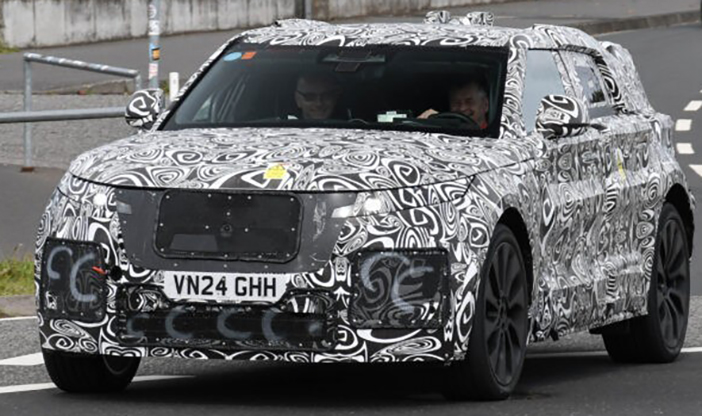
Spies have now captured a prototype of this new Velar undergoing cold-weather testing in northern Europe, and unlike the early prototype spotted on the Nürburgring last year, this development mule has ditched attempts to hide an aggressively sloping roofline. The result is something decidedly sporty, and as much as the term ‘SUV-Coupe’ grates us, this new Velar will be worthy of the description, even though it has more than 2 doors. Nothing else on the market takes the fastback SUV idea so seriously, but there are still questions to which we don’t have the answer. One of the most striking elements of this swoopy new luxury SUV is the rear end, which is somewhat reminiscent of the Porsche Cayenne Coupe. Unlike the German SUV, however, JLR may opt not to fit a rear window. Since this is still just a prototype, the camouflage on the rear end may be hiding glass, but atop the roof, a conspicuous element between two fins seems to house a large rear view camera. Whether or not one can see out the back in the traditional sense, that camera will be necessary. The base of the tailgate includes a large spoiler with an integrated brake light, and this appears to take up at least a third of the upper tailgate, so seeing what’s behind the vehicle without digital assistance will be tricky. This isn’t the first time we’ve been led to believe that JLR is disinterested in a rear windshield, as the mules of the polarizing Jaguar Type 00 concept have also been spotted without a rear window (a concept that has already made its way to production on the Polestar 4). The aggressive roofline will no doubt restrict rear headroom and minimize cargo space. In profile, we also can’t help but notice that the front doors look relatively narrow, hampering ingress and egress. Clearly, this is a vehicle more focused on style than practicality. That said, the front end shows a semi-circular shutline that spans from A-pillar to A-pillar, potentially indicating a capacious frunk. Below this, narrow LED headlights will notch the front fascia’s grille area, though as an EV, the only opening required for cooling is the lower intake. Pumped-up arches, flush door handles, and a relatively low ride height (compared to a typical Range Rover) will help set the Velar EV further apart, while the dual taillight setup maintains a little tradition. The 2027 Velar will be the first JLR product on the British automaker’s new Electric Modular Architecture (EMA), an 800-volt platform expected to deliver 500 km of range per charge. The EMA platform will also underpin the next Evoque EV, but it can also support a plug-in hybrid setup, which the new Velar is expected to offer. Spies report that this Velar prototype has ports on both sides, but since this one is all-electric, the second port is intended to make charging more convenient, whichever way the vehicle is parked. We’ll know more before the year is out, with a reveal due in the summer, and since the camouflage is starting to come off, more updates will be available before long. +++
+++ New details regarding the range and specifications of LEAPMOTOR ’s upcoming A10 all-electric compact SUV have recently emerged. The vehicle, which has already opened for blind pre-orders in China, is slated for an official Dutch market launch in the lasst quarter of this year, promising a maximum pure electric range of 400 km. Information from the Chinese regulatory filings confirms that the Leapmotor A10 will offer 2 battery options. A 39.8 kWh battery will provide a pure electric range of 320 km, while a larger 53 kWh battery will extend the range to 400 km. The A10 will also feature fast-charging capabilities, allowing the battery to replenish from 30 percent to 80 percent in 16 minutes. The Leapmotor A10 adopts the brand’s “Technological Natural Aesthetics 2.0” design language. Its exterior is characterised by “Smiling Headlights” and “Haha Taillights”.
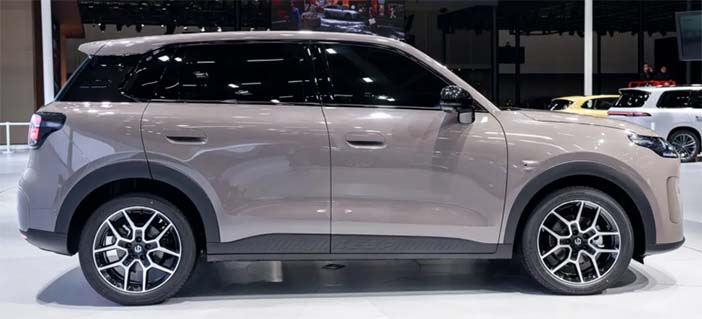
In terms of dimensions, the compact SUV measures 4.270 mm in length, 1.810 mm in width and 1.635 mm in height, with a wheelbase of 2.605 mm. Customers will have a choice of 6 vibrant body colours: Seaweed Green, Acorn Brown, Berry Blue, Tundra Grey, Star River Silver and Morgan Pink. Under the hood, the Leapmotor A10 is powered by an electric motor with a maximum output of 122 hp. Beyond its powertrain, the A10 is equipped with a lidar system, a Qualcomm 8650 intelligent driving chip and a Qualcomm 8295P cockpit chip. This year, Leapmotor aims to sell 1 million vehicles, a target reportedly adjusted to 1.05 million units. This ambitious goal implies that Leapmotor needs to achieve approximately 70% growth compared to last year’s sales of around 600.000 units. Low-priced models such as the A10 are expected to make a substantial contribution to Leapmotor’s sales performance this year. +++
+++ MERCEDES and its AMG and Maybach sub-brands are preparing for a massive vehicle onslaught in 2026, and they won’t lift off next year either. 16 new vehicles will be unveiled this year, and nearly as many are coming in 2027. The particularly exciting news is that seven of these reveals, from entry-level to range-topping cars, will take place within the next 3 months, and while some will be EVs, the majority of the automaker’s new arrivals will be combustion-powered as Mercedes looks to turn around declining sales figures. Let’s take a closer look at what to expect. Mercedes was not forthcoming about which models are on their way this year and next, but we’ve already seen the heavily revised S-Class break cover, so it’s safe to assume that its AMG and Maybach iterations are among the upcoming arrivals. Also at the top of the Mercedes tree, the GLS will be updated this year, followed by the go-faster AMG model and ultra-luxurious Maybach variant. Another fancy SUV on its way is the G-Class Cabriolet, which Mercedes teased at the end of 2025. Elsewhere, we can look forward to AMG’s take on the CLE coupe, the electric S-Class and the electric GLS (currently known as the EQS). Further down the ladder, the first all-electric C-Class is coming, while the combustion-powered model will get a mid-life facelift. This model will also be available in Estate form. Also new are the refreshed GLC and its fastback Coupe sibling. At the bottom of the luxury ladder, an all-new GLA is coming. We also can’t forget that Mercedes teased the Concept AMG GT Track Sport last year, which may herald a new dawn for the hallowed Black Series badge. Sticking with EVs, Mercedes has repeatedly given us glimpses of the production version of the Concept AMG GT XX, which will essentially be the electric replacement for the AMG GT 4-Door. This will also spawn a 1.300 hp super SUV, plus a coupe SUV, though the latter is only expected in 2027. Again, we must reiterate that Mercedes has not been specific about what is coming and when exactly, but a baby G-Class has been spied undergoing testing with electric power, and the A-Class is set to be reinvented once more, though this may only arrive in 2028. The electric EQE sedan and EQE SUV haven’t been successful enough and are expected to face the chopping block this year. With new combustion-powered models outnumbering new EVs, not to mention a move away from 4-cylinder engines in AMG products, the Stuttgart-based automaker is doing its utmost to ensure that its customers are happy. +++
+++ NISSAN reported deeper losses for the latest quarter through December compared to a year earlier, as restructuring costs cut into its profitability. The Japanese automaker, based in the port city of Yokohama, said Thursday it posted a 28.3 billion yen ($185 million) loss for the October-December quarter, about twice the 14 billion yen loss it recorded a year earlier. Quarterly sales slipped 6% to nearly 3 trillion yen ($19.6 billion) from 3.2 trillion yen the year before. “Unfortunately, when you do restructuring, there are costs that are incurred”, chief executive Ivan Espinosa told reporters. “In a way, it is expected”. He said Nissan was on the right track but acknowledged headwinds from president Donald Trump’s tariffs and other pressures on sales. Nissan is hoping to achieve an operating profit by the end of fiscal 2026. It expects an operating loss for the current fiscal year and is projecting a 650 billion yen ($4.2 billion) net loss for the year through March. A Mexican with 2 decades of experience at Nissan, Espinosa has been trying to steer a turnaround at the money-losing automaker since he took the job last year. Nissan has slashed jobs and sold its headquarters building. It is closing its flagship factory in Oppama, Japan, as part of its global production restructuring efforts. Some analysts say the popularity of electric vehicles is subsiding, and that might hurt automakers like Nissan, which has been bullish on EVs. Espinosa said Nissan needs to do more to win over consumers to EVs, including new kinds of batteries, but was optimistic about the new Leaf model. +++
+++ The fate of PORSCHE ’s only mid-engine models, the 718 Cayman and Boxster, seems to be hanging in the balance as the automaker’s top brass are said to have met yesterday to decide if the next-gen 718 sports cars, which are supposed to be EV-only, are still going to see the light of day. 2 unnamed sources told that Porsche’s top execs met to decide the fate of the electric sports cars amid an unfavourable EV climate due to a combination of factors including dwindling EV sales, the scrapping of America’s EV federal tax credit and the rollback of U.S. emissions regulations that favoured EVs, among other things. Slowing global EV demand and declining sales in China could prompt Porsche to scrap EV plans, such as the all-electric 718. The news comes after recent reports that Porsche might kill off the electric sports cars due to what has been referred to as “development hell”. Earlier this month, Porsche sources told that “development delays and expenses” were hamstringing the project, and the company’s new CEO, Michael Leiters, who started on January 1, was forced to take those into account. One of the main problems is the fact that Porsche targeted a 1.800 kg weight for the all-electric 718 Cayman and Boxster, which is understood to be a real engineering challenge for a production-spec electric sports car carrying a heavy battery pack. But things are potentially more serious than that, as Porsche is rumored to be well behind schedule with the vehicle, with previous reports claiming that the automaker had to pause development due to battery maker Northvolt’s bankruptcy. A major sign that Porsche is having second thoughts about the project was the automaker’s September 2025 announcement that the next-generation 718 models would continue to offer internal combustion engine power. At the time, Porsche said the gasoline-powered 718 Cayman and Boxster would sit at the top of the range, implying that they would be positioned above the all-electric versions. Porsche ended production of the current 718 models in October 2025. Then came a report from December that claimed Porsche engineers were having a really hard time adapting the PPE Sport EV platform (developed specifically for the all-electric 718 models) for internal combustion engines. Apparently, the amount of work needed to reverse-engineer the EV-only platform to receive a mid-mounted gasoline engine is titanic, especially since the PPE Sport EV platform has no provisions for such an engine, transmission, fuel tank and many other components specific to ICE vehicles. And that’s just the start of it, as removing the load-bearing battery pack from the platform would significantly affect the structural rigidity of of the entire body shell. Fixing that, plus accommodating the engine and transmission, would require major alterations to the floor, rear bulkhead and rear subframe. With that in mind, it’s probably not a big stretch to think that Porsche might decide the 718 is not worth the effort and cancel it altogether–be it EV or ICE. We certainly hope that’s not the case, as that would probably be one of Porsche’s costliest decisions ever. So far nothing has transpired from the company’s top-level meeting, but we’ll keep an eye out on this. +++
+++ China’s Ministry of Industry and Information Technology (MIIT) has recently published the approval draft of mandatory national standard GB 11557-202X “The stipulation protecting drivers from being injured by motor vehicle steering mechanism”. The new standard, set to take effect on January 1, 2027, notably removes all technical content related to half-steering wheels ( YOKE STEERING ), signalling regulatory caution regarding unconventional steering designs. The current steering safety standard (GB 11557-2011) has been in use for over a decade and has become inadequate for evaluating new technologies emerging with the explosive growth of electric vehicles. The updated regulation tightens requirements in several key areas.
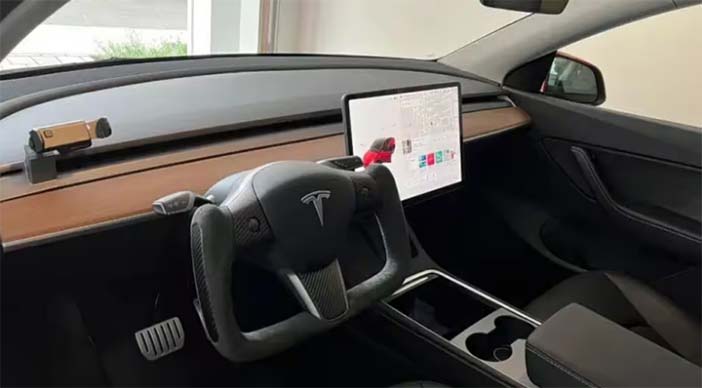
Compared to the previous version, the new standard aligns with international regulations by reducing the horizontal force limit in human module tests to 11,110N, matching UN R12 specifications. It also establishes strict thresholds for upward and backward displacement of the steering column during collisions. Perhaps most significantly, the new standard eliminates exemptions for human impact testing that were previously allowed under certain conditions. All vehicle models must now pass this verification test, regardless of circumstances. Half-steering wheels face fundamental compliance challenges under the new regulations. The standard requires impact testing at ten specific points on the steering wheel rim, including “the midpoint of the weakest area” and “the midpoint of the shortest unsupported area”. For half-steering wheels missing the upper section, these critical test points physically don’t exist, which means these kinds of steering wheels will be impossible to meet the new national standard. Accident statistics quoted by Autohome show 46% of driver injuries originate from steering mechanisms. Traditional circular steering wheels provide large-area buffering when drivers pitch forward, while half-steering wheels allow the body to bypass the steering wheel during secondary collisions, dramatically increasing injury risks. Another key concern is airbag deployment safety. The new standard specifically prohibits hard projectiles (such as metal or plastic parts) from facing occupants during airbag deployment. Half-steering wheels, with their irregular covers and supporting structures, present unpredictable fracture patterns during the instantaneous airbag deployment that are difficult to validate through high-speed camera testing. Beyond regulatory concerns, drivers have reported practical challenges with half-steering wheels. Unlike Formula 1 race cars that use minimal steering ratios appropriate for track conditions, consumer vehicles require much larger steering inputs for everyday manoeuvres like U-turns and parking. Many users report difficulties with one-handed operation and accidental contact with dashboard screens when using half-steering wheels. When the new standard takes effect in 2027, all new vehicle models seeking type approval must comply with the updated regulations. Existing approved models will likely receive a transition period of approximately 13 months to adjust their designs. +++