
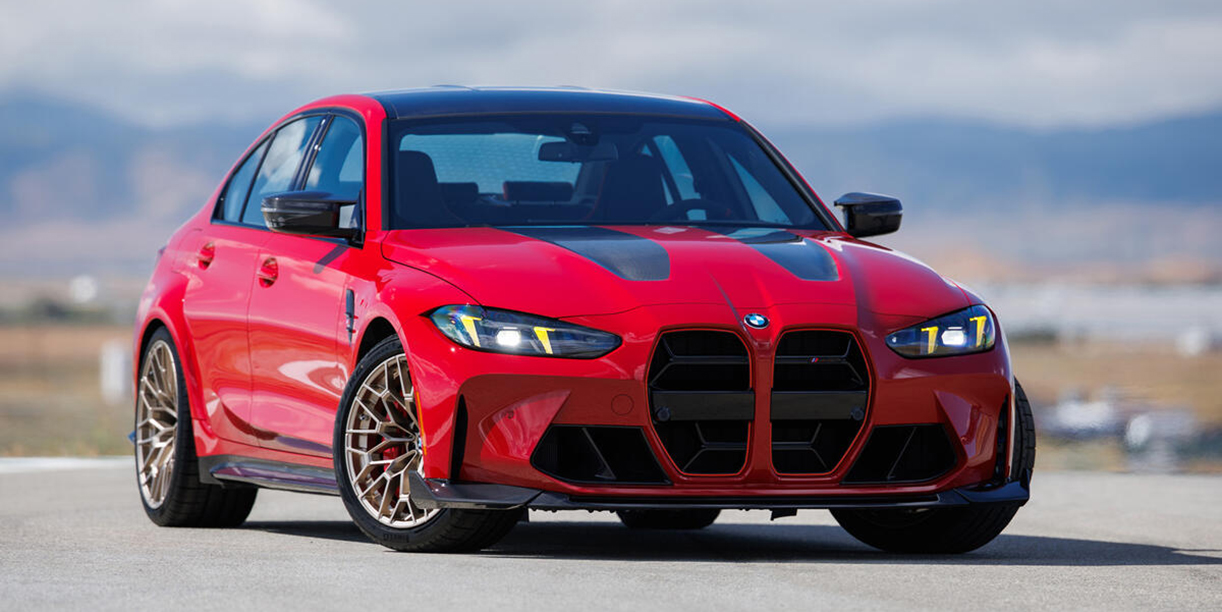
+++ The 6th generation (G80) BMW M3 is bowing out as a special edition of the lightweight CS variant with a manual gearbox. The M3 CS Handschalter, exclusive to the US market, follows the previous Z4 Handschalter in marking the end of the line for one of the brand’s performance models with a 6-speed manual. Being based on the M3 CS, it’s 20 kg lighter than the standard M3 (or 34 kg lighter when fitted with optional carbon-ceramic brakes) and gets a track-focused chassis set-up. This brings stiffer dampers, springs and anti-roll bars, and leaves it sitting 6mm lower than the M3 Competition. The Handschalter is also rear-wheel-drive, whereas the previous M3 CS was four-wheel-drive. Although it receives the same titanium exhaust system as the M3 CS, its power output is reduced by 70 hp to a total of 480 hp. This is because M division limits the power of its cars fitted with manual gearboxes to improve reliability. Its 8-speed automatic is more durable and can therefore handle greater loads. Nonetheless, the M3 CS Handschalter can dispatch the 0-100 kph sprint in 4.1 seconds and go on to a top speed of 290 kph. Completing the Handschalter package is the makeover brought by the CS package, including yellow daytime running lights, stripes and a choice of green, black, red or purple paint. Inside, it gets carbonfibre bucket seats. There is no indication that it could be sold in Europe. The G80 M3 and its 2-door M4 sibling have been offered exclusively with an automatic gearbox since launch in 2020. The next-generation M3 is due to arrive next year – and it will, for the first time, be available as an electric car. The M3 EV will employ 4 motors for a combined power output north of 1.000 hp and simulate the power delivery and noise of a petrol-engined M car to promote driver engagement. The petrol version, meanwhile, will be a heavily updated version of today’s M3, with its turbocharged straight-6 revised to meet the forthcoming Euro 7 emissions requirements. BMW M sales boss Sylvia Neubauer recently told that both will be priced “in the same ballpark”, adding that BMW will host events with the M3 EV in a bid to convince potential buyers to go electric. +++
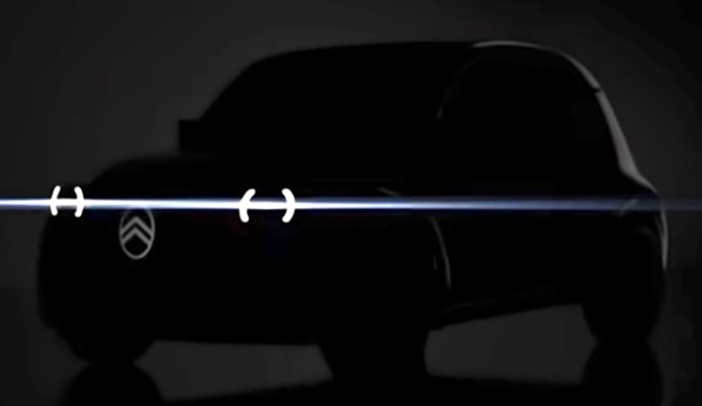
+++ CITROEN has confirmed the revival of the storied 2CV name for its upcoming €17.000 electric city car – and previewed its design ahead of a reveal at the Paris motor show in October. Taking to the stage at parent company Stellantis’s investor day presentation in Michigan, Citroën CEO Xavier Chardon gave a first look at the firm’s new entry-level EV and confirmed: “The 2CV is back”. The long-awaited confirmation that Citroën will redeploy the iconic name for its new E-car (to be built alongside a reborn Fiat Panda in Italy from 2028) comes alongside the first hint that the 1940s car’s styling will be reinterpreted for a new era too. Autointernationaal.nl broke the news that Citroën was plotting a revival of the 2CV in January 2025, as part of a bid to tap into opportunities in Europe’s affordable car segment as rival manufacturers exited en masse. Last month, Chardon said the new model would have “exactly the same purpose as the 2CV did in the late 1940s” in reigniting buyer demand in a stagnant European car market” and added that the company’s priority was to give “buying power” back to European motorists. The first teaser of the new city car reveals that it will adopt the same snail-shaped silhouette as its era-defining forebear, but with a more modern look influenced by Citroën’s recent ELO concept, which set the tone for the brand’s design going forward. The preview comes just days after Stellantis confirmed it would begin building affordable electric city cars, with a target price under €17.000 at its Pomigliano plant in Italy from 2028. Fiat will similarly channel the styling (and likely the name) of its own historic ‘people’s car’, the original Panda of 1980, for its take on the formula. Chardon said the new 2CV will be 1 of 7 new models launching by 2030. Five of these will be renewals of existing models, while the 2CV and one other (expected to be C4 successor) will take Citroën into “new profit pools”. Confirming the name of the firm’s new entry model, which effectively replaces the old petrol-powered C1, Chardon said: “Products alone do not create icons. Icons create emotion. Icons connect brands with people. And today, one icon is about to return. Yes, the Deux Chevaux is back”. He then showed the darkened silhouette of the new EV and said: “If you want to see it in full light, you are invited in person to the Paris motor show in October”. He referenced the importance of the original 2CV in giving “freedom of mobility to millions” in the wake of World War II and said: “80 years later, the new 2CV will democratise electric mobility”. It will be “a true people’s car designed for real life”, Chardon pledged. “For me, the future of mobility will not be won by the most complex cars but by the simplest and the most intuitive ones. What truly matters is to be relevant”. +++
+++ FIAT has given a first look at its new Grizzly crossovers: larger versions of the Grande Panda that are aimed to give the brand a footing in Europe’s crucial C-segment. To be sold in both fastback and straighter-edged SUV form, the Grizzly is an affordable family SUV “designed for the 3 regions” Fiat sells in, according to CEO Olivier François: Europe, Latin America and the Middle East and Africa. “It completes the Panda and Grande Panda families”, he said, previewing the duo at Fiat parent company Stellantis’s investor day presentation in Michigan. “It has the same DNA and is built on the same car, but it’s a different animal. It will not just elevate the market share, it will elevate everything: the revenue, the margins and the brand”. The Grizzly, expected to be officially revealed at the Paris motor show in October, will be built on Stellantis’s value-oriented Smart Car platform, as used for the Grande Panda, Citroën C3 and Opel Frontera. Sized and priced to rival the likes of the Dacia Duster and Skoda Kamiq, the Grizzly will be offered with the same choice of petrol, hybrid and electric powertrains as its little brother. It forms part of a wave of new Fiat products aimed at bolstering the brand’s coverage of the affordable car market and attracting new buyers. Also in the pipeline is a new 4-seat microcar to sit above the Citroën Ami-based Topolino and a new electric city car inspired by the original 1980s Panda. This new sub-€17.000 entry EV will be produced at Stellantis’s Pomigliano plant in Italy alongside a Citroën twin, which today was confirmed to revive the 2CV name and be designed with heavy influence from its 1940s forebear. Unlike Citroën, Fiat didn’t go so far as to preview the design of its new model, but François promised that “the real design is not the revival of an icon, it is literally the next icon”. +++
+++ With nearly 50.000 units sold in 2025, the venerable G-Class had its best year since the reputable off-roader came out in the late 1970s. MERCEDES is now preparing to capitalize on the Geländewagen’s commercial success with a so-called “Little G” designed to capture the essence of its bigger brother in a more compact package and at a lower price point. It’s been a long time coming. The German luxury brand first teased the model nearly 3 years ago. More recently, a camouflaged prototype was spotted looking exactly as you’d expect: like a 75-percent-scale version of the full-fat G. While the test vehicle was purely electric, Mercedes has now confirmed there will also be a combustion engine under the hood. The company initially planned to sell the boxy SUV exclusively as an EV but changed course for a couple of reasons. When dealers in the United States got a sneak preview of the smaller G-Class, they asked whether ICE versions could also be offered. U.S. retailers ultimately played an active role in convincing Mercedes to add gas engines to the line-up. Mercedes-AMG CEO Michael Schiebe confirmed dealers in North America were a determining factor in the decision to develop a combustion-engine version: “The clear feedback from our U.S. dealers, which we from time to time also asked, was we need an ICE version. We said ‘Yes, Ok. Let’s put an ICE version in there.’ It needs to have enough power, and it will definitely happen”. However, there’s more to the story. Mercedes realized uneven EV adoption could make the baby G-Class less appealing in parts of the world where charging infrastructure remains underdeveloped. For prospective customers concerned about range anxiety, the gas-powered model will eliminate worries about running out of juice. While Mercedes has refrained from going into specifics about the downsized G, the company’s head honcho has said it will be a “completely new development”, That statement suggests it won’t use the existing G-Class architecture, nor will it be based on the new CLA. Former Chief Technology Officer (CTO) Markus Schäfer said it would be “as authentic as possible”, leading us to believe it’ll feature a ladder-frame setup with genuine off-road capability. Rumour has it the new G-Class variant will measure around 4.4 meters long, while the prototype also reveals it will retain a rear-mounted spare wheel. The smaller G-Class is expected to go on sale sometime next year, although it remains unclear whether the gas model will be available from day one. Since the ICE version seems to be an afterthought, Mercedes could launch the EV first and add the combustion-powered derivative later. +++
+++ POLESTAR is moving to rapidly respond to customer feedback and address software glitches in its cars, better configure its ADAS and rethink its approach to interior controls. The Swedish brand is poised to launch 4 new cars in the next 2 years: the 5 GT, 4 estate, 7 crossover and next-generation 2 saloon, but is also investing heavily in ensuring its existing models are optimised according to customer feedback, which is playing a significant role in key decisions the brand takes. CEO Michael Lohscheller said Polestar has “very close contact” with its customers and is using their feedback to quickly address shortcomings with its current cars and design the next generation according to their views. “We do listen to customers”, he said. “This community is really interesting: 60,000 people (I couldn’t believe it when I joined) and they write about lots of things. We have very close contact to customers. We have an agency retail model, so we go directly to customers, and we have a very big community who tell us their views, so we are very, very close to them”. One of the more significant changes adopted by Polestar in response to buyer feedback is its move to include more physical controls in its cars, in a break from the touch-centric arrangement that has been common to all models since the 2 arrived in 2020. Asked if Polestar would follow brands like Volkswagen, Mercedes-Benz and Ferrari in replacing touchscreen icons and haptic pads with physical controls for key functions, Lohscheller said: “Absolutely. Customers are very outspoken about that. They say ‘we want more buttons’. It’s that simple. And yes, we will do buttons”. Polestar will take its first step in this endeavour next year when it introduces clearer buttons to the steering wheel of the ‘3’, which currently features 4 unmarked touch-sensitive pads for the cruise control and display screens, as part of a control suite that has been generally criticised for being difficult to navigate and use while driving. Polestar’s upcoming cars are expected to follow suit as part of a drive to boost on-the-move utility and reduce the amount of time drivers need to spend tapping the touchscreen. Asked whether the introduction of new buttons and switches was at odds with Polestar’s characteristically minimalist tendencies, Lohscheller said it was important to ensure any design decisions have the end user in mind. “We’re very open-minded”, he explained. ‘We’re not religious here in terms of saying ‘this is how it has to be’. Customer feedback is overwhelmingly clear: they want buttons back. So we will bring buttons back”. This approach extends to rapidly identifying and addressing shortcomings and glitches in Polestar’s cars, such as the well-documented issues with the digital key’s proximity function on early 3s. Lohscheller claimed the company’s constant dialogue with owners enables it to quickly devise a fix for affected cars and ensure it won’t be a problem on models that follow. “In terms of Polestar 3, we really took those things very much on board, very seriously, and integrated it in the model-year 2026 car”, he said. “This will be a major, major improvement. We have many over-the-air updates to fix things as quickly as possible, because quality is the highest priority. We have a car parc of 240.000, so our customers are super close to us and they tell us the good and the bad things. And of course both matter a lot, and we want to react as quickly as we can”. As with many other brands, Polestar is also working to ensure its ADAS are as intuitive as possible to operate and helpful rather than inhibitive; another area in which real-world feedback is aiding development. “People are super-interested in that. It doesn’t go away,” Lohscheller said about the evolution of ADAS in Polestar’s cars. He said customers are telling Polestar to “give us some features to use which do help” and that he believes all ADAS “should work flawlessly”. The company is thus prioritising the optimal operation of existing systems before looking ahead to more advanced self-driving technology. “I don’t think we have people saying ‘we want level-four [autonomy]tomorrow’”, Lohscheller noted. +++
+++ STELLANTIS said Thursday that it would invest 60 billion euros in a 5-year push to restore profitability by emphasizing growth in North America and reducing capacity in Europe. The strategic blueprint presented at the group’s North American headquarters in Michigan comes after a series of announcements by CEO Antonio Filosa, brought in last year to get the world’s fourth-largest automaker on stronger financial ground. “We are uniquely positioned to offer delight, functionality and affordability”, Filosa said in a statement, as the Italian-French-American auto giant seeks to pivot from deep losses in 2025. Stellantis will trim its annual costs by 6 billion euros in 2028 compared with 2025. It is targeting annual sales of 190 billion euros in 2030 from 154 billion euros in 2025. Investors appeared unconvinced, with shares falling more than 7 percent at one point before finishing up 0.4 percent in New York. The company said it would focus in particular on 4 of its 14 brands (Jeep, Ram, Peugeot and Fiat) where it would concentrate 70 percent of its planned investments, viewing these names “with their multi-regional presence, as natural first launchers for all new global assets”. In one key decision, Stellantis plans to trim European production capacity by 20 percent. The Europe capacity cuts will result in a reduction of 800,000 vehicles per year. This would be achieved by “repurposing plants”, such as in Poissy outside Paris, and “leveraging partnerships” such as in Madrid and Zaragoza in Spain, as well as Rennes in western France, it said. Filosa said there would be no plant closures. The joint venture between Stellantis and Dongfeng would see the Chinese firm’s Voyah EVs built at a Stellantis plant in Rennes for the European market, the companies said Wednesday. But the CFDT union said Thursday that it fears a “new wave of job losses” as it called for workers to gather on June 16 outside Stellantis headquarters at Poissy. Filosa said at a press conference that none of the vehicles at the joint venture sites with Chinese partners compete directly with Stellantis vehicles. North America represents “the biggest opportunity for our growth and our profitability”, Filosa said, adding, “we are not betting on an acceleration in the US market”. The company is eyeing a 35 percent rise in volumes for the US market alone, where it plans 7 new products priced below $40,000 and 2 at less than $30,000. The plan includes adding a retail presence in US markets where Stellantis hasn’t been active and introducing vehicles in categories where it is under-represented. By 2030, Stellantis plans more than 60 new vehicle launches, 50 “significant” refreshes, across all brands and powertrains, including 39 internal combustion engine or “mild” hybrid electric vehicles, according to a press release. Filosa said the “very mature European market will serve as a laboratory” for the US market. Apart from the 4 global brands, the company’s plan designates 5 other brands ( Chrysler, Dodge, Citroën, Opel and Alfa Romeo) as “regional” brands, while DS Automobiles and Lancia will be managed by Citroen and Fiat respectively. Stellantis also said this month that it was considering strengthening its alliance with Leapmotor so the Chinese group can produce its own cars at two of the European auto manufacturer’s Spanish plants. With Dongfeng, Stellantis will produce Peugeot and Jeep models in China for the local market and export. Stellantis also plans a European joint venture with Dongfeng that will begin with a collaboration in Rennes, France. The deal aims to boost Stellantis brands while also letting Dongfeng build locally at a plant in western France, allowing it to avoid hefty EU tariffs on Chinese EV imports. +++
+++ SUBARU ’s EyeSight is giving a new legal headache. In 2021, the company settled a lawsuit after owners complained about their cars braking for no reason. Most people walked away with little more than a warranty extension or a reimbursement offer. Now, Subaru is back in court over what looks like the same old problems. The latest class-action lawsuit says newer models with EyeSight still have glitchy emergency braking and lane-keeping tech that just doesn’t work right. The lawsuit includes Subaru’s entire combustion-powered lineup, from the 2022 model year to the latest Forester, WRX, Legacy, Outback, Ascent, Impreza, Crosstrek, and BRZ. The plaintiffs say Subaru kept pushing EyeSight as a must-have safety feature, even though they supposedly knew about these ongoing problems. The main complaints target Pre-Collision Braking, Reverse Automatic Braking and Lane Keep Assist; features bundled under EyeSight. According to the lawsuit, these systems can hit the brakes for no reason or fail to react when there’s a real danger ahead. The lawsuit lists stories of cars suddenly slowing down on highways, in the middle of a turn, or while taking a curve, sometimes with nothing in sight. One Forester owner says their car braked hard on the highway and almost got rear-ended. Another Crosstrek driver says their SUV slammed on the brakes on an empty country road, leaving them with neck and shoulder pain. There are also claims that Lane Keep Assist can fight your attempts to change lanes, yank the steering wheel without warning, or just quit working altogether. Some owners say their dealers told them to just switch the systems off every time they start the car, instead of actually fixing the problem. To support the allegations, the filing calls back numerous complaints submitted to the National Highway Traffic Safety Administration (NHTSA), many involving “phantom braking” events at highway speeds. This EyeSight lawsuit isn’t the only trouble Subaru is facing right now. The company has also been hit with lawsuits over battery drain issues in some of its cars. One case says certain models go through batteries way too quickly, leaving owners stranded with dead cars. Another lawsuit points to older Subarus with outdated 3G hardware that keeps draining the battery, even though the cellular network is long gone. +++
+++ In a major disappointment for budget-conscious American buyers, VOLVO has officially pulled the plug on the highly anticipated EX30 in the United States. Volvo says, however, that an affordable alternative to the EX30 for the American market is already in the works, promising it will be specifically designed to cater to American tastes. Why did a car with so much promise disappear so fast? It comes down to basic math and bad timing. Stiff new tariffs on Chinese-built EVs inflated that appealing $35.000 sticker price by nearly $10.000. Add in a recent, high-profile battery recall over fire risks, and the compact EX30 simply stopped making financial sense for the US market. But don’t count Volvo out of the affordable EV race just yet. For Americans who are still looking for a compact and efficient runabout, Luis Rezende, president of Volvo Cars America, during an interview with reporters while discussing the brand new EX60, confirmed that a spiritual successor to the EX30 is already in the pipeline for 2027. While it might not match the original $35,000 price tag to the penny, Rezende promised it would be “very similar”. Even better? He noted the new model will offer “a bigger space” while remaining incredibly fun to drive; a welcome upgrade for American families who often find subcompact EVs a bit too cramped for everyday life. If you can’t wait until 2027, Volvo is currently rolling out the all-new EX60. The catch? It starts at $59.795, placing it squarely in luxury SUV territory. To broaden its appeal, Volvo is also planning to utilize its factory in South Carolina to build larger, family-oriented vehicles using a “multi-fuel” approach instead of going exclusively electric from day one. Building an EV that is both desirable and truly affordable in the US is a massive hurdle right now, heavily complicated by international trade tensions. However, Volvo’s commitment to delivering a roomier, cost-effective electric option by 2027 proves they know exactly what American drivers are looking for: practical space, reliable range, and a price tag that doesn’t require a second mortgage. +++