
+++ ASTON MARTIN ’s latest financial results make for grim reading. Sales are down, losses are up, debt has increased, future products are delayed and now staff are being cut. It’s hard to spin any kind of positive angle and Aston Martin hasn’t sugar coated it to the markets. It claims to have a robust plan for a better 2026 but it just cannot escape a cycle where its better days are ahead of it (or, god forbid, behind it) because the present is so bleak. It shouldn’t be this way. Under executive chairman Lawrence Stroll, the Aston Martin product line-up is the best it has ever been, with clearly defined models across different segments. The cars are better built, have better interiors and tug the heartstrings like no other brand in the way they blend driving thrills with stop-the-traffic looks. Aston’s troubles show just how hard it is for a small car firm to operate independently, however incredible the products and deep the pockets of an individual like Stroll. There is no parent company to help insulate it from global economic issues, to share the development cost burden or just to go into bat with, as rivals Bentley and Rolls-Royce do through Volkswagen Group and BMW ownership respectively. It’s starting to feel like Aston, surely as desirable an automotive asset as they come, now needs its own saviour. +++
+++ BMW has dialled the current M2’s attitude up several notches with a rather wild ‘M Performance Track Kit’. Packing 480 hp from its twin-turbocharged straight-6, the M2 is a serious sports car and the new kit starts with a massive rear spoiler. It’s a swan-neck style, as used on the BMW M4 GT4 and M3 GT3 race cars. In its ‘race mode’ the rear wing is moved 50 mm backwards to improve aerodynamics. As you’d expect, there are multiple angles of downforce to play with, should any circuit you find yourself at require such tweaks.
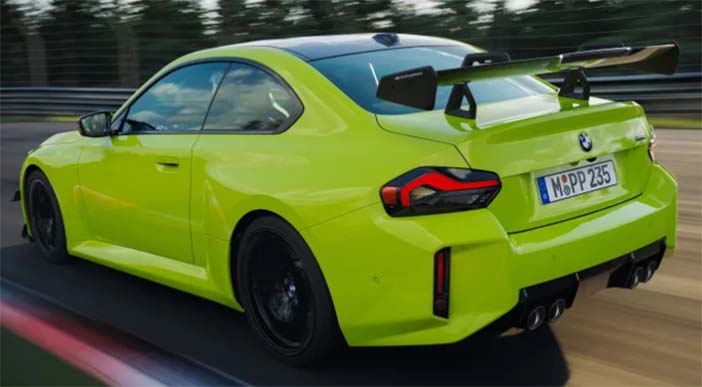
Because the rear spoiler is so large, it blocks the central rear brake lights located in the rear window so a new third brake light is fitted within the spoiler. Around to the front there’s an aggressive and adjustable front splitter for track use (which a helpful sticker points out). This works in conjunction with the wheel arch diffusers and the aero flicks at the side of the bumper. Additional elements include 4-way adjustable dampers derived from BMW’s race cars, while the ride height can be lowered by up to 20 mm.
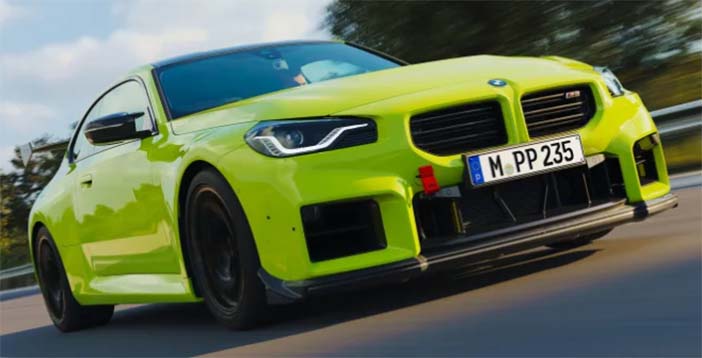
The Track Kit costs 23.500 Euro. That’s not the only new development for the M2, either, because BMW has also developed a new 8.343 Euro exhaust system for the highest-specification CS model. The revised set-up comes with ‘optimised gas routing’ to enhance the 6-cylinder’s sound, plus carbon and titanium tips and an overall weight reduction of 8 kg. BMW says there’s no change to the CS’s 530 hp output. +++
+++ We hear a lot about the speed at which car manufacturers from CHINA can develop a brand new model, but I’m not convinced that universally this is a positive development. Granted, I’m making a vast generalisation across a range of deep, and now multi-talented, car makers. However, if we ignore individual brands and instead focus on the priorities that all manufacturers (hopefully) share, shouldn’t we be concerned that the ability to design, develop and test a new car so quickly simply results in a half-baked product? There are a few reasons why the various Chinese brands can develop cars so much more quickly than the 7-year norm of European makers. For a start, there’s the much larger skilled R&D workforce, while their advanced electronic architectures streamline development by being relatively easy to to update. The vertical integration of many components, rather than sourcing from suppliers, is another time-saver, and the direct-line decision making that’s derived from the ‘Chinese style’ of governing means things don’t generally get bogged down in committees or over-complex management structures. However, such speed isn’t always a good thing, as we’re beginning to notice, with a procession of Chinese brands rolling into the Europe at a phenomenal rate. For a start, there seems to be little scrutiny as to why a particular model might be put into production: Who is the car aimed at? What does it need to be good at? What can it offer beyond a bargain list price, tech and an anonymous SUV body? So often, the rationale of specific models feels undetermined. For those that do have a solid USP, it’s their execution that’s often lacking. Of the Chinese models that have reached Europe, few are better than average when it comes to general competence and technology levels. While the notion of a truly ‘bad’ car seemed to be behind us, it seems to be gaining momentum again courtesy of a select few duffers: Seres, anyone? What would these manufacturers gain by spending extra time developing these new models? I know this sounds like a strictly European sentiment, but few Chinese cars stand out in the handling stakes. This isn’t something the average consumer might notice on a ten-minute test drive, but an under-developed car can be exhausting to drive, or just plain uncomfortable on a daily basis. This is something that could very well prevent a consumer going back to a brand when the time comes to change. A well-executed balance between ride and handling isn’t created through AI algorithms, but rigour. Exhaustive testing, prototyping and more testing are what’s required. This is what delivers a car that feels like it’s been created ‘as a whole’, rather than being thrown together from a collection of bits. The same can be said for the less subjective elements, too. Where are the supersonic charging speeds we’ve been promised? The world-beating range figures or crazy, self-driving software? It seems that in the fog of low prices, propaganda about Chinese ‘advancements’ in the country’s cars seems to have stuck to the news cycle without actually delivering. Not yet, anyway. I’ll be gladly proven wrong when an objectively impressive Chinese car reaches Europe; I’ve no doubt there will be some, in time. In its home market, Xiaomi’s SU7 and YU7 models have a big following. The Avatr range shines brightly with its eccentric and original take on ultra-contemporary luxury, too. Even some of the brands we know from Europe are killing it, with XPeng’s China-only P7 a particularly interesting new model. But in the time these highly-regarded models take to reach our shores, it’s the European, Japanese and Korean brands that appear to be adapting to the faster new reality, and doing so with the hard-earned skill of engineering excellence behind them. Chinese manufacturers still have a way to go before I’ll be convinced they’re able to take over the automotive world. +++
+++ The new LEAPMOTOR B03X is the latest small electric SUV coming from China hoping to make it big in Europe, with the rival to the Renault 4 E-Tech and Volkswagen ID.Cross set to arrive this summer. The car was unveiled in China late last year, where it’s called the Leapmotor A10, but we’ve not had a chance to look inside until now.
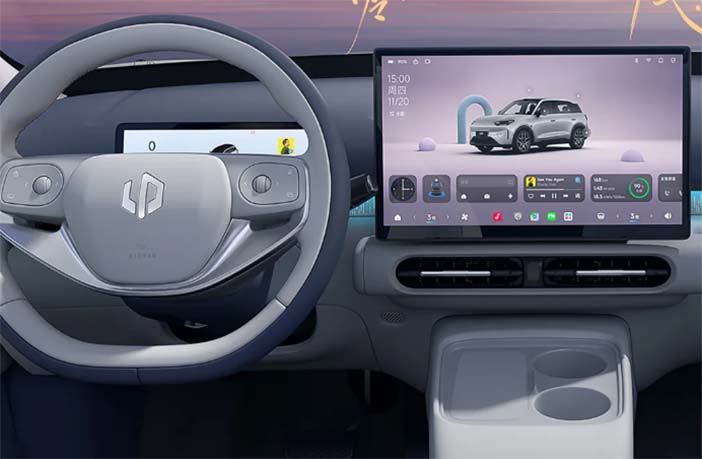
Unsurprisingly, the B03X features the same simple, minimalistic interior design as Leapmotor’s larger B10 and C10, with no buttons to be seen, just a 14.6 inch central touchscreen, a slim 8.8 inch driver’s display and 2-spoke steering wheel.

However, there are some practical features, too, such as a 106 litre storage space underneath the boot floor, which is nearly as big as the electric Ford Puma’s ‘Gigabox’.

In addition, the base of the rear seats can be lifted upwards like the ‘Magic Seats’ in the Honda Jazz, which creates another 39-litre space when you need to carry large items.
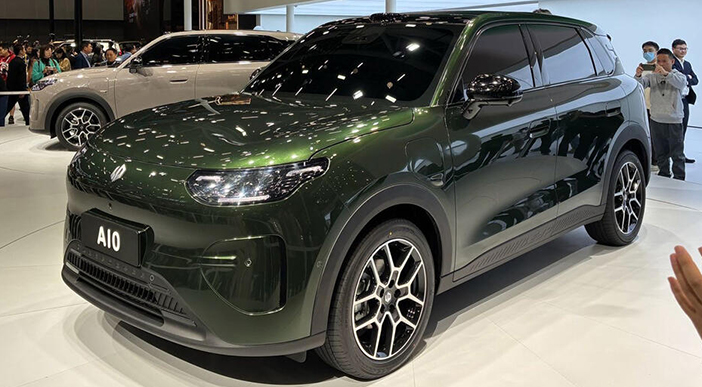
The styling is smart and modern but relatively nondescript, similar to its larger siblings. There is perhaps a whiff of Smart design themes about the B03X, but one unique detail is the led lighting signature on the front and rear that’s supposed to look like smiley emojis. Other features include a LiDAR sensor located just above the windscreen, so-called ‘semi-hidden’ door handles, the charging port incorporated into one of the front wheel arches and a black C-pillar that creates a floating roof effect. The B03X will get 18 inch wheels and be offered in 6 colours.
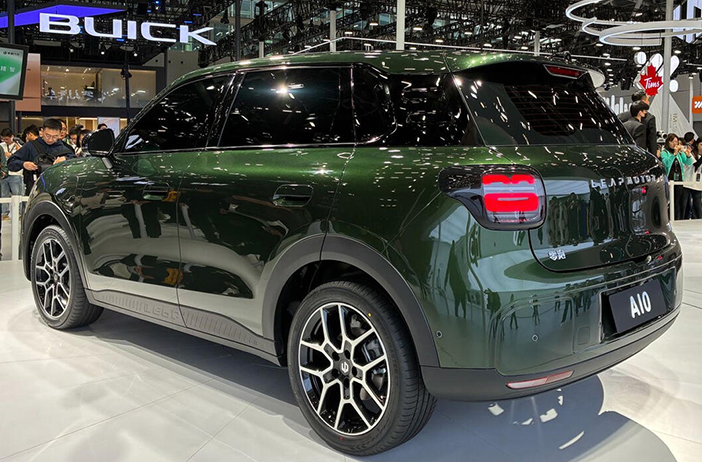
Very few technical details have been announced, but we expect the B03X will use the ‘Leap 3.5’ architecture from the B10 and that car’s next-generation electric motor, which is lighter and uses an oil-cooling system to boost efficiency. Leapmotor has confirmed the B03X will have a range of 420 km, which is about the same as that delivered by most of its key rivals, including the Citroën ë-C3 Aircross. Measuring roughly 4.2 metres long, 1.8 metres wide and 1.6 metres tall, the B03X is also almost exactly the same size as its competitors, too. I expect to learn more about the Leapmotor B03X before it arrives in the summer. Leapmotor’s line-up is growing rapidly. The B05 hatchback has already been unveiled and is due to arrive this year as well. +++
+++ A stripped-down, more focused version of the MG CYBERSTER is one of many ideas bosses at the brand have to keep its drop-top 2-seater feeling fresh, and hopefully not be forgotten as the likes of Alpine and Audi launch their electric sports cars in the next few years. In an interview, vice president of global design Jozef Kaban told of his vision of a more pure version of the Cyberster, trimmed down “just to see how light we can go when you get to the maximum weight loss”. He described “a car which will be sexy just by being very light (like a detox, you know. Reduce everything, maybe even almost empty), immediately conjuring up the idea of a Cyberster Superleggera in my mind. A serious diet would certainly help make the Cyberster more of a pure sports car, because the striking convertible is better regarded as a capable cruiser than a B-road barnstormer. However, that’s not surprising given that it weighs nearly 2 tonnes, whereas we’ve been promised that the new Alpine A110 E-Tech will tip the scales at around 1.450 kg. “Once you start to cut down certain things and certain weight, it can maybe get more exciting to drive, because it’s a totally different experience than straight line performance”, said Kaban. A coupe version of the Cyberster has been on the cards for some time as well, because we saw the fixed-head Cyber GTS concept back 2 years ago. Carl Gotham, advanced design director for MG’s parent firm, SAIC Motor, told me this version would offer a 2+2 seating layout like a Porsche 911. He even hinted it could become a reality in 2025, but it never materialised. Rather than a Cyberster Superleggera or a rugged Cyber Dakar (which I think would also be quite something) MG’s head of product and planning for Europe, David Allison, told he’s very keen to create special editions of the brand’s halo car primarily using unique “paint colours, roof colours, seat colours, wheels, bits and pieces like that. That’s how I think we keep the longevity of that car going in the near future”. The Cyberster Black concept presented at the 2025 Goodwood Festival of Speed showed us what such a special edition could look like, featuring a bespoke deep black paint enhanced with ultra-fine glass particles to give it a “subtle sparkle”. However, there was nothing subtle about its huge chrome rims. There has been a Cyberster Red Top Edition, which was not an homage to the British tabloids, but to MG’s 100th anniversary, with the unique beige paintwork and red roof inspired by icons from its past. Unfortunately, it was only sold in China. Hopefully we’ll be treated to our first special edition soon and the Superleggera does become a reality. +++
+++ The NISSAN X-TRAIL has been recalled as part of a worldwide effort to fix a potentially disastrous engine problem that affects hundreds of thousands of vehicles worldwide. In a statement, a spokesman told: “In accordance with Nissan’s commitment to customer safety, Nissan is recalling certain X-Trail vehicles due to a potential increase in engine oil temperature which may degrade lubrication, which may lead to engine damage and in some cases, engine failure”. The number of vehicles affected by this issue is unclear at this stage, although the issue is said to affect more than 320.000 vehicles worldwide. What I do know is that the X-Trail models in question are those fitted with the 1.5-litre 2-cylinder petrol engine and that were manufactured between 2023 and 2026. Nissan says it will begin contacting customers from March “to notify them that they can visit their local authorised Nissan dealer where an update will be performed free of charge”. Nissan has been asked whether customers are being advised to avoid driving their cars in the meantime, but has not yet had a response. Currently, the X-Trail is only available with Nissan’s innovative e-Power hybrid engine in the Netherlands, which isn’t being recalled. +++
+++ The POLESTAR 2 is set for a complete reinvention in 2027 as a more sporty saloon packing plenty of performance and a new design language. The new 2 will kick off Polestar’s second chapter, being the brand’s first replacement model and also the first shaped by CEO Michael Lohscheller and new design chief Philipp Römers. It will tread a fine line between evolution and revolution. “The Polestar 2 is a very successful car”, said Lohscheller, previously the boss of Opel. “We have more than 180.000 cars on the road, so I don’t think we will have a revolution. The basic role of this new car is to keep those customers, but of course we’re thinking about improvements in battery tech and range”. Don’t go thinking the next 2 will be a facsimile of the current car. Polestar poached new design chief Römers from the Volkswagen Group, where he designed the Audi e-Tron GT and Volkswagen Golf Mk7; cars with handsome proportions. Römers said the 2’s stance is set to change dramatically. The current car is a jacked-up liftback peppered with SUV-style cladding; elements I expect to be diluted on the replacement car. I asked Römers directly if the ride height would be lower and he answered intriguingly: “The new design language, the strong evolution we are doing, it would change a few things. But today’s design is a good car, as you know”. We can expect a sportier saloon that’s significantly longer too, as confirmed by Lohscheller. Today’s car is just over 4.6 meter-long: a 100 mm stretch would make it the same length as today’s BMW 3 Series. Lohscheller said: “It will keep all the great things and add a few things that the current car didn’t address in the most optimal way. The car is a little longer. Customers told us that they would like a bit more room in the back, and that’s exactly what this car does; it’s beautiful and keeps the good things of the current car, but adds things that were not optimal”. Römers says he want to accentuate horizontal design cues, which will visually lower the car. The front end will be dominated by Polestar’s ‘dual-blade’ headlamps, as well as “characterful details: no traditional grille and the Polestar 3’s bridge”. This is a raised section across the nose which pushes air onto the bonnet to improve aerodynamics. Both Römers and Lohscheller are determined to emphasise the car’s performance. “It’s something we want to address even more and that gives me opportunity”, said Römers. And he mentioned the Beast: Polestar’s high-performance, special edition 2 from 2022. It had 478 hp, an aggressive bodykit and lowered suspension. “This is inspiration for the future, because it looks sporty”. The interior design will also reflect Polestar’s sporty ethos. The cockpit will be more driver-oriented, with the screen angled towards the driver. Römers will also use more vibrant colours than today’s grey-dominated shades and a warmer, more human user interface with more switches. The new design is enabled by a box-fresh vehicle architecture. Lohscheller has railed against the number of car platforms the Swedish EV-maker currently uses: “Over time, I want to harmonise architectures, because we have too many different ones”. The outgoing 2, Polestar’s SUVs and the incoming, all-aluminium 5 GT are all based on different vehicle platforms. That’s a luxury for any car maker, let alone one that sold only 60.000 cars in 2025. Spurred on by its crippling losses and the strategic direction of owner Geely Holdings, Polestar is regrouping on a new platform that will feed a number of the group’s brands. Sister marques include Geely, Lotus, Lynk&Co, Volvo and Zeekr. In autumn 2024 owner Li Shufu’s ‘Taizhou Declaration’ called for more component and powertrain sharing across the group to squeeze out unnecessary expenditure. Lohscheller referred to the new underpinnings as “a group architecture”, noting that Volvo executives have also publicly spoken of their integration into family R&D. “We have access to probably the best EV technology in the world. How about we integrate this in a group architecture where Volvo and Geely play a key role? It’s our intention to use it widely over time”. And it’s not just about hardware, as car makers embrace the shift to software-defined vehicles (SDVs) knowing that connected features and the onboard digital experience are the new automotive battleground. Lohscheller said: “You need to have cutting-edge software stacks and central core computing”, which is the ultrafast-processing power that enables hi-tech safety, autonomous and dynamic features. He added: “All this can be done, but it needs to be well planned. The companies who have done it, it took them years”. The CEO confirmed that the new platform has the flexibility to support a variety of vehicles, with different lengths, tracks and wheelbases and suitability for both high- and low-riding cars. That will enable the 2 and the 7, the midsize-SUV that will follow it to market in 2028, to use the same underpinnings. And Römers is incredibly nonchalant about the Geely group’s technological convergence. “I’m happy that I arrived at a time where we want to share platforms and set our brands in clear directions to avoid a horse-race mentality”, said the head of design. “It’s the same at the Volkswagen Group: they share platforms but a Skodais completely different to an Audi”. Precise technical details are still under wraps, with the 2’s premiere still around 12 months away. Unusually, the 2 launched as a front-wheel-drive car but switched to rear-wheel drive in its midlife facelift to boost efficiency. However, during tests, Polestars have missed WLTP figures by significantly more than a few kilometers, and the company’s engineers will be determined to offer more real-world range, plus superior charging. The 2’s imminent sister car, the Volvo EX60, showcases the technological progress we can expect: peak power spans 375 hp to 580 hp, and the longest-range model covers 810 km on the WLTP cycle. With the new 2 having more space to stow batteries, expect a far superior range to the outgoing car’s. Prices for the new electric Polestar 2 will likely start around €57.000 when Dutch sales begin in the summer of 2027. +++
+++ The new RANGE ROVER VELAR is set for an unveiling in the coming months, and the latest pictures from testing reveal just how radically different it will look from the brand’s other models past and present. Expected to be the one of the first models to use JLR’s new EMA platform for smaller electric models, the Mk2 Velar is tipped for a debut by the end of this year before going into production at Halewood in 2027. It will be joined at the Merseyside factory by the new Defender Sport and possibly a next-generation Range Rover Evoque. Like the current Velar, it will be the most overtly ‘road-focused’ Land Rover model, and it looks like JLR is working to emphasise that billing by more dramatically differentiating its design from that of its range-mates. Previously spotted prototypes had already indicated that the Velar would become a much sleeker proposition, but as the layers of camouflage come off it’s becoming clear that it could in fact be closer in shape and profile to a liftback than an SUV. Beneath the light cladding that still obscures the final details of the rear end, it’s possible to see a rakish, fastback-style roofline sloping towards a boot lip that appears to extend beyond the rear window. As with previous mules, the window itself is entirely covered, lending weight to speculation that the Velar could follow its Jaguar Type 00 sibling in swapping glass for a rear-view camera in the name of improving aero and rear head room. The glasshouse appears to be narrower than that of the current Velar, too, helping to give an overall silhouette that would seem to fit the mould of high-riding fastback EVs like the Volvo ES90. Other details that are now visible include distinctive flat haunches, a prominent crease along the sides and a front panel that mimics the shape of the current Velar’s grille. It remains unclear exactly when JLR plans to reveal its answer to the Porsche Macan Electric, having significantly delayed the roll-out of its new flagship EVs, the Type 00 and Range Rover Electric, by more than a year. But with the new Velar (and its recently spotted Defender Sport sibling) now looking all but ready for production, it’s likely that JLR is preparing to renew its line-up via a rapid succession of new product launches, following a four-year drought. +++
+++ A make-or-break revamped RENAULT MEGANE is in the pipeline, as one of three new Renaults hitting the Dutch market in the next 12 months. The first new car of the Renaulution fightback plan, the all-electric Megane went on sale in 2022. But the compact, 220 hp hatchback, hampered by its tight cabin space and modest 460 km max range, has not cut through commercially like the new 5 E-Tech. So Renault will roll the dice with a facelifted model in the spring. “There will be a strong Megane evolution this year”, said Renault product development chief Bruno Vanel. “Megane has got an important role in the line-up: it’s our only low-riding C-segment hatchback”. The headline news comes under the skin. “The strong evolution includes new batteries”, Vanel told at the Brussels Motor Show. The current Megane has a 60 kWh Nickel Manganese Cobalt (NMC) battery, but Renault is industrialising cheaper lithium iron phosphate (LFP) cells in Europe for the Twingo, and the Megane will follow its little brother in adopting them. LFP batteries are typically less energy dense than NMC, but Renault should be able to pack more cells into the same space by adopting a ‘cell-to-pack’ format. This eliminates the structure surrounding the battery modules, freeing up space and eliminating cost and weight. The upshot should be a Megane that goes further, potentially touching the 500 kilometer mark. Visual changes will aim to exaggerate the Megane’s ‘hot hatch’ billing, Renault brand CEO Fabrice Cambolive has previously told. Expect a muscular new bodykit, with an aggressive front bumper and a sporty rear diffuser to amp up the dynamism. Expect the revised Megane to go public in the spring, with Dutch sales later in the year. We’ll also be treated to the Renault 5 Turbo 3e hot hatch and the new Renault Twingo late in 2026. +++