
+++ AUDI ’s 5-cylinder engine is dead in Europe. Emissions regulations have made it difficult for the automaker to continue offering it on the continent, but it might have a future there. In an interview, Audi Sport boss Rolf Michl said: “We are open to every possibility” to continue offering the engine when asked about hybridizing the powertrain. “I can tell you we are still thinking in different technological possibilities”. That likely means Audi is considering turning the 2.5-liter 5-cylinder engine into a hybrid. Audi would need to substantially overhaul the engine to meet the new Euro 7 emissions regulations that take effect later this year. For customers outside of Europe, they don’t have to worry about the 5-cylinder’s demise. The automaker plans to continue producing the RS3, Audi’s last models with the inline-5, for markets outside Europe. +++
+++ CHINA ’s exports of passenger cars accelerated in March, an industry association said Friday, as Chinese automakers stepped up their push to grow overseas markets. Passenger car exports jumped 82.4% year-on-year last month to around 748.000 vehicles, according to the China Association of Automobile Manufacturers, up from the 586.000 vehicles exported in February. Exports of New Energy Vehicles (electric vehicles and plug-in hybrids) surged more than 140% in March from a year ago to 363.000 units. That’s also up 31% from the about 276.000 units of such vehicles exported in February. The biggest Chinese automakers, including BYD and Geely Auto, have been increasing their efforts in boosting sales abroad, including expanding production facilities outside China. There have also been growing expectations that the global energy shock and higher fuel prices due to the Iran war could prompt more drivers to want to switch to EVs. Chinese car brands have made inroads over the past months in regions such as Europe, Latin America and Southeast Asia. “The impact of the Iran conflict hasn’t fully shown up in March data yet, but it can act as a trigger”, said Chris Liu, a senior analyst at advisory group Omdia. “In many markets that are structurally well suited for EVs, adoption has been slow simply because consumers lacked urgency”, he said. “A sharp rise in fuel prices changes that”. The Chinese carmakers’ strong overseas push also came at a time when domestic vehicle sales in China have come under pressure from scaled-back government support this year to encourage drivers to switch to New Energy Vehicles. Fierce competition in China among car brands and a prolonged property sector slump that has weighed on consumers’ desire for big purchases also impacted Chinese automakers. Domestic passenger car sales fell 19.2% last month from a year earlier to nearly 1.7 million units. It was the fifth consecutive month of year-on-year declines for passenger car sales at home. UBS auto analyst Paul Gong believes that the domestic sales weakness will not be too long lasting and that the surge in overseas sales among Chinese carmakers could help with the weaker demand at home. “For the overall industry, the overseas market’s sales volume growth is more than enough to offset domestic decline on a full-year basis”, said Gong, head of China autos research at UBS investment bank. Overseas passenger car sales by units for Chinese automakers might grow by 20% or more this year compared with last year, he predicted. +++
+++ HONDA said Friday it will roll out a new compact electric vehicle in Japan in late May that creates the feel of an engine-powered vehicle with a powerful acceleration mode and simulated engine sounds. The Super-One car weighs 1.090 kilograms, which the Japanese automaker says is “exceptionally light” for an electric vehicle, with a cruising range of 274 kilometers. It will disclose the price at a later date. While other carmakers have marketed EV models that run more than 400 km on a single charge, Honda said it chose to limit the range of the new model and use a smaller battery to reduce weight. “We aimed to strike a balance” between usability and cost as “extending the range requires a larger battery, which ultimately pushes costs up”, Hidetomo Horita, who was in charge of developing the car, told reporters at a test-ride event. Honda began taking pre-orders on Thursday at dealers across Japan, with plans to launch the model in several countries including Great-Britain, Singapore and Australia. The electric motor-powered vehicle offers 5 different driving modes, with the “Boost” option raising output to a maximum of 70 kW, equivalent to 95 horsepower, and providing what the company calls a “high-torque” feeling. Speakers inside the car are positioned to create a sports car-like virtual engine sound and meters including a simulated tachometer displaying a virtual engine speed also enhance the experience visually. “We developed the car with the concept of making drivers happy and we want them to enjoy not only driving but also the time they travel”, Horita said. The main target is customers in their 50s and older who no longer need a large vehicle but still want an enjoyable driving experience, the company said. +++
+++ HYUNDAI MOTOR GROUP executive chair Chung Euisun underlined the US as the carmaker’s critical market, pledging to follow through on plans to invest $26 billion in the country by 2028 even as geopolitical uncertainty continues. In an interview, Chung laid out the group’s strategic priorities, including its focus on the American market and long-term ambitions in robotics, physical artificial intelligence and hydrogen. “The US is a core strategic market for the Hyundai Motor Group”, said Chung. “Our long-term confidence is reflected in our US investment strategy and the $26 billion commitment in America through 2028 that we announced last year”. The planned investment would build on the $20.5 billion Hyundai Motor Group has already poured into the US since entering the market more than 4 decades ago. Chung said the company was reinforcing that commitment at Hyundai Motor Group Metaplant America in Georgia, where the automaker is introducing software-defined manufacturing. “Shifting geopolitical situations today reinforce the importance of our agility”, he said. “By integrating our US operations deeply into our global strategy (including advanced manufacturing and job creation) we can respond flexibly to changing conditions while delivering the highest-quality products and services for our customers”. He added that the segmentation of the global market had become a reality, with customers, regulations and supply chains increasingly fragmented by region. The company’s strategy is to combine “global expansion with localized agility”, said Chung, pointing to the carmaker’s Korean factories, the HMGMA plant in the US, the ramp-up in hybrid vehicle production in the US and new production bases in India and the Asia-Pacific region. The chair further underscored the role of robotics and physical AI. “Robotics and physical AI are central to Hyundai Motor Group’s evolution beyond mobility”, he said. “This is our vision and we are aiming to achieve this by partnering humans with co-working robots, all powered by advanced AI”. Chung reaffirmed the company’s plan announced in January at CES, deploying Boston Dynamics’ Atlas humanoid robots at the carmaker’s manufacturing facilities by 2028 and producing up to 20,000 Atlas units annually by 2030. He emphasized Hyundai’s commitment to hydrogen power, arguing that the technology could become critical amid growing energy demand on expansion of AI infrastructure and data centers. “Energy security is an increasingly important topic we all have to face and at Hyundai Motor Group, we see huge potential in hydrogen as a solution to the world’s energy challenges”, he said. Chung said hydrogen should not be viewed as competing with electric vehicles, but rather as a complementary technology. “In terms of mobility we see hydrogen as a complementary clean technology alongside our full EVs, giving our customers choice”, he said. “We’re building in optionality. That’s how you compete in an uncertain energy transition”. +++
+++ China’s star in the automotive sphere is more than rising: it’s soaring to the very top. It’s enough that traditional automakers are getting concerned about the technological and production advantage they have. So, surely, news of Geely making a nearly 50 percent efficient powertrain will deepen that concern. Geely has achieved a monstrous 48.4 percent thermal efficiency with its newest i-HEV system, which uses AI-based algorithms to more carefully manage energy. Guinness independently verified the figure and a combined fuel economy of 105 miles per gallon, which is similarly astonishing. Geely says this can be achieved with any i-HEV car, whether it’s equipped with a 1.5-liter or 2.0-liter INTERNAL COMBUSTION ENGINE . Just how big of a deal is a 48.4 percent thermal efficiency? Well, thermal efficiency is a measure of how much useful energy is extracted from a given amount of fuel. It means that almost 50 percent of the fuel used in the Geely i-HEV gets turned into power. Up until now, the most thermally efficient production engines were around 42 percent, with Nissan’s e-Power setup and Toyota’s Dynamic Force hybrid engines in that range. Your average ICE-only car will do thermal efficiency in the mid-20s to mid-30s range. Thermal efficiency is the white whale of this era of internal combustion, because it contributes to everything. A more thermally efficient engine produces more horsepower and better fuel economy. Hybrid systems greatly help with this, as they can store wasted energy and reuse it during low-efficiency events such as starting and stopping. Geely’s numbers are approaching Formula 1, where engines are over 50 percent efficient using the absolute cutting edge of technology. +++
+++ NISSAN ’s new Elgrand large minivan will enable hands-free driving in urban areas by using AI to assess road conditions and other factors. Overseas manufacturers, such as Tesla in the U.S., have already made strides with similar technologies.
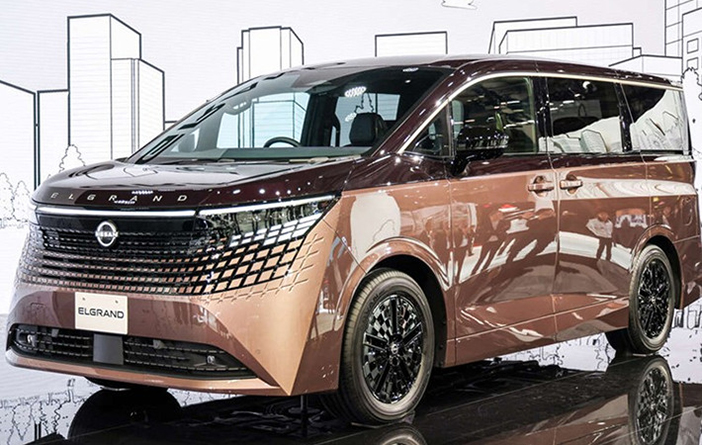
By being one of the first Japanese automakers to introduce this feature, Nissan is aiming for a turnaround in the domestic market, where sales have been sluggish. Nissan’s proprietary driver-assistance technology, ProPilot, already provides hands-free driving in some models, but its use is limited to certain environments such as highways. Through a new collaboration with Wayve Technologies, a British startup specializing in automotive AI, Nissan will incorporate a system where AI predicts driving conditions, thereby enabling hands-free driving even in urban areas. Following a full model overhaul this summer, the new technology will be introduced to the Elgrand in 2027. With other models, such as Toyota’s Alphard, gaining market share in the minivan segment, Nissan aims to enhance its competitiveness through proprietary technology. +++
+++ SMART has released the first images of the Concept #2, which will be unveiled on Wednesday, previewing a successor to the Fortwo city car. The production #2 was announced in September and will arrive later this year as a Europe-focused two-seater developed jointly by parent companies Geely and Mercedes-Benz.
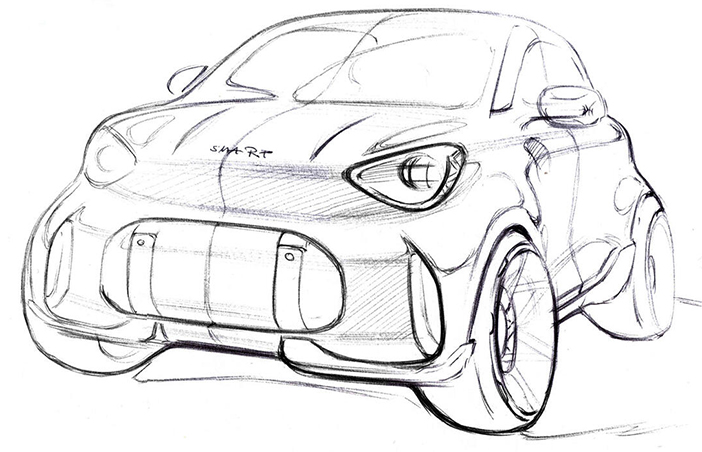
Sketches of the concept reveal a look that stays true to the 1998 original Smart car and even appears to build on the facelifted third generation model (which went out of production in 2024) suggesting that Smart sees this as effectively a continuation of the model line. New elements are a more bulbous overall shape and larger wheel arches; cues that define the Smart brand’s new-era #1, #3 and #5 EVs. Smart said the #2 is a “reinvention” of the Fortwo that will sport a “fresh identity”, penned by Mercedes, albeit with the same “wheels-at-the-corners” stance. It noted that the concept shows a “reinvention of the brand’s iconic 2-seater city car”, adding that it carries the “core genes” and is “unconventional – again”. Further details will be revealed on Wednesday when the concept will be unveiled at the Beijing motor show alongside the #6; Smart’s first saloon which, following initial sales in China, is expected to come to Europe. The electric 2-seater will be Smart’s new entry model and will use the new Electric Compact Architecture (ECA). In a first for Smart, the platform is being developed jointly by Geely and Mercedes, given that the car is built mainly with a focus on the European market. This differs from the rest of the line-up, which were all engineered by Geely and designed by Mercedes. During first testing in December, the platform was paired with a third-generation Fortwo body. Smart said this confirms that the #2 will offer similar proportions to the car it replaces. Smart has also confirmed the #2 will be offered with the same 2-door, 2-seat, rear-wheel-drive configuration as its predecessor, resulting in the same “core driving dynamics”. Former Smart CEO Dirk Adelmann told last year that creating such a platform isn’t cheap and suggested that another vehicle would need to use it in order to justify the huge cost of creating it. “We need the economies of scale”, he said. “The tricky part was to get it small enough for the #2; it’s much easier to expand slightly”. He suggested that Smart could even consider a Forfour successor. While further technical details are yet to be confirmed, Adelmann said the #2’s platform could also accomodate a dual-motor powertrain. “The wishlist features we gave to engineering was a very small turning cycle (the same as the last Fortwo) to make the #2 really practical in city centres”, he added. +++