
+++ The world’s largest car manufacturers are embracing artificial intelligence with open arms and BMW is among them, tapping an AI company to improve its crash simulations. Although the partnership won’t directly or immediately impact BMW owners, the automaker says it will help with “value creation”. Moving forward, BMW will work alongside Mistral AI to boost the quality, accuracy and speed of complex engineering tasks. It will combine its comprehensive engineering datasets with Mistral AI’s model-training capabilities to train an industrial AI model. BMW runs thousands of virtual crash simulations every week and has accumulated more than a petabyte, or 1.000 terabytes, of crash data in the process. That archive lets engineers analyse how specific vehicle structures and materials behave in an accident and how much each one actually matters to the outcome. The specific target is what BMW calls Large Industry Models, AI systems trained narrowly on engineering and simulation data drawn from safety testing and vehicle development. The pitch is that these models learn from BMW’s own processes rather than the open internet, which in theory should make them useful where general-purpose AI tends to flail. “As Industrial AI becomes the new frontier for AI, we are proud to partner with the BMW Group”, said Marjorie Janiewicz, Mistral AI’s chief revenue officer. “This collaboration shows how industry-specific AI models can help solve complex engineering challenges such as crash simulation”. Beyond aiding crash simulations, AI is helping BMW accelerate the development of its future models, particularly in coding and software development. Tasks that once filled an entire day can now be completed in a matter of minutes. As revealed by BMW development director Joachim Post last year, AI also allows BMW to significantly reduce the manpower it needs. “We’ve needed significantly more manpower in the past”, he said. “Now we can leverage much greater efficiency potential. And AI is helping us massively in this regard, for example, with coding. We’re gaining incredible speed in software development, and with it, we’re gaining additional speed in the entire development process”. +++
+++ A car can be panned by the public and still find buyers. FERRARI is betting the gap between the two is wider than the noise suggests. The Luce’s unveiling set off a wave of criticism and dragged on the company’s share price before it rebounded, yet CEO Benedetto Vigna insists there is “strong interest” from clients, and that the €551.687 (Dutch pricing) asked for Ferrari’s first EV is “fair to pay for innovation”. Vigna made the case at an event in Modena on Thursday, where he said there is “strong interest, including from new clients”. He claimed buyers who attended the debut earlier this week have already put money down. “We’ve already received bank transfers, clients who were there want it”, the CEO said. According to Reuters, around 1.600 prospective customers saw the EV in person on Monday and Tuesday in Rome, with order books opening on Wednesday. The company will announce precise figures about the number of Luce orders in July, as part of the financial results for Q2 2026. The loudest complaints concern the way the Luce looks; a design that breaks sharply with Ferraris of the past. The electric sedan was penned by LoveFrom, the studio founded by former Apple design chief Jony Ive and Marc Newson. Most fans came away cold, missing the emotion they expect from Maranello, while others pointed an uncomfortable resemblance to cars from far less exotic brands, such as the third generation Nissan Leaf. The CEO believes that critics would change their minds if they saw the Luce in person: “If you see it and try it, you immediately understand it was not copied and it has nothing to share with other EVs you have seen and are produced by others, in terms of interiors, exterior and performance”. Vigna also stressed that the electric Luce is an addition to the range, not a replacement, and that Ferrari will keep building ICE and hybrid cars alongside it. Ferrari shares are clawing back ground after sliding 8.8 percent in the wake of the Luce’s debut. The current CEO’s optimism isn’t universally shared. Former boss Luca di Montezemolo took a dimmer view, arguing the Luce is “hurting Ferrari” and that the company risks the “destruction of a legend”. +++
+++ JEEP and LAND ROVER have spent decades duelling it out in the rough stuff, but the two brands are about to become inextricably linked thanks to the announcement of a collaboration between Jeep’s parent company Stellantis and JLR in the USA. In a non-binding memorandum of understanding, Stellantis and JLR recently announced they will “explore opportunities to collaborate on product development in the United States”, utilising both of the companies’ strengths to “create value for both organisations”. Since then, Emanuele Cappellano, Chief Operating Officer at Stellantis, shed some light on what that means for both JLR and Stellantis in Europe. In reference to the joint venture, Cappellano simply said: “JLR is US only”. However, he followed up by stating Stellantis remains “very open to look for complementarity with other brands. Whether there is opportunity for growth without creating overlap in Europe, we are always open so why not, but this is not the case today, we don’t see it”. So while it appears that Stellantis has poured cold water on its JLR joint venture expanding to Europe in the near future, it’s not ruling out further collaboration closer to home. While I don’t expect cars produced by the joint venture in Europe, there’s no word on whether this extends to global use of technology developed from the partnership. Antonio Filosa, chief executive officer of Stellantis, previously said: “By working with partners to explore synergies in areas such as product and technology development, we can create meaningful benefits for both sides while remaining focused on delivering the products and experiences our customers love”. Meanwhile, JLR’s CEO, PB Balaji, confirmed the partnership would help support its long-term growth plans in the US market. This cooperation could yield many benefits for both companies, but it’s arguably JLR which stands to benefit more. That’s because this could unlock a more direct path into manufacturing in the USA, which could side-step the Trump administration’s erratic trade policy. More pertinently, JLR’s next-generation BEV architectures (such as the one used by the new Jaguar Type 01) could also be of use for high-end brands including Maserati and Alfa Romeo. These two relatively low-volume brands both need investment in high-end electric car technologies to remain competitive with premium European brands. Then there’s the obvious overlap of Land Rover and Jeep; 2 iconic off-roading brands that have spent decades competing against one another. With production capacity to spare in the USA, could Land Rover consider manufacturing future models in its most profitable market? Such a plan could make a lot of sense for both JLR and Stellantis. +++
+++ As impressive as the KIA EV9 is, a growing number of owners are experiencing serious battery pack issues and enduring long waits for repairs. It will be a huge concern for Kia, particularly given that several other EVs from the broader Hyundai Group have also suffered serious powertrain-related faults in recent years. Reports from EV9 owners have been swirling online since at least last year, and a writer from The Verge, who just so happens to own an EV9, has experienced them first hand. It started with a small issue, where the 12 volt battery was drained and he was unable to unlock the car. To get it up and running, he had to access the frunk manually and then hook up a booster to the battery. As it turns out, this fault would soon be the least of his worries. Several weeks later, he says the SUV’s battery would suddenly jump from 82 percent to 100 percent charge when plugged into his home AC charger. The EV’s estimated driving range at 100 percent also plummeted. After purchasing an OBD-II scanner, he discovered that when the Kia displayed 100 percent charge, it was actually only holding 71 kWh, despite having a 99.8 kWh pack. The scanner revealed that some of the pack’s 38 individual modules were dead. A Kia dealership soon verified the issue and confirmed the SUV would need to have the high-voltage battery pack replaced. It’s been entered into Kia’s battery repair program, available through the 8-year warranty for the batteries, but there’s no clear timeline for when it will be repaired. The Verge writer says he’s spoken with more than a dozen other EV9 owners in the country who have had similar problems, and some have been unable to continue driving their vehicles while waiting for a new battery. He says at least one has seen their EV9’s range drop to just 48 km. Numerous other owners have also complained about battery pack failures, indicating this could be a global issue. For years, EVs from Hyundai, Kia and Genesis have also suffered failures of the Integrated Charging Control Unit (ICCU). The automaker stayed quiet about the problem for a long time before finally acting in 2024, recalling every e-GMP-based EV sold in the US. That didn’t resolve things. Owners continued reporting faults and Hyundai eventually extended warranties for electric vehicles with ICCU-related problems. At this stage, no recall has been issued for battery pack failures in the EV9. However, if more owners start experiencing problems and these reports receive greater media coverage, the South Korean car manufacturer may be forced to act. +++
+++ Autointernationaal.nl can confirm that development is now well under way on the all-new second-generation LAMBORGHINI URUS that’s slated to arrive in 2029, packing plug-in hybrid V8 power just like the incredibly popular current iteration of the flamboyant super-SUV. While Ferrari and Aston Martin created bespoke architectures for their rival SUVs, Lamborghini will continue to utilise technology shared with the wider Volkswagen Group in the next Urus. This will be a new version of the PPC platform being developed by Audi for its Q7, plus the next Bentley Bentayga. It’ll also be utilised by a next-generation ICE-powered Porsche Cayenne and the forthcoming Audi Q9. PPC, in effect, is a heavily modified version of the MLB Evo architecture from the current Urus and the advances it offers should allow the new model to be more dynamic, more efficient and even more powerful. For context, the latest Urus SE already spits out nearly 800 hp. Stefano Cossalter, product director for the Urus, said: “It’s no secret that the VW Group has those platforms and it’s a way to get access to good technology”. Referencing Lamborghini’s sway in the direction of these technologies, he told us: “Of course we are influencing the development of some components for the future, because we have our technology roadmaps now for all the main items which are very, very important for the car, like dampers, for instance. So we are sitting together with the suppliers to understand what they have in mind and what we need, because we need to steer their development to create solutions together”. However, he added that with competitors all over the world having access to these same components, “the real difference is the driving dynamic controls and the software we’re developing in-house. The magic is putting it all together and getting this amplitude into the driving of the car”. Cossalter continued: “At the end of the day, besides the hardware, the big difference is the software and the predictive software we are putting into the car to understand what the car is going to do next to improve the steering, the cornering, the braking and the acceleration”. This suggests the Italian brand is continuing to develop the ‘predictive logic’ software and LDVI (Lamborghini Dinamica Veicolo Integrata) supercomputer that it’s been using in its supercars for the past several years. In case there’s anyone out there hoping there will be a fully-electric version of the next Urus, the brand’s CEO Stephan Winkelmann told me, after some analysis, there is simply “no way that we are going to do the Urus as a BEV” for the moment. That explains why it’s sticking with plug-in hybrid power, which also provides a link between the big luxury SUV and Lambo’s latest supercars: the 920 hp Temerario and 1.001 hp Revuelto. The Urus reportedly accounts for more than half of Lamborghini’s sales, but its importance to the brand goes far beyond that. “The Urus was especially in the beginning a conqueror car and we counted about 80% of customers were new to the brand”, Cossalter told us. “What we noticed is that a lot of those customers were not considering our super sports car before. But the moment they bought an Urus, they said: ‘Oh, why not! I’ll go for a Temerario’ or ‘Let’s go for a Revuelto!’, you name it. “And we see that there’s a lot of loyalty. Once they’re getting in with the Urus, they’re buying and rebuying Lamborghini products. With the Urus SE, around 60% are new conquests and 40% are repeaters, which are very important for us”. We’re still a few years away from the next-generation Urus arriving of course, so not surprisingly there’s a new version of the current model on the horizon, to keep the Italian heavyweight at the top of its game. What we suspect is the new Urus Performante has been spotted testing and should be arriving later this year. However, when asked if this would be the swansong for the current generation, Cossalter slyly replied: “We will see. But nobody knows exactly what is going to happen in the future”. +++
+++ The auto industry’s EV reality check is definitely not over. The latest brand to backtrack on its electric rollout is LEXUS , whose parent company Toyota has axed plans for a next-generation battery-powered sedan that was supposed to showcase some of the company’s most advanced electric and construction technology. The casualty appears to be the production version of the Lexus LF-ZC concept (shown below), a sleek electric sedan unveiled in 2023 that was going to spearhead Lexus’s next wave of battery-powered luxury vehicles.
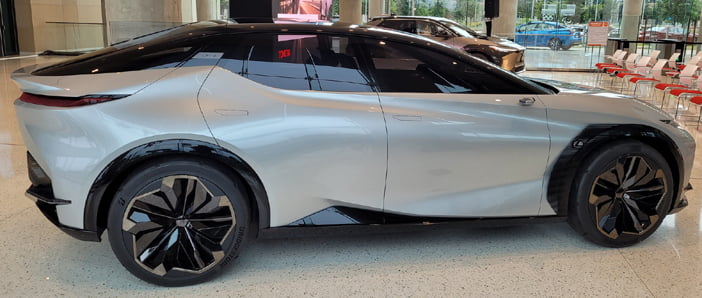
Production had originally been scheduled to begin this year before reportedly being pushed back to 2027. Now, the project to build a rival to BMW’s i3 sedan has been shelved altogether. That’s not because Toyota has given up on the technology itself. The company is reportedly continuing development of both gigacasting manufacturing techniques and solid-state batteries; 2 technologies heavily associated with the cancelled sedan. Instead, Toyota appears to be reconsidering where those innovations make the most business sense. And right now, the answer isn’t hard to find. Buyers continue flocking to SUVs while traditional luxury sedans struggle to gain traction, particularly in the EV segment, regardless of what younger Americans say they want. If Toyota eventually launches a next-generation electric vehicle featuring those advanced technologies, there’s a good chance it’ll ride higher off the ground. The move comes despite Toyota’s EV sales increasing by 42 percent in 2025 to more than 190.000 units globally. Models such as the updated BZ4X and China-market BZ3X have helped boost demand, but global market conditions are challenging, particularly in North America. The removal of federal EV incentives in the US, and shifting political sentiment in Europe, a region moving away from a 2035 ICE ban, have forced automakers to reassess electrification plans made several years ago. Plans which now look hopelessly ambitious. Toyota certainly isn’t alone. Over the past 2 years, numerous manufacturers have delayed, scaled back, or outright canceled EV programs as growth rates slowed from their earlier breakneck pace. Some have paid heavily for those decisions. Honda’s recent retreat from parts of its 0 Series EV strategy reportedly resulted in almost $16 billion in charges and write-downs. But this latest Toyota U-turn doesn’t mean Lexus is abandoning EVs altogether. The luxury brand is still developing a flagship electric coupe that’s a successor the the V10-powered LFA and positioned as a counterpart to Toyota’s upcoming V8-powered GR GT. +++
+++ When the Emira came out in 2022, LOTUS claimed it would be its last production vehicle powered by a combustion engine. From that point forward, the Hethel-based niche brand planned to launch only electric vehicles. For a while, it kept its promise, as the Evija, Eletre, and Emeya were all EVs. However, the Eletre has since received a 4-cylinder gasoline engine for the strangely named For Me in China. There’s more to come on the ICE side from Lotus. The Emira will switch to a completely new V6 engine, while the future supercar is getting a V8. Both engines are being developed by Horse, a 50:50 joint venture between Lotus’ parent company Geely and Renault. The future performance models will both be hybrids. You might be wondering why Lotus has abandoned its goal of exclusively selling EVs. In an interview, the automaker’s CEO admitted it overly estimated how quickly people would switch to electric sports cars. Feng Qingfeng concedes the rate at which EV demand is growing is slower than what the company had initially projected: “The luxury auto segment has gone through tremendous changes. We thought EVs could be the future. That is why we acted fast and we acted aggressively. But the EV penetration rate was not as good as we expected, and we could see customers still like ICE vehicles”. As to why some customers are unwilling to let go of combustion engines just yet, the head honcho at Lotus has figured it out: “Certain customers simply enjoy the thrill of driving a car with a powerful engine, even with some lag in the power delivery. A smooth powertrain is good for those people who use their car daily for commuting. However, those who purchase performance cars make that decision in the pursuit of driving thrills, of entertainment. They just want to have fun”. Looking ahead, the Emira will indeed drop the AMG- and Toyota-sourced engines in favor of an electrified Geely powertrain based on a new V6. Feng Qingfeng ruled out another 4-cylinder version because, unsurprisingly, customers want the larger engine. The Lotus boss didn’t provide a timeline for the switch, but with the current Emira recently getting a 420 Sport flagship version, it’s unlikely to happen anytime soon. The number one at Lotus suggested that the 1.000+ hp supercar, internally codenamed “Type 135,” could revive the Esprit moniker. It may even have a central driver’s seat, in the same vein as the 2024 Theory One concept. Feng Qingfeng explained that doing so would reduce development costs, as the company wouldn’t have to engineer both left- and right-hand-drive configurations. Lotus sees the Ferrari 849 Testarossa as a direct rival, which would put the new flagship model in $500.000+ territory. However, the plan is to undercut and outpace Maranello’s plug-in hybrid V8 supercar: “We want to make sure that more people will have access to a performance car that is even better than a Ferrari with a lower price”. +++