
+++ ALFA ROMEO has released a teaser image of its new C-segment SUV, a new offering that’ll sit alongside the recently updated Tonale and the smaller Junior SUVs. Announced as part of the Stellantis Investor Day, this new teaser image gives us our first glimpse of not only the new model, but also Alfa’s next-generation design language. Sadly, this new model won’t be revealed in full until late 2027. Despite the wait, this as-yet-unnamed C-segment SUV will be based on the existing Stellantis STLA-M architecture, which also underpins models like the Peugeot 3008 and Opel Grandland. This means that it’ll easily adopt a range of hybrid, plug-in hybrid and full BEV powertrains. While it’ll share its key architecture with those models, I expect it’ll be slightly longer and wider than its platform mates, with an expected length around 4.7 meter, leaving space for the existing 4.5 meter long Tonale to sit below. Frankly, the basic designs stems from Opel too who wanted to sell this car as the new Manta, but the German brand was overruled. What is clear, however, is that this future C-segment model will feature a new design language, thanks to a small glimpse of the car’s rear quarter panel. Unlike the Junior, this Alfa Romeo will feature a more traditional look, with a strong solid C-pillar, and no split-lines or contrasting colours visible. The rear lights also appear to be a more traditional shape than the eccentric integrated lights of the Junior.
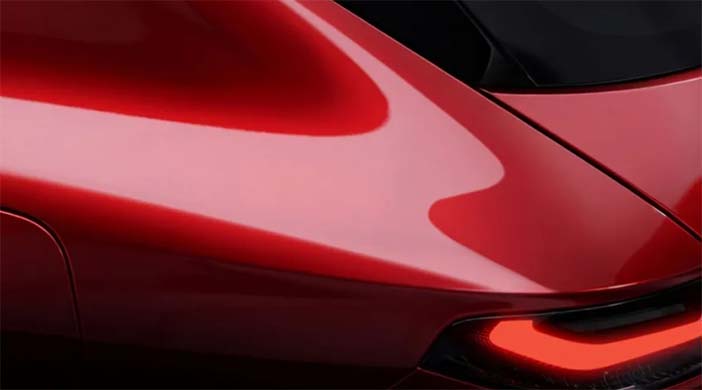
However, it’s not yet known whether this new Alfa Romeo model will be in-line to pick up the next-generation technology that was announced alongside the forthcoming STLA One architecture program. This next-generation platform is the brand’s next big step in development, including elements like the ‘STLA Brain’, where control systems for parts including the powertrain, chassis and infotainment are centralised in one computer. Other technical innovations include cell-to-body (which integrates the battery cells into the chassis for extra rigidity while simplifying the production process to remove costs) and steer-by-wire. I’ve already tried the latter on the Peugeot Polygon concept, but I expect the Alfa to get its own configuration to suit the dynamic expectations of the Italian brand. Another piece is the ‘Smartcockpit’ technology, which provides the ‘driver-interaction layer’ (voice command and infotainment). Just as it is tailored in other Stellantis cars, Alfa’s Smartcockpit interface will be bespoke to its models. +++
+++ The Volkswagen Group wants to halve its massive portfolio to cut costs drastically, but obviously that won’t happen overnight. Before it starts swinging the axe at vehicles that don’t make enough money, the AUDI arm of the automotive giant is planning to roll out two models it has never offered before. While the 3-row Q9 is no longer a secret, some will be surprised to learn an RS Q5 is also on the way. Audi has been selling the Q5 for nearly 20 years, yet it has never given the SUV the RS treatment. A new spy video shot in sunny Europe shows a fleet of camouflaged prototypes, including the RS Q5. It’s not just the double oval exhaust finishers that give away the vehicle’s identity. We can also clearly spot the flared wheel arches concealing meaty tires and possibly wider front and rear tracks. As if that wasn’t enough, the high-voltage yellow sticker indicates we’re looking at a plug-in hybrid. Given that the Q5 is closely related to the A5, the high-performance versions should follow the same formula. The RS Q5 is likely to borrow the plug-in hybrid V6 from the RS5, which produces 630 hp and 825 Nm. Audi Sport’s first plug-in hybrid comes with a chunky 25.9 kWh battery, a major reason why the RS5 Avant tips the scales at a hefty 2.370 kilograms. I wouldn’t be surprised if the RS Q5 ends up even heavier, given that SUVs typically weigh more than equivalent sedans or wagons. For reference, the SQ5 is 75 kilograms heavier than the S5 Avant. The RS Q5 is important not just for Audi but for Porsche as well. Zuffenhausen is retiring the first-generation Macan at the end of this month and will launch a direct successor in 2028. Once again, it’ll be closely related to the Q5, so it’s reasonable to expect similarities between Porsche’s range-topping version and the upcoming RS-badged Q5. The 2 Volkswagen Group brands are working more closely together to spread development costs and accelerate new projects, including Porsche’s 718 Boxster/Cayman EVs and Audi’s Concept C. Additionally, the upcoming Q9 I mentioned earlier could share some of its underpinnings with Porsche’s 3-row SUV. +++
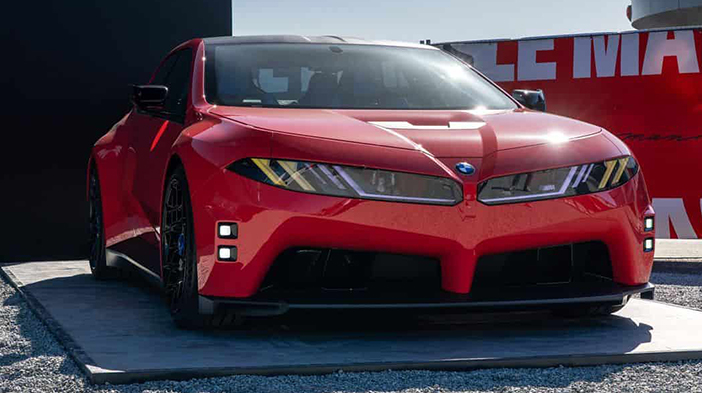
+++ Ever since BMW said it would build an electric M3, reports flooded the internet claiming the car would carry the iM3 badge. However, that won’t be the case. When the production version of the M Concept Neue Klasse arrives next year, it’ll borrow the name from the gas-powered sports sedan the company has been selling since 1986. Yes, to the dismay of some purists, the electric M3 will be called… M3. The confirmation comes from none other than the man calling the shots at BMW M. In an interview with Bimmer Today at the Goodwood Festival of Speed over the weekend, Frank van Meel set the record straight: “Of course it’s called M3. I’ve never said anything different, but I always find it interesting how people talk about the iM3. An M3 was always an M3. Whether it was a 4-cylinder, 6-cylinder, V8, or had M xDrive, it simply said M3 on it. That doesn’t change even if it’s electric”. Don’t worry; The high-performance EV won’t replace the gas-powered car. BMW is developing another generation of the M3 with an inline-6 engine, but it isn’t expected to arrive until later in 2028. As a result, the electric version could be the only M3 on sale for roughly a year. The current G80 bows out sometime next year, while the G84 isn’t expected to hit the streets until the following year. During the same interview, Van Meel also confirmed plans to give the next-generation 3 Series the M Performance treatment once again with a combustion engine. It’s likely the 2027 M350 xDrive that accidentally appeared on BMW USA’s website earlier this year. Much like the full-fat M3, the not-quite-M variant is expected to retain all six cylinders, but using the B58 engine rather than the M-developed S58 found in the flagship model. There’s also a good chance BMW will offer a fourth M-badged 3 Series by introducing an electric M Performance i3. Logic suggests it’ll wear the i3 M60 xDrive badge and slot between the already revealed i3 50 xDrive and the upcoming electric M3. Offering so many variants should appeal to a broad range of buyers looking for a sporty sedan, whether they prefer a gas engine or electric motors. With another 3 Series Touring on the way, there could also be something exciting on the horizon for wagon enthusiasts. However, the company isn’t committing to M versions of the long-roof model just yet. +++
+++ A pilot scheme using NISSAN LEAF robotaxis is set to be launched in Tokyo later this year, subject to approval by the authorities. The scheme is part of Nissan’s plan to deploy robotaxis worldwide in collaboration with Wayve, Nvidia and Uber. The major difference between the Leaf-based taxis and regular retail Leafs is that Nissan is developing fully redundant systems for the robotaxi versions. This is a widely used practice in safety-critical technology, such as the fly-by-wire systems used in aircraft, which have two or more totally separate systems to do one job in case one fails. Level four means it needs no intervention by a human even in an emergency and pedals and steering are not necessarily installed at all. It also means the conditions it can drive in are restricted (to a specific geographical area, for example) and it is aimed at robotaxis and urban delivery vehicles. The next step up is level five, which defines fully automated vehicles capable of driving anywhere in any conditions. The Drive Hyperion platform incorporates essential hardware such as cameras, radar, lidar, ultrasonics and in-cabin sensors.
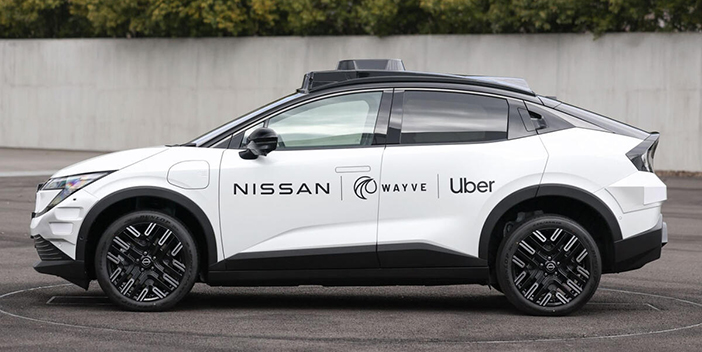
As a ready-made platform, it allows engineers to focus on the job of developing automated vehicles like the Leaf. Wayve AI Driver is literally the brains behind the operation and is described as “rooted in end-to-end AI” learning from real-world data and working without the need for detailed high-definition maps and to navigate in real time. The term ‘end-to-end’ AI is jargon that essentially means a level of intelligence in the true sense of the word. Show end-to-end AI the finished product and it can work out how to achieve the same result without the need for human intervention to spell out individual steps. The Leaf will have a comprehensive array of sensors to give the robot car full visibility of its surroundings, including cameras covering 360 degrees combined with forward- facing radar and lidar. All of that sensing will be used by AI Driver to understand its surroundings and make decisions. It will process the data from the sensors to figure out complex traffic environments and take safe decisions, says Nissan. As it isn’t relying on maps, it can learn how traffic situations evolve and it anticipates the impact of its actions on other road users. Nissan is also planning to continue to refine its cars for use as robotaxis, including features to make the journey more interesting for passengers, such as intuitive cabin displays and communication systems. Wayve and Uber intend to expand their robotaxi trials to more than 10 cities worldwide. AI Driver is designed to work with any vehicle platform (and so any manufacturer) and across all cities and driving conditions. +++
+++ POLESTAR is putting the finishing touches on the new, more upright Estate version of its ‘4’ ahead of its unveiling on 2 September. The new rival for the BMW iX3 and Mercedes-Benz GLC Electric has now been spotted testing on the Nürburgring Nordschleife with production-ready bodywork, showcasing how it has been transformed from a rakish saloon into a more conventional SUV.
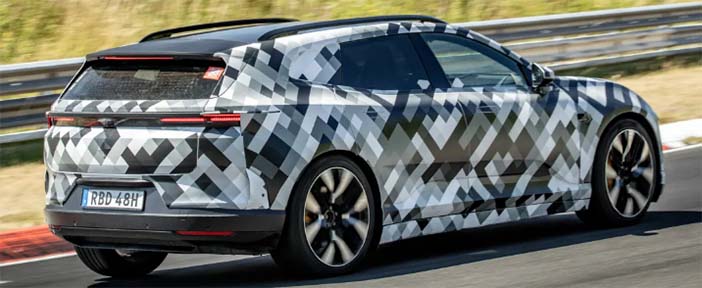
The Polestar 4 Estate will place a greater emphasis on “flexibility and practicality”, the company said, with “versatile storage capabilities for every journey”. Autointernationaal.nl first reported on plans for the new 4 variant in January, when Polestar CEO Michael Lohscheller referred to it as “combining the space of an estate and the versatility of an SUV”. At that stage the name was not yet confirmed, and the decision to firmly brand it an SUV likely reflects the bigger market for such machines. Confirming the first technical details of its new entrant, Polestar revealed that it will be offered with the choice of rear- and four-wheel-drive powertrains, topping out at 545 hp, like the existing 4. It will also roughly match the current 4’s maximum official range, claiming 625 km between charges in its most efficient form, and use the same 400V electrical architecture, which allows charging at up to 200 kW. The 4 Estate will be built in Busan, South Korea, alongside its coupé-roofed sibling, and is set to be revealed in the coming weeks before orders open in September. The first official details of the car came after it was revealed that it would feature a traditional, upright rear window in place of the familiar camera-based rear-view system. That will tie into an overall design treatment that is more conventional than that of the existing 4, which straddles the boundaries between coupé, crossover and saloon, and is most easily thought of as a Porsche Macan Electric rival. The newcomer will be slightly shorter than the US-built Polestar 3 (which is more of a premium, sporting proposition), at around 4.850 mm long. It will face a much larger field of direct rivals than the 4 Coupé, including the recently launched iX3 and GLC Electric, as well as the Audi Q6 E-tron, Lexus RZ and best-selling Tesla Model Y. The 4 Estate is one of four new models that Polestar is priming for launch by the end of 2028, as part of a drive to recover from heavy financial losses and find a path to sustained profit. The firm sold around 60.000 cars last year, but aims to increase its annual output to 100.000 units and estimates that its new models will boost its coverage of the EV market segments from 25% to 55-65%. The 4 Estate follows the new Polestar 5 GT, and will be joined next year by the next-gen Polestar 2, and in 2028 by the smaller Polestar 7 crossover. +++
+++ A new SKODA KAROQ is on the way and it’s set to arrive sooner than expected. In fact, progress is so fast that the new Karoq could be here as early as 2028 as Skoda looks to match the speed of model development achieved by its Chinese competitors. However, don’t think Skoda is just trying to rush its new mid-sized SUV into production. The Czech brand will still aim to deliver on all the same values as its other highly regarded models. Specifically, impressive levels of space, an easy-going driving experience with as few annoyances or distractions as possible will feature. The interior will also put sustainability front and centre, plus the Simply Clever ideas the brand is known for. The current Skoda Karoq is fast approaching a decade on sale, but it remains one of the company’s most popular models. More than 102.000 examples were sold in 2025 alone. Key rivals such as the Nissan Qashqai and Kia Sportage have evolved much more in the past few years, and pressure in the segment is now fiercer than ever, mostly due to value-driven newcomers from China, such as the popular Jaecoo 7. So a new model is long overdue; uncertainty around the EU’s forthcoming regulations regarding emissions was the main reason why Skoda held off from giving the all-new second-generation Karoq the green light sooner. But now it’s all systems go. In an exclusive interview, Skoda’s head of technical development, Johannes Neft, revealed that the goal is to design, develop and ready this second-generation Karoq for launch in exactly 3 years; at least 12 months less than it would normally take the marque to bring an all-new model to market. “This will be one of the fastest developments we will have in the Volkswagen Group and in the brand”, Neft told. “The reason for that was it took us some time to make that decision because of the uncertainty of what’s coming up in Europe. But now we have taken the decision, and we will do that at ‘China speed’ ”. Neft said the entire VW Group is working on speeding up the development processes in all areas, in common with many European car makers that are now trying to match Chinese manufacturers’ fast and agile way of working. The new Karoq will be one of the first examples of the speed the German goliath’s family of brands is now capable of. What’s enabled Skoda to move so much faster with the new Karoq is that it will be based on an existing platform. “That really helps us and this is also what our Chinese colleagues are doing”, the development boss pointed out. “As soon as you have something existing, you can be much faster. This is what we are doing here and we try to make a lot of synergies with our existing cars as well to be fast, to be competitive”.
+++ A new sub-€23.000 electric city car in 2027, growing sales of the Swift hatchback and a third EV in 2029 underpin SUZUKI ’s expansion plan after the upheaval of the early years of the zero-emission vehicle (ZEV) mandate. The firm is pushing sales of the e-Vitara, Suzuki’s first EV, alongside the buoyant Swift, and focusing on private sales. A boost will come in spring 2027 when a production version of the Vision e-Sky urban EV will be launched.
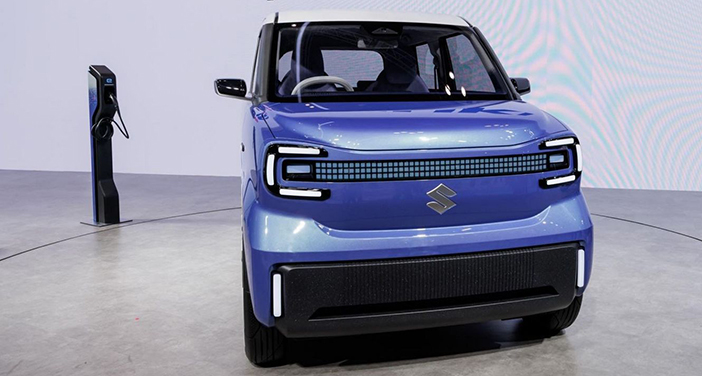
It will join a growing segment of affordable electric city cars, like the new Honda Super-N, a similarly boxy kei car. The production Vision e-Sky will have five doors like the concept and share its tall, boxy proportions. Details of the EV powertrain remain scarce but a battery of around 29 kWh capacity for a 200 km range would be typical for the class. “The A-segment BEV is vitally important. It’s an entrant in a different segment for us and I’m very excited about its prospects”, said Kateley. Given Suzuki’s traditional appeal among private buyers, the e-Sky should be a keenly priced offering. The e-Sky will also pave the way for the 2029 launch of Suzuki’s third EV, which is most likely to be a B-segment SUV to slot between the e-Sky and e-Vitara. It most definitely won’t be an electric Swift. +++