
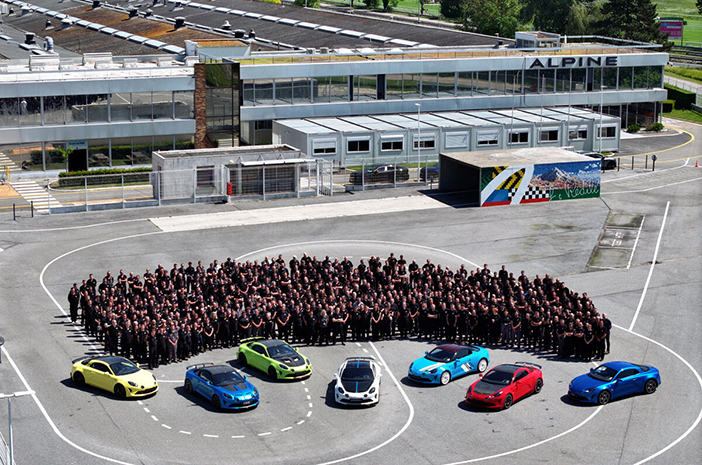
+++ The ALPINE A110 has ended production after 9 years, as the French firm gears up to launch its long-awaited electric successor. The last of 28.701 A110s rolled off the line at Alpine’s factory in northern France today, specified in a commemorative 70th-anniversary trim. Overall, Dieppe has produced more than 35.000 A110s, including the original iteration (Alpine’s first production car) that ran from 1963 to 1977. It isn’t an end to A110 production at the Normandy site, however, as the third-generation car is set to start running down the line next year. Based on the new Alpine Performance Platform (APP), the new A110 will launch with an electric powertrain but has been engineered so that it could take a combustion engine in the future. The first variant will be a traditional 2-seat coupé, but a 4-seater and a convertible will follow in the coming years, as Alpine seeks to broaden its portfolio and expand its share of the sports car market. The new A110 will make its dynamic debut in prototype form at next week’s Goodwood Festival of Speed, before Alpine reveals more details and components at the Paris motor show in October. +++
+++ Earlier this month, I spoke with automotive design legend Ian CALLUM about everything from the lineage of the Aston Martin Vanquish to the challenges facing modern Jaguar. Unfortunately, not once during our conversation did he mention this: a reborn Jaguar XJ220. Cheeky. In a post on the Callum Designs Instagram page, the company revealed a teaser of what it describes as a modern interpretation of the iconic XJ220. Callum himself designed the project, and while there’s no confirmation that it will reach production, the idea hasn’t been ruled out entirely. Either way, just look at it:
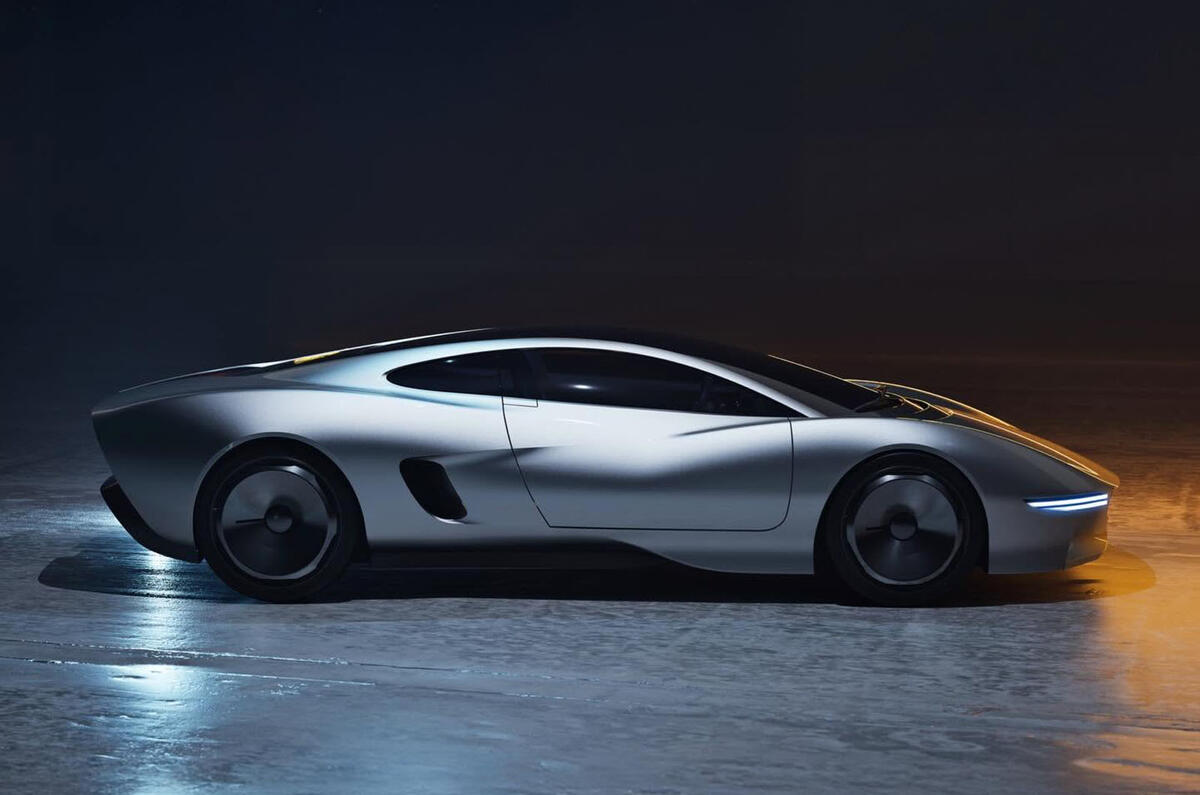
Details remain scarce, but the single image released so far is enough to get people excited. The design looks stunning. Its sleek, modern lines are paired with just enough DNA from the original XJ220 to make it feel like a genuine successor rather than a simple homage. The overall silhouette, greenhouse and rear vents all echo the original supercar. Even the distinctive disc-style wheels appear to be a contemporary reinterpretation of the XJ220’s famous alloys. The car also appears to wear a shade of Spa Silver, a nod to the original model’s signature colour. For now, Callum Designs is calling the project a “design study,” which means there’s no guarantee it will ever see production. That said, the company also teased that there’s more to come, writing: “Keep an eye out for more on this Callum project… Coming Soon”. +++
+++ FIAT will launch a new tiny 4-seat electric vehicle called the Multiplina, which will feature retro styling cues and be around the same size as the 1950s 500, as part of its continued focus on small vehicles. The new urban runabout has been previewed with the Multiplina Concept, shown during a micromobility event at the Vatican City. The 2028 production version will sit above the Italian firm’s current 2-seat Topolino but below the current Fiat 500 and the affordable electric city car due to be shown later this year. Plans for a 4-seat microcar were first hinted at with mention of a new ‘Quattrolino’ model during a Stellantis strategy presentation last month. Fiat boss Olivier François showed an image of the new Multiplina during a presentation and said it would be revealed later this year, likely at the Vatican in October or November. François said the Multiplina would “be super-important for us, because it’s really the missing link between Topolino and the traditional city car”. The new Multiplina concept takes its name from the 600 Multipla of 1956, which Fiat called the “original people mover”, but the firm also noted that it has a similar footprint to the 500 of 1957. That would make it just under 3 metres in length, compared with 2.53 metre for the Topolino.
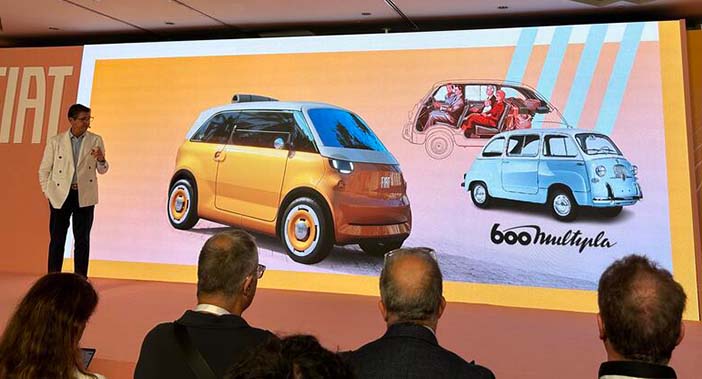
While the Citroën Ami-based Topolino sits in the L6 quadricycle category, the Multiplina will be built to the L7 regulations, allowing it to be more powerful and faster. The Topolino is limited to 45 kph and gets a range of around 75 km from a 5.4 kWh battery, but Fiat claims the Multiplina will be able to reach a top speed of 90 kph (the maximum allowed under the L7 regulations) and offer an “extended range”, which should make it a far more versatile offering, able to operate outside of city centres. The Multiplina will use the same basic platform as the Topolino and the 3-seat Tris commercial vehicle, but this will be extensively reworked to offer more space, range and a larger battery. The styling of the new concept makes clear callbacks to the original 600 Multipla, including the overall silhouette, vertical nose and round headlights. François said it would “play a lot on our DNA and be rooted in our style”, adding that it shows that “Fiat will be the brand within Stellantis that will really go all in on micro mobility”. The expansion into ‘urban mobility vehicles’ (the category below full-sized cars) is part of Fiat’s continued focus on small and affordable vehicles, centred around the existing 500 and Panda/Pandina. The forthcoming Grizzly is a Dacia Duster-rivalling C-segment SUV and will be the largest vehicle the firm will produce. The Topolino was launched 3 years ago in Italy. +++
+++ LAMBORGHINI is vying for the performance SUV crown with the new Urus SE Performante, the hottest derivative yet of its exuberant family hauler. Its plug-in-hybrid powertrain pairs the venerable 4.0-litre twin-turbo V8 with a single electric motor, boosted to combined outputs of 800 hp and 1.000 Nm. This represents an increase of 11 hp, thanks to a free-flowing exhaust set-up and reworked engine management software. A new Akrapovic exhaust swaps the SE’s cross-pipe set-up-with which header pipes from each cylinder bank meet at a cross section, before running through the length of the car to split silencers, for 2 separate exhausts, with 1 per bank. This improves the flow of exhaust gases out of the engine while creating what Lamborghini claims to be a “more powerful” tone. The new pipes are made from aluminium, so the revised system also results in a 10 kg weight saving. Shedding yet more mass is the extensive use of carbonfibre, which is used for the bonnet, roof, wings, side skirts and rear diffuser. A new one-box brake and stability controller saves 4 kg, lightened sound deadening cuts 3 kg; and swapping leather for the new ‘Corsa Tex’ Dinamica upholstery saves a further 2.7 kg. All combined, it makes the Performante 32 kg lighter than the regular SE, at 2.473 kg. The Performante also features the ‘6D’ drive computer that was introduced with the Temerario supercar.
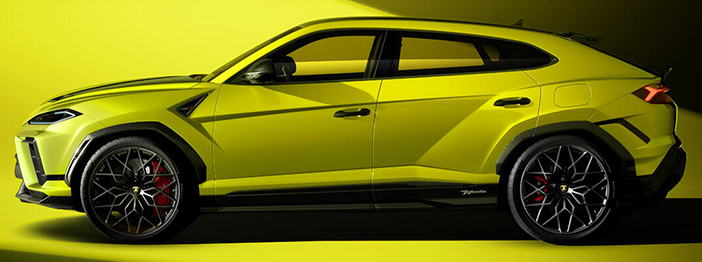
This measures acceleration over the X, Y and Z axes, along with pitch, roll and yaw, to allow for finer control over the dynamic state. Completing the package is an outlandish new look intended to maximise the tall, wide SUV’s aerodynamic performance. Thanks to an array of chunky splitters, skirts and spoilers, the Performante produces 23% more downforce than an Urus SE. Key to this is the integration of an S-duct through the front bumper and bonnet, to push the nose down as speed builds. Despite this, the Performante also produces 5% less drag than a regular SE, helped by reworked underbody cladding that includes the largest rear diffuser yet fitted to a Urus. Lamborghini design director Mitja Borkert told the new look was intended to inspire awe. “We are not form follows function”, he said. “We are form follows adrenaline. As a brand, we want to Inspire future generations. When you look at the design you can park the car anywhere and it looks like a spaceship, it looks like something outlandish, different from what else is on the street. For me, this is my personal motivation”. Borkert accepted that even more aggressive styling may be polarising but added: “It’s a Lamborghini. We have a clear design DNA that we don’t want to compromise”. Borkert said his goal was to make the driver “feel Iike a pilot” once inside the Performante. Much of the cabin is trimmed in black, with the suede-like Dinamica textile used on the dashboard to reduce reflections on sunny days. Alongside a new 12.3 inch infotainment touchscreen is an array of buttons intended to dial up the sense of tactility, “This [buttons], for me, is the key”, said Borkert. “You always need to have a mechanical experience, you need to feel the machine”. +++
+++ LAND ROVER has revealed a high-spec new edition of the Discovery, which could be the final version of the 9-year-old 7-seater before it comes in for a dramatic reinvention. The new Landmark model reprises a name previously used for run-out editions of the Discovery 2, 3 and 4 in their final months of production, suggesting that the end could finally be near for the fifth iteration. The new Landmark (sitting between entry-level S and top-link HSE trims) comes in a bespoke shade of Tasman Blue paint that nods to the original Disco 1’s Clearwater blue, and is marked out from its range-mates with a raft of bespoke styling cues inside and out. Standard kit on the Landmark includes a sliding panoramic sunroof and a fridge in the centre console. All versions come exclusively with the D350 straight-6 diesel, the Discovery having dropped all petrol and PHEV powertrain options. Having been launched in February 2017, the Discovery is not just JLR’s oldest model but also one of the longest-running cars currently on sale. The Discovery 5 was briefly offered in a Landmark trim from 2019-2020, to celebrate its 30th anniversary. Details of the nameplate’s future remain unconfirmed (with JLR focusing for now on the launch of the upcoming Range Rover Electric, Defender Sport and Velar successor) but the company has hinted at plans to dramatically reposition its big family hauler to differentiate it from the vastly more popular Defender. Mark Cameron, who leads the Defender and Discovery brands, previously told: “If you look from a product perspective, Defender came in and sat quite squarely on top of Discovery and cannibalised a lot of that business”. He said JLR was working on “recreating what Discovery stands for”, and said the priority was to “make sure it sits in a really unique territory”. A successor model would be likely to use the similarly sized Range Rover’s MLA architecture, which can accommodate electric, combustion and hybrid drivetrains, in keeping with JLR’s renewed commitment to preserving a multi-powertrain offering across its model lines for the medium term. +++
+++ LOTUS is taking steps to shore up Hethel, its British sports car factory, by kicking off exploratory talks to assemble Zenos’ track legal road car, the E10. Not that the E10 will put much of a dent in Lotus’s unused capacity: Zenos probably makes about 30 cars in a good year. Hethel’s maximum annual capacity across 2 shifts is 10.000 cars: even on a single shift, last year’s 2.000 volume is painfully under-utilised. But it’s the first step on a long road towards a bigger, stronger future. That’s the potential reformation of Hethel as a regional ‘Performance Hub’, with Lotus’s engineering, sourcing and assembly capabilities outsourced to a series of clients to boost the acclaimed but struggling sports car business. Over time, the E10 (or future Zenos cars) could be re-engineered to share more components and know-how, boosting economies of scale for both parties. Alan Lubinsky, Chairman Zenos Cars, said: “To have a centre that seamlessly pulls together so many of the disciplines needed to deliver highly advanced vehicles for clients globally represents a significant opportunity for Zenos Cars. Today the barriers to low-volume, high performance automotive engineering are considerable and, with the Hethel Performance Hub able to tap into and draw from the region’s already strong reputation for excellence, we are excited for what lies ahead”. Zenos was founded by ex-Lotus employees in 2012, and its lightweight aluminium structure and high-performance from a humble 2.0-litre engine is true to the Lotus playbook. The firm has bounced back from administration under AC Cars’ owner Alan Lubinsky, with the E10 set to be relaunched using a 390 hp Volvo engine; plenty in a car weighing just 780 kg. Lotus’s Norfolk sports car factory has been running on fumes, with a four-month shutdown last year as the exporter figured out how to handle President Trump’s US import tariffs. Well-placed sources said Hethel’s future was placed under review in summer 2025, with its Chinese owner, Geely, exploring all options (including closure) to stem losses at the British sports car outpost. But speaking at the FT’s Future of the Car summit in May 2026, Lotus CEO Qingfeng Feng dismissed the reporting as “rumours”. Autointernationaal.nl subsequently sat down with Feng at the brand’s marquee retailer in London, and asked him about Hethel’s future. He announced a V8-powered hybrid supercar, the Type 135, will enter production in 2028, with the V6-powered Emira successor due to follow by 2030. “We are currently doing the feasibility studies of producing the new models at the Hethel factory”, Feng told. “The manufacturing process is great, but we really need to think about the supply chain and tariff impact”. Feng confirms the British Government has helped the exporter obtain lower-interest finance and contributed to Hethel’s redevelopment. What more can it do going forward? “It would really help if the Government could [assist with]the supply base: it would be quite costly to do that by ourselves in the EU and UK region”. Lotus has been trapped in a perfect storm, buffeted by tariffs that have inflated the cost of UK sports car exports to the United States, and exorbitant American import duties on its Chinese-built lifestyle EVs that make sales commercially impossible. Lotus is also grappling with inconsistent electric car demand, and growing the brand from a tiny customer base. Geely has pumped billions of investment into Lotus, funding the clean-sheet electric technology that underpins the Eletre and Emeya, and a factory in Wuhan, China, with a 150.000-unit capacity. It has also invested €117 million in its Norfolk site, yielding new production lines to build the petrol-powered Emira sports car and the pure electric Evija hypercar. Nonetheless, Lotus sold only 12.134 vehicles in 2024, which slumped again to 6.520 cars last year, triggering a €415 million loss. Yet Lotus still managed to slash its operating loss by a remarkable 46 percent year-on-year. It laid off production line and administrative staff, and slashed marketing budgets. Amortising costly technologies (the new V engine, electric/electronic architecture and the upcoming Eletre X SUV’s 955 hp plug-in hybrid system) across the Geely group also helped squeeze expenditure. But it’s critical to staunch the red ink. “If Lotus disappeared in our hands, wow…” finance chief Dr Wang told me, his voice tailing off at the enormity of the prospect. “The ambitions of the management, the shareholders, will never change: we want to keep this brand for another 78 years, another 100 years. We want to make Lotus sustainable and great again”. That’s why it has announced its new Focus 2030 strategy, superseding Vision 2018. The 150.000 sales target has shrunk to 30.000 cars by the end of the decade, but even that is more than 17 times Lotus’s volume in the last year of the Elise, Exige and Evora sports cars. Two-thirds will be ‘lifestyle cars’, with powertrains split 60:40 hybrid:EV across the range. Dr Wang says Lotus will break even at that volume, assuming a 20 percent margin on sales. So what makes CEO Feng most proud after 8 years running Lotus? “The transition from outdated sports cars to ‘new energy vehicles’ (NEVs) with intelligence”, he shoots back. “We are very proud that after 8 years of harsh effort, commitment and devotion, we have built our production base and brought out new products such as Eletre, Emeya and Emira. We have laid a great foundation for the march towards the NEV era. The electrification of sports cars is inevitable”. +++
+++ A couple of months ago the covers came off the all-new Mercedes C-Class Electric, and the forthcoming AMG variant promises to continue the German super-saloon fight into the electric age. The hot electric C-Class, which we expect to be called MERCEDES-AMG C 63 ELECTRIC , will be aimed squarely at the upcoming BMW iM3, recently previewed by the M Neue Klasse Concept at this year’s Le Mans 24 Hours race. Although the Mercedes-AMG C 63 Electric’s styling is more reserved than the electric M3’s, it’ll likely compete with the BMW’s radical performance stats. Rather than the AMG.EA platform of the recently revealed AMG GT 4-Door, the Mercedes C-Class Electric sits on the firm’s new MB.EA platform. So far this architecture is only shared with the new GLC Electric. The standard C-Class Electric comes with a choice of single or dual-motor variants with up to 489 hp, providing a 0-100 kph time of 4 seconds. The regular car’s 94.5 kWh battery is likely to be retained in the AMG, but in order to keep pace with the quad-motor BMW iM3 (which looks set to have around 750 hp), the C 63 Electric could receive a tri-motor set-up. Not only would this give the Mercedes plenty of power, it would also allow a greater distribution of power and torque between each axle to sharpen the AMG’s driving dynamics. Rear-wheel steer and adaptive air suspension should come standard on the hot AMG model and it’s almost certain that these elements will receive a more aggressive, bespoke tune too. I expect the electric C-Class AMG model to arrive sometime in 2027, by which point Mercedes-AMG will be bringing out a new V8-powered CLE 63 coupe. Unlike the current, plug-in hybrid four-cylinder C 63, the C 63 Electric won’t be offered as an estate, because that isn’t an option with the standard car. +++
+++ The SKODA OCTAVIA is being geared up for another update. Changes to the popular family car promise to closely align its styling with the marque’s electric models, while also bringing back plug-in hybrid power. I’ve spotted the revised Octavia model testing but there’s no word on when it will arrive at Dutch dealers and I don’t expect to see it until late next year. One of the key reasons for this second revamp is to bring back the PHEV version, which was removed from sale a few years ago. The new version should combine a 1.5-litre 4-cylinder petrol engine and an electric motor, fed by a battery pack of around 20 kWh. As it stands, the Volkswagen Group offers this option in 2 power options, 204 hp and 272 hp, and should generally offer around 100-120 km of all-electric range. Power will go to the front wheels via a dual-clutch transmission. However, given the speed of plug-in hybrid powertrain development from all manufacturers, these figures could all improve on this future Octavia. The subtle styling changes include a new grille that’ll integrate the brand’s ‘tech-deck’ feature. Expect some smaller changes to the front and rear bumpers, along with new wheel and colour choices. The cabin will have its own tweaks, but these will probably remain inside the digital interfaces. However, new and more contemporary materials should be introduced, keeping the model fresh until it’s completely reborn in its all-electric form in 2029. +++