
+++ Nobody needs a reminder that CHRYSLER has largely fizzled out as a brand in recent years. Since the 300 went out of production, it’s been a one-vehicle company, its showrooms carrying nothing but the Pacifica and Voyager minivan twins. That’s about to change. Fiat just launched 2 new crossovers called the Grizzly and Grizzly Fastback. It turns out that they’re coming to America, but they’ll wear Chrysler badges when they do. Stellantis showed both vehicles behind closed doors at its May 21 Capital Markets Day event in Michigan, wearing Chrysler badges and lightly reworked fascias. The Grizzly Fastback is said to have appeared as the Chrysler Arrow, while the standard Grizzly was shown as the Arrow Cross. If those names sound familiar, that’s because Stellantis has been teasing Chrysler’s revival for years and most notably mentioned each in the last month. Now, the company may finally have products ready to fill out the brand’s line-up. The Grizzly twins ride on Stellantis’ Smart Car platform, which already underpins vehicles such as the Citroen C3 Aircross, Opel Frontera and Fiat Grande Panda. Both models measure almost 4.5 meter long, placing them in the subcompact class, roughly the footprint of Toyota’s new C-HR. That’s a solid size and shape to start from if you’re a brand trying to regain market share like Chrysler is. Better yet, Stellantis said that both will start from under $30.000. Fiat says buyers will be able to choose from gasoline, mild-hybrid and fully electric powertrains. While exact specifications haven’t been announced, the lineup is expected to utilize Stellantis’ familiar turbocharged 1.2-liter 3-cylinder engine in both conventional and hybrid forms, alongside a battery-electric variant across the pond. What makes the cut for North America is still anyone’s guess. The standard Grizzly features upright proportions and a boxier design intended to maximize passenger and cargo space. The Fastback trades some practicality for a sleeker coupe-like roofline and more lifestyle-oriented styling. Inside, Fiat promises a 12.3 inch infotainment display, a 10.25 inch digital instrument cluster, adaptive cruise control, automatic emergency braking, cyclist and pedestrian detection and Level 2 driver assistance technology. How much of this will make it to the Americanized Chrysler versions? It’s tough to say for sure just yet, but it stands to reason that almost all of it will. If the Arrow and Arrow Cross reach production largely unchanged from their Fiat counterparts, they could provide Chrysler dealers with something they’ve lacked for years. Attainable products positioned below the Pacifica. Production of the Fiat Grizzly models is scheduled to begin during the second half of 2026. +++
+++ Stellantis has just provided us with a better look at the new FIAT GRIZZLY. The larger sibling to the Fiat Grande Panda is set to go on sale later this year in both traditional SUV and Fastback coupe-SUV forms. Fiat’s CEO, Olivier Francois, said that “Grande Panda marked the return of Fiat to affordable family movers. With Grizzly and Grizzly Fastback, we’re completing this line-up with 2 vehicles designed around different needs, different lifestyles, but sharing the same idea: smart, accessible and rooted in Fiat’s design DNA”.
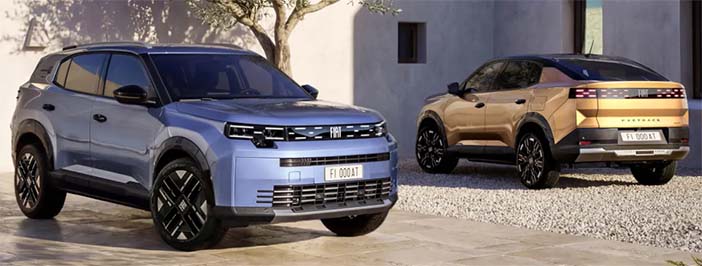
All of this highlights the fact that, at 4.5 meter long, the Fiat Grizzly will sit in the sector above the Grande Panda, despite both cars using the Smart Car platform. This puts the newcomer in direct competition with the likes of the Dacia Bigster and entry-level versions of the Nissan Qashqai. Prices for the Grizzly are expected to start from around €29.000 in The Netherlands when the car eventually goes on sale. The Fiat Grizzly’s boxy proportions make it instantly identifiable as a member of the Grande Panda family. Both the Grizzly and the sleeker Grizzly Fastback look identical from the front, with a gloss black trim piece spanning the area between the four-pixel headlights. This is very much reminiscent of the arrangement on the Grande Panda, but the Grizzly also gets what look to be further illuminated elements that converge towards the Fiat logo in the centre. The bulky wheelarch cladding should appeal to those who enjoy the rugged nature of the Grizzly’s main rival, the aforementioned Dacia Bigster, while the latest image shows how we can expect the wheel design to vary between the standard SUV and its coupe sibling. At the back, both versions of the Grizzly get a similar black strip to the one at the front, again adorned with pixel-style led lighting. The periwinkle and burned orange paint colour showcased here also appear to reaffirm that Fiat is standing by its promise not to offer the colour grey on its cars. Instead, buyers should expect an array of vibrant shades, similar to what’s offered on the Grande Panda. As you’d hope for with family SUVs, the cars’ interiors will focus on spaciousness and versatility, with rugged finishes designed to be practical and hard-wearing. Fiat will attempt, however, to set its offerings apart from the likes of the value-focused Dacia Duster (another key rival) by emphasising their heritage and having a greater sense of fun, not just usability. Fiat will continue to reference its famous Lingotto factory in the interior’s design and detailing. As such, the oval-shaped elements that are found in the Grande Panda will probably be carried across, with a similarly varied use of different soft and hard-touch materials. Both cars will also probably feature the same technology package. Fans of separate climate controls will also be glad to see Fiat retaining fixed buttons. As with the Grande Panda, Fiat’s colour and trim department will focus on using as many recycled materials as possible, including bamboo-fibre mixes and a combination of bright, high-contrast stitching. Small item storage has also been a focus, so there will be plenty of interior oddment space, and the Panda’s clever integrated charging cable, which is coiled away and accessible via the front bumper, should also be retained. The key for both Grizzly models, though, will be offering enough space for families; something that the Grande Panda is a little short on. Fiat is promising “best in class” boot capacity. The additional half a metre in length the Grizzly has over the Grande Panda should pay dividends in terms of rear passenger space. The Grizzly models won’t only share their design language with the Grande Panda, as mentioned above, they will also use the Stellantis Group’s Smart Car platform that underpins the smaller model, plus larger B-segment cars including the Citroen C3 Aircross and Opel Frontera. The electric models will be offered with a choice of a 44 kWh or 54 kWh battery. These should provide close to 290 km and 400 km of range, respectively. A 100 kW maximum charging speed will allow for a 10 to 80 percent top-up in about half an hour, and driving the front wheels is likely to be a 112 hp front-mounted electric motor. However, Fiat may choose to fit a beefed-up e-motor to give these bigger cars a bit more oomph than the smaller Grande Panda. Fiat’s slow rate of new product launches and updates to existing models over the last few years has been a worrying sign for such an iconic brand; one that’s important not just to the Italian car industry, but also to the country’s manufacturing base in general. However, this is about to change, as Fiat exploits the Smart Car platform and access to synergies across Stellantis. The Grande Panda was a bold first step, but the SUVs have the potential to re-establish Fiat as a true volume player across most European countries. +++
+++ FORD isn’t giving up on Europe, and the good news is that it won’t exclude buyers who want to stick with combustion engines, because alongside the new electric Puma and Fiesta coming in 2028, there could well be a new hybrid-powered Ford Focus. The company has confirmed it’s working on a new C-segment crossover, which is said to be inspired by Ford’s ‘motorsport’ heritage and could well signal the return of the iconic Focus nameplate. The new crossover will also feature a four-point headlight design inspired by iconic racers and models from Ford’s past. These are offset with a combination of muscular surfaces and some rugged design elements to remind buyers that the car is still an SUV. It might be a stretch to call this new model a traditional hatchback like previous generations of the Focus. Rather than challenge the Volkswagen Golf rival, it will instead rival crossovers such as the T-Roc, a model that has an even bigger appeal to European buyers. Other mainstream rivals will include the Nissan Qashqai, Toyota C-HR and Cupra Formentor. However, few technical details of the new Focus are known, such as whether it will run hybrid, plug-in hybrid or range-extender hybrid engines. The decision will depend on whether these new models are built from their own joint-venture partnership; Ford refused to elaborate, but it did say it has entered into strategic partnerships to boost scale on these projects and speed up development times. “These aren’t just deals, they are strategic levers”, said Jim Baumbick, president of Ford in Europe. “We partner with the best to move with speed and scale, and we obsess over the product to deliver passionate, unmistakably Ford vehicles”. I asked whether this would result in the revival of the Focus nameplate? “I’m not in a position to share anything, but certainly the history and the heritage of some of those names are not lost on us”, he responded. The Focus isn’t the only hybrid-powered crossover coming, though, because 2029 will also bring the introduction of a larger D-segment model that’ll in effect replace the current Kuga. This more dynamic model will join Ford’s new European Bronco due in 2027, creating 2 options for buyers looking for family-focused SUVs at opposite ends of the style spectrum. These new models will complement the existing Explorer and Capri, which are based on Volkswagen underpinnings from an earlier Ford partnership. But these won’t continue unchanged either, as Ford Europe’s general manager of passenger vehicles Christian Weingartner explained. “The Volkswagen partnership is a really good one”, he said. “We can tap into all of their developments and the advancement of the platform, and that’s what we want to do”. +++
+++ The striking LAMBORGHINI Lanzador was destined to be the brand’s first-ever electric car, with bosses promising us it would deliver a hypercar-humilating 2.000 hp, but not any more, because the ‘2+2 Ultra-GT’ is getting plug-in hybrid power instead. However, it will still be used to bridge the gap between the company’s supercars and its hugely popular Urus. As we understand it, the all-electric Lanzador was pretty much ready for launch and was slated to arrive in 2028 until, essentially, Lamborghini realised very few of its customers (or those within the luxury sports car segment generally) want an EV right now. In an interview, Stefano Cossalter, product director for the Lanzador and Urus, explained: “We decided not to go with an electric car because the acceptance among our customers was little to none. So we decided to postpone the introduction of an EV”. He added: “It’s about the acceptance of a Lamborghini EV and the maturity of technology, because if we have to come out with an electric car, it has to be a masterpiece in terms of performance”. Cossalter is keeping his cards close to his chest about the Lanzador for the moment. It’s even unclear when the high-riding 2-door coupe will be hitting the streets, although that’s hardly unsurprising given the U-turn the brand has made, and the fact that engineers suddenly have to figure out how to fit an engine under the car’s shark-like nose. As a result, we wouldn’t be surprised if it didn’t arrive until after 2030. However, the product boss did promise: “This car is going to be unexpected. This is what I can say to you”. He also explained how the Lanzador will slot into the Lamborghini line-up: “It’s going to fit in our product portfolio perfectly between the ‘Super Sport’ cars and the Urus. If you look at the silhouette, you’ll have the Temerario, you’ll have a Revuelto, then you’re having the Lanzador, and then the SUV, which is the Urus”. With the Lanzador and the next-generation Urus that’s due in 2029 both featuring plug-in hybrid power, we expect there will be some differences in the driving experience. Considering this new addition to the family is referred to as an ‘Ultra-GT’, it’ll probably focus slightly more on long-distance cruising ability. If Lamborghini wanted to do more to separate the two, perhaps to contrast the sleek and dramatic design of the Lanzador that was previewed by the 2023 concept, the next Urus will go for a blockier design as a nod to its ancestor, the outrageous Lamborghini LM002. When it was planned to be a fully electric car, the Lanzador was set to use the Volkswagen Group’s latest, most cutting-edge SSP architecture designed specifically for EVs. Now it’s going to be a plug-in hybrid, we assume the car will use the same underpinnings as the next-generation Urus and, fingers crossed, its V8 engines, too. +++
+++ Can 2 struggling automakers make 1 powerhouse? That’s the question China’s BYD is asking in relation to MASERATI , after BYD dominatrix Stella Li told reporters that brands like Maserati are “very interesting”. Maserati Chief Operating Officer Santo Ficili has reiterated that Maserati is “not for sale”; a drum Stellantis has been beating for ages to a skeptical audience. But we can see why such a move would make sense. The new Stellantis comeback plan prioritizes Jeep, Ram and Dodge. If Stellantis were interested in letting go of ailing Maserati, it would have 1 less brand to reinvigorate, plus some extra cash on the ledger. But that’s not the only potential benefit. With increasing competition from other Chinese automakers, BYD (Build Your Dreams) is seeing a decline in sales and a tumble in profits in its home market, and in Europe, tariffs are also impacting profitability. If BYD were to take over Maserati, or at least form a partnership with the brand, it could gain access to European manufacturing, helping cut production costs and avoid tariffs. Maserati would also be a prominent feather in any Chinese conglomerate’s cap, with decades of history from which to draw. For Maserati, the upsides look good too. The Italian marque could gain access to impressive EV technology, and BYD would surely invest considerable sums toward new products. It’s also worth noting that BYD has been eyeing a Formula One entry for some time now, and while racing in the pinnacle of combustion-powered single-seater motorsport might look strange for an EV-centric company with mostly family vehicles under its umbrella, using the Maserati trident in F1 could be very promising. However, don’t bet on Maserati becoming Chinese-owned any time soon. Stefan Bratzel, founder and director of the independent research institute Center of Automotive Management, told AutoNews that while a BYD takeover of Maserati isn’t unrealistic, he “can’t see it happening at the moment”. Similarly, others have suggested that this could be a financial risk for BYD in its current throes, and with Stellantis promising new Maserati creations, it doesn’t look like the Italian brand will be let go for the foreseeable future. However, analysts say that if legacy automakers choose to get rid of some of their brands, several Chinese automakers, not just BYD, would be very interested, and as these relatively new brands try to move beyond just outpricing the competition, investing in improving quality and technology, a future where Chinese brands begin taking over European companies whose veneer has faded looks ever more likely. +++
+++ Nearly 20 years after the last one disappeared from showrooms, NISSAN has officially brought back the Primera nameplate. The catch? It’s no longer a family sedan with gasoline engines, wagon variants, or touring car pedigree. Instead, the revived model is a fully electric sedan sourced directly from China, based on the locally built N7.
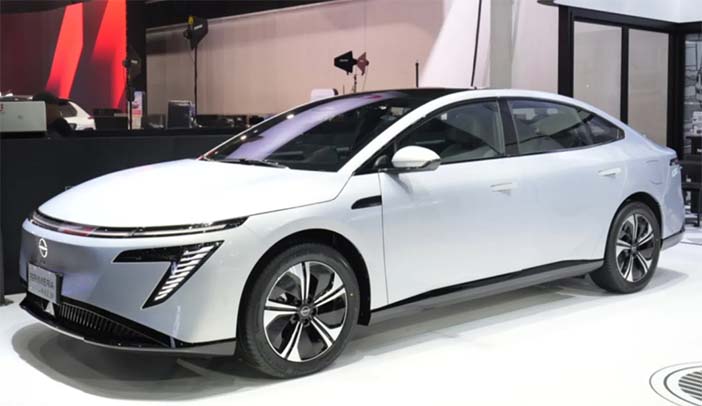
The all-new Primera EV made its public debut at the Philippine International Motor Show (PIMS), where it joined the launch of the X-Trail e-Power and previews of several future electrified models. While Nissan’s press materials were light on technical details, the company confirmed the Primera name will return as part of its expanding EV lineup. For longtime Nissan fans, the badge carries significant history. The original Primera debuted in 1990 and survived through 3 generations before production ended in 2007. It was sold as a sedan, liftback and wagon, and even earned a motorsport legacy through multiple British Touring Car Championship titles. We even got it in the States as the Infiniti G20 from 1990 to 2002. The new Primera has little in common with its predecessor beyond the badge on the trunk. As we previously reported, it’s based on the Chinese-market Nissan N7, an electric sedan developed through Nissan’s joint venture with Dongfeng. Let’s define what that means for buyers. At 4.930 mm long and riding on a 2.915 mm wheelbase, the new Primera is actually larger than a Toyota Camry. Philippine certification documents previously revealed specifications that match the entry-level N7 almost exactly, including a single electric motor producing 215 hp and 305 Nm of torque. Power comes from a 60 kWh battery pack with a claimed range of approximately 500 km. Visually, the car itself is almost unchanged from the N7. It features a fastback profile, controversial flush door handles, and wide LED lighting elements. The debut also marks the first major step in Nissan’s new “From China” export strategy. Nissan says China will serve as both an innovation center and a manufacturing hub for future global products. Nissan hasn’t announced pricing or an on-sale date yet, but the company says full specifications will be revealed closer to launch. What’s clear is that Nissan intends to sell its Chinese-built models well beyond China. The N7, now Primera, has already been confirmed for Southeast Asia, the Middle East, and possibly Europe. +++
+++ A new one-off commission from ROLLS-ROYCE has been built to celebrate the 120-year anniversary of Henry Rolls’ race win at the Isle of Man Tourist Trophy. That’s right, before 200 mph bikes, the Isle of Man TT was fielded by cars, and 120 years ago it was one of the founders of Rolls-Royce that won in a car that inspired this Black Badge Ghost. The Ghost’s Emerald Green paintwork is a contemporary take on the original Light 20 H.P Rolls-Royce Racer, but more directly connected is the Ghost White pinstripe with a small number ‘4’ added into its length.
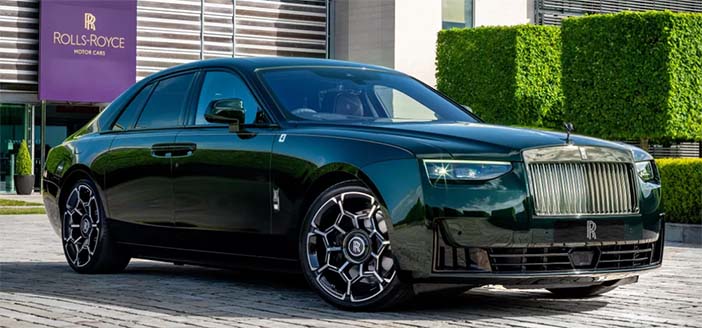
The cabin has a two-tone interior with black and tan leather, the latter used on contrasting piping and seat inserts, as well as stitching and deep-pile carpets. Look a little closer and you’ll find other, more direct connections to the TT, including an embroidered outline of the Isle of Man itself on the rear seats. Other neat touches include etched markings on the underside of each circular air vent, featuring motifs that mention the original racer’s registration number, chassis number and the co-ordinates of the Isle of Man Short Highroads Course where the race was held. All of these elements sit within the Ghost’s inherently luxurious cabin elements, from the finest leathers and wool carpets on the seats and floor, and the Black Badge-typical woven fibre in place of the more traditional wood. As with most commissions, there are no technical changes to the existing Black Badge Ghost. This means it features the same 6.75-litre V12 engine producing a relaxed 600 hp and 899 Nm. Power is sent to the rear wheels via a smooth-shifting 8-speed automatic transmission, and while there’s no real ‘Sport’ mode, the simple ‘L’ button on the small gear selector sharpens up the shifts, wakes up the throttle response and better controls the ride. +++