
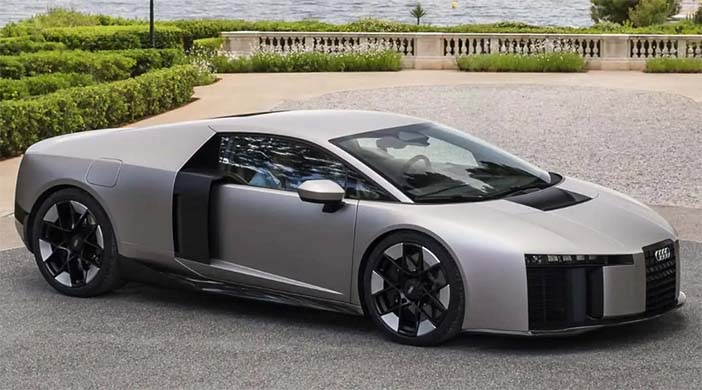
+++ It’s safe to say AUDI took us all by surprise yesterday when it introduced a de facto replacement for the R8. Although the Nuvolari looks like a concept car, this is essentially what deep-pocketed customers will get once deliveries begin in the first half of 2027. Production will be capped at 499 units, but the company is already hinting at a possible convertible follow-up. In an interview, CEO Gernot Döllner was asked whether there are also plans to build 499 examples of a Nuvolari Spyder. While he said no, he was referring only to the production quantity, effectively confirming that a droptop is already in the works. Perhaps we shouldn’t be surprised that Audi’s most powerful car ever will get a folding roof, given that the mechanically related Lamborghini Temerario is also set to receive Spyder treatment. Döllner’s response suggests that a Nuvolari Spyder would carry a separate production run, should it happen. We would wager Audi would build even fewer examples and charge a premium over the coupe, which starts at about €680.000 in The Netherlands. While this is speculative, reading between the lines of the CEO’s comments suggests that an unspecified number of convertibles is planned. It’s too early to say whether it will use a fabric roof like the R8 Spyder before it. With the Concept C revealed last year, Ingolstadt took a different approach by introducing an Audi-first targa-style hardtop that stows electrically behind the seats. The production version of the brand’s smaller fully electric sports car is due in 2027 and will exclusively feature this setup, as there are no plans for a fixed-roof coupe. While the Nuvolari has a limited production run, Audi hasn’t said whether the production-ready Concept C will also be a temporary member of the lineup. These two are the company’s first models to introduce a fresh, monolithic design language and a rethought interior layout with higher-quality materials and more analog controls. Meanwhile, Audi is open for business and will happily sell you a Nuvolari coupe; if your bank account allows it. It’s also unclear how the 499 units will be allocated globally, though more details are expected later this year. +++
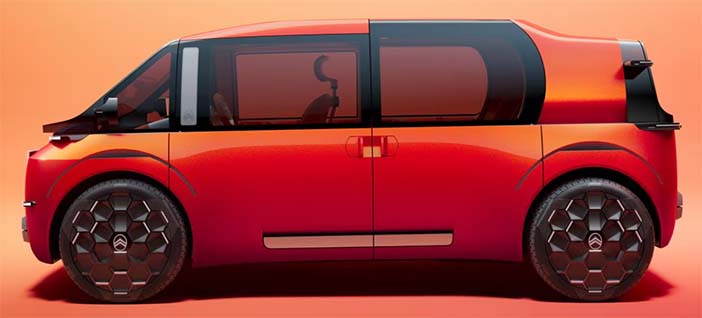
+++ The iconic and hugely popular CITROEN C4 PICASSO is set to be reinvented as a spacious, design-led MPV based on the ELO concept, marking the start of a new era of practical family cars for the brand. Citroen’s CEO, Xavier Chardon, told me that he and his team are “working on the future of the MPV” and that the ELO concept, which debuted at the Brussels Motor Show this year, is “a good inspiration” for what’s to come. Changes will be necessary to productionise the innovative, future-gazing MPV, including a more mainstream 5 or 7-seat layout. The concept featured a McLaren F1-style central driving position, with an offset seat on either side. This will be swapped for a traditional dashboard arrangement. Citroën has been experimenting with colours, materials and textures in its recent models, so expect some bright flashes and innovative design flourishes for the production car. But the ELO’s slim infotainment system that runs the entire width of the cabin (not dissimilar to the BMW iX3’s Panoramic Vision iDrive display) will probably make way for a conventional central screen, possibly with a head-up display to complement the digital instrument cluster. “I don’t believe every customer is looking at more and more technology”, Chardon told me. “That’s why in current and future Citroëns you won’t see multiple screens everywhere. This is not our territory”. Behind the ELO’s funky front row was a rear bench seat that folded flat for added versatility. Depending on the car’s length, Citroën could look to add a pair of folding chairs in the boot. As before, the maker may choose to offer differing body lengths, with a longer wheelbase for the Grand 7-seat version. Pierre LeClercq, who has been the head of design at Citroën since 2018, told us previously that “interior design, ergonomics and functionality are so, so important”. He said: “The customer has to be in the centre of all this. If we do a feature that is unusable, let’s not do it. We’re doing what we do really well”. The future Picasso successor will double down on this idea of usefulness, with LeClercq insisting that design flair cannot come at the expense of functionality. “Where do you put your phone? How do you read your information?” he asked. “Whether you’re a tall person or a short person, you have to make sure you use every square centimetre perfectly”. Given the expansion of the Aircross line-up, if the new MPV is a success, there’s nothing to stop Citroën building a range of SpaceTourer models (both bigger and smaller) that could cover all corners of the market. Citroën will continue to favour a multi-fuel strategy and offer its customers a variety of powertrains. Any future ELO-inspired MPV is therefore likely to be offered with a range of hybrid and electric engine options; expect an evolution of Citroën’s current line-up, plus PHEVs and EVs with greater zero-emission range and faster charging. Citroën has so far refused to comment on when the reinvented MPV might come to market, but last week announced plans for 3 new models before the end of the decade. We know one of these will be the fruits of the reinvented 2CV E-Car project, while the remaining 2 models (both set to be based on Stellantis’s Smart Car platform) could include this mooted C4 SpaceTourer. +++
+++ FORD is preparing to launch several new models with starting prices under $40.000 in the United States. One of those should be a new sedan. What kind of sedan remains a mystery, but one Ford executive might have just hinted at what’s to come, and it might take the form of a 4-door Mustang. In an interview, Andrew Frick, Ford’s president of Ford Blue and Model E, said in response to a question about sedans and why they make sense right now that the automaker is looking “to expand on the Mustang family as we move forward”. He added: “It’s going to have to make sense within a family that we may already offer. And it’s going to have to be very cost-effective for us to do it. That’s what we’re focused on in general with a lot of our new affordable products. We want the concepts to be right and the costs to be even better”. There have been rumours that Ford is considering a 4-door version of the Mustang. In May 2024, Ford CEO Jim Farley was confident that the automaker could make a Mustang with different body forms, like a 4-door, “as long as these models have all the performance and attitude of the original”. A few months after Farley made those comments, a report surfaced that alleged Ford showed dealers a Mustang sedan called the Mach-4 alongside an unnamed, safari-like off-road variant of the vehicle. Ford’s current line-up lacks a sedan. The automaker hasn’t offered one since the Fusion (Mondeo in Europe), which ended production 6 years ago. The Fiesta, Focus and Taurus died before then, leaving the Mustang as the brand’s only car with a low seating position. Ford produces just the Mustang at its Flat Rock plant in Southeastern Michigan, which is underutilized. It used to assemble the Lincoln Continental, the Ford Fusion and the Mazda6 alongside, but those models aren’t around anymore. While Mustang sales are strong so far this year, they are down by thousands compared to a decade ago. Expanding the Mustang family to include a 4-door would likely increase the plant’s utilization without being too costly for Ford to develop or accommodate. Despite sedans not being as popular as they once were, several automakers continue to offer them. Even General Motors is preparing a next-generation sedan platform that will underpin a new Cadillac CT5 and likely result in Chevrolet resurrecting the Camaro. Dodge is also getting ready to put a V8 back into the Charger. +++
+++ Nissan’s announcement that Jaecoo owner Chery is ready to take over one of the two production lines at its underutilised Sunderland plant neatly illustrates a wider trend: that car companies from JAPAN are facing an existential crisis in Europe as their fingertip hold on a difficult market is now starting to crumble in the face of Chinese competition. All Japanese brands bar Toyota are struggling to compete in the region and Nissan is the latest to admit that it can no longer commit to developing models just for Europe. +++
+++ The OPEL ASTRA will be reinvented for a new generation by the end of the decade, morphing into a less “traditional” shape as it aims to maintain market share in the face of soaring SUV demand. Opel has confirmed the new Astra is one of “at least” four new models it will launch by 2030, alongside the next-generation Corsa, a new SUV co-developed with China’s Leapmotor, and an as-yet unnamed new car which is thought to replace the current Mokka. To be built at Opel’s HQ in Rüsselsheim, Germany, the new Astra will move onto parent company Stellantis’s new STLA One modular architecture, which offers the flexibility for electric and hybrid drivetrains, and will underpin the majority of upcoming Stellantis cars in Europe. Opel has not given a precise launch date, but the facelifted version of the current Astra is just arriving in showrooms now, suggesting a replacement is at least 3 years away. Speaking to media following the announcement of the new Astra, Opel CEO Florian Huettl hinted at a dramatic reinvention for the firm’s longest-running model line, to meet changing customer demands in Europe’s crucial C-segment, most pertinently the increased popularity of SUVs. “Whenever we look at what the next generation of a well-established car such as the Astra should be, looking at the evolution of the segment is a big deal of our work. “The hatchback segment continues to decrease; we see a lot of flow to other segments, namely the SUV body styles. Sometimes as smaller cars get more mature and provide more performance, people move down and then also people move up, for example, as family life evolves”. His allusions to the increasing popularity of mid-sized SUVs (Europe’s most popular type of car) gives a strong indication that Opel could transform the Astra into more of a crossover than a conventional hatchback for its next generation, just as Ford is set to do for the replacement for the Astra’s main historic rival, the Focus, in the coming years. Indeed, Huettl added that the Astra name “doesn’t mean necessarily that it’s a traditional hatchback”, alluding to a body shape that could straddle multiple segments in a bid to maximise its appeal. However, he did confirm that whatever form it ends up taking, the next-generation Astra will continue to offer an estate (or ‘Sports Tourer’) body option because it remains “hugely popular” in Opel’s native German market. “What I can tell you for sure is that there will be a station wagon, because that’s what our home market requires, and this is what we will serve”. Huettl said the new model “will certainly be a BEV”, but STLA One can accommodate various types of hybrid drivetrain, which Huettl suggested could mean the next Astra follows the current car in offering a range of different fuel types. “STLA One isn’t limited to BEV only in its capabilities, so we’re currently looking at the right calibration of powertrain offer. The market is highly dynamic: the electric market this year is really going through the roof, and we see a lot of demand coming depending on certain stimulus measures, but also we feel that with the current global situation people seem to value a bit more the independence [that comes with]fossil sources of energy”. He said that no final decision had been reached on specific types of powertrain: “We don’t have to make it yet, we’ll make it in due time”. Stellantis has confirmed that STLA One will be equipped with LFP battery technology and 800V charging hardware, which means the next Astra EV is likely to offer a far greater range than the current car, which uses an adapted version of the CMP combustion car platform. Opel had previously been planning to resurrect the long-defunct Manta badge for a segment-straddling crossover flagship offering a choice of powertrains, but had to put the project on ice because Stellantis needed the funding for the new Lancia Gamma. Based on the revealed details, the new Astra could neatly fill the gap left by that cancellation, but Huettl emphasised that it is a separate programme rather than a rebranding. “The new Astra will be a new Astra. It will deliver the values and the product proprieties that our customers look for, which means a high level of practicality, loading space, long-distance driving comfort and all of that. There’s absolutely no link” to the Manta programme, he said, and that model is “not something that today is part of our development process”. Instead, Opel is well advanced on the next-generation electric Corsa, which will share the STLA One platform with the larger Astra and is likely to be sold alongside an updated version of today’s hybrid Corsa, and a new mid-sized SUV based on a platform supplied by Stellantis’s Chinese joint venture partner Leapmotor, which is due in 2028. +++
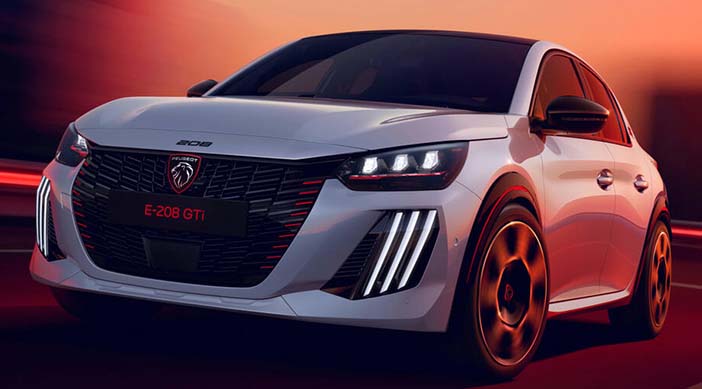
+++ PEUGEOT has revealed the new e-208 GTi in production form, ahead of its public debut at the Le Mans 24 Hours later this week. The electric hot hatch was unwrapped in concept form at La Sarthe last year, but this is the finished product, ready for showrooms in the coming months with a design that Peugeot says “is incredibly close” to the original show car. The first new Peugeot GTi model since the hot 308 retired in 2021 is also its most powerful yet, with its single front-mounted electric motor producing 280 hp and 350 Nm of torque for a 0-100 kph time of 5.7 seconds; slightly quicker than its Alpine A290 rival. Technically, it’s a close relation to the Abarth 600e, Alfa Romeo Junior Elettrica Veloce and upcoming Opel Corsa GSE, which means it also gets a mechanical limited-slip differential to increase its agility in the bends. Beyond the hefty power increase of 124 hp over the standard e-208, the GTi also gains bespoke hydraulic bump stops, a rear anti-roll bar and a unique steering tune that’s said to boost responsiveness. It also rides 30 mm lower and has significantly widened tracks (by 27 mm at the rear and 56 mm at the front) for improved poise and stance. As previewed by the concept, the visual makeover extends to a prominent rear spoiler and diffuser, a beefier front lip and striking 18 inch alloy wheels with a design inspired by the distinctive ‘pepperpots’ of its hallowed 205 GTi forefather. Further details will be revealed on Friday 12 June as Peugeot marks the 100th anniversary of its first Le Mans race by taking to the circuit in three GTis; painted red, white and blue to celebrate the brand’s French heritage. Dutch sales of the new hot hatch will begin towards the end of the year. The standard e-208 tops out at around €33.000, so I expect the e-208 GTi to reach €43.000, which would line it up neatly against the A290. +++
+++ Another month has passed and a handful of automakers have reported their May sales results in the UNITED STATES . Hybrids were a strong driver of growth, as the average price of petrol remains well above $4 a gallon. This has been huge for brands like Hyundai and Kia, which offer a range of hybrid and electric vehicles, but last month wasn’t a success for all. Ford saw sales falter last month, continuing a trend, while the affordable Maverick stands out as a popular model. The auto industry is facing numerous hurdles right now, including tariffs that are upending products and plans. There’s still plenty of time for the market to change, but until then, here are the May auto sales winners and losers. Last month, Kia set a sales record, selling 80.502 vehicles. That’s an 11 percent increase over May 2025, with the Sportage outselling every other Kia model. Hybrids accounted for a large percentage of Kia’s sales last month, which were up 179 percent. Sales for the Sportage Hybrid and Sorento Hybrid were up 171 and 101 percent, respectively, while Carnival Hybrid sales jumped 32 percent. So far this year, Kia has sold 360.220 vehicles; 2.0 percent more than in the first 5 months of 2025. In May, Ford’s sales slipped 13.3 percent year over year to 181.627 vehicles. Most models saw their sales decline, including the Mustang, Bronco Sport, Expedition and F-Series. The Ranger saw the largest decline (23.3 percent), more than any other model. Strong sellers included the Maverick, up 10 percent for the month. It’s available with a hybrid powertrain, which makes it look appealing amid high petrol prices. Bronco sales were up 5.2 percent, while Explorer sales climbed 8.8 percent. Hyundai sold 87.468 vehicles last month, an increase of 3.0 percent, and year-to-date sales are up 1.0 percent. According to the automaker, electrified vehicles drove growth, with hybrid sales up 90 percent year-over-year. The Tucson, Santa Fe, Elantra and Sonata hybrids all had sales records last month. The Tucson remains the brand’s best-selling model, up 3.0 percent, followed by the Elantra and then the 3-row Palisade. Sales for both are up by 7.0 percent and 17.9 percent, respectively. Even the Ioniq 5 saw sales increase 28 percent last month, with year-over-year sales up 16 percent. However, the Ioniq 6 is virtually dead. Just a few months ago, Hyundai confirmed it would only sell the high-performance Ioniq 6 N in the United States, discontinuing the regular trims. That decision is reflected in the sales numbers, with the automaker selling just 176 units, down a whopping 85 percent compared to May 2025. Sales for the EV are down 79 percent for the year, but if you want one, you will have to live with the hot N version for now. It has up to 650 horsepower, and it can rocket to 100 km/h in 3.2 seconds. The iconic little sports car, the Mazda MX-5, had a sales resurgence last month, with sales increasing 196.6 percent. The automaker sold 1.053 Miatas in May, the majority of which were soft-top models. So far this year, Mazda has sold 3.911 Miatas, up 10.9 percent. It outsold the Subaru BRZ at 255 units, down 21.8 percent. Honda sold just 319 Preludes, which is a new model this year. That might not be much, but it’s on par with Honda’s sales expectations, so it won’t be coming for the Miata anytime soon. Mazda sales were up 35.0 percent in May but are down 6.9 percent year-to-date. After months of sales declines for the brand’s beloved sports sedan, Subaru WRX sales are finally back on the rise. After the automaker introduced its new entry-level model (starting at just $33,690), sales were significantly up in May. The WRX improved a whopping 148 percent compared to last year, with Subaru moving 1,195 units. Last May, Subaru only sold 482 WRX models. So far this year, Subaru has sold 5,875 WRXs, and it shows no signs of slowing. +++