
+++ There are a dizzying number of Chinese automakers and they’re in a mad dash to release new products. The numbers are truly staggering and executives seem to know the pace isn’t sustainable. According to Nikkei Asia, BYD executive vice-president He Zhiqi took to social media last month to say 542 MODELS were released between January and May. That’s an average of 3.6 per day, but sometimes even that number is eclipsed. Once such example was July 16, which has become known as ‘Crazy Thursday’. At least 8 automakers unveiled new vehicles that day as companies are flooding the market with new product to keep sales up. While exports of Chinese-made vehicles are exploding, there’s been a slump domestically. Overall sales are down 21% and sales of new energy vehicles fell 13%, thanks in part to revamped tax incentives. Automakers are feeling the pinch and Zhiqi said things are “brutal.” As he explained, automakers can spend years and ¥1 billion ($149 million) to develop a new vehicle. When it finally arrives, there’s an initial rush of excitement and sales, but this “doesn’t last even 3 months” as so many new vehicles are being introduced. The publication says BYD sales have dropped 16% through the first 6 months of the year and this is the first time the company has posted a first half decline in 6 years. They’re not the only Chinese automaker struggling as Seres Group is expecting to post a net loss, while Great Wall’s first-half net profit could tumble by around 60%. Part of the problem seems to be a desire to chase growth at all costs. Some automakers, like Nio, seem to be acknowledging that circumstances are changing and the Chinese automotive landscape is becoming more mature. As CEO William Li recently noted: “many households already own one vehicle”, so the “automotive market must shift from the traditional era of increasing volume to one that considers growth based on the premise of existing vehicle ownership”. That likely means smaller, but more consistent sales as well as a reduced pace of new vehicle introductions. However, with intense competition, some companies likely won’t want to be left in the dust. +++
+++ Monterey is a gathering place for some of the world’s most expensive and beautiful classics every year. But amid the concours, auctions and historic race cars, there’s also a strong focus on what comes next. BMW M is using Car Week to bring the new M Concept Neue Klasse to North America for the first time, while also celebrating the M3’s 40th anniversary. It’s a fitting setting. In Monterey, the past and future are often separated by little more than a few steps. After making its world debut at the 24 Hours of Le Mans, the M Concept Neue Klasse headed to California for Monterey Car Week. BMW displayed the concept at the House of M, on the Concept Lawn at Pebble Beach, at The Quail, and during the Rolex Monterey Motorsports Reunion at Laguna Seca. Few automakers this year have tied a new vehicle so closely to their design, motorsport and brand history. The concept offers a concrete preview of the first fully electric generation of BMW M high-performance models. At its core is a drivetrain with 4 electric motors and a new M-specific vehicle control system. BMW calls the central control unit the “Heart of Joy”. It is designed to coordinate the powertrain, brakes and vehicle dynamics much faster and more precisely than previous systems. The concept therefore shows not just a new design language, but above all the technical direction of future M models. At first, presenting this future at Laguna Seca seems unusual. The storied race weekend is built around roaring V8s, historic touring cars and the smell of racing fuel. BMW M is clearly choosing to put itself in direct conversation with its own history, signaling that electric performance is also expected to meet the brand’s standards. At the same time, BMW is celebrating 4 decades of the M3. Since the E30 arrived in 1986, the model has been considered the heart of BMW M GmbH. The first M3 was originally created as a homologation model for touring car racing. From that came a model line that, to this day, connects road and track like few other performance cars. That is why BMW showed more than just road cars from various generations in Monterey. At the Motorsports Reunion, legendary racing versions of the M3 also took to the track, from the E30 DTM to the E92 M3 GT. Even M boss Frank van Meel got behind the wheel of a historic race car himself. The message is clear: motorsport remains central to BMW M’s identity, even as the technology of the future turns electric. Against this backdrop, Laguna Seca provided the right setting for a conversation with Van Meel. Surrounded by historic M3 race cars and the new M Concept Neue Klasse, I spoke with the BMW M boss about the future of the M3, the role of motorsport, and how driving fun can be carried into the age of electrification. Question: The BMW M Concept Neue Klasse is one of the main topics here in Monterey. What message is this car meant to send? How clearly does it already show the future of BMW M? Answer: “This year we are celebrating 40 years of the M3. We started in motorsport. We had to build the first M3, the E30, in order to homologate the race car. That is really where the story of M began: bringing motorsport technology into production cars. You no longer had to choose between a sports car and a normal production car; you could have both in one. We have continued that through every generation. The M Concept Neue Klasse shows that it will continue, and that it will also become electric. But that does not mean our world is changing completely. The heritage of M and the motorsport DNA remain. You can see that in the car, too. We have the widebody stance, the yellow lights from our special models and motorsport, track lights like on the LMDh race car, and aero elements from the M4 GT3. Inside, there are bucket seats made from natural fiber. We have used this material for years in GT4 racing and now it is ready for production. So the message is: It continues, but don’t be afraid; everything is not suddenly becoming completely different. Form follows function applies one-to-one to future M vehicles as well. That is especially interesting here in Monterey, because this event is very much shaped by gearheads. We are deliberately showing where things are going, and we want to have that discussion”. Q: The shift to electric mobility is being intensely debated among high-performance car fans. Some manufacturers are following their path fairly undeterred. With BMW M, however, it feels as if you are listening very carefully. How much influence does feedback from customers and fans actually have on your decisions? A: “A very large one. We are in close contact with our fan community, our dealers, customers, and car clubs. And we are no different from our fans. The questions they ask themselves are the same ones we ask ourselves, especially when it comes to electric mobility. We are not doing this because it has to be done, but because we are convinced you can build a fast and even better car this way. The timing has to be right, though. It only works if we can do it 100 percent the way we want to do it. The Neue Klasse gave us a clean-sheet platform for that. We said we could only make a high-performance M with 4 electric motors, torque vectoring, individual control, a central control unit, and our own software. The high-voltage battery and electric motors also have to feel M-like. At the same time, we ourselves like our inline-6 and our V8. That is why we are bringing these engines up to the Euro 7 emissions standard and continuing with combustion engines as well. There are customers who can’t charge their vehicles or who like the sound and want to keep driving internal combustion engines. We follow the discussion in our community very closely, and we read the comments as well. Of course there are people who say nobody needs electric cars. But there are also many who are still skeptical and say they would at least like to drive one once. We do not decide for our customers what they have to drive. We want to build cars that we ourselves love, whether electric or combustion-powered. Customers can choose what they like better”. Q: Is there a concrete example where this feedback has already influenced a product decision? Is the manual transmission one of those cases? A: “Yes. Especially in the U.S., the love for the manual transmission is enormous. Every second M2 we sell there has a manual gearbox. Rear-wheel drive and a manual transmission are the dream combination for many purists. That is why we also made a limited model with a manual transmission for the U.S. Demand was enormous; the car was practically sold out immediately”. Q: BMW M depends heavily on the feeling behind the wheel. In an electric car, sound and feedback partly have to be created in new ways. How far can you go with simulation? Where is the line for you? A: “For me, it becomes artificial when you simply copy what you have today and transfer it into an electric car. That would be copycat behavior. We measured all the engines we have made at M, from 4- and 6-cylinders to V8s and the V10 from the M5. Our sound engineer once played the V10 at a constant 6.000 rpm. It is an iconic engine, but at a steady 6.000 rpm it sounds like a kitchen appliance. Sound that feels authentic and emotional in a certain car cannot simply be copied into another car. Even a V8 sound would not automatically fit in today’s M3. In an electric car, we have to create the emotionality we had with 6-, 8-, or 10-cylinder engines. But it has to suit the electric drivetrain and the specific car. The sound is allowed to amplify what is actually happening. I have an electric drive system, and I have to take its characteristics into account. From there, I can develop a sound that moves me emotionally and gives me the feeling of being at one with the machine”. Q: And what about simulated gear changes? A: “The same applies to shifting. Of course, you could replicate the entire automatic or dual-clutch shifting process. But then you also take on the disadvantages of a mechanical drivetrain. Why would I artificially limit an electric drivetrain so it can imitate something a combustion engine can do? What I want are different drive stages and different accelerator-pedal maps. On track, the driver should get a feeling for where they are, how the car responds to load changes and how fast they are going, without constantly looking at the speedometer. The right acoustics and feedback are part of that. That’s why, when it comes to simulated gear shifts, my answer is: yes to distinct gear changes. But imitating a traditional gear change with an interruption in power delivery just so you can feel a shift makes no sense to me. We want to make the new world more controllable and more emotional without copying the disadvantages of the old one”. +++
+++ The European expansion of car manufacturers from CHINA is in its early stages and already local production is growing rapidly. Within the next decade, as many as 1.5 million vehicles from Chinese brands could be built in Europe annually. This year, Chinese brands like BYD, Leapmotor and Chery are expected to manufacture approximately 90.000 of these vehicles in Europe, either in new factories or existing ones that have been underutilized. Global Mobility expects this figure to grow to 1 million units annually by 2030 and 1.5 million by 2035. However, lawmakers in Europe are eager to ensure that brands don’t exclusively rely on Chinese parts when building new vehicles, and instead work with local suppliers. They’re doing this through the Industrial Accelerator Act (IAA), which aims to strengthen Europe’s industrial base and boost domestic manufacturing. Details are still being ironed out, but the act is expected to introduce quotas for European parts to be used in vehicles manufactured across the continent. Without this act, “the main risk is that China will open pure assembly plants for Chinese components in the EU, with minimal economic added value for the Europeans”, economist Sander Tordoir said. BYD will soon start production of its cars in Hungary and is also looking to add a plant in Spain to its local portfolio. In addition, several Jaecoo and Omoda vehicles are being built in Spain, and soon, Leapmotor will also start building EVs at the Stellantis site in Zaragoza. Geely will also manufacture vehicles in Valencia through a partnership with Ford. The key reason Chinese brands are building locally is to avoid paying hefty import tariffs. However, if the IAA enforces car companies to increase their reliance on European suppliers and manufacture more components locally, brands like BYD, which have a high degree of vertical integration, will have to consider if the investments are worthwhile. “Because, to be considered ‘Made in Europe,’ large parts of the components, including the battery, would then have to be manufactured locally”, Gregor Williams from the Rhodium Group think tank told Automobilwoche. +++
+++ HYUNDAI will launch more than 100 new models globally by 2030, as it seeks to navigate mounting challenges from tariffs in the United States, rising Chinese rivals and the industry’s rapid shift toward future mobility.
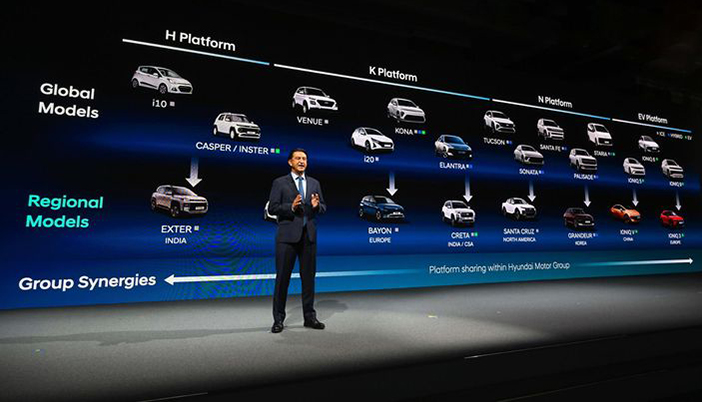
The automaker unveiled the plan at its 2026 CEO Investor Day in Seoul, attended by investors, analysts and credit rating agencies. The new vehicle launches include full and partial model changes and derivatives. More than 18 of them will be entirely new models entering vehicle segments where Hyundai currently has no line-up. Hyundai also presented a vision to expand beyond its traditional automotive business into autonomous driving and robotics, seeking to solidify its position as a physical artificial intelligence (AI) company. In the 4th quarter of this year, the company will supply the autonomous driving company Waymo with robot taxis based on the Ioniq 5 produced at the Hyundai Motor Group Metaplant America (HMGMA) in Georgia. Hyundai also plans to expand its contract manufacturing, or foundry, business in the autonomous vehicle sector. Starting in 2028, the carmaker plans to deploy its industrial humanoid robot, Atlas, at HMGMA. Genesis, Hyundai’s luxury brand, will launch its first hybrid model, the GV80 hybrid, in Korea and the U.S. in the second half of this year. An extended-range electric vehicle, or EREV, will follow in the first half of next year. The new Tucson is also scheduled for a launch in the second half of this year. To support the expanded lineup, Hyundai will increase its global production capacity by 1.27 million units by 2030. The figure will include 500.000 units in North America, 320.000 in India, and 200.000 in Korea. “Our fundamentals have never been stronger”, Hyundai CEO Jose Munoz told investors during the event. “The Hyundai Motor Group (which also includes Kia) is the third-largest automotive group and the second-most profitable, which gives us the ability to invest while others are pulling back”, he said. “We are leveraging partnerships to scale new technologies and opportunities and becoming a physical AI company, which will produce and deploy robots and robotaxis”. Hyundai maintained its previous target of selling 5.55 million vehicles globally in 2030 and having electrified vehicles account for 60 percent of total sales.
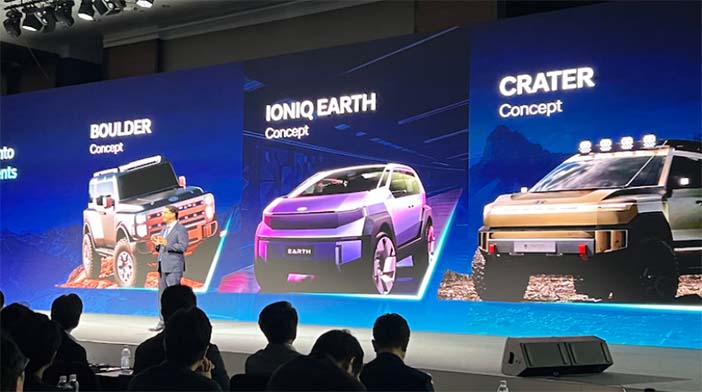
Despite geopolitical risks and intensifying competition from Chinese automakers, Hyundai said its core vehicle business remains solid. Hybrid sales rose 18 percent to 363.000 units in the first half from a year earlier. The carmaker raised its 2030 operating profit-to-sales ratio target to at least 9 percent, citing the expansion of hybrid models and the group-wide cost-cutting efforts. In North America, Hyundai plans to launch 10 new hybrid models by 2030 and raise hybrids’ share of its sales to 50 percent. The Santa Fe EREV will go on sale in the U.S. in the first half of next year. In Europe, the carmaker will raise annual electric vehicle (EV) sales to 420.000 units by the timeline. The Europe-specific Ioniq 3 will officially launch next month to drive the carmaker’s EV sales growth there. The company expects SUVs’ share of sales in India to increase to 80 percent by 2030. In China, Hyundai plans to launch 2 new models next year (a compact electric SUV and a midsize EV / EREV model) as the carmaker seeks to revive sales from one of the most competitive auto markets. +++
+++ JAGUAR LAND ROVER has not given a firm launch date for a fully electric Defender and it has not officially said the next-generation model is locked into the 2030s. Company updates instead stress keeping gasoline, diesel and hybrid engines available while other electric sport-utility vehicles move ahead, with timing chatter around Defender framed as a delay in reports and investor coverage rather than a dated change on the record, including a report from The Times. Reports suggest Jaguar Land Rover is taking a slower approach to a full Defender redesign while it explores a compact Defender-style model, building on early plans for the baby Land Rover Defender. Recent investor and corporate briefings describe spending cuts and a tighter focus on vehicles already close to production, supported by a delayed battery expansion at AESC’s Sunderland plant that had been linked to potential Jaguar Land Rover supply talks. Jaguar Land Rover has confirmed that Range Rover Electric and Range Rover Sport Electric will use the Modular Longitudinal Architecture and be built at Solihull, while the first Electric Modular Architecture sport-utility vehicle will be a new Range Rover family model assembled at Halewood. The company has said Range Rover Electric will be revealed later in 2026 with launch in the second half of its 2026–2027 financial year, despite an earlier target of reaching showrooms closer to 2024. Now it sits with the EMA-based Range Rover model and the new Jaguar battery-electric car as the main short-term EV projects, as covered in our first look at the Range Rover Sport Electric. Jaguar Land Rover has not set public timing for when a fully electric Defender would join that pipeline, nor has it confirmed any plan to build Defender-family vehicles with partners in the United States or tied a date to such an arrangement. Mercedes already sells the G 580 with EQ Technology, a battery-electric G-Class introduced for the 2025 model year, giving it a showroom-ready electric off-roader while Jaguar Land Rover’s equivalent remains in the planning stage. Jaguar Land Rover is far from alone in juggling shifting electric timelines. Scout’s electric pick-up and SUV lineup has also been pushed back to the 2028–2030 window. +++
+++ The first of no doubt many new special edition LAMBORGHINI TEMERARIOS made its debut at Pebble Beach Concours this year, reviving the iconic Tricolore colour scheme that was first seen on the iconic Gallardo Tricolore of 2011. Like that car, the new Temerario Tricolore celebrates the brand’s essential Italian-ness with insignia derived from the iconic flag, mounted on tri-tone paintwork.
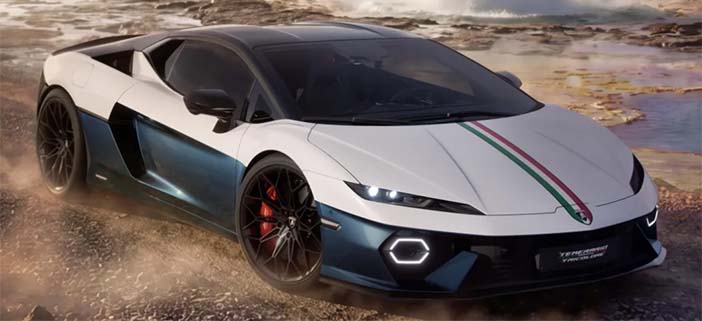
The one-off model was designed by Lamborghini’s Centro Stile, and executed by the brand’s rapidly growing personalisation division Ad Personam. In this case, the painted 3-colour stripe runs from the badge up and over the bonnet, but stops there as the roof, rear engine panel and rear bumper switch from Bianco Monocerus to Nero Noctis. Lower elements of the exterior are then finished in a third colour, this one being Blu Marinus which creates a shadow effect on the lower half of the bodywork. Wheels are finished in black, with red calipers behind and there are black mirrors to match the roof. A Tricolore theme then extends to the cabin, with black leather contrasted with red stitching in a recurring hexagonal pattern. This is mounted on the seats and doors, with unique Tricolore badging embroidered onto the door card. There are no changes to the car’s powertrain or chassis, but the manic 4.0-litre twin-turbocharged V8 engine remains with its incredible 10.000 rpm redline. It also still integrates Lamborghini’s clever plug-in hybrid system, which adds-in no less than 3 e-motors, giving the front axle drive and adding to the total combined power figure of 925 hp. Pricing for this one-off hasn’t been revealed, but expect a hefty increase over the standard car’s base price given all the bespoke paint and interior work. +++
+++ A new software update has given the VOLVO EX60, EX90 and ES90 the ability to alert drivers of other such Volvos to animals by the roadside. It uses the car’s sensors and cameras to detect larger animals, such as deer or sheep, in order to warn drivers before they may have spotted such hazards themselves. The car then uploads the positional data of the hazard to the cloud, which pings other EX60s, EX90s and ES90s within the vicinity to warn them as they approach, potentially preventing a collision. The update adds a similar system to warn of vulnerable road users, such as pedestrians or cyclists, and roadworks ahead. Other cars connected through the European Data for Road Safety programme will also be able to read the alerts. Volvo safety chief Åsa Haglund told that such systems are enabled by the improved computational power of the new models compared with the brand’s previous models. Haglund added that a key consideration in adding such systems was to ensure that drivers are not overwhelmed by information, and that the warnings are “trustworthy”. Otherwise they may fall on deaf ears. “We need to make sure that whenever we warn you, it makes sense to you”, she said. “If every second time it doesn’t make sense, that’s when you’re going to stop trusting the system”. Haglund said the new cars’ technological platforms are key to ensuring that reliability: “Now, when we have this data, the new technological platform with the capability of collecting that amount of data and being able to analyse and train software models on it, that’s when we are mature enough to kind of train the system to be very precise and alert people when relevant and leave them alone when not”. She added that “we have launched it now, we know the quality and the preciseness make sense to people” because “only when you know drivers trust the system will it actually have an impact”. To that end, Haglund said Volvo will not aim to be first to the market with new functions but instead only roll them out once it is confident in their reliability. “If we acted on any idea and just sent it out there, could we be quicker? For sure. Would it make the world safer? I doubt it”, she said. False positives “deteriorate trust” in driver assistance systems, she added. More broadly, she suggested Volvo’s ambition is not to wrestle control of cars away from drivers but instead to provide support when their standard of driving slips. She said: “We’re human. We are prone to making mistakes. A machine can stay vigilant at all times. It does not get distracted, it does not get tired, and it can keep its eyes all around the car at the same time, right? That’s the move we have to make; what we need to train [systems]for and make sure that we can cover all those situations that come up. What we need to look out for is that as long as the driver is in the loop, it’s very clear what is needed and what is expected from them”. +++