
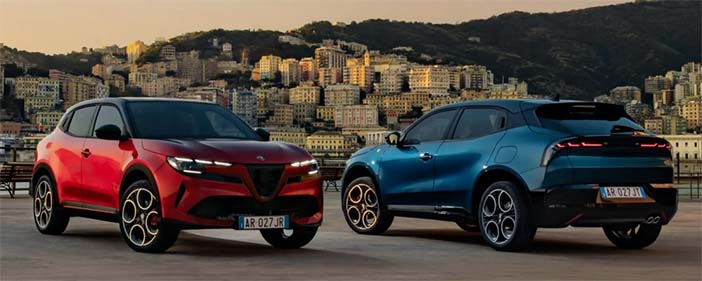
+++ Changes are coming to ALFA ROMEO ’s entry-level car for 2027, though this time the badge on the tail isn’t looking for a new home. The Junior, which was originally called Milano before the Italian city objected to its use on a car built in Poland, benefits from some upgrades that promise to give it a more premium feel. New 18 inch 3-hole and 19 inch 4-hole alloy wheels help you spot one of the upgraded SUVs from the outside.
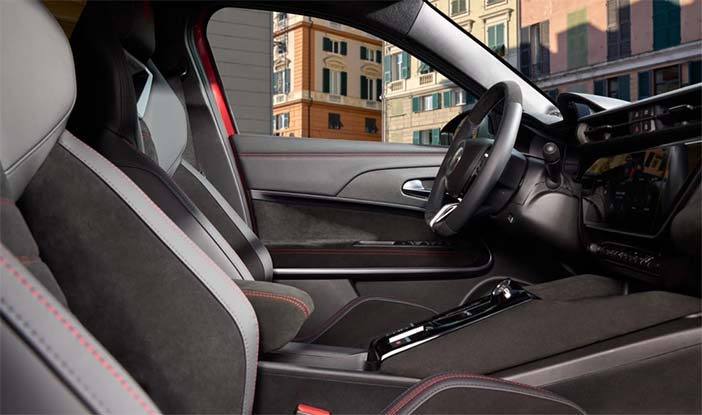
However, the biggest changes are found inside. And not just on the more expensive variants. Base, Sprint and Speciale trim levels head into MY27 with new ‘Icona’ upholstery that mixes black fabric seats, gray stitching and black Scuba material across the dashboard, console and door cards. Step up to Ti or Sport Speciale spec and you upgrade to Alfa Romeo’s ‘Carbon’ interior. Scuba fabric is used again, but this time with red stitching and details and a new Microcloud material on the dash and doors. What you won’t find, despite that name, is any carbon trim, but these upgrades might offset criticism that the Junior’s cabin has always felt a bit low rent for something wearing a premium badge. A load of extra standard equipment ought to lend an extra hand in that department. Sprint versions look like the sweet spot in the range now that they come with navigation, keyless entry, adaptive cruise, a reversing camera, wireless phone charging and blind-spot monitoring. But the Ti’s heated, powered and massaging seats, and ambient lighting will surely help open a few wallets wider.
What Alfa hasn’t messed with is the mechanical package. Base Junior Ibrida models still feature a 145 hp 1.2-litre, mild hybrid engine in front-wheel drive, or Q4 all-wheel drive forms. The Junior Elettrica EV makes 156 hp, but only drives the front wheels. Top dog is another EV, this one the 281 hp Junior Veloce, which relies on a sportier suspension tune and a mechanical limited-slip differential to help its front end handle the extra muscle.
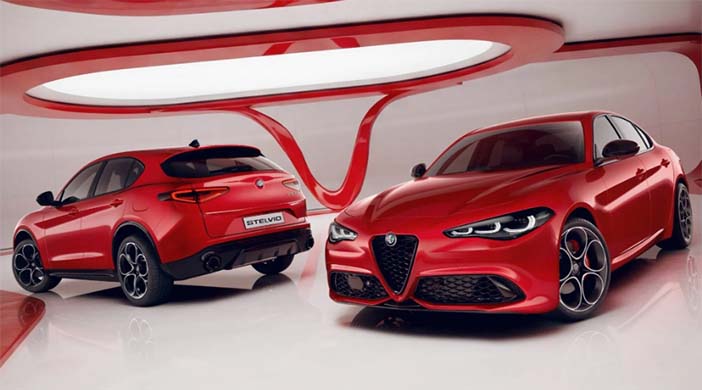
Alfa Romeo have thrown a few teaks on the geriatric Giulia and Stelvio. By rights both of those models should have been replaced by now, but the planned replacements were EVs and in the wake of falling electric sales in the United States, Alfa Romeo was forced to go back to the drawing board and come up versions that could also take combustion power. We won’t see those new Giulia and Stelvio models until at least next year, by which time the pair will be 12 and 11 years old. To keep potential buyers interested while we wait, the current models gain updated software and driver monitoring kit required by EU law, black and white Alfa Romeo badges and a new Anodized Blue paint option. Hardly, the kind of thing to worry BMW when it has a brand new 3 Series and i3 EV ready to ship to dealers. But the new M3 and X3 M are a year or two away, and you can still buy both Alfa Romeos in 513 hp 2.9-liter V6 Quadrifoglio guise. Go for the Stelvio Quadrifoglio and you now get 21-inch wheels instead of 20-inch rims, while buying either of the QVs unlocks a day’s on-track training at the Alfa Romeo Driving Academy. +++
+++ ALPINE is the latest among a slew of European automakers drawing on their heritage to design stunning new models, and its new A310 Vision concept is the latest to prove it. It pays tribute to the company’s history with a retro-themed design and modern flair. Strip away the concept body, and it likely gives us an idea of what the long-awaited, next-generation A310 production model will look like. The original Alpine A310 was built between 1971 and 1984 as a rival to the Porsche 911.
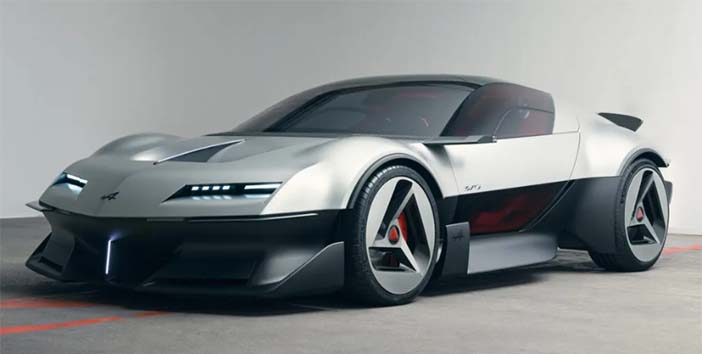
The A310 Vision concept shares many common design themes with the original and, at least to my eyes, looks even better. If Alpine doesn’t build something very similar and sell it to the public, we’ll be deeply, deeply disappointed. Like the original, the concept is a gorgeous 2-door coupe with a low front-end and a surprisingly bulky rear. Narrow led headlights, a massive front splitter, a bold bumper and a wild hood immediately catch the eye. Like the 1970s model, there are also bulging front wheel arches and an evocative shape that can only be fully appreciated when viewed from the side. Here you will see bold silver and black wheels, digital wing mirrors, angular side windows and door panels with a clear element, akin to what’s found on the McLaren Senna. The rear of the original A310 was dominated by a huge rear window. There’s no such window in sight with the A310 Vision and instead, a giant aluminum clamshell across the rear. Other highlights include the large lip spoiler and led taillights. Unlike some concepts which are purely theoretical, Alpine says the A310 Vision has been built on the same Alpine Performance Platform (APP) that will underpin the new all-electric A110. Curiously, the French brand says the concept was conceived purely “as a creative exploration of Alpine’s heritage rather than the announcement of a future production model”. However, not all hope is lost. In mid-2023, Alpine announced an ambitious new product plan for 2030, revealing that a new 4-seat A310 would launch on the same architecture as the A110. Little was heard about this car until early 2025, when a series of spy shots emerged reportedly showing the Porsche 911 testing as a 2-door sports car with very similar proportions to this concept. The final form of the new A310 remains somewhat mysterious. It’s unclear how much (if any) of the A310 Vision’s design could influence this new model, but we’re crossing our fingers and toes that it looks just like the concept. +++
+++ FERRARI ’s transition into the inevitable EV era apparently got going with an unlikely source of automotive wisdom. According to chairman John Elkann, a conversation with Jeff Bezos in July 2016 planted the seed that eventually became the Luce, Maranello’s first foray into the electric segment. However, Amazon’s founder wasn’t pretending to be a know-it-all by telling the company what it should do. According to a new report from Italian news agency Ansa, Elkann recalls chatting with Bezos in July 2016 while they were out for a walk. The man behind the giant online retailer said at one point: “I don’t know anything about cars, but I really know a lot about innovation. I think you need to think seriously about building an electric Ferrari”. That seemingly simple comment had enormous consequences. Elkann admits the conversation was the first moment he began thinking seriously about what an EV could actually be. The goal wasn’t merely to take an existing model, swap its combustion engine for batteries, and call it a day. Instead, Ferrari set out to build a standalone model by leveraging the rapid developments in electric vehicles. Ferrari didn’t publicly announce plans to launch a model without a gas engine until June 2022 and it took another 4 years for the EV to materialize. The Luce finally broke cover on May 25, immediately sparking huge speculation about its exterior design. So much so that the technical specifications somehow became less important, as all eyes were on the styling. Love it or loathe it, we can all agree on one thing: It marks a radical departure from every Prancing Horse model before it. However, Ansa quotes the company’s chairman as saying the end goal wasn’t to create a design that would stir so much debate: “We had absolutely no intention of creating a controversial Ferrari. We didn’t expect a reaction like this”. That’s not to say the feedback was necessarily a bad thing. Quite the opposite, actually. Well, at least in Maranello’s view: “In the face of these reactions, our conviction has grown much stronger. Having 1.3 billion people around the world who have seen this car is incredible”. Ferrari claims people who see the Luce in the metal often react much more positively than those who only see it online. The car reportedly attracted long queues when displayed at the Wave technology conference in Turin with Elkann arguing that its physical presence doesn’t translate particularly well through images. Despite the online backlash, Ferrari has gone on record multiple times to say orders are pouring in and client feedback has been positive. And while the Luce doesn’t have an engine, it doesn’t mark the beginning of the end for ICE. Other models will continue with V6, V8 and even V12 power, so the Luce isn’t a replacement but an addition to the stable. Circling back to Bezos, he may have admitted that he didn’t know much about cars, but his suggestion apparently gave Ferrari’s chairman something rather important to think about. A decade later, the result is a €500,000+ electric car that probably wouldn’t exist in 2026 without that little nudge from one of the wealthiest people on the planet. Whether the Luce ultimately becomes a commercial success remains to be seen, but it’s kind of amusing to think that Ferrari’s electric future may have been fast-tracked by a casual walk and a few words from Jeff Bezos. His comment apparently gave John Elkann plenty to think about, and now the outlandish EV is finally here. Luce deliveries are kicking off this quarter, and we’ll be watching future sales reports closely. However, logic suggests its full impact won’t be felt until 2028, since next year will be the first year of its gradual rollout. Meanwhile, Ferrari is sold out through 2027. +++
+++ FIAT has quietly revealed the final design for its upcoming Multiplina city car, which will feature retro styling cues and be around the same size as the 1950s 500, as part of its continued focus on small vehicles. The new urban runabout was previewed in a single picture earlier this year, but has now made its debut on Fiat’s stand at the Paris motor show, alongside the larger Multiplay concept which channels the spirit of the quirky 1990s Multipla.
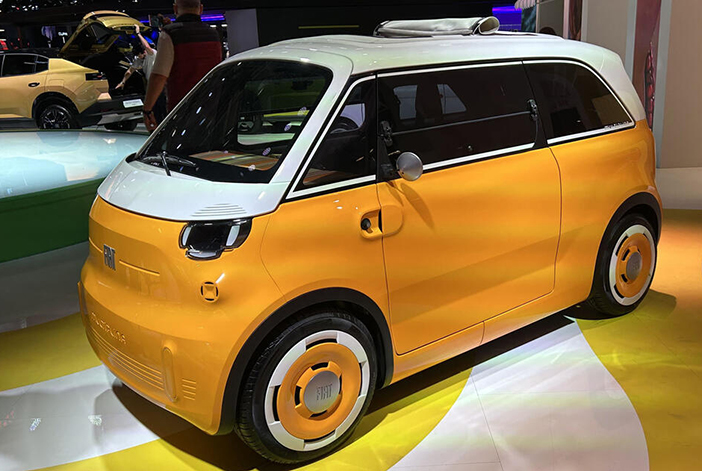
Due on sale in 2028, the Multiplina will sit above the Italian firm’s current 2-seat Topolino but below the current Fiat 500 and an affordable electric city car due to be shown later this year. Former Fiat boss Olivier François said recently that the Multiplina would “be super-important for us, because it’s really the missing link between Topolino and the traditional city car”. The new Multiplina concept takes its name from the 600 Multipla of 1956, which Fiat called the “original people mover”, but the firm also noted that it has a similar footprint to the 500 of 1957. That would make it just under three metres in length, compared with 2.53 meter for the Topolino. While the Citroën Ami-based Topolino sits in the L6 quadricycle category, the Multiplina will be built to the L7 regulations, allowing it to be more powerful and faster. The Topolino is limited to 45 kph and gets a range of around 75 km from a 5.4 kWh battery, but Fiat claims the Multiplina will be able to reach a top speed of 90 kph (the maximum allowed under the L7 regulations) and offer an “extended range”, which should make it a far more versatile offering, able to operate outside of city centres. The Multiplina will use the same basic platform as the Topolino, but this will be extensively reworked to offer more space, range and a larger battery. The styling of the new concept makes clear callbacks to the original 600 Multipla, including the overall silhouette, vertical nose and round headlights. François said it would “play a lot on our DNA and be rooted in our style”, adding that it shows that “Fiat will be the brand within Stellantis that will really go all in on micromobility”. The expansion into ‘urban mobility vehicles’ (the category below full-sized cars) is part of Fiat’s continued focus on small and affordable vehicles, centred around the existing 500 and Panda, the latter of which continues to be sold in Italy. The forthcoming Grizzly is a Dacia Duster-rivalling C-segment SUV and will be the largest vehicle the firm will produce. The Topolino was launched 3 years ago. +++
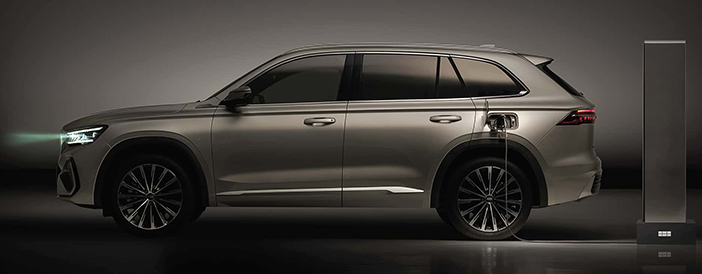
+++ GEELY is rolling out the Monjaro EM-i, its first global hybrid SUV in the midsize segment. The vehicle will debut in Europe on the Paris Motor Show. The Chinese automaker describes the Monjaro EM-i as a global flagship for the brand, using the group’s latest technologies and focusing on upscale ride comfort and material quality. Technically, the 15.7-foot-long SUV from Volvo’s parent company is based on the GEA-Evo architecture. The platform was developed specifically for vehicles with electrified powertrains and is intended to support flexible cabin packaging, multi-energy compatibility, and safety. It also incorporates the GEEA 3.0 electronic and electrical architecture. This technical foundation supports the EM-i Super Hybrid system, which appears to be a plug-in hybrid based on the images, as well as the vehicle’s interior packaging and digital equipment. The cockpit uses systems such as Xingrui and Flyme Auto. For the first time in a global overseas model, the company is also fitting an intelligent e-AWD all-wheel-drive system. The model’s name is a play on Mount Kilimanjaro. Geely has not yet released exact output or efficiency figures. At the Paris Motor Show, the Chinese automaker is presenting the Monjaro EM-i alongside the E2, E5, and Starray EM-i. According to Aiden He, CEO of Geely Auto Europe, the company’s presence at the show underscores how quickly new electrified powertrains and intelligent technologies are entering the European market. The product lineup is intended to give European customers a wider range of vehicle concepts.
The Geely Auto Group is a global automaker headquartered in Hangzhou, China. The company is part of Zhejiang Geely Holding Group, founded in 1986 and entering automobile production in 1997. Its strategy focuses on electrification, vehicle connectivity and developing modular vehicle architectures. Beyond the core Geely brand, Geely Auto Group’s brand portfolio includes Lynk & Co and Zeekr. Through its parent company, Geely Holding Group, the automaker has ties to several other international car brands. Volvo Cars, Polestar, Farizon, Lotus and LEVC are all part of the holding company’s ecosystem. Geely also operates a joint venture with Mercedes-Benz Group for the Smart brand. The group’s founder, Li Shufu, additionally holds stakes of around 10 percent in Mercedes-Benz Group and about 14 percent in Aston Martin. +++
+++ No one could accuse HYUNDAI of dragging its heels on electric vehicles. While some of its legacy rivals have been a little slow to embrace EVs, the South Korean brand continues to grow its fleet of battery-powered cars at an impressive rate, and it’s already working on at least 2 more. One of these all-new EVs will be the Hyundai Ioniq 7. For quite some time, the brand’s flagship electric SUV and compatriot to the Kia EV9 was referred to as the Ioniq 7, but it ended up launching as the Ioniq 9. Wearing the Ioniq 7 name will be a new SUV positioned between the Ioniq 5 and the Ioniq 9. Like most other EVs from Hyundai, the Ioniq 7 should launch with an 800 volt electrical architecture and be sold in both single- and dual-motor configurations. Although prototypes have yet to be seen testing out in the wild, Autointernationaal.nl understands this model will be closer in size to the Ioniq 5 than the Ioniq 9. If so, then it may end up being similar in size to the Chinese-built Elexio. If that’s the case, the Ioniq 7 may inevitably snatch some sales from the Elexio in markets where both are sold. Crucially, Hyundai’s ‘Ioniq’ branded models are positioned as slightly more premium offerings, helping to differentiate the two. In addition, the Elexio uses a 400 volt system and front-wheel drive, so the Ioniq 7 will have it beat on the powertrain front, too. Hyundai isn’t just working on the long-awaited Ioniq 7. The company is also developing a smaller EV that may be badged the Ioniq 4. It’s expected to be similar in size to the new Ioniq 3, but unlike that model, it will be a slightly more conventional SUV and similar to the Kia EV3. In morphing the Ioniq 3 into an SUV, Hyundai’s designers are believed to have given it a boxier, more upright design, so it may hold slightly broader appeal than the somewhat odd Ioniq 3. In addition, it’ll offer more interior space than the Ioniq 3, so it should be better for young families. Hyundai will probably use the same battery packs and electric motors as the Ioniq 3 in the new Ioniq 4, meaning 42 kWh and 61 kWh batteries will be available. +++
+++ The new RENAULT E-SPACE CONCEPT previews a future electric MPV designed to disrupt the dominance of family SUVs. The original Espace, launched in 1984, was a key player in popularising the people carrier. It stuck with that format until 2023, when it became a stretched version of the Austral. But amid a wave of retro revivals spearheaded by the 5 E-Tech, Renault is considering a return to tradition, as shown by its Paris motor show reveal.
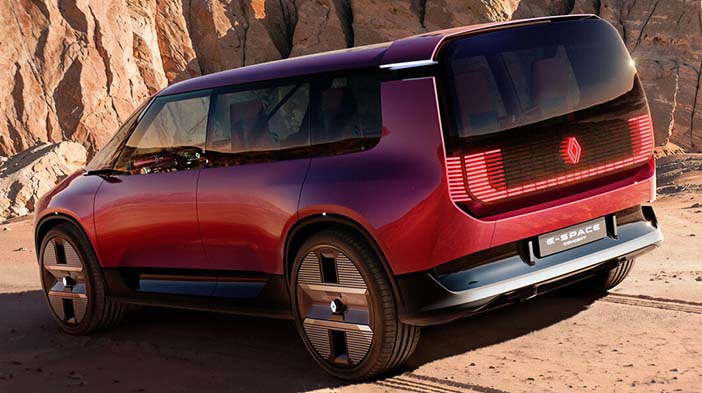
“We have captured the iconic character of Espace”, said Alexandre Malval, Renault’s vice-president for design. “At the same time, we have taken it into the future with cutting-edge technology and style”. Chief among the throwback design cues is the heavily raked windscreen reminiscent of France’s TGV trains. Meanwhile, the rear spoiler recalls the roof bars that were prominent on the Mk3 and Mk4 Espace. Renault said the E-Space was designed from the inside out and the size of its glasshouse has been maximised to ensure the cabin feels light and airy. It took inspiration from Bauhaus designer Ludwig Mies van der Rohe’s Farnsworth House, a monolithic building clad almost entirely in windows. To that end, Renault said it attempted to obscure the meeting points between the large-windowed box section and conventional bodywork. The effect is particularly pronounced at the D-pillar, where the spoiler ‘floats’ above the glass, with back-lighting for emphasis. The E-Space can house 6 people across 3 rows of seats. Passengers in the second row have access to folding tables mounted on the backs of the first-row chairs, or they can spin around to face the third row, giving an arrangement similar to a train’s. The second-row seats can also be folded flat to form a table for those in the third row.
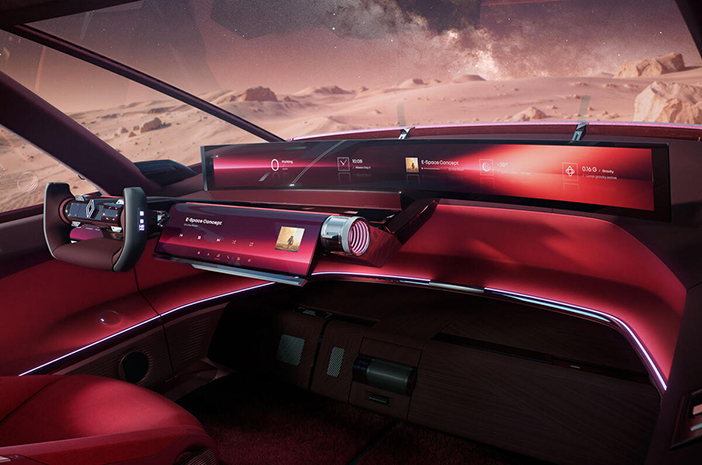
Up front is the new ‘OpenR Panorama’ screen, which spans the entire width of the dashboard. Renault said this feature will enter production on the next-generation Scenic and Rafale, due around 2030. The move reflects a wider industry trend towards placing instrumentation in the driver’s eyeline. A smaller infotainment touchscreen (suspended from the dashboard to place it closer to the driver) provides control over functions such as music and sat-nav. Notably, the E-Space has a yoke in place of a traditional steering wheel. It uses a steer-by-wire system, meaning it has no mechanical link with the front wheels, and the lack of a traditional steering column frees up extra space in the footwell. Placed on the yoke are touch-sensitive controls used to interact with the OpenR screen.
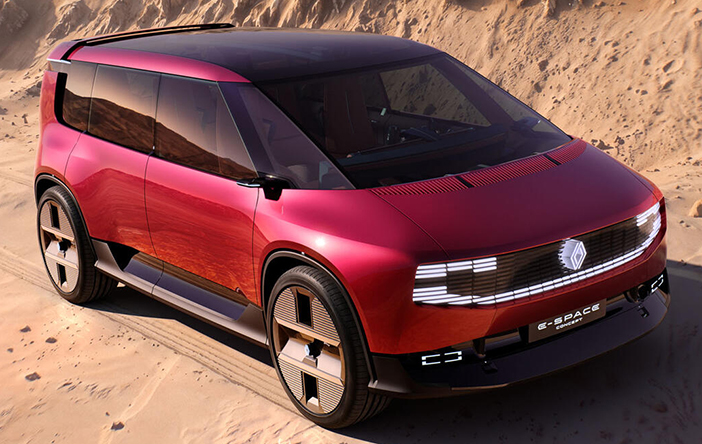
Renault has said it will “explore possible futures” for the E-Space but has yet to comment on whether it is intended for production. The firm is currently developing a new RGEV Medium 2.0 architecture for future vehicles, which any production Espace would likely be based on. The flexibile skateboard chassis can accommodate both electric and range extender powertrains, with an 800V system allowing for fast-charging. Renault claims that EVs on the platform could offer up to 750 km of range, with range extenders reaching 1.400 km. +++