
+++ Ultrafast charging of electric vehicles from CHINA is only getting faster. Geely Auto has unveiled technology that can charge an electric vehicle battery from 10% to 70% in just 4.5 minutes, a leap analysts called a significant development for the Chinese auto group. Geely is joining the ranks of BYD, which last year overtook Tesla as the world’s biggest EV maker, as well as CATL, the world’s largest EV battery maker, both of which this year rolled out around 5-minute EV ultrafast charging. By comparison, some of the fastest-charging EVs available in the U.S. currently can take roughly 20 minutes, analysts said. “China is way, way, way ahead in terms of multiple players engaged in the charging competition”, says Lei Xing, an independent analyst of China’s auto industry based in Easthampton, Massachusetts. Chinese automakers are seeking to eliminate the “ultimate barrier” to EV adoption (range anxiety) by narrowing the gap between EV charging and the roughly 5-minute refuelling experience of gasoline vehicles, explained Stephen Chan, an analyst at S&P Global Ratings. At a launch event Wednesday, Geely Auto announced its new system that can charge an EV from 10% to 70% in 4.5 minutes and from 10% to 97% in just 8 minutes and 40 seconds.
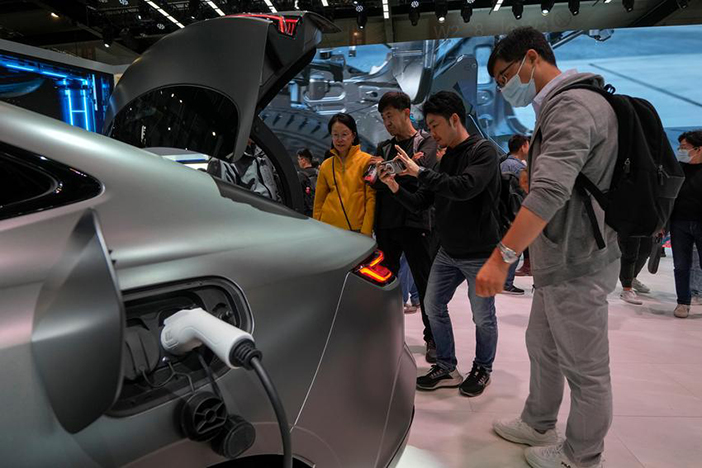
BYD in March launched a new generation of its “blade” EV battery that it said can charge an EV from 10% to 70% in 5 minutes and from 10% to 97% in 9 minutes. In April, CATL rolled out technology that can charge an EV from 10% to 80% in 3 minutes and 44 seconds and from 10% to 98% in 6 minutes and 27 seconds. Despite the breakthroughs, experts cautioned there are other obstacles. “The real challenge is whether the battery can accept that level of current quickly and repeatedly without overheating, excessive degradation or internal bottlenecks”, said Chris Liu, a Shanghai-based senior analyst at Omdia, a technology research and advisory group. With more than 100 domestic passenger car brands, Chinese auto makers face intense competition. Domestic car sales have fallen for months in China as automakers are exporting more cars overseas. A focus on technological advancements like ultrafast charging is a way to set themselves apart and try to improve sales. But success will depend on factors including the scale of companies’ charging network. For one, the majority of China’s public charging stations still operate below 1 megawatt, while Geely, BYD and CATL’s ultrafast charging technologies rely on higher charging power to reach their full potential, said Chan at S&P. That means network expansions or grid updates will remain as hurdles for large-scale adoption. Some in the industry are already taking ambitious steps. China’s BYD, for instance, is targeting 20.000 superfast charging stations by the end of this year, followed by 30.000 more in 2027 and 40.000 in 2028, bringing the total to 90.000 stations by that time, according to a Deutsche Bank analysis. Other countries including the U.S. is still behind China when it comes to ultrafast EV charging. In the U.S., EV fast-charging sessions typically take roughly 20 to 40 minutes to charge from 10% to 80%, according to S&P, although newer models from brands like Hyundai, Kia and Porsche can reduce charging times to approximately 18 to 20 minutes under optimal conditions. “Overall, while the battery charging network in the U.S. is growing at a rapid pace, it is still well behind China’s ultrafast charging speeds by orders of magnitude”, said Neal Ganguli, a partner and managing director in the automotive and industrial practice at consultancy AlixPartners. But Ganguli also believes the U.S. may not be attempting to match China’s “megawatt race” in EV charging at least in the near future, but to pursue a “more moderate” path to upgrades. +++
+++ GENERAL MOTORS ‘ Five-Year Rare Earth Gamble Is Finally Paying Off. Most of the world’s rare earth materials come from China, but GM is betting on the U.S. as another major source. Modern cars use multiple raw materials that aren’t abundant everywhere; as we all know, certain regions and countries have specific raw material endowments. Most rare earth materials essential to car production are found in China, which supplies most of the world. With supply not necessarily stable and with the rest of the world, it makes sense for some automakers to invest in new sources, and it would be more beneficial to have them closer to home. General Motors (GM) made a long-term investment in a local supplier of rare earth materials. Most rare earth materials are used to produce electric vehicles (EVs), and as demand for more efficient vehicles rises, GM’s gamble is starting to pay off. GM’s U.S. supplier is MP Materials, and the partnership began during the turbulent supply chain issues brought about by the Covid-19 pandemic. At the time, the world was running out of semi-conductor supply, which led to shortages of technological products as well as cars. GM then decided to re-evaluate its own supply chain and took a risk with MP Materials. Shifting from a global supply chain, GM went for a more regional approach that follows the mindset of “buy where you build”. As a result, GM’s 5-year-old gamble is starting to bear fruit, with the automaker now set to begin receiving its first supplies of rare earth materials from MP Materials. Rare earth materials are a group of 17 metallic elements found mostly in the Earth’s crust. Despite their relative abundance, the problem is the cost of mining these vital materials. The list of products and technologies that use these elements is extensive, with notable examples including hybrid car batteries, fiber optic cables, audio technology, and data storage. +++
+++ The HYUNDAI MOTOR GROUP is poised to overtake Ford in quarterly vehicle sales in the United States for the first time, underscoring the growing presence of the Korean automaker in the world’s largest car market. Cox Automotive estimates that the group’s 3 brands (Hyundai, Kia and Genesis) will sell 511.421 vehicles in the U.S. between July and September, up 6.5 percent from a year earlier. By contrast, Ford is projected to sell 504.172 vehicles, down 7.1 percent, according to the market researcher’s latest forecast. If the estimates hold, the Hyundai Motor Group would rank third in quarterly U.S. sales behind General Motors, with 671.706 vehicles, and Toyota, with 642.707. The result would mark the first time the Korean group has surpassed Ford on a quarterly basis. The shift comes as U.S. consumers increasingly favour fuel-efficient vehicles amid elevated gasoline prices. Utilizing the market condition, the Hyundai Motor Group has been going all-out to expand hybrid sales in the U.S. However, Ford sells much fewer hybrid or fuel-efficient vehicles there. Cox Automotive Executive Analyst Erin Keating said Asian automakers are gaining ground in the U.S. due to their diverse hybrid offerings. “We see some of these Asian brands coming forward and really taking the industry by storm”, Keating said. “Most importantly, they have the hybrids”. +++
+++ MERCEDES could join Volkswagen as the latest German automotive juggernaut forced to close local production plants that it no longer views as competitive. Such moves would be hugely controversial for the century-old brand and signify the ongoing struggles across Germany’s manufacturing sector. Mercedes production chief Michael Schiebe spoke with workers at the brand’s Sindelfingen plant, stating that the firm’s “clear goal is to maintain all of our German locations”. This statement had a major caveat. “If we are unable to do this, we will have to close one German assembly plant and one German powertrain plant”, he said. It’s believed that Mercedes needs to agree to new cost measures with the IG Metall union, which represents thousands of employees at the company. In addition, “we need framework conditions that boost productivity in Germany”, Mercedes confirmed in a statement. The prospect of 2 possible plant closures has not gone over well with IG Metall representatives. “Threatening plant closures is no way to shape the future”, the union said. “Anyone who resorts to such threats must expect our determined resistance. If the management board believes it can pressure employees with the ultimatum of ‘concessions or plant closures,’ our answer is a clear ‘not on our watch’ ”. Schiebe provided no indication as to which of its German assembly and powertrain facilities are under threat. It currently operates 7 powertrain plants in Germany, in addition to 3 vehicle assembly sites. Mercedes-Benz’s struggles are similar to those being experienced at Volkswagen. A recent report suggests that the VW Group is considering the closure of 4 German plants between 2031 and 2034. Both companies have been hit hard by increased competition from Chinese car manufacturers, including BYD, Geely, GAC, Changan and others, whose vehicles often significantly undercut those from Mercedes and its traditional European rivals. In the second quarter, Mercedes sales in China plummeted 30%, and it booked an $800 million impairment in the market. In addition, high tariff costs have hampered the company. In 2025 alone, the automaker took a $1.1 billion hit from US tariffs. +++
+++ Nissan is expected to maintain its current stake in MITSUBISHI , even after the lockup period ends in October, sources familiar with the matter said. Nissan took a 34 percent stake in Mitsubishi in October 2016 and then reduced it to 26.67 percent as of the end of March. The 10-year lockup deal restricts Nissan from selling its stake. The move comes as Nissan works to turn around its business, amid speculation that it might sell its Mitsubishi shares to Honda or Taiwan’s Hon Hai Precision Industry. A sale was seen as a possible catalyst for realignment in the auto industry. Nissan’s partnership with Mitsubishi remains seen as important to its turnaround. The 2 companies are jointly developing kei-cars and working to share parts and vehicle bodies to improve their competitiveness. Selling the stake now would also mean taking a loss, as Mitsubishi shares are trading below the price Nissan paid when it acquired the stake in 2016. In October 2016, Nissan, then led by chairman Carlos Ghosn, invested 237 billion yen in Mitsubishi after falsification by the smaller automaker of fuel efficiency data came to light. Nissan and other major shareholders agreed to the lockup, which expires October 20, to keep an unwanted outsider from gaining influence over Mitsubishi’s management. Nissan posted a net loss for a second consecutive fiscal year in the year ended March 2026 amid weak global sales. “There hasn’t been much to show for the investment”, an auto analyst said of Nissan’s stake in Mitsubishi. +++
+++ Rumours about a NISSAN GT-R SUPER SUV refuse to die. GT-R fans have dreamed about an SUV for nearly 20 years. A fresh rumour from Japan is giving that idea renewed attention. For almost 2 decades, Nissan fans have joked, hoped and even used Photoshop to imagine a GT-R SUV. A brave soul even went so far as to turn a Nissan Murano into an R35-inspired SUV, showing just how persistent this fantasy has been. Now, a new report from Japan is adding fuel to that fire. This says Nissan is “positively considering” a super-SUV that could use technology from the R35 GT-R, possibly including a twin-turbo V6 hybrid setup similar to what’s rumoured for the next-generation GT-R. The main issue is that nothing new supports the SUV rumor. Most of the talk is just speculation or guesswork, like ramblings about a V6 hybrid powertrain and comparisons to other super SUVs, but nothing official from Nissan. More importantly, previously GT-R-related reports were published that never materialized. One example involved claims of a Final Edition R35 GT-R equipped with a mild-hybrid system, a model that was widely discussed but ultimately never reached production before the R35’s lifecycle came to an end. There’s also the business side. Nissan is currently going through a major overhaul. Launching a new performance SUV to compete with expensive European models would require a lot of money, strong engineering and a clear strategy. If Nissan is cooking up something exciting, all signs point to the next GT-R, not an SUV. CEO Ivan Espinosa has already said the GT-R will be back, though he admits the next-gen R36 is a serious technical headache. Word is, Nissan’s working on a hybrid successor with a brand-new platform, not just a warmed-over R35. Espinosa has also suggested that Nissan might bring back other models for car enthusiasts, like the Silvia. This shows that Nissan still values dedicated sports cars, even as it expands its lineup of electric vehicles. A GT-R-inspired SUV is still possible, since almost every performance brand offers one now and buyers like the combination of speed and practicality. However, for now, this new rumor from Japan seems more like an attention-grabbing headline than real evidence that Nissan is making one. +++
+++ “Genuinely, people have their heads turned more by it than a 12-cylinder Ferrari”. Jack Morgan-Jones, a senior salesperson at Bramley Motor Cars, isn’t talking about one of the exotic cars that fill this Surrey showroom. Instead he’s referring to a small, boxy 4×4, priced at around £20,000, that looks as though it belongs to another age, namely a Lada Niva, one of only a few dozen still on British roads. “It is staggering”, continues Morgan-Jones. “People smile when they see it on the road”. A major part of the Niva’s appeal is that it’s a throwback to an earlier era of motoring. “They are utterly dependable”, says Morgan-Jones. “It’s all route-one mechanical engineering. There’s very little that can go wrong. If there’s ever going to be a turn-key car out there that we could always rely on, it’s probably that one”. However, this isn’t the story that Lada expected to be telling in 2026. In 2021, its manufacturer Avtovaz and its then parent, the Renault Group, announced plans for a new generation of the Niva. Two models were planned. The first was a short-wheelbase Niva, due to be launched in Russia in 2025; the second, a larger Grand Niva, was expected in 2026. Both were going to use Renault’s CMF-B platform, and sales in Western Europe were also planned. Then, in February 2022, Russia unexpectedly invaded Ukraine. Three months later, Renault pulled out of the country and the new Niva plans were aborted. Avtovaz unveiled an updated 1.8-litre version of the half-century-old Niva this year. Svyatoslav Kuchko, an analyst at Mobility Global, says sales are expected to begin in September. With RUSSIA heavily sanctioned by Western countries, how did it continue to develop the Niva, and what does this development say about the Russian automotive sector? According to figures from GlobalData, 1.53 million new cars were sold in Russia in 2021, the year before the war started. Lada’s market share was around 22%, while European, American, Japanese and Korean brands collectively took 69.6%. In contrast, the market share of Chinese brands was only 7.5%. The invasion changed that dramatically. Vivek Kumar, an automotive project manager at GlobalData, notes that Western manufacturers left the market and supply chains were severely disrupted, hampering production. In 2022, car sales plummeted to just 629.922. Charles Hecker, an associate fellow at the Royal United Services Institute and an expert on Russia, says the departure of foreign manufacturers left the country’s automotive industry in an “extremely fragile state”. “Supply chains did collapse, so there was a significant decrease in output”, he says. “Every foreign auto maker that had investments on the ground in Russia left”. Since then, China’s share of the Russian car market has soared. In 2019 it accounted for just 2.5% of car sales; by 2025, its share had risen to 54.3%. The main beneficiaries have been Chery, Great Wall Motor, Geely and some local joint ventures, such as Belgee (Geely), Tenet (Chery), Evolute (Dongfeng) and Moskvitch (JAC). According to Felipe Munoz, founder of Car Industry Analysis, China’s involvement goes far beyond selling cars in Russia: through partnerships between Russian capital and Chinese car makers, it supplies technology, spare parts and cars in kit form for local assembly. “It’s a market that is now totally dependent on China and in the future that is only going to become more evident”, says Munoz. “Whether through joint ventures, imports or local production, the Russian car industry is slowly becoming a satellite of China”. Kumar says that “while striving to localise its manufacturing base”, Russia “has moved from one dependency to another. It has moved from Nissan, Renault and Volkswagen to Chery and GWM”, he says. “But it has also lost some of the R&D quality that came from working with Western partnerships. If Chinese auto makers left tomorrow, the Russian automotive sector would survive, but it would be much smaller than it is now”. However, Hecker adds: “Russia realised that it had a certain technical dependency on China and has been trying to reduce that dependency”. In 2021, before the war, Lada’s market share was around 22%. Despite its Western parent company leaving Russia, that share has grown to 25.6% and its Granta (a cheap little saloon, hatchback or estate) has been the best-selling model for 6 of the past 7 years. Munoz isn’t at all surprised: “Lada is still alive because of government support, because basically it’s alone in those segments”. That Lada occupies the least expensive part of the market also helps explain why its market share hasn’t risen further, he says. “A Lada is more Russian than before, but that doesn’t mean that it’s better. They are popular because they are the only choice and they are the cheapest. But whenever you have more income, you just buy something else”. Avtovaz claims 99.8% of its components are locally sourced. That figure has been questioned, but Kuchko says the engine and transmission “remain genuinely Russian”. Any Autointernationaal.nl reader wishing to see a new Niva on Dutch roads will be disappointed. Regardless of international sanctions, Ladas haven’t been officially sold here for many years, because of the manufacturer’s failure to keep pace with advancing safety and emission regulations. Plus, as Hecker says: “I just can’t see a Russian car brand being popular in Western Europe or the United States right now. Western Europe is firmly in punishment mode on Russia right now”. Back at Bramley Motor Cars, the black Niva Luxe sitting next to Ferraris and Rolls-Royces is still waiting for a buyer-but Morgan-Jones says he has had enquiries from people who owned Ladas back in the 1980s and 1990s: “I must say, when it does go, we’ll miss it”. +++
+++ SUBARU is Holding its first Japan Fan Event in 10 Years. Finally, Subaru’s home country is getting its own Subie fan event after a decade. The last Japanese Subaru fan event was held in 2016, and it’s been more than a decade since the brand held an event like that. Dubbed the Subaru Fan Meeting 2026, the event will be held at the brand’s main factory in Ota City, Gunma Prefecture, on December 6th, 2026. It’s been over 10 years since Subaru celebrated with its fans.

Subie Fest springs to mind, and the events hosted by Subaru Motorsports USA grew so large that one date and venue couldn’t handle the number of fans from the United States and beyond. To put it in perspective, Subie Fest has 6 dates and events in 2026: 2 are done, 1 is happening and 3 fans have yet to see. The Fan Meeting in 2016 was the brand’s inaugural event and unfortunately the last for a while. Hopefully, the next fan meeting after this 2026 edition doesn’t wait until 2036, but I digress. Fans in 2016 were invited to the Subaru Kenkyu Center in Tochigi. The area serves as Subaru’s Research and Testing Center; it’s normally closed off to the public. During the event, Subaru opened this center’s doors to welcome as many fans as it could on March 27, 2016. About 1.000 cars were selected to participate and about 3.000 spectators traveled from across Japan to experience the event. The brand even opened its testing facility track so fans could experience the high-speed ring and other features of the facility. That said, the question is: how will 2026 compare? To reiterate: the second Subaru Fan Meeting will be held at the company’s main factory in Ota City, Gunma Prefecture, on December 6, 2026. As for the location’s significance, the Gunma plant was the first plant to manufacture Subaru vehicles. It was ground zero and the birthplace of the automaker’s cars and technologies. Like before, but not really, Subaru has promised to open its latest research and development facility, called the “Innovation Hub” to the public. Exhibits will be scattered throughout the event grounds so fans can experience Subaru and interact with several of the people who define what a Subaru is. If that’s not enough, Subaru is also holding passenger test drives on its test course, factory tours, historic vehicle displays, official merchandise sales, and perhaps even seminars and speeches that shed more light on what makes a Subaru, a Subaru. With this event, Subaru wants to get closer to its fans in Japan, and the venue can accommodate up to 4.000 visitors. +++
+++ The all-electric future once seemed inevitable, but the picture changed after U.S. president Donald TRUMP took office in January 2025. His administration reversed several EV-friendly policies, most notably by ending the federal $7,500 EV tax credit after September 30, 2025, which contributed to a sharp slowdown in the U.S. EV market. Now, Trump is doubling down after saying on Saturday that he approved new fuel economy standards that would replace Biden-era standards. The full details have yet to be disclosed, but for reference, the Biden-era Corporate Average Fuel Economy, or CAFE, standards were projected to require an industry fleetwide average of roughly 50.4 mpg for cars and light trucks by model year 2031, a ruling that pushed automakers toward more fuel-efficient vehicles, including hybrids and EVs. Trump called the previous policy a “ridiculous EV Mandate” in a Truth Social post and claimed that the new standards would lead to lower-priced cars while helping plants return to operation and bringing back jobs. Rolling back the previous standards would give automakers more room to continue offering combustion cars without relying as heavily on hybrids and EVs. Combustion models may also be more affordable than comparable hybrid alternatives because the latter add more hardware, such as an electric motor and high-voltage battery. It is a timely development, given that the average new-car transaction price in the U.S. surpassed $50,000 in December last year. On the other hand, high fuel prices could make electrified cars more appealing. Trump also slammed EV adoption for, according to his post, having “forced Americans into cars they never wanted” while wasting “billions on chargers that were never built”. With the EV market in the U.S. already under pressure, EV-only brands such as Tesla, Rivian, and Lucid could experience further headwinds. It will also be interesting to see how other automakers respond, though some may have already been ahead of the shift, including Volkswagen, which ended production of the ID.4 at its plant in Chattanooga, Tennessee. Ram has already canceled the all-electric 1500 REV and introduced performance-focused alternatives, including the 1500 TRX SRT and the 1500 Rumble Bee lineup. Trump also claimed that more than $100 billion is being invested in the American auto industry under his administration, adding that “that’s just the beginning”. The new fuel economy standards are expected to be finalized on Monday. Despite the broader shift back toward combustion vehicles, some states still continue to provide incentives to encourage EV adoption. One of them is California, which offers an instant rebate of up to $3,500 on qualifying new zero-emission vehicles for first-time EV buyers, with up to $1,750 available for qualifying used models. +++