
+++ HYUNDAI has turned the Bayon into a bona fide mini-SUV for its next generation, in a bid to better differentiate it from the related i20 hatchback. Now slightly longer, taller and wider than before, the Bayon employs Hyundai’s ‘Art of Steel’ design language, manifesting in a boxier look that emphasises hard edges.
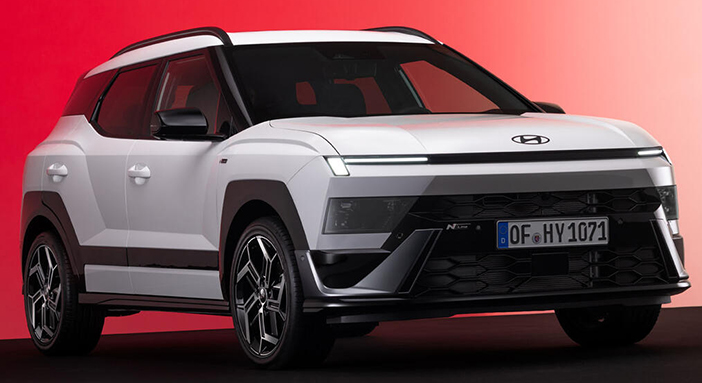
This was key to making it more obviously SUV-like, despite still being a small crossover. “Today’s Bayon is too similar to the i20”, Eduardo Ramírez, Hyundai’s European design chief, told. “That is something we understood: we recognise that we need to really separate these 2 products and it started by defining the Bayon more clearly as a compact SUV with its very distinctive, more robust character, while the i20 remains an i20”, he said. He also said that making the Bayon “more SUV” was key to fielding a stronger competitor in one of the most hotly contested classes. Among Hyundai’s other priorities in making the Bayon more SUV-like was to improve interior space, particularly for passengers sitting in the back. To that end, its wheelbase is now 20 mm longer than before, at 2.6 meter. The rear seats have 2 positions (one upright and another with a slight recline) and the middle seat can be folded out to give the other passengers in the back an armrest and cupholders. Boot space measures 440 litres.
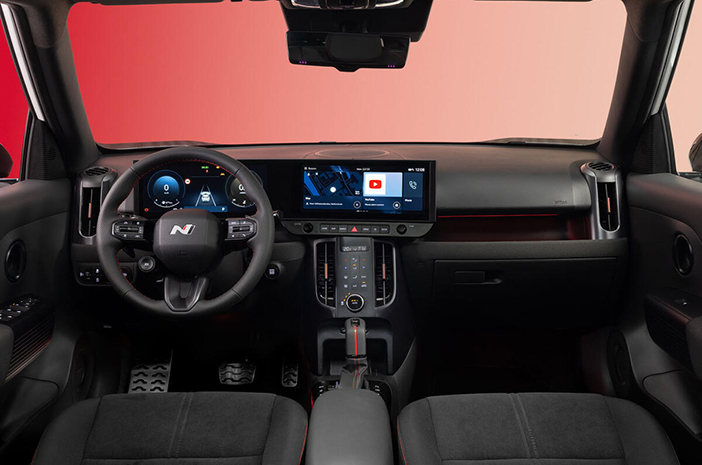
Up front, the Bayon borrows its screens from the larger Ioniq 5, but it does not follow its newer Ioniq 3 and Tucson stablemates in adopting the Pleos operating system. That means over-the-air updates and the ability to install additional apps aren’t possible, although wireless Apple CarPlay and Android Auto smartphone mirroring are standard. Initially, the Bayon will be offered only with a turbocharged 1.0-litre 3-cylinder petrol engine, putting out either 90 hp or 115 hp. Both versions can be had with a 6-speed manual or a 7-speed dual-clutch automatic gearbox. The Bayon will shortly after that get its first hybrid powertrain, packing 136 hp. This, said McKinnon, was a key consideration in the design of the car. “The only reason it grew in size overall was because we wanted to get the hybrid in there, so we had to add to the front overhang in order to fit the powertrain”, he said.
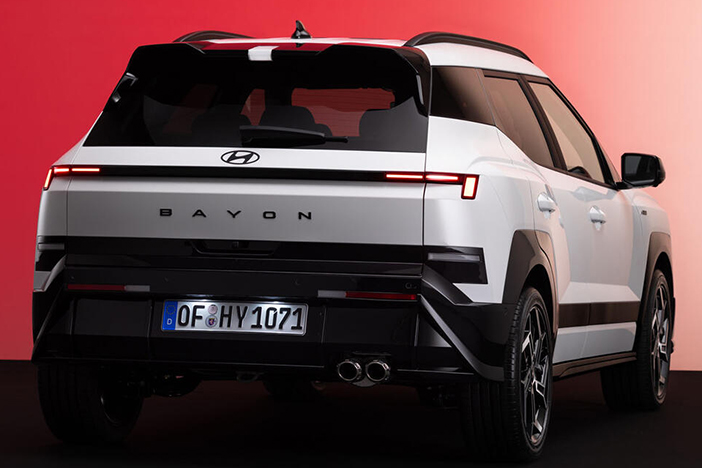
The first examples of the new Bayon are due op the Dutch market next spring. Pricing is unknown but it is likely to remain around €30.000, while the range-topping N Line car could nudge €36.000. That trim now accounts for 1 in 3 Hyundai sales in Europe, said McKinnon, reflecting the increasing importance of the N performance brand. +++
+++ JEEP is mulling a revival of its original model, the legendary, military-honed Willys off-roader, in a bid to fight off Chinese competition in Europe. Speaking at the Paris motor show, the brand’s chief Xavier Peugeot described the Willys as its “key attention” for the future, as one of several “new ideas” it could launch in the years to come. Plans remain at an early stage, though; Peugeot said “we are not confirming any concrete launch”, and implied it was a project for after the brand’s current ‘Road to 2030’ strategy was complete. He said that by 2030 a new generation of the Jeep Renegade crossover would be “on the road” and “ideas around Willys confirmed”. Peugeot did not confirm what segment the new Willys might compete in but, when asked about B-segment models such as the Avenger, he pointed to the historic model. He added that “original values” would be key in the brand’s fightback against Chinese entrants to the European market and that Willys is “a key card to play”.
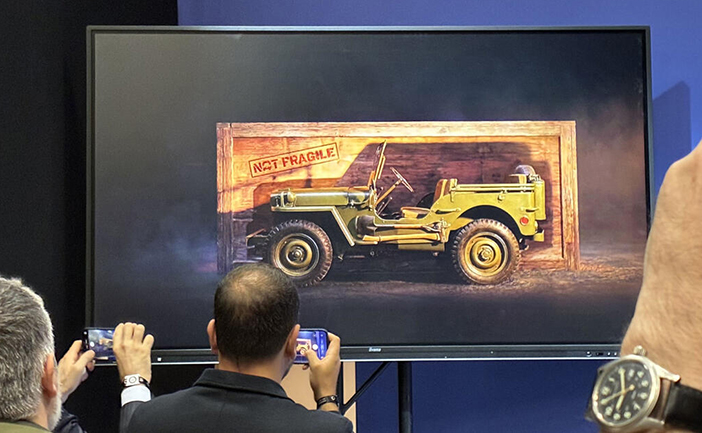
Before the Willys arrives, Jeep will launch 6 new models in Europe, led by a new Renegade. The latest iteration of the small crossover will be based on the forthcoming STLA One architecture and has big sales ambitions. Peugeot pointed to the original Renegade having achieved 610.000 sales since 2014 and said the brand “would be mad not to consider it”. Jeep aims for the 6 new models to give it coverage of 90% of the SUV class by 2030. Peugeot also confirmed that the Recon (effectively an electric Wrangler) will be launched in Europe next year. +++
+++ LEAPMOTOR has confirmed that its new electric supermini, the B03, will touch down in The Netherlands next year with a range of up to 385 km. The Chinese firm’s Renault 5 E-Tech and Volkswagen ID.Polo rival, already on sale in China as the Leapmotor A05, is a smaller and lower-slung sibling to the recently launched B03X, and will sit between that car and the tiny T03, with an expected starting price around €23.000.
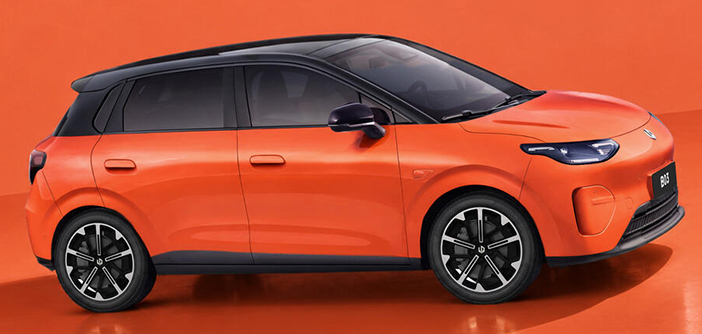
It measures 4.175 mm long and 1.790 mm wide, and when it lands at Dutch dealers early next year it will be offered with a 53 kWh battery said to be good for a range of 385 km; competitive against its French and German rivals. Bolstering its urban credentials, the B03 has a turning circle of just 9.8 metres; almost as small as a Dacia Spring’s. That battery sends its reserves to a 197 hp motor on the front axle that produces 200 Nm of torque, and gets the B03 from 0-100 kph in 7.6 seconds. Leapmotor says that with a maximum charging speed of 133 kW, the B03 can go from 10-80% capacity in just 21 minutes.
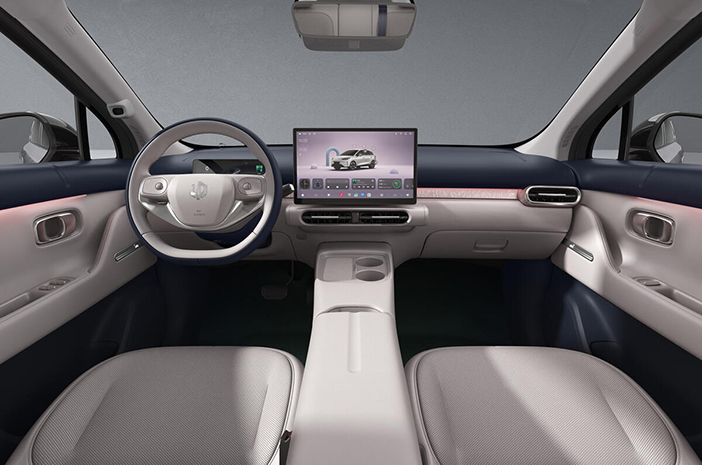
Leapmotor’s new model takes a similar approach inside to its range-mates, with a minimalist cabin centred on a 14.6 inch central touchscreen that serves as the primary control interface, with physical buttons and switches largely absent. Unusually for a small car, the B03 has a front passenger seat that folds completely flat to make space for long loads, while the driver’s seat reclines almost horizontally in the other direction so the driver can lay down during charge stops. The rear seat base flips up, too, to make space for bulkier items like bikes to be stored upright across the car. That’s in addition to the 30 storage spaces that are dotted throughout the interior and a 405-litre boot with an extra 90 litres of hidden storage beneath the carpet.
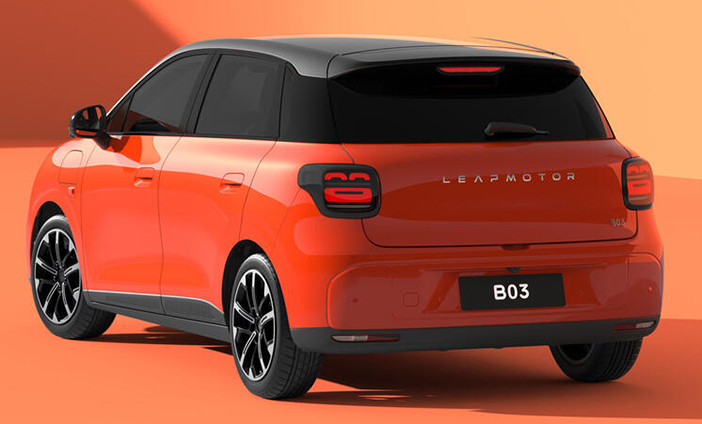
The B03 will be offered in just one trim, with 17 inch alloys, a 360 degree camera, automatic airconditioning, led lights, heated seats plus steering wheel and synthetic leather trim equipped as standard. Official pricing will be confirmed nearer to the B03’s launch early next year. +++
+++ Fast-growing Chinese brand OMODA will add a third model to its Dutch line-up next year: the striking new 4 crossover. As the name suggests, it will be positioned below the 5 and 9, nd it will serve as the entry point into the range, with a starting price of less than €28.000. Making its debut at the Paris motor show, it’s a close relation to fellow Chery brand Jaecoo’s similarly sized 5 crossover, and will offer the choice of full-hybrid or pure-electric power. The hybrid 4 will be first, pairing a 1.5-litre petrol engine with an electric motor for 225 hp. This will be a close rival for the Kia Sentos, Nissan Juke and Renault Captur hybrids. The electric version is expected to use a 61 kWh battery for a range of 400 km and will be priced at nearer €30.000, making it a natural rival to the Skoda Epiq and Volkswagen ID.Cross.
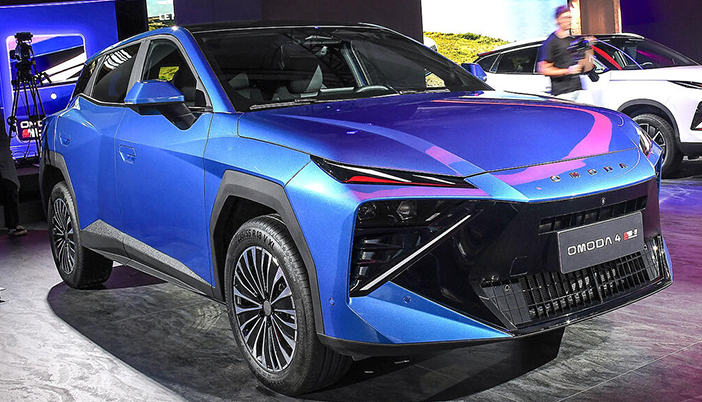
The Omoda 4 takes a dramatically different design approach to its range mates, eschewing their curvy silhouettes and minimalist cabins for a sharper and more sporting-influenced treatment. The pointy angular exterior cues are echoed in the cockpit, which features a dramatic sports car-style control panel in the centre console (complete with Lamborghini-esque ignition button) and is decorated with carbonfibre effect trim. Otherwise, though, the 4 sticks with Chinese car tradition inside, featuring minimal physical controls and a digital cockpit that majors on AI functionality. +++
+++ The United Kingdom should be part of any EU ecosystem for automotive manufacturing, according to RENAULT GROUP boss François Provost, even if that means introducing import tariffs on Chinese cars. The EU is currently developing the Industrial Acceleration Act (IAA), which is designed to boost production in the region and has a large focus on automotive manufacturing. At present vehicles and components built in the UK could be excluded from the potential benefits on offer in that bill. Asked at the Paris motor show about growing Chinese competition in Europe and what help European car firms such as Renault need to combat them, Provost cited 3 key factors: being “reasonable” on the electrification path, stopping the “tsunami” of regulations and a deal between the EU and China. “Being reasonable in the electrification path does not mean we should withdraw from the ambition to be fully electric”, said Provost. “On the contrary, we have to give even more confidence to the customers. But 100% electric is unrealistic and is not good for Europe. We say this should be 10% non-BEV plus 10% with compensation. For regulation, we need to stop the tsunami of regulation, which has zero interest for customers. This is a European playbook: the happiness of people in Europe is supposed to be linked to regulation and free trade. It does not work like this. Finally, the IAA alone will not work if there is no deal between China and EU to limit the flow of imports into Europe”.

Provost highlighted that the UK is currently one of the few markets that levies no additional tariffs on Chinese cars and noted that their market share exceeded 20% last month. He said: “The UK has been part of the EU ecosystem for automotive for decades. So for me there is no other choice than to have a deal between UK and EU in order to have UK embedded in the IAA and European ecosystem. But on your side you have also to take decisions. You have to make choices. If the UK is willing to join the European ecosystem, this is to have an industrial ambition, and this industrial ambition is to keep a strong automotive industry. One which is not closed to Chinese competitors but says ‘if you want to operate in Europe, you have to deeply invest in the whole value chain, not only final manufacturing, but suppliers, R&D technologies’. Again, I’m not here to demand anything, but if the UK is willing to join this ecosystem of IAA, there is an open question about the level of imports of Chinese cars in the UK. I’m not the UK government; I just hope there could be a deal between the UK and EU. And if so, clearly you cannot have huge level of imports in the UK if there is limited imports in EU. It’s just common sense”. +++
++ SMART will return to its roots with the arrival of the new #2 city car, which channels the spirit of the original 2-seater and will hit the Dutch next year priced from less than €23.000. Unveiled in production form at the Paris motor show, 28 years after the first-generation Fortwo was launched at the same event, the new city run-around sits on a bespoke new platform and returns the reinvented Smart brand to its urban origins.
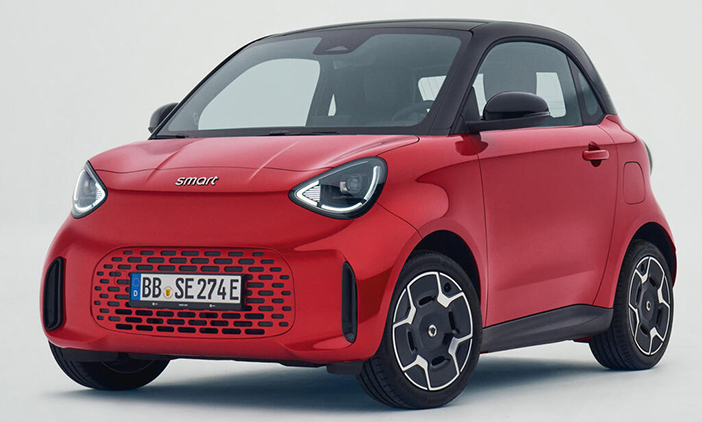
Smart is a joint venture between Mercedes-Benz and Geely, with the cars styled in Germany but built in China on Geely platforms. It has expanded into offering a wider range of models, including a large SUV, the #5. But the firm has long vowed it wouldn’t abandon its city car roots. The #2 is just 2.746 mm long, actually making it slightly shorter than the third-generation Fortwo that went out of production in 2024. The styling clearly draws inspiration from the original, and it has a turning circle of just 6.95 metres, matching that of its predecessor. The #2 is powered by a rear-mounted 82 hp electric motor, which drives the rear wheels. Thanks to a 35.8 kWh lithium-iron-phosphate battery, it has an official WLTP range of 285 km, and can be charged at speeds of up to 65 kW. It also offers a vehicle-to-load outlet. For comparison, the previous electric Smart EQ Fortwo offers the same power, but had a 17.6 kWh battery for a range of just 145 km. Smart says it has developed a bespoke platform, called the Electric Compact Architecture, for the #2. This involves 5-link rear suspension, which the firm claims will both smooth the ride on urban roads and allow for “sportier” handling. The new #2 features a next-generation version of Smart’s Tridion Cell Evo body structure, which is made from 78% high-strength steel. It will also feature adaptive cruise control, highway assist and led headlights as standard.
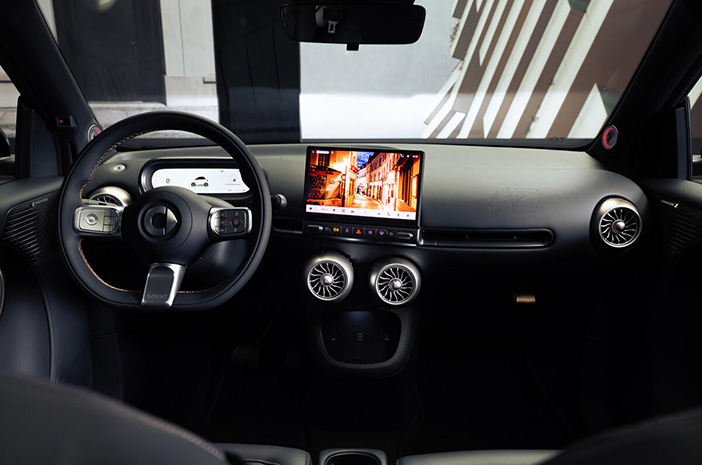
Inside, the 2-seater offers bench-style seating, while the dashboard pairs a 10.1 inch central touchscreen with an 8.8 inch digital driver display. There is also a ‘smart pillar’ in the dashboard that small gadgets can be attached to, and a sizeable 305 litre boot, with an unusual split tailgate for ease of access.
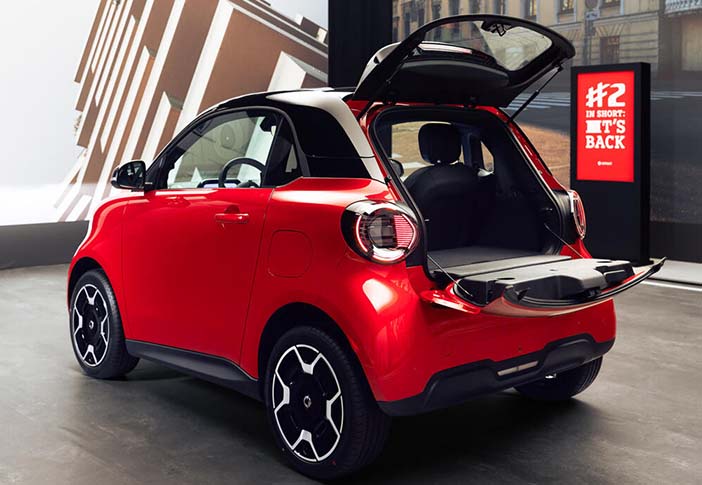
The #2 will initially be offered in 3 trim levels. Base-level Pure models sit on 15 inch wheels and will be priced in line with competitors such as the Renault Twingo and new Citroën 2CV, although those cars are both 4-seaters. Premium models will add 11 kW AC charging, 16 inch wheels, heated seats, a glass roof and a Sennheiser audio system. At launch, 999 Couture Edition models will be offered, which add bespoke white paint, a gold roof and a numbered interior badge. Pre-orders are set to begin in early 2027, with full Dutch pricing set to be confirmed at a later date. +++
+++ A new-generation of the VOLKSWAGEN ID.BUZZ is happening, Chief Executive Officer Thomas Schäfer has revealed. Despite the once eagerly-anticipated, very loveable retro minibus not proving to be the sales success that was hoped so far, plans for a replacement using the latest tech are underway. In an interview at the 2026 Paris Motor Show, when asked about the future of the ID.Buzz, Schäfer said that “they’re working on it”. Updates are on the way for the existing 4-year-old model, then we’ll see an all-new second-generation that the Volkswagen’s boss confirmed will use its cutting-edge Scalable Systems Platform (SSP) architecture. “The car is iconic, absolutely”, he said, and emphasised that Americans do love the ID.Buzz, even if that’s not reflected in the MPV’s sales figures. Part of the reason why it’s struggled to translate retro nostalgia into actual sales is price, with Schäfer admitting the ID.Buzz “is on the wrong cost base. That makes it difficult to really be successful and get into volume in the market, unfortunately. But it shows that if you stay true to the brand, you can have an exciting brand”. It’s not about creating some romantic image of VW reliving some glory days, Schäfer stressed, adding that the famous brand will not reuse every single name or iconic car from its past like certain others seem to be doing. But he did acknowledge “the iconic stuff, you need to use, because the other new brands don’t have that. They have no history”. The timeless style of the ID.Buzz is probably the reason most people buy it and that’s almost certainly going to remain a core part of the next model. Interestingly, however, Volkswagen’s head of design Andreas Mindt recently reminded us how people can get tired of retro-inspired cars, as VW saw with its own new Beetle not that long ago. “I don’t want to repeat a design over and over again, I think there’s a dead end to it”, VW’s design boss told. “We had that with the new Beetle. You do one Beetle, then another and then people get tired. How can you succeed from there? There’s a stop somewhere when you go down this path. We did it already and we found it’s no good”. But, Mindt also tells us he and VW’s design team have some clear ideas about where to take the ID.Buzz and seemed excited about the challenge: “When you have a van, it doesn’t have too much character; one white van looks like the other white van. So what do you do to make it interesting? Well the ID.Buzz is one of the interesting ones and when I do a Van, I want to make an interesting one. This I can promise you in the future: it will be interesting”. I’m eager to see how Volkswagen will evolve the ID.Buzz to create something that has all the charm, character and sense of nostalgia that the current model exudes, but perhaps in a more nuanced way. Volkswagen has begun embracing its heritage more overtly in recent years but in a less obvious way than firms like Renault, for instance. It’s refocusing on the core values that fans loved about its most treasured models for. “Our 3 values are: stable, likeable and secret sauce”, Mindt explained. “You can apply this in the past, in the present and in the future as well, as these values are timeless”. The ID. Buzz requires lots of secret sauce, says Mindt, but I’m confident that there’s plenty to go around at the newly re-energised Volkswagen that appears to have found its mojo again under Schäfer and Mindt’s leadership. Volkswagen’s latest interior design concept, as featured in the new ID.Polo and ID.Tiguan, offers big improvements in functionality and quality compared to what’s currently found in the ID.Buzz. The retro minibus still features the much-hated touch-sensitive temperature controls, rather than physical switches. So as well as focusing on space and practicality, the new bus should also get this much nicer, still fun cabin set-up. As I mentioned, the next ID.Buzz will be based on the VW’s new SSP architecture that will offer several significant advantages over the old MEB platform used by the outgoing model. These include more range, faster charging and better software. It could even help make the new-age hippie bus less expensive, as SSP will become the one highly unified foundation for a massive number of models within the expansive Volkswagen Group, bringing down development and production costs as a result. When we asked about how VW will make the new ID.Buzz less expensive than the outgoing model, Schäfer hinted that more affordable lithium-iron phosphate (LFP) batteries could play a role too. But advancements that offer cost-savings like these will happen continuously over time, so we’ll have to stay tuned to see what the German powerhouse comes up with. Schäfer didn’t drop any hints on when exactly the next-generation ID.Buzz might arrive, but I know that VW’s first model based on the SSP platform will be a flagship SUV, that I suspect will be called the ID.Touareg. That car is due before the end of the decade, so the new Buzz will be some time after that. +++