
+++ Porsche has confirmed it is talking with AUDI about where to build the next A8, and Leipzig keeps coming up in that conversation. Nothing is signed yet, but the sedan Audi stopped taking orders for may not be as dead as it looked a few months ago. Porsche says the 2 brands are in close contact to evaluate production scenarios for Audi’s flagship sedan, without confirming any specifics. Reports point to Leipzig, the plant that currently builds the Panamera and the Macan, as the likely home for a next-generation A8. Porsche’s own statement is the only confirmed piece of this story. The company is evaluating production scenarios with Audi, and it has declined to discuss any details beyond that. Everything past that line, Leipzig, a 2030 start, a shared platform, comes from reporting, not from either automaker’s official word. As reported by German newspaper Heilbronner Stimme , the next A8 could enter production at Porsche’s Leipzig plant from 2030 at the earliest. That coverage also describes a structure shared with the next-generation Panamera. The current A8 is built in Neckarsulm, a plant that has relied on the sedan for decades. Audi’s flagship has had an uncertain future for a while now. Recent sales reports from industry analysts show low volumes for the outgoing A8 and its S8 performance variant in Europe. Dataforce is one of the firms tracking those registrations, but neither it nor Audi has publicly tied specific figures to the decision to stop taking new orders. Leipzig isn’t a random guess. Porsche’s plant there already builds the Panamera alongside the Macan, and it’s engineered to handle multiple powertrain types on the same lines. That flexibility is needed if Audi wants petrol, hybrid and electric A8 variants down the road. A shared platform with the next Panamera would be the bigger shift. Pairing Audi’s flagship sedan with Porsche’s own luxury sedan architecture would let Volkswagen Group spread development costs across more vehicles at a time when every large project is under budget pressure. A successor to the current A8 has been rumored for the late decade before, and earlier plans for the car have shifted more than once as Audi weighed demand against investment. This time, Porsche itself is confirming the talks, not just Audi deflecting questions about the car’s fate. Whether that turns into a production plan in Leipzig, a different factory choice, or another round of renegotiation is the detail nobody outside the two companies knows yet. +++
+++ DACIA is preparing a new generation of its Jogger seven-seater to join the next Sandero supermini due in 2028, repeating a successful recipe that in future will soon include an electric powertrain option for the first time. Speaking with us at this year’s Paris Motor Show, Dacia’s head of design, David Durand, confirmed that a new Jogger is very much part of the company’s future product offensive as the brand approaches a new phase of model launches. “This is a big part of our job in this strategic moment of redefining the future line-up of Dacia. How Dacia should evolve and question what fields we are and are not involved in”, said Durand. “The Jogger is very Dacia, in the sense that we have no competitors. There are no European or Chinese brands in front of us; there is no real 7-seater on the market at that price or weight. There is perhaps a 10.000 euro difference for a 7-seater and 300 kg in terms of weight, which is especially important today”. Dacia is typically able to offer its cars at a low price due to a prudent approach to building the business case for each model by leveraging existing assets and technology from the Renault Group combined with strict cost control. Dacia is able to price the Jogger at a point lower than the competition at all costs, and it’s a position that will continue for this next-generation model. However, given that the current model is so distinctive in the marketplace, we queried whether its success would give Dacia a mandate to include more fundamental variation in design and general packaging as it developed the new model. Durand responded: “If I were to start with a clean sheet of paper, I would definitely try to move forward the windscreen because it works well to emphasise the roominess of the car. But think of the advantage of sharing the front end with the Sandero. We are saving a lot of money; we can manufacture it on the same line, and there’s a heavy cost advantage to sharing so much with the Sandero”. From the B-pillar backwards, the Jogger’s expanded bodywork will then be able to fit 2 further rows of seats and a reasonably sized boot in a rear end that’s styled to sit somewhere between an MPV and an estate. However, the Jogger’s technical package will be quite different next time around, as Dacia prepares a more flexible architecture for various powertrains in its next Sandero, and by extension the Jogger, too. Key to this is Renault’s CMF-B platform, which is flexible enough to support both ICE and all-electric powertrains. In the case of the next Jogger, expect to see the option of hybrid and fully electric powertrains in the UK, with CNG or compressed natural gas offered in other markets, too. The hybrid powertrain will be familiar from the current model, with a 155 hp power figure derived from a 1.2-litre turbocharged engine matched to a small electric motor and battery pack. As for the all-electric model, its battery size is almost certain to be governed by the packaging constraints of the CMF-B platform. Currently, the largest battery pack available in a car running on this technical basis is found in the Renault 4 and 5, which have 52 kWh capacities good for around 400 km. However, Renault is constantly updating its electric powertrain technology, so a more powerful, space and cost-efficient battery pack could be on the cards, if for no other reason than keeping the 5 E-Tech competitive against its own crop of tough new rivals. The Jogger, however, will have no such rivals. But it will continue to offer customers a versatile, flexible and practical family car at a very low cost. Dacia’s CEO Katrin Adt put it clearly: “We are always looking at it from the perspective of customer needs, and we can see that we have a very specific offer, with a loyal customer base. So it has a very specific position, and we’re in constant discussion on how to carry that forward”. With the addition of a battery-electric powertrain option that should offer closer price parity between ICE and BEV powertrains, Dacia’s future Jogger has never been more relevant. +++
+++ The all-new FIAT GRIZZLY has made its public debut at the 2026 Paris Motor Show. The larger sibling to the Grande Panda is set to go on sale later this year in both traditional SUV and Fastback coupe-SUV forms. Fiat’s CEO, Olivier Francois, said that “Grande Panda marked the return of Fiat to affordable family movers. With Grizzly and Grizzly Fastback, we’re completing this line-up with 2 vehicles designed around different needs, different lifestyles, but sharing the same idea: smart, accessible and rooted in Fiat’s design DNA”. All of this highlights the fact that, at 4.500 mm long, the Fiat Grizzly will sit in the sector above the Grande Panda, despite both cars using the Smart Car platform. This puts the newcomer in direct competition with the likes of the Dacia Bigster and entry-level versions of the Nissan Qashqai. Prices for the Grizzly are expected to start from around €30.000 in The Netherlands when the car eventually goes on sale. The Grizzly’s boxy proportions make it instantly identifiable as a member of the Panda family.
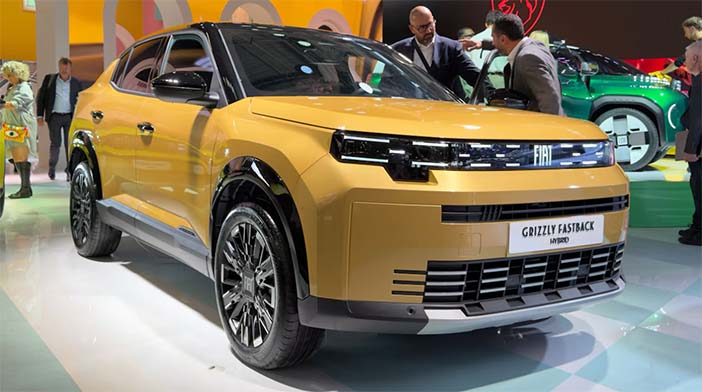
Both the Grizzly and the sleeker Grizzly Fastback look identical from the front, with a gloss black trim piece spanning the area between the four-pixel headlights. This is very much reminiscent of the arrangement on the Grande Panda, but the Grizzly also gets what look to be further illuminated elements that converge towards the Fiat logo in the centre. The bulky wheelarch cladding should appeal to those who enjoy the rugged nature of the Grizzly’s main rival, the aforementioned Dacia Bigster, while the latest image shows how we can expect the wheel design to vary between the standard SUV and its coupe sibling. At the back, both versions of the Grizzly get a similar black strip to the one at the front, again adorned with pixel-style led lighting. The periwinkle and burned orange paint colour showcased here also appear to reaffirm that Fiat is standing by its promise not to offer the colour grey on its cars. Instead, buyers should expect an array of vibrant shades, similar to what’s offered on the Grande Panda. The Grizzly’s underpinnings have proved impressive in its smaller Grande Panda already. As you’d hope for with family SUVs, the cars’ interiors will focus on spaciousness and versatility, with rugged finishes designed to be practical and hard-wearing. Fiat will attempt, however, to set its offerings apart from the likes of the value-focused Dacia Duster (another key rival) by emphasising their heritage and having a greater sense of fun, not just usability. Fiat will continue to reference its famous Lingotto factory in the interior’s design and detailing. As such, the oval-shaped elements that are found in the Grande Panda will probably be carried across, with a similarly varied use of different soft and hard-touch materials. Both cars will also probably feature the same technology package, including a 10 inch driver’s information display and a 10.25 inch touchscreen. Fans of separate climate controls will also be glad to see Fiat retaining fixed buttons. As with the Grande Panda, Fiat’s colour and trim department will focus on using as many recycled materials as possible, including bamboo-fibre mixes and a combination of bright, high-contrast stitching. Small item storage has also been a focus, so there will be plenty of interior oddment space, and the Panda’s clever integrated charging cable, which is coiled away and accessible via the front bumper, should also be retained. The key for both Grizzly models, though, will be offering enough space for families (something that the new supermini-sized Grande Panda is a little short on. Fiat is promising “best in class” boot capacity – for context, a Bigster offers up to 677 litres) plus the additional half a metre in length the Grizzly has over the Grande Panda should pay dividends in terms of rear passenger space.
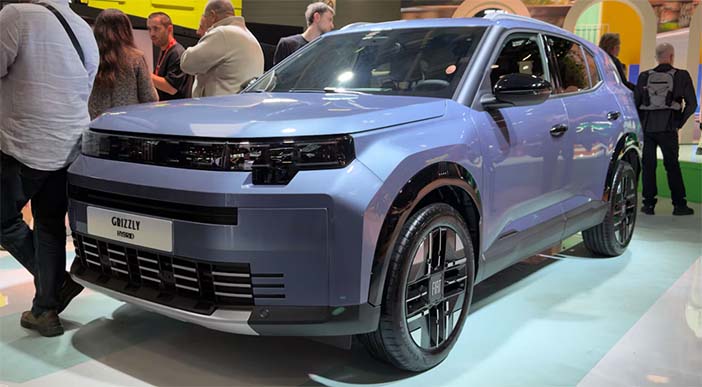
The Grizzly models won’t only share their design language with the Grande Panda, as mentioned above, they will also use the Stellantis Group’s Smart Car platform that underpins the smaller model, plus larger C-segment cars including the Citroen C3 Aircross and Opel Frontera. We’ve already seen the Smart Car architecture can accommodate a wide selection of pure-petrol, hybrid and electric powertrains and it’s flexible enough to allow Fiat to lengthen the wheelbase and widen the track to produce these C-segment models. All petrol-powered models will use a 1.2-litre 3-cylinder engine, which hybrid versions will pair with a 6-speed automatic gearbox that has an integrated e-motor, as we’ve seen in all the Smart Car-based models. Meanwhile, the electric models will be offered with a choice of a 44 kWh or 54 kWh battery, as in the e-C3 Aircross and Frontera Electric. These should provide close to 300 km and 400 km of range, respectively. A 100 kW maximum charging speed will allow for a 10 to 80 percent top-up in about half an hour, and driving the front wheels is likely to be a 112 hp front-mounted electric motor.
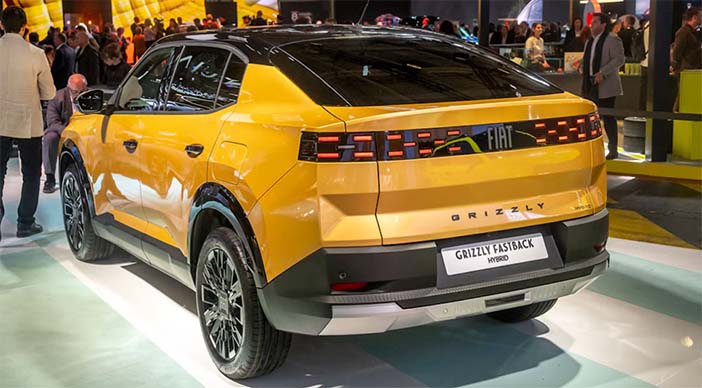
However, Fiat may choose to fit a beefed-up e-motor to give these bigger cars a bit more oomph than the smaller Grande Panda. Fiat’s slow rate of new product launches and updates to existing models over the last few years has been a worrying sign for such an iconic brand; one that’s so important not just to the Italian car industry, but also to the country’s manufacturing base in general. However, this is about to change, as Fiat exploits the Smart Car platform and access to synergies across Stellantis. The Grande Panda was a bold first step, but the SUVs have the potential to re-establish Fiat as a true volume player across most European countries. +++
+++ HONDA has a name for its next hybrid system, and it is as plain as it gets: Honda Hybrid. The company says the global rollout of the Honda Hybrid name starts in 2027, with about 15 models in North America, Japan and India adopting the system by the fiscal year ending March 2030. Those 3 regions are the first focus for the new hardware. Honda pitches the next-generation system as a way to boost efficiency and drivability across its core lineup. The new system builds directly on e:HEV, the 2-motor hybrid setup Honda has offered under that name since 2019. Engineers widened the engine’s most efficient operating range and shrank the drive unit, aiming for better fuel economy without changing the basic layout. Honda Hybrid replaces a messier naming history. The automaker’s hybrid lineage runs back to Integrated Motor Assist on the original Insight in 1999, followed by three separately branded Sport Hybrid systems in 2012. One name now covers all of it going forward. The 2027 start date gives Honda roughly 3 years to field those 15 vehicles across the 3 priority regions. The push lines up with Honda’s broader plan to rebuild its car business, announced back in May 2026, which shifts development and production money toward hybrids. Honda’s own Ohio hybrid plant strategy already points in that direction. Honda Hybrid models use a new platform with revised body rigidity. The company says the structure is lighter and stiffer than before to improve both ride comfort and handling without relying on a completely different suspension concept. Honda links the rigidity changes to more stable behavior at speed. The focus is on balancing weight reduction with enough stiffness in key areas to help the suspension working cleanly. 2 features come along with the platform. The Motion Management System is Honda’s integrated vehicle control technology and a newly developed electric all-wheel-drive system will be offered as part of the lineup alongside front-wheel-drive configurations. Honda has not disclosed how the e-AWD hardware is laid out, what the motors are rated at, or how the system decides to send power rearward. Honda has already previewed some of this technology. A next-generation Civic Hybrid prototype runs a new 2.0-liter engine paired with 2 electric motors, using the improved system as a template for future sedan and SUV applications. +++
+++ Distracting car INFOTAINMENT SCREENS , reclining seats and customisable headlights: these are some of the car tech features on the Chinese Ministry of Industry and Information Technology’s (MIIT) hitlist. Following a ban on Tesla-style pop-out door handles earlier this year, China’s safety watchdog is looking at other features on modern cars and its findings could ultimately impact the vehicles we drive in Europe. As part of a public consultation, the MIIT has itemised several features it plans to regulate in sweeping new rules on car design and tech. While flush-fitting door handles and ‘yoke’ steering wheels were ruled out earlier this year due to safety concerns, the most notable of these new potential restrictions focuses on in-car touchscreens. The MIIT proposes that cars equipped with “central control entertainment screens, large-area displays, or complex head up displays (HUDs) must undergo safety evaluations regarding information presentation impact on driving safety, functional reliability in extreme environments, and collision safety assessments”. This suggested that certain car infotainment systems could be banned under new rules if they are deemed too distracting or unreliable. In a similar vein, the Chinese ministry says it plans to place a blanket ban on “folding” and “flexible” displays. This comes just months after tech firm BOE showcased new infotainment screen designs which can fold away like a laptop or bend to provide a better viewing angle. So-called “critical functions” like gear shifters, window defrosters and headlight controls must also now all be adjustable via physical buttons and switches. Euro NCAP is making this a requirement to achieve top safety scores in its European tests. Moving away from infotainment systems, China is also looking to ban the use of so-called ‘zero gravity’ reclining seats (ie those that can fully recline as in first class on an aeroplane) while the vehicle is in motion, as well as enforce moderation in the use of user-customisable headlights. Headlights with predetermined light signatures, such as those offered by the likes of Audi and Mini, will continue to be allowed but features that allow user-generated light designs must be moderated to ensure they don’t “impact on the safety of other road traffic participants”. While the European Union doesn’t necessarily have laws forbidding such features on cars, Beijing’s latest slew of regulations will undoubtedly see this tech phased out of all relevant models (even those exported internationally. That said, the EU is also said to be investigating the safety impact of pop-out door handles, no doubt partially provoked by bans in China) so it’s not necessarily out of the question that we could see a crack down on potentially dangerous and distracting tech here, too. +++
+++ JEEP is working on a follow-up for the Renegade, confirming that a new generation of the compact SUV will arrive by the decade’s end as part of an ambitious plan to expand its European line-up. The second generation will have to find its place in an increasingly crowded market where electrification is becoming harder to ignore. Announced at the Paris Motor Show this week, the new Renegade is part of Jeep’s broader strategy to offer up to 6 models in Europe by 2030. The automaker hasn’t revealed when the next-generation will debut. Nor did it provide technical details, but it has made clear that electrification will play a bigger role in its future. Jeep says it has sold more than 610.000 Renegades in Europe since the model was launched. That’s a respectable tally for a brand built on rugged off-roaders, and it explains why the Stellantis brand isn’t ready to abandon the SUV segment between the Avenger and the Compass. The next-generation Renegade will aim to attract a broader audience while retaining the brand’s core identity. Jeep hasn’t confirmed which powertrains it will offer. Still, its European roadmap emphasizes a multi-energy strategy, suggesting customers could have different propulsion options rather than being forced into a single technology. That approach makes sense for a market where electrification is progressing at different speeds across countries. Whether the new Renegade will offer gasoline, hybrid, plug-in hybrid or fully electric power remains to be seen. Jeep hasn’t committed to specific configurations yet. The new Renegade is expected to ride on Stellantis’ STLA One platform, a modular architecture designed to underpin a wide range of vehicles and powertrains. That flexibility should allow Jeep to offer the compact SUV with different levels of electrification and help its parent company Stellantis keep development costs in check by sharing components across multiple brands and models. Purists have criticized the Renegade, arguing that a small SUV tied to the nearly forgotten Fiat 500X isn’t a “real Jeep”. However, the sales figures tell a different story. At the same time, it also helped Jeep attract buyers who might never have considered the brand before, proving there was a market for a smaller, more affordable model that traded some of the Wrangler’s ruggedness for everyday practicality. Love it or hate it, the Renegade has been a commercial success, and Jeep clearly believes demand remains strong enough to justify a second generation, which is part of Jeep’s broader European expansion. By 2030, the brand plans to cover the B-, C- and D-SUV segments with as many as 6 models, aiming to reach about 90 percent of Europe’s SUV market. The Avenger has already established itself in the B-SUV segment, with nearly 300.000 units sold since its launch, while the latest Compass strengthens Jeep’s presence among compact crossovers. At the other end of the range, the all-electric Recon will spearhead the brand’s return to the D-SUV segment, with another new model joining in 2028. Jeep also reiterated its commitment to offering customers powertrain choice, with a 4×4 version planned for every model. That promise could help distinguish the lineup from rivals that increasingly prioritize front-wheel-drive configurations in their smaller SUVs. Looking beyond 2030, Jeep is exploring new models inspired by its heritage, including the original Willys. The challenge will be to adapt that DNA to increasingly urban lifestyles without losing the capability that defines the brand. +++
+++ PEUGEOT is bringing back one of its greatest motorsport legends, but don’t expect a modern take on the 205 T16 at your local dealership anytime soon. Meet the E-T16 Concept, an electric hot hatch that celebrates the original rally car while offering a glimpse into the next-generation E-208.
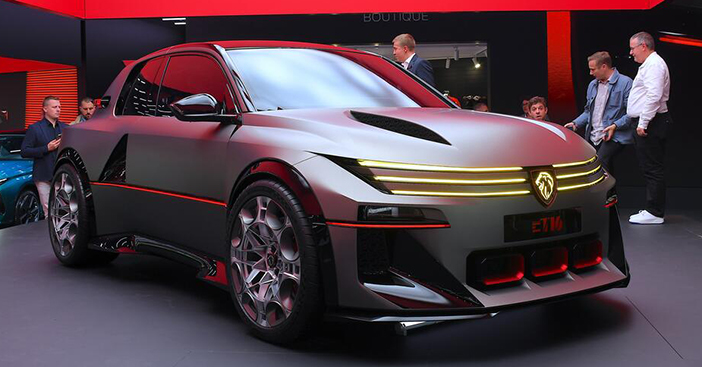
Unveiled on the eve of the Paris Motor Show, the radical concept marks the 40th anniversary of the 205 T16’s back-to-back World Rally Championship titles in 1985 and 1986. Developed with Peugeot Sport, the E-T16 reimagines that rally-bred spirit for the electric era, pairing a muscular body with a three-motor powertrain that produces a whopping 816 horsepower. No, that’s not a typo. That makes it Peugeot’s most powerful model ever. The 3 electric motors, 1 at the front and 2 at the rear, deliver a power-to-weight ratio of less than 2 kilo per horsepower, an impressive figure for a car like this.
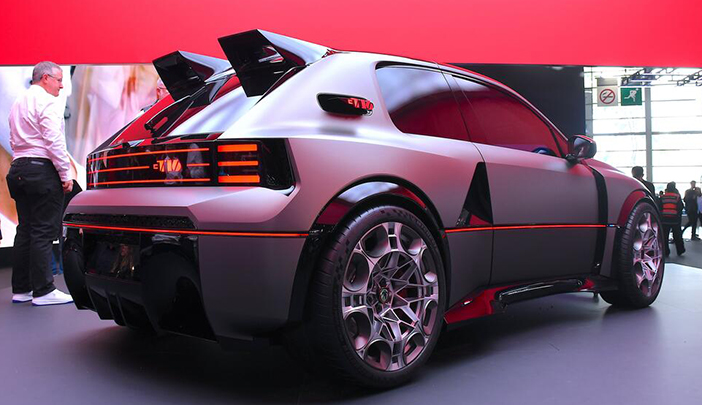
Predictably, the performance numbers are equally staggering. The electric pocket rocket accelerates from 0-100 km/h in 2.5 seconds and reaches 300 km/h in just 16 seconds. Peugeot hasn’t disclosed a top speed, but those acceleration figures suggest this isn’t your average hot hatch. Torque vectoring continuously adjusts power delivery between the front and rear axles and across the rear wheels, depending on available grip. Drivers can choose from three driving modes that adjust power delivery, torque distribution, and suspension settings. These include Track mode, designed to unleash the car’s full potential, and a fourth mode that lets drivers customize the settings to their liking.
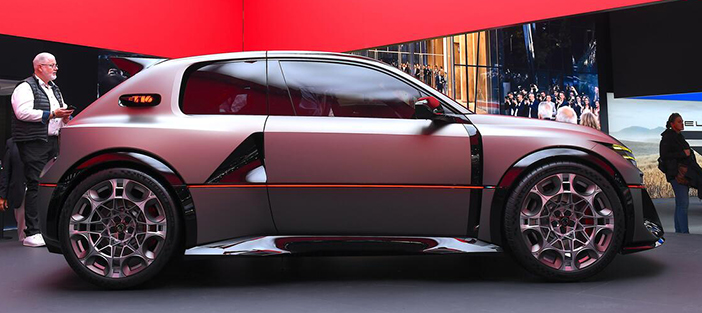
Peugeot Sport has paid particular attention to maintaining consistent performance during hard driving. Battery cooling is crucial in a high-powered EV, as excessive heat can trigger power reductions to protect the cells. The E-T16 uses a motorsport-derived ‘Side Cooling’ system that cools the battery cells through their side walls rather than their bases. According to Peugeot, the system provides enough thermal headroom to complete 3 laps of the Nürburgring Nordschleife, covering more than 60 kilometers, in Performance mode without losing power. The hardware includes four 15-inch (380 mm) brake discs, a hydraulic handbrake mounted vertically like those found in rally cars, and Michelin tires measuring 275 mm at the front and a massive 315 mms at the rear.
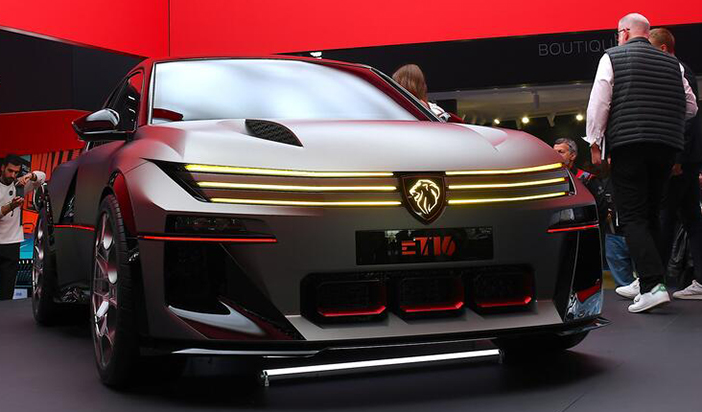
The E-T16’s design mixes familiar references to the 205 T16 with Peugeot’s upcoming ‘Feline Future’ styling language, which we saw earlier on the RCZ Concept. The exterior features wonderfully exaggerated wheel arches, a sculpted hood with 2 large air outlets and 3 oversized cooling intakes in the front bumper. Air extractors behind the front wheels and a rear diffuser with two adjustable aerodynamic blades help manage airflow. In contrast, a large rear wing with distinctive “cat-ear” styling adds a final touch. Peugeot has also reinterpreted its signature 3-claw lighting graphic. Instead of the familiar arrangement, the concept uses 3 slim, horizontal illuminated bars at both ends, framing an illuminated lion emblem. The Winchester Matte Grey paint recalls the original 205 T16, while silver wheels with body-colored inserts provide another retro-inspired touch. A thin, illuminated red line runs around the entire car, paying homage to the red pinstripe on its legendary predecessor. There’s a clever functional nod to the original, too. The air intake ahead of the 205 T16’s rear wheel once helped feed its combustion engine. On the electric concept, that area houses the charging port and door-opening mechanism. The floating C-pillar design also survives, now optimized to channel air toward the rear.
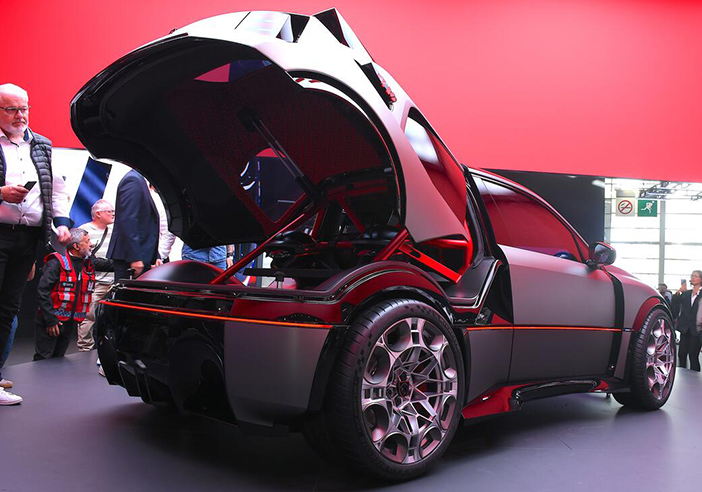
And yes, the rear section opens up. Like the original rally car, the E-T16 tilts its entire rear bodywork to reveal the electric motors and suspension components underneath. Pretty neat. The cabin is another preview of Peugeot’s future production cars. The concept introduces a new generation of the brand’s i-Cockpit, built around the rectangular Hypersquare steering control and steer-by-wire technology. Inspired by the steering wheel in Peugeot’s 9X8 endurance racer, the wacky Hypersquare replaces a conventional steering wheel with a compact control featuring a configurable central display. It shows information such as vehicle speed and lap times, while the steer-by-wire system is calibrated to deliver precision and agility during spirited driving. A curved, ultra-slim 21-inch panoramic HD display combines the head-up instrument display and central touchscreen, sitting directly in the driver’s line of sight. The layout is intended to reduce the need to look away from the road while keeping essential information close at hand. The rest of the cabin is every bit as extreme as the exterior. Carbon fiber, anodized aluminum, and technical mesh feature throughout, while deeply sculpted bucket seats use carbon-fiber shells for support. Four-point harnesses and a red tubular roll cage underline the concept’s motorsport ambitions. Peugeot has also incorporated recycled materials into the interior. The seats use a leather material made from untanned offcuts from the leather-goods industry that would otherwise go unused. For all its track-focused hardware, Peugeot insists the E-T16 Concept hasn’t forgotten everyday usability. Its 800 volt electrical architecture and 85 kWh battery promise up to 400 kilometers of WLTP range. Under the company’s stated conditions, charging from 10 to 80 percent takes less than 15 minutes. It doesn’t say how long the battery juice would last during sustained high-performance driving. The bigger question is whether any of this will make it into production. Peugeot describes the E-T16 as the ultimate vision of the next E-208, but that doesn’t mean an 816-hp electric hot hatch is on the way. The concept primarily showcases future design cues, the next-generation i-Cockpit, and the possibilities of high-performance electric propulsion. Still, it’s an intriguing direction for a brand with such a rich rallying history. The original 205 T16 helped put Peugeot on the motorsport map, and its spiritual successor shows the company isn’t ready to leave performance behind as it transitions to electric power. Whether the E-T16 ever reaches the road in anything resembling its current form remains to be seen. For now, the prospect of a tiny Peugeot packing more than 800 electric horsepower is enough to make the hot-hatch segment look a lot more interesting. While the E-T16 remains a one-off, Peugeot already has an electric hot hatch in its lineup. The company recently revived the GTI nameplate, this time ditching the combustion engine for an all-electric powertrain in the E-208 GTi. +++
+++ RENAULT boss Fabrice Cambolive has insisted that a production version of the E-Space concept MPV “is not a concrete project as of now” and that the immediate focus is on new SUVs. Inspired by the 1984 original, the E-Space concept was one of the stars of the French brand’s Paris motor show stands, largely conceived as a project to show the design direction of new brand design chief Alexandre Malval. Asked at the show about the production potential for a new Espace, Cambolive said “we are not capable of embracing everything at the same time”. He noted that Renault’s focus for the next year is the launch of the Trafic E-Tech electric van, the brand’s first software-defined vehicle. “The next step after that will be the renewal of Scenic and Rafale, and after that we will have to decide what will be the next Espace”, said Cambolive.
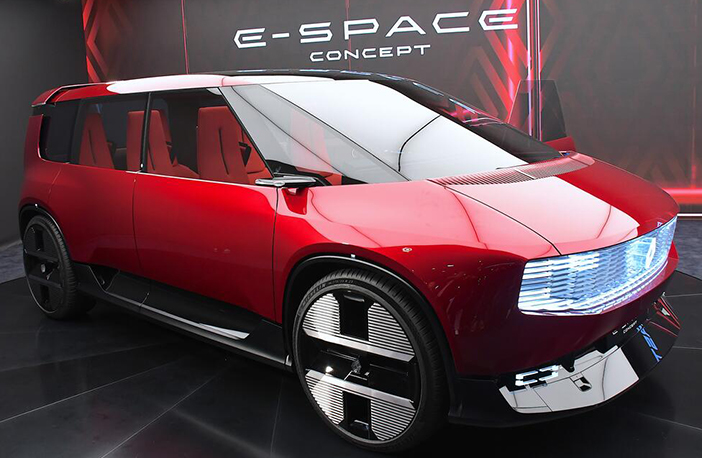
“But as you know, we like MPVs, we like EVs with flat floors, we like immersivity, we like panoramic roofs, we like versatility in the seats. All the ingredients, all the brand markers from Renault are in the E-Space concept. Let’s try to demonstrate it would be a real and serious project”. Renault had already said it would “explore possible futures” for the E-Space but had yet to comment on whether it was intended for production. The firm is currently developing a new RGEV Medium 2.0 architecture for future vehicles, which any production Espace would probably be based on. The flexible ‘skateboard’ can accomodate both electric and range-extender powertrains, with an 800V electrical system allowing for ultra-rapid charging. Renault claims that EVs on the platform could offer up to 750 km of range, with REx models reaching 1.500 km. Cambolive suggested that while a traditional MPV remains possible, the next Scenic will follow the current car in taking on a SUV shape.
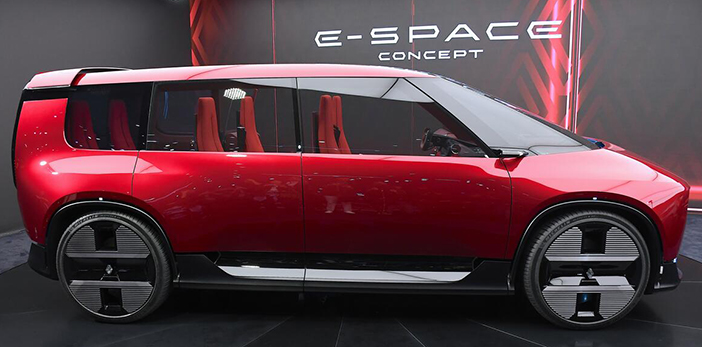
While the Scenic was originally a mini-MPV, Cambolive said it will remain in SUV territory, “because the work we’ve done in terms of design is good, so the next-generation Scenic should really be loyal to this design”. However, he hinted that the Mk6 Scenic will focus on offering more of an “MPV kind of interior” focused on maximising interior space and comfort. The original Espace was a key player in popularising the people carrier. It stuck with that format until 2023, when it became a stretched version of the Austral. But amid a wave of retro revivals spearheaded by the 5 E-Tech, Renault is considering a return to tradition. “We have captured the iconic character of Espace”, said design chief Malval. “At the same time we have taken it into the future with cutting-edge technology and style”. Chief among the throwback design cues is the heavily raked windscreen reminiscent of France’s TGV trains. Meanwhile, the rear spoiler recalls the roof bars that were prominent on the Mk3 and Mk4 Espaces.
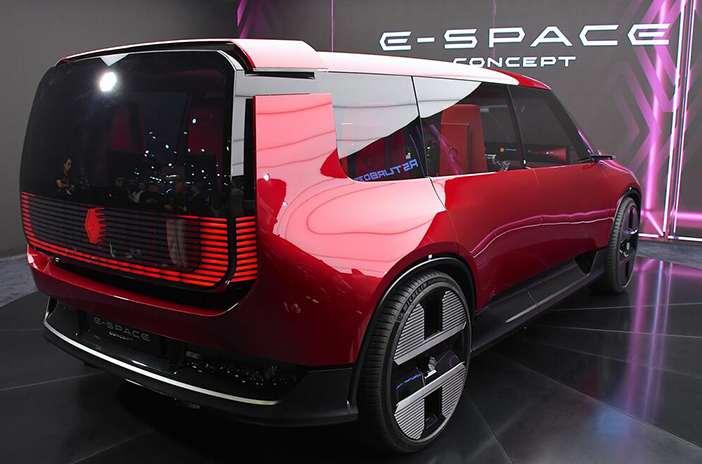
Renault said the E-Space was designed from the inside out and the size of its glasshouse has been maximised to ensure the cabin feels light and airy. It took inspiration from Bauhaus designer Ludwig Mies van der Rohe’s Farnsworth House, a monolithic building clad almost entirely in windows. Renault said it attempted to obscure the meeting points between the large-windowed box section and conventional bodywork. At the D-pillar, the effect is particularly pronounced: here the spoiler ‘floats’ above the glass, with back-lighting for emphasis.
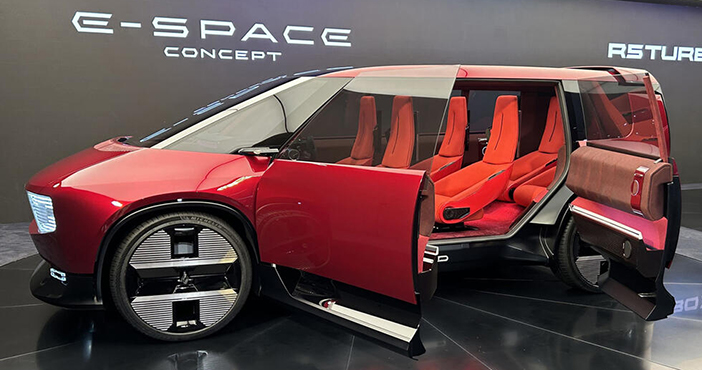
The E-Space can house 6 people across 3 rows of seats. Passengers in the second row have access to folding tables mounted on the backs of the first-row chairs. They can spin around to face the third row, giving a arrangement similar to a train’s. The second-row seats can also be folded flat to form a table for those in the third row. Up front is the new ‘OpenR Panorama’ screen, which spans the entire width of the dashboard. Renault said this feature will enter production on the next-generation Scenic and Rafale, due around 2030. The move reflects a wider industry trend towards placing instrumentation in the driver’s eyeline. A small infotainment touchscreen (suspended from the dashboard to place it closer to the driver) provides control over functions such as music and sat-nav. Notably, the E-Space has a yoke in place of a traditional steering wheel. It uses a steer-by-wire system, meaning it has no mechanical link with the front wheels, and the lack of a traditional steering column frees up extra space in the footwell. Placed on the yoke are touch-sensitive controls used to interact with the OpenR screen. +++
+++ The boss of SEAT has said no decision has been taken about the brand’s long-term future, and its future could depend on forthcoming regulations about how long combustion-engined cars can be sold. The Spanish’s brand’s future has been in doubt for some time, owing to the growth of its higher-margin sibling brand Cupra, and it now currently only offers the ageing Leon, Ibiza and Arona models. The wider Volkswagen Group is currently in the midst of a major restructure that could lead to half its model variants being cut, and Autointernationaal.nl has seen documents that says the Seat brand will be axed by 2029. But at the Paris motor show, Markus Haupt, CEO of both Seat and Cupra, insisted that the former brand’s future has not yet been decided. “The Ibiza is our best-selling car in Spain and the Seat brand has grown share in some markets, so the brand is strong. And we’re investing in the brand: next year, we’ll launch mild-hybrid engines for Ibiza and Arona, and that is proof we believe in this brand, because we need this brand. Seat is part of our strategy, and we keep investing in Seat”, he said. Haupt acknowledged the reports following the VW Group restructure, but said “there is not only one way” for Seat in the future. “We have different scenarios on the table, and yes, there is a scenario where a phase-out of Seat could be reality,” he said. “But even if that would come, I would say to our customers that they can be relaxed by this, because even if this were to happen someday, we will still give 15 years of service for the brand. So there is no real panic about any decision – totally the opposite. Asked what would determine Seat’s future, Haupt added there was no fixed date for a decision: “There’s lots of regulation. Now we know that CO2 is playing a big role already, but starting in 2030 it will be even harder. But there can be flexibility, and this could directly impact our decision-making. So the geopolitical environment, and also the customer experience and the speed of electrification, will be something that will define if Seat will still be needed after this time. We are working with the scenarios and I think any date will be determined by regulation and customer behaviour”. +++