
+++ Ushered in by the second-generation iX3, BMW ’s Neue Klasse design philosophy abandons the brand’s gargantuan front kidney grilles in favour of smaller ones, and an overall sleeker and more restrained design. Since the iX3, we’ve seen this new design language adopted by the i3, 7-series and the X5. Soon, the X2 will follow them into this new design era. Not only all combustion-powered versions of the X2 are getting the new design, but also the all-electric iX2 adopts the visual updates. Rather than an all-new generation, like the iX3, this new model is only a mid-cycle facelift, which explains why the overall shape and size of this updated model is virtually identical to the outgoing iX2. BMW’s designers have worked to overhaul the SUV’s front fascia, incorporating the same small kidney grilles as other Neue Klasse models, as well as all-new headlights. One image shows the front turn signal enabled and previewing the led daytime running light. While it’s hard to say for sure, it looks like it adopts a V-shape. By comparison, the new iX3 daytime running lights are a diagonal slash, while the X5 has X-shaped light signatures. BMW hasn’t bothered tweaking the SUV’s unflattering rear window and decklid spoiler, so the new iX2 still looks unnecessarily chunky. We can see there are new taillights, although the overall shape of them appears similar to the current model. What is different is the layout and shape of the leds, as they’ve been updated to better suit the Neue Klasse era. Like other Neue Klasse era models, the updated interior will feature BMW’s new Panoramic iDrive system stretching across the width of the dashboard. It also has the same angular central infotainment display and will likely hit the market with the same odd 4-spoke steering wheel as the iX3. Given the all-new interior layout, the updates made to the new iX2 and the combustion-powered X2, will be substantial considering this is only a facelift. With that being said, interested buyers shouldn’t expect the new iX2 to debut with the latest-generation batteries and electric motors as the iX3. You see, while it will include the Neue Klasse design, it isn’t expected to be based on the Neue Klasse platform and will use the current FAAR architecture. This new model will likely continue to be offered in eDrive20 and xDrive30 configurations, depending on the market. The first of those delivers 204 hp and 240 Nm of torque, while the xDrive30 has 313 hp and 450 Nm. Both share the same compact 66.5 kWh lithium-ion battery. BMW may choose to increase the same of the iX2’s battery pack, though that’s yet to be confirmed. +++
+++ Only a few athletes have captivated fans as much as Rafael Nadal. The retired Spanish tennis player, who spent 209 weeks as the world’s number 1, has received a special present from KIA , celebrating his illustrious career. Believe it or not, the pictured full-size model of the EV4 GT is made with earth gathered from the actual courts where Nadal gained the nickname “King of Clay”. Though he retired from professional tennis in late 2024, Nadal has been a Kia global brand ambassador since 2006, after he won his first Grand Slam. In order to honor their longtime collaboration, Kia created a special sculpture by blending traditional styling clay with tennis court clay from Monte Carlo, Paris, Rome and Madrid.
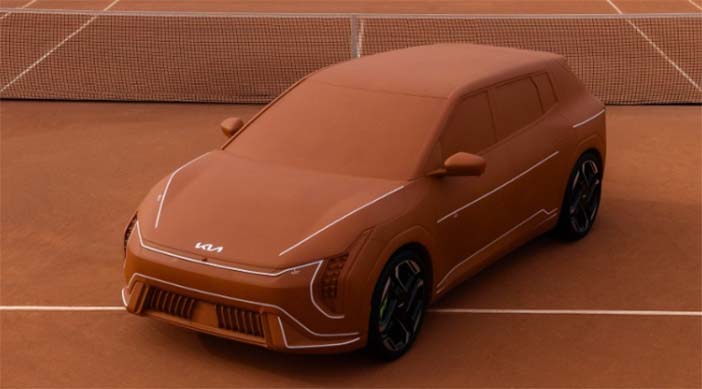
To break up the monotony of the orange material, Kia used white design tape to highlight the character lines of the EV4 GT. These accents double as a reference to the white tennis court lines and are joined by custom exterior graphics highlighting Nadal’s major career milestones. The unique Kia EV4 was presented to the tennis legend at his Rafa Nadal Academy in Mallorca, Spain. It has the same footprint as the production EV4 GT hatchback, but is non-drivable and doesn’t have an interior. Still, it rides on production wheels and tires, so it likely rolls. Most clay models sit on special platforms with cart wheels, making it easier to move them around in tight spaces.
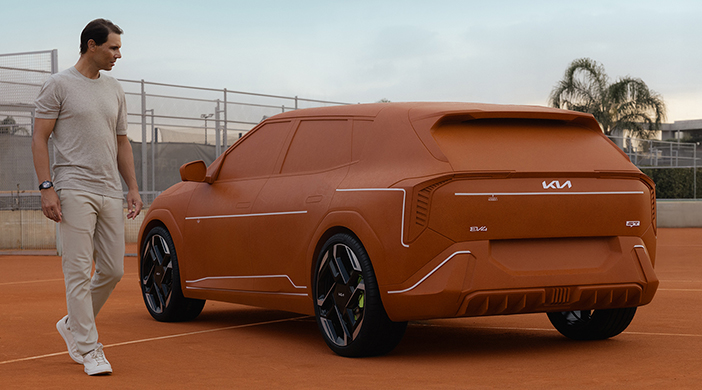
While Kia could have chosen a higher-end model, like the electric Stinger successor, over a compact electric hatchback for the tribute, the eye-catching material and tennis references will certainly make it a great conversation starter in Nadal’s garage. After all, the “King of Clay” should have a car made of clay in his collection. “For more than 20 years, Kia has been by my side throughout my career, through all the highs and the challenges”, said Nadal. “Receiving this tribute, created from the material that has defined so much of my journey, is incredibly meaningful. It is a special reminder of everything we have shared, and I am honoured by this gesture”. The automaker noted that despite the increasing use of digital tools in automotive design, clay modelling remains an integral part of vehicle development as it allows designers to judge “proportions, surfaces, finishes, and tensions” on a physical product. +++
+++ The MAZDA 3 MPS lasted just 2 generations over 7 model years, but it left a lasting mark on enthusiasts. A direct competitor to the Ford Focus ST, Honda Civic Type-R and Volkswagen Golf GTI, the Mazda 3 MPS was a proper hot hatch that is unlikely to return to Mazda’s line-up anytime soon, despite the speculation. A report circulating alleges the Japanese automaker is preparing to launch a performance variant of the hatchback soon. It would supposedly have a turbocharged engine producing more than 300 hp, but that appears to be untrue. In an interview, Vinesh Bhindi, Mazda Australia’s managing director, squashed any notion that Mazda is readying a hotter ‘3’. He bluntly told: “No, it’s rumours”. The current-generation Mazda 3 launched at the end of 2019 and is starting to feel dated compared to its competitors, but consumers don’t seem to care. Under the hood is a naturally aspirated 2.5-liter 4-cylinder engine which delivers 140 hp (SkyActiv-G) or 186 hp (SkyActiv-X). Mazda still offers buyers a choice between a 6-speed manual and a 6-speed automatic. What the current-generation Mazda3 lacks in horsepower, it makes up for in its ride and handling. Mazda knows well that you don’t need a lot of power to have fun behind the wheel of its cars. The Mazda 3 MPS hasn’t been around for as long as the Volkswagen Golf GTI or Honda Civic Type-R. Even the Ford Focus ST has a longer legacy than Mazda’s hot hatch, predating the Japanese hatch by half a decade, but the 3 MPS burned bright and fast. The car was on sale for 7 model years across 2 generations, from 2007 to 2013, launching with a 265 hp 2.3-liter turbocharged 4-cylinder engine and a 6-speed manual. A completely redesigned model with a more aggressive design launched in 2010 with the same powertrain. Mazda would kill the car with the arrival of the third-generation model in 2014, when the automaker adopted its Kodo design language and introduced its SkyActiv engines. +++
+++ Winter is around the corner, which means contending with issues like increasing battery failures, troublesome engine starts and fitting snow chains in more extreme conditions. There’s another annoyance that comes with winter driving, particularly for those who live in areas that experience heavy snowfall. Opening a car door can often lead to snow falling on your seat, creating a mess and potentially damaging your upholstery. Automakers are constantly working on solutions to everyday inconveniences like this one, and MERCEDES-BENZ has just filed a patent for a seemingly simple nozzle system that can quickly remove snow from the roof or doors, before it has a chance to fall inside the car. The German patent describes a roof element with nozzles, presumably built into the area close to where a roof rail would be positioned. Air is blown through these nozzles to remove snow sitting on the vehicle, particularly in areas above or around the door opening, where snow can accumulate and fall into the interior. A compressed air supply delivers the blast of air needed to remove the snow, but the document does not detail the pressure, flow rate, compressor type, or whether the air is heated. Heated air could partially melt the snow, but that alone wouldn’t fully alleviate the issue. A more logical expectation is that the force of the air will be sufficient to physically propel the snow off the door/roof. A simple button could be pressed to allow the snow-removal system to do its job. By preventing snow and liquid from entering the cabin, the invention would also have the secondary benefit of protecting electronic components and control units, which could lead to expensive repairs if damaged. The invention would be of particular value in states where it’s legally required to clear snow from the roof, hood, trunk, windows, and windshield before driving, as in New Jersey. The Mercedes solution won’t clear snow from all these areas, but it should make at least part of the task easier. Since any vehicle with this technology would need a compressed air supply, one likely candidate for the feature is the Mercedes-Benz E-Class All Terrain. This luxury wagon comes with a standard air suspension, as do several other high-end Mercs. Additionally, the patent also includes a sketch of what is obviously a Mercedes wagon. However, there’s no reason that Mercedes couldn’t install a dedicated air supply for the snow-removal nozzles, whether or not the vehicle in question has an air suspension. If the feature ever makes it to production, Mercedes may choose to bundle the option into a Winter Package, which includes a heated steering wheel and heated windshield washers. The snow-removing nozzles would be a sensible addition, assuming the system can be fitted at a price that makes sense for the automaker and buyers. A patent application is no guarantee that a particular feature will make it to production. Automakers are constantly innovating behind the scenes and like to secure the rights to certain technologies, whether or not they end up being used. It’s obvious that people living in snowy countries could benefit from the tech. Mercedes is also in a position to charge a premium for the feature, as German automakers are known to do. We’ll now have to wait and see if the innovation makes it into your next GLE or S-Class. +++
++ RANGE ROVER has entered the electric car market in a big way, but that doesn’t mean its old challenges are confined to history. A perception of poor reliability has dogged the Land Rover brand’s products in the past, but managing director Martin Limpert is confident the corner has been turned, particularly with the new batch of Range Rover electric cars. On the big question of Range Rover reliability, Limpert is open: “I still feel it’s a gap we have to close, but the gap is getting narrower”. Range Rover builds complex vehicles; many with air suspension, all with highly capable and configurable off-road drivetrains, so it doesn’t make life easy for itself. Given its premium positioning, however, doubts of any kind over reliability can be corrosive. The 2026 edition of a customer satisfaction survey placed Range Rover parent brand Land Rover in an impressive 10th place overall out of 30, but 23rd in the specific ‘quality and reliability’ section. Limpert points to the results of the Initial Quality Study by America’s JD Power customer survey, where Land Rover climbed from 21st place in 2025 to 10th place in 2026; 4 places in the luxury section ahead of Mercedes-Benz and BMW. That study looks at customer issues in the first 90 days of ownership, but the Vehicle Dependability Study that examines problems in the first 3 years still placed Land Rover 27th out of 29 brands. Signs of a corner being turned, but with work still to do? That’s certainly what Limpert, who heads up the Range Rover division in Jaguar Land Rover’s new House of Brands configuration, is trying to say. With Range Rover now sitting alongside Defender, Discovery and Jaguar, there will technically be no Land Rover badged cars, which feels like a reset in itself. He would not be drawn on the Ingenium engine reliability saga that has not helped Land Rover’s cause in this area. Instead, the boss prefers to look forward to the clever systems employed to monitor and maintain Range Rover’s new crop of EVs. “We have a big focus on quality and you see this in our manufacturing processes but also in technology like our Battery Digital Twin”, Limpert explains. He’s referring to the new system that allows Range Rover to hold a digital replica of the battery in every one of its electric cars. The model comprises 900 data points that are drawn from the car in regular over-the-air uploads. It lets engineers act proactively to maintain the battery and optimise its performance without the car even visiting the dealership. It enables an 8-year or 160.000 km warranty for the propulsion system in Range Rover’s EVs. Improvements in quality and reliability will certainly assist the Range Rover brand in its wider aims. It’s not the game-changing leap Jaguar has attempted, but Range Rover is in the process of its own hop up market. ‘Modern luxury’ is now very much at the heart of Range Rover and it’s telling that with the new Range Rover Sport Electric and Range Rover Electric the brand has not opted for the extreme horsepower figures of some EVs. “We feel that the 550 hp car is very well balanced in terms of performance, all-terrain capability, refinement, quietness, everything”, says Limpert. “In Range Rover terms, we have the perfect balance. We don’t need 800 or 900 horsepower”. All the Range Rover and Sport EV models have the same 550 hp power output and formidable 850 Nm of torque, but Limpert does not envisage that we will see a higher powered electric Range Rover Sport SVR, for example. He does not write it off, but will at least wait to see how the market reacts to the new EV. “Everything in the future really depends on how this lands and how this vehicle performs in the first place”. That’s not to say that further developments of the Range Rover and Sport are off the table. The fifth-generation Range Rover was launched back in 2022, but with the arrival of the electric version the plan is for a few more years to elapse before we see an all-new model.“We’re always looking forward,” says Matt Becker, JLR’s vehicle engineering director. “We’re always optimising and developing the cars for as long as we can, but there will come a point when you need to start looking at future architecture. “This architecture was conceptualised 11 years ago and it’s starting to get towards the end, I would say. But it’s got at least another 5 years”. First we’ll see chassis tweaks and other technology enhancements developed for the Range Rover and Range Rover Sport EVs find their way on to the petrol and diesel models as part of a significant facelift. A more affordable, less powerful EV450 version of both the Range Rover and the Range Rover Sport is also due to hit the showrooms. Beyond that, improvements to the EV’s battery may be an area the brand looks to explore in the longer term. “We’re locked and loaded on the battery chemistry we’re using right now, but obviously a battery is a given size, it has a given package space. Could you develop it in future and look at different chemistries? For sure”. We won’t see Range Rover follow Jaguar in a drive even further upmarket, though. In a sense, the EV’s arrival in itself has elevated the range. The brand offers the SV Ultra trim level in the Range Rover, which is designed for buyers to spec their own truly high-end model. Prices are ‘on application’, but taking this route to a long-wheelbase Range Rover with all the bells and whistles will get you into the rarefied ballpark of the Bentley Bentayga, if not the Rolls-Royce Cullinan. That’s the very pinnacle of the luxury SUV market where Range Rover feels it belongs. +++
+++ The SKODA KAROQ has been on sale for almost a decade and in that time a host of new Chinese mid-sized SUV rivals, such as the Jaecoo 7 and Chery Tiggo 7, have appeared. Now the Czech manufacturer is planning to fight back with an all-new Karoq, and it could arrive sooner than expected thanks to a rapid new development program. Skoda is aiming to rush the new Karoq to market, possibly as soon as 2028, taking inspiration from the rapid development speeds many of its Chinese rivals utilise. However, don’t think the speedy approach will result in corners being cut, as the brand will still aim to deliver on all the same values as its other highly regarded models. Specifically, impressive levels of space, an easy-going driving experience with as few annoyances or distractions as possible will feature. The interior will also put sustainability front and centre, plus the Simply Clever ideas the brand is known for. The current Karoq remains one of the company’s most popular models. More than 102.000 examples were sold in 2025 alone. Key rivals such as the Nissan Qashqai and Kia Sportage have evolved much more in the past few years, and pressure in the segment is now fiercer than ever. So a new model is long overdue; uncertainty around the EU’s forthcoming regulations regarding emissions was the main reason why Skoda held off from giving the all-new second-generation Karoq the green light sooner. But now it’s all systems go. In an interview, Skoda’s head of technical development, Johannes Neft, revealed that the goal is to design, develop and ready this second-generation Karoq for launch in exactly 3 years; at least 12 months less than it would normally take the marque to bring an all-new model to market. “This will be one of the fastest developments we will have in the Volkswagen Group and in the brand”, Neft told me. “The reason for that was it took us some time to make that decision because of the uncertainty of what’s coming up in Europe. But now we have taken the decision, and we will do that at ‘China speed’ ”. Neft said the entire VW Group is working on speeding up the development processes in all areas, in common with many European car makers that are now trying to match Chinese manufacturers’ fast and agile way of working. The new Karoq will be one of the first examples of the speed the German goliath’s family of brands is now capable of. What’s enabled Skoda to move so much faster with the new Karoq is that it will be based on an existing platform. “That really helps us and this is also what our Chinese colleagues are doing”, the development boss pointed out. “As soon as you have something existing, you can be much faster. This is what we are doing here and we try to make a lot of synergies with our existing cars as well to be fast, to be competitive”. The MQB Evo platform that’s used by the current Kodiaq and Superb, plus the Volkswagen Golf and T-Roc, Cupra Formentor and numerous other cars, is the obvious solution. Particularly because Neft believes hybridisation is the most important thing the next-generation Karoq needs to have, with the architecture offering plenty of flexibility in that regard. “The MQB Evo platform is still one of the most important platforms of the Volkswagen Group for sure, because it’s not only important in Europe, it’s important all around the world”, Neft added. “We are using MQB Evo in the States, in China, everywhere. Therefore this platform, for sure, will be updated as long as it is needed all around the world”. Volkswagen’s first-ever full-hybrid system is coming to the Skoda Octavia as well. A turbocharged 1.5-litre 4-cylinder petrol engine is paired with 2 electric motors; one to help drive the wheels, with the other generating energy for a small 1.6 kWh battery under the boot floor. This tech will allow cars to drive on pure-electric power to boost their fuel efficiency, without having to be plugged in. A plug-in hybrid set-up may also be available in the new Karoq, such as the one found in the larger Kodiaq and Superb. This powertrain will also return to the Octavia line-up later this year. The Karoq will not be offered as an EV, with this role filled by the Elroq. The new Karoq it’s not just a Kodiaq with a few feet chopped out of the middle. Skoda’s lead exterior designer Romain Bucaille would balk at such a notion, telling me: “If we repeat everything, you don’t need designers basically. A computer can do it or you just scale it, and then it all looks the same”. The Karoq’s design will be guided more by the Vision O concept seen last year, which represents the next step in the evolution of Skoda’s ‘Modern Solid’ styling philosophy. Some of the elements have been carried over from the futuristic family wagon, including the black loop around the front, the sculpted powerdome bonnet and the razor-sharp daytime running light design. Being petrol-powered, not electric, means the Karoq will need a tweaked interpretation of the Vision O’s Tech-Deck Face, but it should remain true to the general aesthetic of Skoda’s next-generation cars. We first saw it on the Elroq, and it also features on the new Epiq and Peaq SUVs. As a result, I expect to see the use of a larger grille opening with vertical slats typical of Skoda models integrated into a more streamlined shape. Bucaille told me: “What is important is to have one design language and one family feeling in the showroom when we enter. You don’t want to have the electric cars on one side and the combustion cars on the other side and they look completely different. So we said we will keep some elements to be identified as a Skoda by the customer, whether it’s ICE, whether it’s BEV”. So although the new Karoq is sure to look very different to the outgoing model, it will be immediately recognisable as a Skoda. Bucaille told me: “Our job is interesting because it’s the balance between how to keep the essence of Skoda’s design but how to make it new while still having that link. You don’t want to lose customers because you don’t want to do something completely different and you don’t want to lose them because you are just not evolving”. Meanwhile, the interior will feature big displays running Skoda’s new Android-based infotainment system and, hopefully, physical climate controls like the ones set to appear in the flagship Peaq. In terms of Simply Clever features, all the classics should be present, such as an umbrella hidden in the driver’s door and an ice scraper tucked into the tailgate. But we’re sure the boffins at Skoda will have a few new bright ideas to go with them. The new Karoq is part of the brand’s plan to provide buyers with an equally strong selection of combustion and electric cars. Head of sales and marketing for Skoda, Martin Jahn, told me earlier this year: “We will run combustion-engined cars as long as the customers want them, as long as it’s legally possible and as long as it’s financially viable for us”. By the end of next year, Skoda will also fit the current-generation Fabia, Scala and Kamiq with their own mild-hybrid systems, the same as we’ll see in the Volkswagen Polo. +++
+++ In the UNITED KINGDOM , electric car registrations in October reached their highest share of total sales this year, at almost 33%, as the overall market continued to grow. The Skoda Enyaq was the biggest electric seller in the month, followed by the Mini Countryman, according to figures from the Society of Motor Manufacturers and Traders (SMMT). The Jaecoo 7 was the UK’s top seller for the second consecutive month in October, with 3.412 sales, closely followed the Ford Puma, which remains the UK’s overall best-seller for the year. Volkswagen remained the UK’s favourite brand, with a market share of 9.0% in the month, while BMW overtook Audi for second spot with a 5.6% share. Sales overall grew 5.4% to 152.730. Chinese brands again shone in October, but their combined market share of 21.3% was lower than for the month of September, when it stood at a record 23.3%. MG remained the leading Chinese brand, recording an 85% increase in sales over the same month last year, landing it in 4th spot ahead of Kia and Skoda. Jaecoo was 9th and BYD 10th. Strong EV sales in October came without the might of Tesla, which recorded just 282 registrations after its September push, when it topped electric sales in the country. Instead Kia was the number-one EV seller, according to data from independent transport researcher New AutoMotive. The EV share for the month came within a whisker of reaching the government’s mandated figure of 33% for the year. The EV share has steadily risen throughout 2026 as buyers have reacted to the rising fuel prices caused by the attack of Israel and the United States on Iran, plus the increased availability of more affordable EVs. The overall EV share for the year stands at 30.4%, although flexibilities in the ZEV mandate system means car makers need to reach only 24.6%, according to calculations by New AutoMotive. Car makers are hopeful that the government’s review of the ZEV mandate will lower the rising EV sales targets, which are currently set to hit 80% by 2030. The rise of EVs and plug-in hybrids has bitten into demand for petrol cars, which accounted for 37% of sales, down from 41% same month the year before. Diesel meanwhile dropped to a new low of 3.8%, recording just 5.811 sales in October. Hybrids also suffered after sales dropped 5% in the month. PHEVs grew by 30%, overtaking hybrids with a 15% share versus a 12% share. Year-to-date, the Ford Puma has clocked up 46.295 registrations, but the Jaecoo isn’t far behind with 42.885 in second place. That means the 7 alone has significantly outsold Jaecoo’s Omoda sister brand in its entirety, and by a significant margin. The gap between the Ford Puma and Jaecoo 7 has narrowed significantly, with the latter nearly 7.500 units behind the former by the end of August. Then again, the Jaecoo only closed in on the Ford marginally in October. This would suggest overhauling it by 3.410 cars in just 2 months is quite a tall order. The Jaecoo 7’s sales figures are more erratic than the Puma’s, however, which will be down to a number of factors, including promotions and shipping schedules. These numbers are for car registrations rather than sales and some brands have the habit of pre-registering large numbers of cars to massage their numbers so actual sales always remain a grey area. With all that in mind, a bumper September for the Jaecoo 7, and the car industry as a whole, saw it outsell the Puma by nearly 4.000 units. It’s still too close to call, then, but wherever the Jaecoo 7 finishes in the league table, it’s an incredible achievement for the ‘Temu Range Rover’ to come from nowhere to become one of the UK’s most popular cars. +++