
+++ The first battery-electric ALFA ROMEO will arrive in 2024, new company boss Jean-Philippe Imparato has confirmed, and it could gain a Quadrifoglio-badged performance version. The Italian firm is now part of the Stellantis empire, and it has already committed to launch only Battry Electric Vehicles (BEV) from 2027. Stellantis CEO Carlos Tavares recently signed off on a bold new product plan that has been developed by Imparato, which includes one new model per year between now and 2025. That product plan will begin with the delayed Tonale SUV in 2022. Further new models will come in 2023 (tipped to include the Brennero small SUV) and 2024. “I will launch in 2024 the full BEV version of the first Alfa Romeo to be fully electrified”, said Imparato. “I will have one trim, with two engines: one side will be 100% electrified, but it will be on top of that my first full BEV”. Alfa Romeo is working on multiple versions for its battery-electric vehicle models and that high-performance versions could carry the Quadrifoglio branding. Speaking about performance models, Imparato said: “For all our model launched, I will always study the possibility to make a performance version of the car that will be fully consistent with the product portfolio message we send. If I consider that I’m not able to offer the right level of performance steps of Quadrifoglio, I will not do a Quadrifoglio version”. Future Alfa models will make extensive use of the new STLA Large platform that has been developed by Stellantis, with Imparato noting that Alfa Romeo engineers had been involved heavily in the development to make sure it could meet the performance and premium parameters that the brand requires. Imparato also said that he has a further product plan laid out for 2025 until 2030, including models that will focus more on autonomous driving other technology developments, but that would be dependent on the success of the plan until 2025. Imparato confirmed that he would be keen to revive the Spider Duetto as an electric car and admitted that design work had progressed on realising one. However, he conceded that the firm must first focus on growing sales in volume markets. “I have the car; I’ve showed it to dealers”, said Imparato. “But I would not dare to put that on the table to Carlos Tavares until I’m completely secure in terms of market share”. Imparato also said that he was keen to revive the GTV as a 3-door model, but that such a car would also sit on his ‘dream car’ list, behind a new Spider Duetto. Despite that, a GTV could appear sooner: the badge could be revived for a forthcoming 2-seat or 5-seat model that will help to spearhead Alfa Romeo’s electric expansion. +++
+++ The new DBX continues to bolster ASTON MARTIN ’s financial health as the company enters the final quarter of 2021, with the SUV accounting for more than 50 % of its core sales so far this year. Since January, Aston has sold 4.250 cars worldwide, of which 2.186 were DBXs. That’s despite restricted production capacity at the firm’s new St Athan factory during the ramp-up to full-scale output. China alone accounts for 16 % of Aston sales so far this year, compared with 6 % in 2020, and sales in this market have surged by 600 % year on year. The brand is well under way with its ‘Project Horizon’ transformation strategy, just over a year since ex-AMG boss Tobias Moers took over as CEO, and compared with this time in 2020, it has almost tripled its year-to-date revenues, which currently run at £736.4 million. But the short-term impact of the transformation plan is a dramatic increase in debt repayments in the third quarter, which rose from £79 million to £133 million year on year as Aston pays back the interest on a substantial £1.1 billion loan it took out last October. That’s partly why its pre-tax loss last quarter climbed from 2020’s £80.5 million to £97.9 million. Aston Martin’s finance boss, Ken Gregor, said that the costs are “higher than we would have wished” and that the firm will bear the brunt of these interest repayments until “probably 2023”. However, operating losses were reduced significantly from £69.8 million in Q3 2020 to £30.2 million, which Ason said is “despite increased investment in brand and marketing activities, particularly in Q3, higher D&A and non-repeat of 2020 £13 million furlough credit”. A strengthened brand positioning, Aston said, is supporting higher pricing and improved residuals, in part because the firm has just launched a new-look configurator that has tripled the number of leads to dealerships, is recording spikes in website traffic during Formula 1 races and features prominently in the latest James Bond film, which was released in October. In addition, a new paint shop facility at the St Athan plant has delivered “efficiency and quality improvements” and Aston is striving to “mitigate disruption” caused by the ongoing supply chain difficulties that are blighting the industry, although it has not detailed the specific impact of the semiconductor shortage. With its financial status taken into account, Aston Martin has reiterated its ambition to achieve 10.000 annual sales by 2024/2025, which would net around £2 billion in revenue and £500 million in pre-tax earnings. It estimates it will finish 2021 with 6.000 sales, with an earnings margin of around 14 %, taking into account the £15 million impact of Aston’s legal proceedings against Nebula Project, a Swiss car dealership alleged to have withheld customer deposits for the Valkyrie hypercar. As it detailed its financial status, Aston revealed that the first customer-bound Valkyrie hypercar has been completed ahead of deliveries beginning in Q4 and that the droptop Valkyrie Spider is “now 2 times oversubscribed”. It has also reported a “strong response” to the new Valhalla supercar, which was revealed in prototype form in summer, and confirmed that a second derivative of the bigselling DBX will be launched in the first half of 2022. As reported earlier this year, Aston Martin will launch electrified versions of all models from 2025/2026, on its way to having electrified cars accounting for 90 % of its global sales by 2030. It is widely anticipated that the new DBX variant will be a mild hybrid, while an all-electric SUV and sports car will be built in the UK from 2025. In the first quarter of 2022, Aston will publish further details of its sustainability strategy, pledging to “reduce carbon emissions, increase diversity and engage communities”. Moers highlighted the shift to a “demand-led, ultra-luxury operating model” as a factor in the brand’s relative financial health and said the brand has taken orders for cars stretching into 2022. He added: “Our excellent progress on ‘Project Horizon’ as we drive efficiency and agility throughout our business is delivering results with further operational milestones of consolidating our paint shops and restructuring our St Athan operations completed during the quarter. “We continue to strengthen our operational teams, with a triple-digit number of new engineers joining the company over the last year as we focus on developing our future portfolio of compelling products on our journey from combustion to hybrid to electric”. +++
+++ A new study by DACIA has found customers are likely to dismiss unnecessary or non-essential in-car technology in favour of lower prices. The study, which surveyed 2.000 drivers, found that 76 % of drivers believe that too much technology can be distracting, while 61 % would prefer more affordable prices for cars equipped with just the tech they regularly use. The research also showed that a third of drivers believe too many technologies are fitted to cars, while 69 % said that in-car tech has become too complicated. Overall, 78 % of respondents said that they only want in-car technology that they deem to be useful in making their life easier and more comfortable on the road. Parking sensors, DAB radio, Bluetooth and reversing cameras were found to be the most-used and desirable features in a car. The study comes following Dacia product boss Andreea Guinea saying at the recent Munich motor show that the firm would keep car prices low by avoiding “useless” features. “Customers aren’t ready to pay” for advanced technologies, she told. “They don’t go for features that aren’t useful. Our brand strategy is to focus on the essential without being boring; we want to offer essential features in a cool way”. The firm also stated it would not chase Euro NCAP safety-rating stars but would retain its reputation for affordability while striving for compliance with rapidly changing legislation. “We can keep up with the technology,” Guinea said, “but we always keep a second eye, and a big eye, on the price. We always make a balance in what we choose as features for the cars. We don’t have very complicated things or useless features because we don’t want to spend our money developing things and increase the price of the car”. Last month, Dacia announced that the next Duster, due in 2024, will follow the same strategy, offering a “very good price-to-feature ratio”, despite the introduction of a hybrid drivetrain. +++
+++ JAGUAR LAND ROVER posted a £302 million loss from July to September as the impact of the ongoing semiconductor shortage results in tens of thousands of lost sales. The British firm, which is owned by Tata Motors, sold 92.700 cars in the second financial quarter of 2021, compared with 114.000 in the same period last year. That was reflected in reduced revenues of £3.9 billion. The £302 million loss compared with a £110 million loss in the 3 months from April to June this year. Jaguar Land Rover blamed the sales shortfall on supply issues caused by the ongoing shortage of semiconductor chips that has forced it and other cars firms to cut production. The firm was only able to deliver 64.032 cars to dealers in the last financial quarter and says inventories are at “historically low levels”. But the firm noted it had a record order bank, with outstanding orders for more than 125.000 vehicles and the company is hoping to boost sales further with the launch of its fifth-generation Range Rover. On sale now, the luxury SUV is based on an all-new platform and will be available with a plug-in hybrid powertrain. A fully electric Range Rover has also been confirmed to join the line-up in 2024. The company believes that the chip crisis should ease by the second half of 2022, and that the high order book will help it to bounce back once production can be increased. Jaguar Land Rover said it was also taking measures “to increase the future visibility and control over semiconductor supply for our vehicles”. “The global shortage of semiconductors continued to constrain our production, sales and financial performance in the second quarter but we’re encouraged to see the continuing strong demand for our products with order books at new record levels”, said finance boss Adrian Mardell. Sales were down for every Jaguar Land Rover model bar one: the firm sold 16.725 Land Rover Defenders, a 70.4 % year-on-year increase. That was enough to make the off-roader the company’s bestselling model in the 3 month period. Jaguar Land Rover also highlighted the growth in sales of its electrified vehicles, noting that 66 % of models sold during the period were electrified. More than half of those (54.9 %) were mild hybrid, with plug-in hybrids accounting for 8.3 %. The firm’s only electric car is the Jaguar I-Pace, which accounted for 2.9 % of sales. The company’s sales were down year on year in most regions, although the United Kingdom was particularly badly hit with a 47.6 % fall. By contrast, sales in China were down only 6.3 %, suggesting the firm may have prioritised wholesale deliveries to that region. Jaguar Land Rover added that it continued to have strong liquidity with £3.8 billion of cash, and said that its ongoing Refocus transformation programme is continuing to boost the company. The firm claims it is on track to achieve £1 billion in value by the end of 2022 through various cost-cutting measures. In its financial results presentation for the quarter, Jaguar Land Rover confirmed details of the agreement with Tesla and Honda to join an emissions pool to ensure it avoids financial penalties for missing the UK and European Union’s CO2 emissions targets. The firm said that it had been on track to meet its compliance target for CO2 emissions based on demand, but that the semiconductor shortage had disproportionately affected production of electrified cars. To avoid penalties, Jaguar Land Rover has entered a pool with Tesla and Honda, and it has an agreement to extend that into 2022 if needed. While the firm did not directly say how much it had paid Tesla to join the pool, it noted it had been able to reduce its compliance reserves by £52 million to £37 million. Jaguar Land Rover is aiming to reduce the material cost per car it builds by £1.000 over the course of the next year, as well as working to secure a more reliable supply of semiconductors. +++
+++ MINI ’s all-important third-generation Countryman, which will play a crucial role in the brand’s pure-electric reinvention, has broken cover on public roads for the first time. Due in 2023, the bigselling crossover will join the closely related BMW X1 in being offered with a choice of pure-electric and combustion powertrains, and will be built on the same line as its X1 sibling in Leipzig, Germany. The current-generation Countryman is made in the Netherlands under contract by VDL Nedcar. The SUV duo will move across to an evolved version of the front-driven UKL architecture that underpins the current models. Called FAAR, it can accommodate pure-combustion, hybrid and all-electric powertrains and will provide the basis for the successors to most of the BMW Group’s compact models. We have now had our first look at the hot Cooper S range-topper, which gave itself away with its beefy quad-exit exhaust, sports alloys and prominent rear spoiler. Powertrain details remain under wraps, but an evolved version of the turbocharged 178 hp 4-pot used by the current car, in both front- and four-wheel-drive forms, is a likely candidate. Importantly, however, FAAR will not be used for Mini’s long-awaited entry-level supermini, known at this early stage as the Minor, which will be built in China as part of a new joint venture between BMW and Great Wall Motors and use a platform supplied by the latter. The X1 is likely to be launched before the Countryman, given that near-ready prototypes have been testing on public roads for several months, and that will provide further details on the powertrain offering for Mini’s largest model. The EV option for each is likely to be an all-new powertrain, because the existing electric Mini hatchback uses a relatively small-capacity battery and motor and the slightly larger BMW iX3 is rear driven. Otherwise, the duo are likely to offer a familiar mix of petrol and petrol-electric powertrains, with the longest-range plug-in hybrid offering an EV range that surpasses the current car’s 50 km maximum. Crucially, the Countryman will be noticeably bigger than today’s car, with early estimates suggesting a 200 mm increase in length to provide enhanced load capacity and leg room. Effectively, this increase will bump Mini’s crossover into a new segment, moving it away from rivals such as the Toyota CH-R and Nissan Juke, and lining it up against the larger RAV4 and Qashqai. The Countryman’s tenure as Mini’s only SUV model is nearly up. It will be joined in dealerships shortly after launch by an all-new electric crossover model built in China by Great Wall Motors, as part of the ‘Spotlight’ joint venture between the 2 companies. However, that model is expected to be smaller than the Countryman, so the existing car will continue to cap out the 4th generation of models sold by Mini under BMW ownership. +++
+++ In the UNITED KINGDOM , the new car sales decline has continued into October, with latest figures from the Society of Motor Manufacturers and Traders showing a decline of 24.6 percent to 106.265 units. Electric vehicle sales continue to buck the trend, but not in sufficient quantities to dent the overall slump. There were 16.155 battery-powered cars sold in October, representing a 15.2 percent market share, while the plug-in hybrid market grew to 8.383 units or 7.9 percent of monthly sales. A further 9.1% of cars sold have been hybrid vehicles, which means that more than 25 percent of all cars sold this year have been electrified. The SMMT now predicts that ‘electrified’ vehicles (a term that encompasses both fully electric and hybrid cars) will account for more than 30 percent of the 2021 market come year end, with predicted combined sales volumes of around 287.000 vehicles. The backdrop is far less rosy for the industry though, with the SMMT figures portraying automotive sales ravaged by both Covid and the semiconductor shortage. Sales in October this year were the weakest since 1991, and while the drop in private car sales was modest compared to last year at just -3.3 percent, fleet sales in October dropped -40.4 percent year-on-year. Latest SMMT predictions suggest a final year sales volume of 1.66 million cars in 2021, which is just 1.9 percent up on last year but a whopping 650.000 sales short of the pre-pandemic figure. “A partial recovery, however, is forecast for 2022, with industry anticipating some 1.96 million new car registrations next year”, the SMMT said. “This will be driven by continued demand for plug-in vehicles, which is expected to continue at pace with new BEVs anticipated to be more popular than new conventional and mild-hybrid diesels by the end of 2022. Plug-in cars are also expected to account for more than a fifth (21.5 percent) of all new car registrations next year”. A total of 141.296 EVs have been sold so far in 2021, an 86 percent increase from last year, while diesel car sales have plummeted by 45.8 percent over the same period to just 124.633 units. Petrol car sales fell by 15.2 percent compared with this point last year, although they still make up the majority of the market, with 669.982 units sold since January. The Vauxhall Corsa remains the best-selling car for the year to date, with 35.183 units sold; 7.429 more than the Volkswagen Golf, its nearest competitor. However, the bestselling car in October was the Volkswagen Polo (3.167 units), with the Corsa (2.567 units) being relegated to fifth. Despite a significant fall in registrations compared with the previous month, overall sales are up slightly on 2020 for the year to date. A total of 1.422.879 new cars have been registered in 2021, a 2.8 percent increase on last year. “The current performance reflects the challenging supply constraints, with the industry battling against semiconductor shortages and increasingly strong economic headwinds as inflation rises, taxes increase and consumer confidence has weakened”, said SMMT chief executive Mike Hawes. “Electrified vehicles, however, continue to buck the trend, with almost 1 in 6 new cars registered this year capable of zero-emission motoring, growth that is fundamental to the UK’s ability to hit its net zero targets. “With next year looking brighter, and even more new models expected, the continuation of this transition will depend on the preservation of incentives that overcome the affordability barrier, and the ability of the public and private sectors to increase public on street charging to allay EV driver concerns”. +++
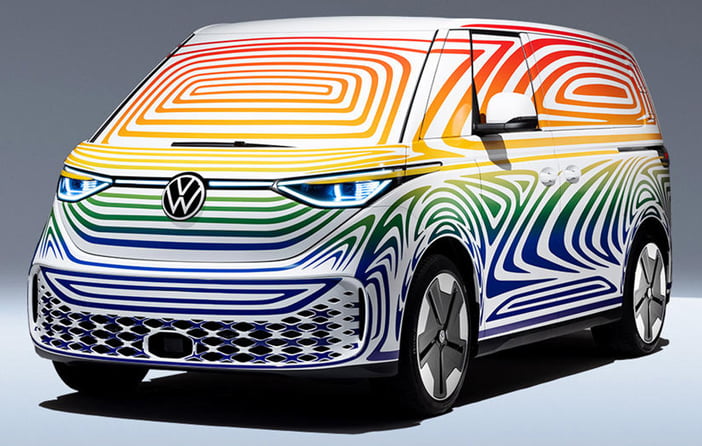
+++ VOLKSWAGEN has provided the clearest look yet at its upcoming electric-powered ID.Buzz with the unveiling of a camouflaged, pre-production version of the multi-seat MPV. The unveiling took place on the sidelines of a presentation dedicated to the new ID.5 at VW’s headquarters in Wolfsburg. Planned for sale during the latter half of 2022, the ID.Buzz is set to become Volkswagen’s 4th dedicated electric model, following the ID.3, ID.4 and newly unveiled ID.5. It will also be the first ID model to be offered both as a passenger vehicle and a commercial vehicle, with production planned to take place at VW’s commercial vehicle plant in Hannover, Germany from early next year. Based on Volkswagen’s MEB electric vehicle platform, the new MPV will be offered in both standard- and long-wheelbase guises – the latter not planned to be launched until 2023. Both models will offer a variety of seating layouts and interior configurations. The production ID.Buzz adopts a squarer shape than the earlier concept in a move that, Volkswagen officials have told, is aimed at providing it with maximum interior space. The overall silhouette mirrors that of Volkswagen’s latest internal-combustion-engined Microbus, with which the new ID model is claimed to share elements of its bodyshell, chassis and interior architecture. Many of the earlier concept’s styling cues have also been toned down, giving the new ID model a cleaner and perhaps less heavily contrived look than originally expected. Key exterior design details exposed in the latest photographs issued by Volkswagen include angular headlights that wrap into the front wings. They are connected by a light band that runs through a large VW badge featured prominently on an angled bonnet. Lower down, there is a full-width grille similar to that of the concept. As with the Microbus, the production version of the ID.Buzz adopts 2 conventional front-hinged doors at the front as well as two parallel sliding doors at the rear. Technical details of the new ID model have yet to be announced, although it is expected to share its drivetrain and battery configurations with other ID-badged models. Significantly, the ID.Buzz is also set to play a crucial role in the launch of Volkswagen’s autonomous driving technology, which the firm is developing in partnership with Argo AI. From launch in 2022, it is planned to be equipped with level three functionality, but Volkswagen says it will be able to introduce level four capability shortly afterwards. Volkswagen Group sibling company Moia has already confirmed it will be the first company to make use of the self-driving functions planned to be made available on the ID Buzz. +++
+++ VOLKSWAGEN has outlined plans to within the next 4 years start a ride-sharing scheme of autonomous-capable ID.Buzzes as a precursor to a range of commercially offered EVs with advanced self-driving functionality. A prototype version of the self-driving MPV was shown last month in Munich, which is one of several locations playing host to Volkswagen and partner firm Argo AI’s comprehensive autonomous vehicle testing programme. Trials are currently being held non-stop at a dedicated test track near Munich airport, but the test vehicles will soon be deployed on public roads throughout the city as the firm ramp up to commercialising their new technology. The scheme will be run by Volkswagen’s Moia mobility division, which runs a ridesharing service in Hamburg and Hannover, Germany, using a bespoke electric minibus, and before the pandemic was also conducting a British pilot scheme in partnership with transport operator RATP Dev in the London borough of Ealing. The Volkswagen Group’s push for autonomous vehicles is a central part of its ambitious New Auto strategy, under which it is seeking to grow revenues with a focus on EVs and software services. By 2030, it hopes to have transformed into a “mobility company” from purely a car manufacturer. “Autonomous driving has huge potential for the industry”, said Volkswagen Group CEO Herbert Diess. “We think that until 2030, the mobility industry can double in size because of autonomous driving”. Projects like that under way with Argo AI are crucial to achieving that goal, as a fully developed autonomous vehicle ecosystem could eventually give the Volkswagen Group a revenue stream comparable to that currently resulting from traditional car sales. However, Diess remains adamant that conventional cars will continue to form the backbone of the firm’s output, because “people driving or being driven in owned, leased, shared or rented cars will still account for 85 % of mobility, and those 85 % will be at the core of our business”. The Volkswagen Group will invest some £1.9 billion into Argo AI as part of their partnership deal, but the autonomous vehicle trial programme is a wholly collaborative operation. Argo AI founder and CEO Bryan Salesky said the US company’s engineers are working “hand in hand” with Volkswagen Group product developers. The trial process’s 2025 end date won’t represent a definitive conclusion. In fact, said Salesky: “The world underestimates how complex this is. It’s a multi-generational problem that I’m working on and our kids will be working on. It will probably never really be done”. He emphasised that deals such as those Argo AI has with the Volkswagen Group and Ford are key to the development and roll-out of autonomous driving technology, giving large manufacturers access to new tech and in return providing small start-ups with the means to scale up their offerings. “Everything we do is with the intention of scaling it out”, he elaborated, explaining that the project’s ultimate aim is to create “the world’s best driver”. As well as the wide-reaching usability benefits afforded by autonomous vehicles, there is also the safety aspect. A computer isn’t susceptible to tiredness or distraction like a human, so they should theoretically cut crash rates. However, the technology has some way to go before it will be ready for a commercial roll-out. As much as these early trials are being carried out with the aim of fine-tuning the technology, they are also essential for the artificial intelligence system to learn how to behave on public roads. Busy urban environments are much more challenging for such systems than motorways, but as Volkswagen sees a larger customer base for self-driving cars in cities, it is “going for the highest complexity” possible,according to Diess. Salesky agreed, predicting that autonomous ride-sharing will be of most interest to people in cities who are less attracted to the idea of private car ownership, so the system must be able to cope with pedestrians, bicycles, buses and other urban hazards. He also noted that developing the system in this way will allow it to be eventually used by urban delivery companies as well as passenger-carrying services. That’s why the ID.Buzz is being used for the trials: its flexible interior and all-electric powertrain make it ideal to investigate different use cases. The prototype displayed at Munich showcased Argo AI’s hardware, including a roofmounted lidar sensor it claims is the “farthest-reaching” in operation, with an ability to see more than 400 metres and identify complex hazards such as matt-black cars. Eventually, Volkswagen will extend its autonomous driving programme to cars for private use, with the Project Trinity saloon being designed “from the inside out”, such is its emphasis on automation. When it launches in 2026, it will have level-three autonomous functionality, enabling a human driver to take over, before being upgraded to level four in around 2030. Private cars capable of full autonomy are dubbed “time machines” by Volkswagen, because time spent driving will instead be available for working, relaxing or socialising in its vehicle. +++