
+++ We’ve done lots of reporting about how parts shortages, particularly semi-conductor chips, and the coronavirus pandemic have been reducing the number of new cars being built. As a result, there are fewer cars from which to choose on dealer lots, prices for those you can find are much higher, and as a major side effect, used car prices have skyrocketed. All of that has to do with the plight of car buyers, but the AUTOMOTIVE INDUSTRY ’s parts shortages and subsequent inability to build as many cars will have ripple effects throughout the economy. Those ripple effects were detailed today by a newspaper article, called “How Car Shortages Are Putting the World’s Economy at Risk”. It’s an insightful, recommended read. Here are some key excerpts: “For every car or truck that does not roll off an assembly line in Detroit, Stuttgart or Shanghai, jobs are in jeopardy. They may be miners digging ore for steel in Finland, workers molding tires in Thailand or Volkswagen employees in Slovakia installing instrument panels in SUVs. The auto industry accounts for about 3 percent of global economic output, and in carmaking countries like Germany, Mexico, Japan or South Korea, or states like Michigan, the percentage is much higher”. “The pain is falling hardest on workers and anyone in need of an affordable car. Auto companies have been allocating scarce chips to high-end and other vehicles that generate the most profit, leading to long waits for less expensive vehicles. Used car prices are skyrocketing because of the lack of new cars”. “It’s difficult to calculate just how much auto industry problems will spread to the rest of the economy, but there is little doubt that the impact is enormous because so many other industries depend on carmakers. Auto manufacturers are big consumers of steel and plastic, and they support vast supplier networks as well as restaurants and grocery stores that feed autoworkers”. “Semiconductors are not the only components in short supply. Carmakers are also scrounging for the type of plastic used to hold windshield wiper fluid and mold the dashboard as well as the foam used to construct seats, said Dan Hearsch, managing director in the Detroit office of global consulting firm AlixPartners. Because there is a shortage of a tiny bracket used in SUVs, Hearsch said, the amount of time it takes to fix a vehicle damaged in a crash has shot up to nearly 20 days, from 12”. +++
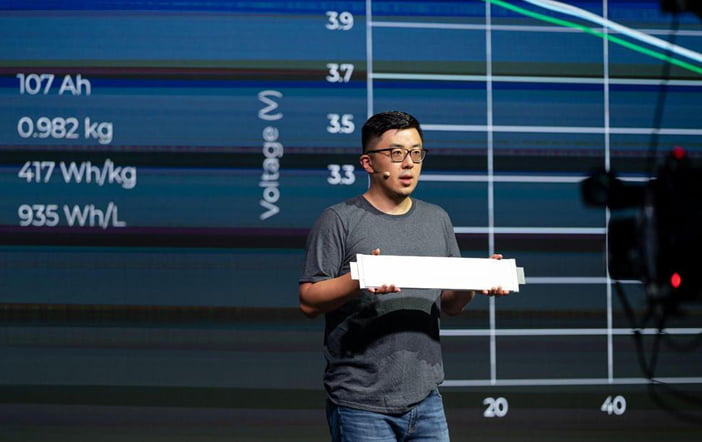
+++ Singapore-based BATTERY maker SES unveiled the world’s largest lithium-metal battery, marking a breakthrough for the automotive industry that is shifting towards electrification. The battery cell, with 107 ampere hours, is also the world’s first 100 plus Ah lithium-metal battery ever demonstrated. The average capacity of a lithium-ion battery cell in electric cars today ranges from 50 to 120 amp hours. SES founder and chief executive officer Qichao Hu said: “There’s a race among leading global carmakers and next generation battery suppliers to develop and demonstrate the world’s first 100 Ah Li-Metal battery. We are confident that we and our OEM partners will win this race, and be the first to commercialize this next generation lithium-metal battery”. Hu said SES is building a production facility in Shanghai, which is scheduled for completion in 2023. It will be capable of producing 1 GWh of li-metal batteries annually, by far the largest of its kind in the world. SES is working with General Motors and Hyundai to deliver practical samples next year, and aim to start commercialization of lithium-metal batteries in 2025. Analysts said its commercialization will prove important for the automotive industry that is shifting towards electrification. Carmakers in China, Europe and the United States have rolled out plans to go electric, ranging from volume brands including Volkswagen and GM to premium marques such as Jaguar and Volvo. In China alone, electric cars and plug-in hybrids are expected to exceed 3 million units this year, according to the China Association of Automobile Manufacturers. +++
+++ Some unfortunate chip shortage news just broke for those in the market for a new BMW . Certain models are going to lose their touchscreen functionality to save silicon and allow BMW to maintain its current production levels. The following models are going to be shipped without touchscreen functionality: 3 Series. 4 Series Coupe, Convertible and Gran Coupe (excluding the i4), X5, X6, X7 and Z4. It wasn’t all that long ago that iDrive equipped BMWs didn’t have touchscreen functionality at all, as all infotainment screen control was done through the iDrive controller. We’re taking a trip back to the past with the above models now, as once again, the only way to control them will be via the iDrive controller on the center console. I asked BMW what additional information it could provide about the issue, and were provided with the following statement from a spokesperson: “As you know, the global chip shortage is ongoing and impacting automakers worldwide. We are actively managing the situation and are in close contact with our suppliers. We do not have any further detail to share at this time”. Customers who take delivery of a car without the touchscreen will be given a $500 credit listed as “Deletion of Touchscreen”. BMW confirmed this to me, so expect $500 off the price of your BMW if it doesn’t come with touch functionality. In addition to the loss of the touchscreen, those cars will also lose the BMW Backup Assistant if they’re equipped with the optional Parking Assistant Package. The Backup Assistant is BMW’s auto back-up feature that will automatically reverse your vehicle along the same path that you pulled into a spot with. It could be useful in very narrow parking areas or spots with poor visibility. Vehicles without touchscreen functionality should be arriving to BMW dealerships soon, and then it’s up to customers to decide if $500 is enough of a boon to still drive home their brand-new car without a touchscreen. +++
+++ BMW will soon crown its SUV line-up with a range-topping X8, including a flagship hybrid M version that will be the Munich firm’s most powerful series production model to date. BMW has fuelled rumours that the Porsche Cayenne Turbo S E-Hybrid rival is about to be unwrapped, confirming “an all-new high-powered, hybrid-electric, concept vehicle” will be shown to media at the LA motor show on 16 November, ahead of a public reveal on 29 November. Notably, Franciscus van Meel, boss of the M division and Marcus Syring, head of M design, will be on hand at the reveal – suggesting a heavy performance focus for the new model. Expected on sale in 2022, the X8 serves as a sportier, more daringly styled version of the seven-seat X7. Although the X8 was once thought to take coupé-like rear-end design cues from the smaller X6, these first spy shots reveal that it retains a squared-edged roofline, albeit one that appears to be lower than the X7’s. This suggests that the X8 will retain 3 rows of seats, either in 7-seat form or with six captain-style chairs offering greater luxury. Neither is confirmed, though. Other design cues that mark this car out from the X7 include what appears to be a sharp nose design and broader shoulder line, plus a reduction in the glasshouse. Details of the X8’s technical make-up have yet to be revealed, but the expectation is that it will share its platform and much of the wider mechanicals with the X7. That means a range of six-cylinder petrol and diesel engines with mild-hybrid tech, an eventual plug-in hybrid and a 4.4-litre twin-turbo V8 with 530 hp in an X8 M50i. But, unlike the X7, the M50i won’t be the pinnacle of the range because the X8 has also been conceived with a full-fat M version at the forefront of its development. The X8 M will feature a plug-in hybrid system, mating the 4.4-litre V8 to an electric motor and battery pack. Insiders suggest anything up to 750 hp would be possible as a result, making this easily the most powerful BMW yet. Internally dubbed Project Rockstar, the X8 M hybrid will mate an electric motor of around 200bhp to the petrol engine and offer four-wheel drive. However, it is likely to adopt the switchable system of the M5 and M8 models, allowing on-demand rear-wheel drive when required. The plug-in hybrid element will also allow BMW to dramatically reduce the car’s fleet average emissions. Expect a CO2 rating of well under 100g/km as a result. What’s not yet clear is if BMW is also planning a conventionally fuelled X8 M to sit alongside it, with reduced power and weight. Given the X7 M50i is over €176.000 in the Netherlands, these range-topping models should push the X8 well over € 200.000. However, the most affordable X8 is expected to start from around €160.000. +++
+++ Global carmakers from Daimler to Toyota are showcasing their latest products and technologies at the ongoing CHINA INTERNATIONAL IMPORT EXPO , as a sign of their confidence in the world’s largest vehicle market. German auto group Daimler, which has been participating in the annual event for 4 years in a row, is presenting passenger vehicles including its first large electric sedan, the EQS. Hubertus Troska, member of the board of management of Daimler and responsible for Greater China, said: “Our participation underlines our strong commitment to the Chinese market and our customers. The CIIE is a prime example of China’s promotion of free trade and opening up. It is also a valued opportunity for us to learn from and exchange with our customers, business partners and friends in China”. China is the largest market for Daimler. As it is shifting towards electric, many of its EV models will be introduced or locally produced in China as well. In the coming months alone, the new EQA, EQB, EQS and the EQE will be launched in the Chinese market, said Daimler. The carmaker is scheduled to start production of Mercedes-Benz heavy-duty tractors in China in late 2022. Another German carmaker BMW is showing 6 imported models this year, including its flagship iX and the first-ever i4. The carmaker said the iX will be launched within this year, and the i4 will be available in the Chinese market soon. “The CIIE is the world’s first national-level expo with the theme of imports, demonstrating the determination and confidence of China’s opening-up and the great potential of the Chinese market”, said Jochen Goller, president and CEO of BMW Group Region China. He said BMW will promote open cooperation for a win-win result, and make continuous contribution to the community. “Apart from offering diversified products and seamless customer experience for our Chinese customers, we will continue our investment on the Chinese market and fully support China’s low-carbon economy”, said Goller. General Motors, the largest carmaker in the United States, is showing its electric GMC Hummer, the Chevrolet Corvette Stingray Convertible and the Chevrolet Silverado pickup. “The positive feedback we received for our halo products shown at the first 3 editions of CIIE has been tremendously helpful to our business planning”, said Blissett, GM executive vice-president and president of GM China. “We are making steady progress in introducing the displays at CIIE to the domestic marketplace to satisfy the increasingly diversified needs of local consumers in the era of high-quality development”, he said. The carmaker is also showing its Ultium platform for electric vehicles. GM said Ultium provides the power, range and flexibility to make almost every vehicle an EV and also offers an ideal technical pathway for intelligent and connected driving. Drawing on Ultium’s flexibility, GM aspires to eliminate emissions from all new light-duty vehicles by 2035 and achieve carbon neutrality by 2040. “This is also an era of technology transformation, one that is empowering us to offer new value propositions for our iconic nameplates as electrification and intelligent connected driving become game-changing forces,” said Felix Weller, GM China’s vice-president of premium import. Another US carmaker, Ford, is showcasing its models including the electric Mustang Mach-E, the Evos crossover and the F-150 pickup. Ford is the largest US vehicle exporter to China. From 2016 to 2020, it exported vehicles and components valued at 77 billion yuan ($12.02 billion) to the country. Annning Chen, president and CEO of Ford China, said the CIIE is a perfect platform for Ford to present its latest products and technology in China. The company said it will participate in the annual event in 2022 as well. It has been an exhibitor of the CIIE since its establishment in 2018. South Korean carmaker Hyundai and Japan’s Toyota are presenting hydrogen fuel cell vehicles and components at the event. Toyota has started production and sales of fuel cell systems in China and Hyundai is scheduled to produce the systems in late 2022. Hyundai’s plant in Guangzhou, Guangdong province, is its first overseas fuel cell system production facility. China imported over 750.000 vehicles in the first 9 months this year; up 21.9 percent year-on-year, mainly from Japan, Germany and the US, according to the China Association of Automobile Manufacturers. +++
+++ HONDA lowered its profit and vehicle sales forecasts for the fiscal year, pointing to shortages of computer chips and rising material costs. Honda recorded a 31 % drop in its fiscal second quarter profit, to 166.6 billion yen ($1.5 billion) from 240.9 billion yen last year. Quarterly sales slipped 7 % to 3.4 trillion yen ($30 billion). Honda is among many global manufacturers hard hit by a shortage of computer chips due to disruptions related to the pandemic. Executive vice president Seiji Kuraishi apologized for the problem. “We feel so sorry about all those people waiting eagerly for our cars”, he said, making a slight bow at a news conference. Kuraishi said the supply situation was starting to improve, but the recovery in Honda production likely won’t come in this fiscal year. Honda plans to rev up production in the next fiscal year to make up for the loss, and the current problems won’t hurt investments in future technology such as electric vehicles, he said. Honda expects a 555 billion yen ($4.9 billion) profit for the fiscal year through March 2022. That’s down 16% from the previous fiscal year, and lower than an earlier forecast for a 670 billion yen ($5.9 billion) profit. Honda sold 917,000 vehicles in the July-September period, down from 1.25 million vehicles last year. The company now expects to sell 4.2 million vehicles for the fiscal year through March 2022. It had earlier forecast sales of 4.85 million vehicles. Honda sold 4.5 million vehicles last fiscal year. +++
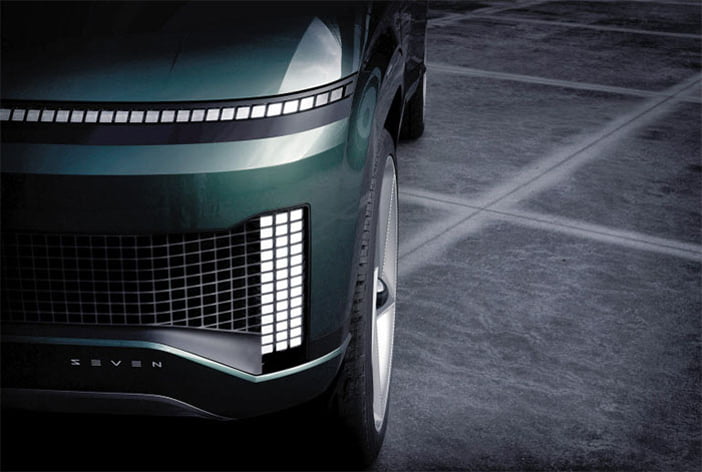
+++ HYUNDAI has unveiled a teaser image of its next fully electric large SUV, which will be called the Ioniq 7 and is due out in 2024. The image reveals only part of the front and pixel headlamps. Hyundai will unveil the concept car entirely at the AutoMobility LA motor show in California on November 19. It is creating a full lineup of electric cars under the Ioniq brand. The Ioniq 5 crossover came out in April and has racked up sales of 40.000 around the world already, and the Ioniq 6 sedan is expected next year. +++
+++ The HYUNDAI MOTOR GROUP said its mobility and software developers and leaders of research and development will speak about the conglomerate’s future technologies at an online conference from November 10-11. Albert Biermann, head of Hyundai-Kia’s R&D division, will talk about where the group stands now in research and development, and where it is headed to, how it is speeding up software development to provide a platform that hyper-connects the user and the vehicle. Cho Kyo-woong, head of electrical and electronic systems development, will introduce the group’s exclusive platform for electric cars called the E-GMP, hydrogen fuel cell, high-performance N brand, connected car and robotics technologies. Choo developed the Android Auto currently embedded in Hyundai – Kia cars, and currently heads electronic technology development such as infotainment and connected cars. Jang Woong-jun, chief strategy officer at Motional, an autonomous driving affiliate of Hyundai, will discuss self-driving software technology, and Hyun Dong-jin, head of Hyundai Motor’s Robotics LAB, will present on the need for robotics technology and what his team is working on now. Daniela Rus, director of the MIT-Computer Science & Artificial Intelligence Laboratory and AI adviser to Hyundai, will speak about robotaxis and Song Han, professor at MIT’s electrical engineering and computer science department who is conducting a joint AI research project with Hyundai on autonomous driving, will present on machine learning and deep learning. Anyone interested in mobility and software can participate in the conference and can have consult Hyundai ecruiters online during the conference. +++
+++ RENAULT SAMSUNG is likely to return to profitability thanks to the popularity of its new compact SUV, the XM3. The automaker has exported over 50.000 units of the vehicle in just 5 months since sales in Europe took off. If the brisk performance continues, it could see its fortunes turn around and earn W300 billion to W400 billion in annual profit (US$1=W1,182). Renault Samsung said that 50.840 XM3s have been exported so far this year, mainly to Europe, where the SUV sells under the name of Arkana: 19.737 to France, 6.245 to Spain, 5.785 to Germany, 4.275 to Italy, 4.268 to Poland, 1.884 to the United Kingdom and 1.254 to Belgium. Between 2015 and 2018, Renault Samsung manufactured 100.000 to 130.000 Nissan X-Trail SUVs annually, accounting for half of its total production. After the contract with Nissan ended in 2019, however, it started to post losses. But the success of the XM3 will turn the automaker’s fortunes around and its sales could reach 100.000 vehicles next year. “There was a global shortage of semiconductors, but the Renault Group prioritized the XM3 for chip supplies”, said a staffer at Renault Samsung. “The SUV will be our main vehicle to export at our plants” in South Korea. +++
+++ In SOUTH KOREA , local carmaker sales fell 22 percent last month on year as an extended global chip shortage and the Covid-19 pandemic continued to weigh on vehicle production and sales, industry data showed. The country’s 5 carmakers (Hyundai, Kia, GM Korea, Renault Samsung and SsangYong) sold a combined 548.192 vehicles in October, down from 705.047 units a year earlier, according to data from the companies. Their domestic sales declined 21 percent to 106.424 units from 135.495, while overseas sales dropped 22 percent to 441.768 from 569.552 during the same period, the data said. Hyundai’s sales fell 21 percent to 307.039 units from 387.197 a year ago. Kia’s declined 19 percent to 217.872 from 268.729 during the same period. Disrupted vehicle production amid the extended chip shortages drove down their monthly sales. Hyundai suspended the Asan plant several times since July due to the parts problems, which affected the production of the Santa Fe and the Sonata. To ride out the pandemic, Hyundai and Kia said they will focus on promoting their new models, including Hyundai’s all-electric Ioniq 5 and Kia’s all-electric EV6 model, for the rest of the year. To reflect the supply issues, Hyundai revised down its sales target to 4 million vehicles for the year from 4.16 million units announced early this year. Last year, it sold 3.74 million autos. Kia expected it won’t achieve this year’s sales target of 2.92 million units due to the same parts problems. Three other carmakers also achieved poor sales results last month due to parts shortages and a lack of new models. Increased exports at Renault Samsung did not help drive up its overall results last month. GM Korea was the worst performer in domestic sales and exports. Renault Samsung’s exports soared to 6.625 last month from 392 on increased shipments of the XM3, but its local sales declined 30 percent to 5.002 from 7.141. GM Korea’s local sales plunged 65 percent to 2.493 from 7.064, and exports nosedived 82 percent to 4.382 from 24.327. SsangYong’s domestic sales fell 57 percent on year to 3.279 autos last month from 7.612 and exports declined 42 percent to 1.500 from 2.585 during the cited period. From January to October, combined sales of the 5 carmakers rose 6.3 percent to 5.96 million units from 5.61 million in the year-earlier period. Their domestic sales fell 11 percent to 1.18 million in the 10-month period from 1.33 million units a year earlier, while overseas sales were up 11 percent to 4.78 million from 4.28 million. Sales of imported vehicles in South Korea fell 23 percent in October from a year earlier as a global chip shortage caused a lack of supplies, an industry association said. The number of newly registered foreign vehicles fell to 18.764 units last month from 24.257 a year ago, the Korea Automobile Importers & Distributors Association (Kaida) said in a statement. Vehicle sales declined as an extended semiconductor parts shortage continued to affect vehicle production and sales. The 3 bestselling models last month were Audi’s A6 45 TFSI, Volkswagen’s Jetta 1.4 TSI and BMW’s 520. In October, 3 German brands (Audi-Volkswagen Korea, BMW Group Korea and Mercedes-Benz Korea) sold a combined 12.317 units, down 26 percent from 16.604 the previous year. German cars accounted for 7 out of 10 imported vehicles sold in Asia’s 4th biggest economy last month, Kaida said. 3 Japanese carmakers (Honda, Toyota and its independent brand Lexus) sold 1.703 units, down 1.8 percent from 1.735 during the same period. From January to October, imported carmakers sold 233.432 autos, up 8.1 percent from 216.004 units in the same period of last year. Import brands accounted for 20.65 percent of the Korean passenger vehicle market in September, up from 15.7 percent a year ago. Their market share for October will be available next month, Kaida said. +++
+++ SSANGYONG said its sales plunged 53 percent last month from a year earlier on weaker demand for its models and a prolonged chip shortage. SsangYong sold 4.749 vehicles in October, down from 10.197 units a year earlier, the company said in a statement. Domestic sales dropped 57 percent to 3.279 units last month from 7.612 a year ago, while exports declined 42 percent to 1.500 units from 2.585 during the same period, it said. From January to October, sales fell 22 percent to 66.603 autos from 84.904 during the same period of last year. SsangYong’s lineup consists of the Tivoli, Korando, Rexton and Rexton Sports SUVs. The SUV-focused carmaker has been in a debt-rescheduling process since April 15 as its Indian parent Mahindra failed to attract an investor amid the prolonged Covid-19 pandemic and its worsening financial status. It filed for court receivership in December 2020 after failing to obtain approval for the rollover of 165 billion won ($148 million) of loans from creditors. SsangYong and its lead manager, the EY Hanyoung accounting firm, recently selected a local consortium led by Edison Motors as the preferred bidder for the debt-laden carmaker. +++