+++ In a lengthy interview with BMW chief technical officer Frank Weber, he hints that come 2026, BMW product planners will merge the 4 and 8 Series into a new 6 Series range. Rumor predicts that the 8 Series Gran Coupe will be the last car standing out of both lineups. It will no longer be an 8 Series, though, as it will be absorbed into the 7 Series range. If this comes true, it would be, as Shirley Bassey used to sing, “just little bits of history repeating.” The original 6 Series arrived in 1976, a shark-nosed icon of gorgeous badassery until 1989. The first breathtaking but slow-selling 8 Series appeared in 1990, holding on until continued slow sales forced BMW to kill it in 1999. The 6 Series returned in 2004, not as sharp as the first generation, but just as able to draw a very specific and devoted crowd. It would see a second generation, but BMW would eventually send the 6 back to its crypt in 2018 save for the sole survivor 6 Series GT, which was really just a renamed 5 Series GT. The Munich automaker then re-animated the 8 Series in 2018, also not as sharp as before, but even more slow-selling. So the rumor about a third act for the 6 Series, assuming it happens, would merely be the latest chapter in a decades-long saga. The death of the 4 Series, on the other hand, could be rationalized as an effect of coupe and convertible sales continuing their groundward trajectories. A lot is going to happen in the next 4 years in terms of technology and electrification, which could alter consumer tastes. On the other hand, 2026 is only four years away, so BMW is probably very close to a decision on what to do with the 4-series. Enthusiasts might also like to hear Weber say that the coming New Class (NKL) platform that will eventually support every BMW could easily create a path to “a highly-emotional model”. This could be the unicorn hybrid or electric halo car that whisperers won’t shut up about either as an i8 revival or a production version of the Vision M Next. +++
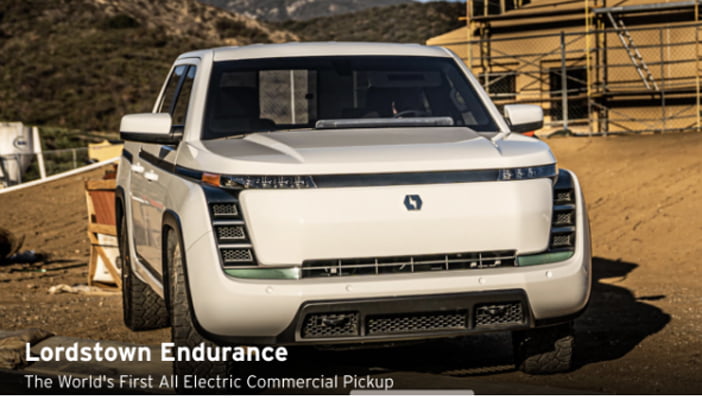
+++ Last November, LORDSTOWN MOTORS closed the deal to sell its manufacturing facility in Lordstown, Ohio, to Taiwanese electronics manufacturing conglomerate Foxconn. The plant went for $230 million, and could have been decorated with one of those banners reading, “Under new management!” On top of that, Foxconn put down another $50 million for an equity share of Lordstown Motors that opened up a joint-venture development deal for commercial EVs for North American and international markets. That part of the deal should have come with its own banner: “There’s a new sheriff in town”. That’s how you get Foxconn chairman Young Liu saying in an interview, “Electric pickups made in cooperation with Lordstown will begin shipping in the second half of this year”. and nary a peep from executives at the aspirational electric vehicle maker. A few days later, Lordstown Motors posted a picture of at least three pre-production Endurance pickups at the facility. The caption explained, “Thanks to our collaboration with Foxconn, our pre-production vehicles are rolling out of assembly and into diverse testing environments.” This would be the second foray into pre-production that we know of, and everyone will hope it goes better than the first. Last February, when powertrain engineers took one of the first Endurance prototype for its first drive, the pickup caught fire after 10 minutes, and burned to a crisp. None of the three engineers in the truck were hurt, and of course that’s the point of prototypes and testing: to catch issues like fire hazards before customers get their homes burned down. We’re sure there have been a lot of lessons over the past year that will make this latest version better. If Liu can be believed, we’ll all be finding out within the next 11 months. When the factory sold, Lordstown execs (not Liu) said Endurance deliveries would begin one quarter later than planned, in Q3 of this year. Liu’s new statement makes us think December could be more likely, especially if prototype testing has only recently begun. The lack of clarity about the whats and the whens is an effect of more than just the Foxconn deal; Lordstown got a new CEO and CFO in August last year, then it scrubbed information about the Endurance from its website as “a reminder for everyone that we’re geared toward fleet customers and so we don’t communicate with them through our website necessarily”. Also, investigations by U.S. prosecutors in Manhattan and the Securities and Exchange Commission need to be dealt with. If prototype testing goes well, we image we’ll start hearing more about the Endurance come the middle of the year. Meanwhile, Foxconn will be playing its own EV hands after showing 3 electric vehicle concepts of its own, built on its Mobility in Harmony open EV architecture, and it also has a deal to co-develop and build a Fisker EV called the PEAR at the Lordstown, Ohio, plant. +++
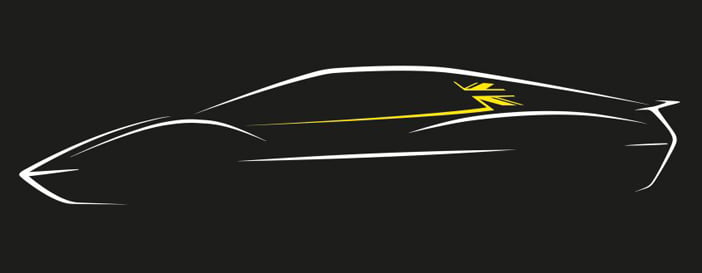
+++ Over the next 4 years, English sports car maker LOTUS will make its oft-attempted transformations real by unveiling 3 “lifestyle vehicles” on its new Premium Architecture. The first is the Type 132 electric crossover, expected to debut in the next few months. After that will come the Type 133 four-door coupe, then the Type 134 crossover that’s smaller than the Type 132. In that 4th year, we’ll get the Type 135, an electric sports car that will recall the Lotus of old. This electric coupe, sitting on the firm’s E-Sports architecture, is being called “a spiritual successor of the Elise”, which would be a good thing. The teaser sketch Lotus released to hype up the car also makes us think Esprit, which, as far as we’re concerned, is an even better thing. True, there’s Elise and Exige and Emira in those exaggerated fenders, but the pointy ends are vintage early Esprit. But the looks aren’t the point right now. The reason for the hubbub is Lotus signing a Memorandum of Understanding with British battery firm Britishvolt “to collaborate on research and development of advanced EV technology”. The cooperation would put Lotus in charge of “electric propulsion technologies” like motors and control systems, while Britishvolt oversees a “new battery cell package.” Goals for the pack are energy density, fast charging and weight reduction. Novel placement is on the menu, too, the E-Sports architecture laid out so that it can also accept batteries in the traditional style under the floor, or behind the cockpit à la a mid-engined sports car. The Memorandum of Understanding could give the battery company 2 clients in 1, as the Type 135 will be shared with Alpine across the Channel as well. By the time the Type 135 shows, Britishvolt’s $5.1 billion battery factory in Northumberland should have been up and running for two years, ready to supply cells to the Type 135 that will be built at Lotus’ historic Hethel, England headquarters (the other Types will be built in Wuhan, China at a manufacturing facility being developed by Lotus parent company Geely). The sports car will come in single- and dual-motor versions powering RWD and AWD trims, those motors expected produce anywhere between 469 and 872 horsepower providing a range of up to 450 miles on the WLTP cycle. The electronics will run on 800-volt architectures, the batteries ranging from 66.4 kWh to 99.6 kWh capacities. +++
+++ New survey results from J.D. Power just dropped today concerning the SATISFACTION of electric vehicle owners with their cars. Among non-luxury manufacturers, the Kia e-Niro ranked highest with a score of 744 (out of a potential 1.000). In second place, we have the Ford Mustang Mach-E with a score of 741. As for the “premium” segment, Tesla took both first and second in J.D. Power’s survey. The Model 3 ranked No. 1 at 777 points, and the Model Y trailed with 770 points. How does J.D. Power arrive at these rankings, you ask? It asked owners of EVs to score their cars in a variety of categories including: accuracy of stated battery range; availability of public charging stations; battery range; cost of ownership; driving enjoyment; ease of charging at home; interior and exterior styling; safety and technology features; service experience; and vehicle quality and reliability. From there, we arrive at a score. Looking at the EV market in general, J.D. Power posits that those making the initial leap into electric car ownership are highly satisfied with their experience; the same goes for those who have owned EVs in the past. On average, “satisfaction” of new EV owners with their cars is at 754. That number ticks upward to 766 for owners who have owned an EV prior to their current one. J.D. Power found that the top purchase reason to buy new for previous EV owners is the improvement in driving range versus older EVs, as 86 % of mass market buyers and 87 % of premium market buyers cited this aspect of ownership as their reasoning to buy what they did. In one rather “duh” conclusion, J.D. Power also says it found that ownership satisfaction is higher when receiving their EV tax credit is an easier process. Lastly, J.D. Power says that the top three problem areas for new EVs are infotainment issues, exterior quality problems and squeaks/rattles. +++
+++ Jaguar Land Rover (JLR) owner TATA MOTORS reported a quarterly loss on Monday that was bigger than expected and warned of rising inflationary costs. Automakers worldwide have been roiled by chip shortages, supply chain disruptions, Covid-19 restrictions and rising raw material prices after a short-lived recovery towards the end of 2020. “Demand remains strong despite near term concerns. The semiconductor supply situation is improving gradually whilst inflation worries persist”, Tata Motors said in an exchange filing. The company expects chip shortages at JLR to continue through 2022 as suppliers gradually ramp up production, and is also engaging directly with chip manufacturers to secure supply longer-term supplies for the Range Rover maker, it said. Tata Motors’ consolidated net loss came in at 15.16 billion rupees ($203.23 million) for the quarter ended Dec. 31, compared to a profit of 29.06 billion rupees a year earlier, when an easing of pandemic-related restrictions led to a pick-up in sales. However, the recovery was short-lived as acute semiconductor shortages and supply chain disruptions delayed production, and Tata Motors slipped back to losses. For the reported quarter, analysts had expected the Mumbai-based company to report a loss of 3.30 billion rupees. Tata Motors’ earnings before interest, taxes, depreciation, and amortization (EBITDA) margin, a key measure of profitability, was 10.2% for the quarter, above estimates of 9.3%. Total revenue from operations for the quarter fell 4.5% to 722.29 billion rupees, below estimates of 775.93 billion rupees. +++
+++ TESLA pushed back introductions of new models to next year, wagering the best way to continue expanding sales in the face of supply-chain challenges will be to further leverage a narrow lineup of big sellers. The world’s most valuable automaker will focus on scaling up production in 2022 to follow up what CEO Elon Musk called a breakthrough year both for Tesla and electric cars in general. Relying on just 2 vehicles (the Model 3 and Model Y) for 97 % of deliveries helped alleviate challenges led by the semiconductor shortage crimping output across the car industry. “Both last year and this year, if we were to introduce new vehicles, our total vehicle output would decrease”, Musk said after Tesla reported record revenue and earnings per share, both of which beat analysts’ estimates. Rolling out the Cybertruck, Semi or Roadster in 2022 “would not make any sense because we’ll still be parts-constrained”. While having to procure chips for just a handful of models has been an advantage for Tesla, putting off launches of new products carries some risk. Rivian is ramping up production of its R1T electric pickup, and truck-segment leader Ford is coming to market with a plug-in version of its best-selling F-150 in the coming months. General Motors has begun production of the GMC Hummer EV, with the Cadillac Lyriq and Chevrolet Silverado EV to follow. Tesla shares fell as much as 2 % to $919 before the start of regular trading in New York. The stock advanced 50 % last year after soaring 743 % in 2020. “Tesla shares tend to work the best when something new is coming”, Jeffrey Osborne, a Cowen & Co. analyst with the equivalent of a hold rating on the stock, said in a note. Lacking near-term additions to Tesla showrooms to promote, Musk spent much of Tesla’s earnings call discussing the potential of self-driving technology and a humanoid robot the company supposedly has under development. While Tesla has for years charged thousands of dollars for “Full Self-Driving” capability that it has said will live up to that name sometime in the future, the features are still in beta and humans must continue minding the steering wheel. Musk said the robot he first teased 5 months ago may be the most important product the carmaker is working on and has the potential to be more significant than its vehicle business. That will be a tall order, at least from an earnings perspective. Automotive revenue soared to almost $16 billion in the fourth quarter and was 90% of total sales. Tesla delivered more than 936.000 vehicles worldwide in 2021, up 87 % from the year before and exceeding the 50 % average annual expansion projected over several years. While Musk expects to comfortably exceed that growth again in 2022, the company warned its factories are likely to continue running below capacity through this year because of supply-chain issues. “The commentary on the risk factors is taking on a different weight in the current environment”, said Gene Munster, a co-founder of investment firm Loup Ventures. “Whenever there are unknowns about the future it can spook investors a little bit”. After sitting out Tesla’s earnings call last quarter, Musk returned Wednesday to explain the decision to further delay models he first showed prototypes of as far back as 2017. Tesla will do engineering and tooling work this year to get the Cybertruck, Semi and Roadster ready for production, “hopefully next year”, Musk said. The company isn’t currently working on a $25.000 vehicle that he said in 2020 Tesla would try to make in roughly 3 years. “We have enough on our plate right now, too much on our plates, frankly”, Musk said. “The thing that overwhelmingly matters is when is the car autonomous”. Tesla’s “Full Self-Driving” capability will become the most important source of profitability for the company over time, he said. Already the company has raised the price of the option and launched a subscription alternative. With last year’s net income of $5.5 billion on a generally accepted accounting principles basis, Tesla clinched a milestone that its CEO touted toward the beginning of the call. “Our accumulated profitability since the inception of the company became positive, which I think makes us a real company at this point”, Musk said. +++
+++ In the UNITED STATES , General Motors and Ford are expected to report next week they turned solid profits for the last quarter of 2021, but rarely has past performance mattered less to investors. The 2 Detroit automakers are in mid-leap between a combustion-powered present, and a future they have promised will be defined by electric vehicles and software-powered services. Both companies have mapped out multibillion-dollar investments in new North American electric vehicle and battery factories, aimed at challenging Tesla and a flock of smaller EV startups in the still-tiny market. But those new factories will not be at full speed until the middle of this decade. Though GM and Ford were once giants of the global auto sector, their market capitalizations have been dwarfed by EV maker Tesla. Tesla reported stronger than expected revenue and profit for the fourth quarter of 2021, but warned that supply-chain bottlenecks would continue through 2022 and likely prevent its factories from running at full capacity. GM last year sold fewer vehicles in the United States than Toyota, the first time in 91 years that GM was not the No. 1-selling automaker in its home market. GM and Ford’s profits in 2021 were lifted by consumers willing to pay record-high prices for gas-powered pickup trucks and SUVs. In 2022, analysts are concerned the Detroit manufacturers will face a more uncertain economic environment, including rising interest rates, high oil prices and continuing supply-chain bottlenecks that could curtail production. Analysts expect both companies to be cautious in their outlooks for 2022. Shortages of semiconductors are expected to weigh on production into the second half of the year, Bank of America wrote in a note. “While automakers will enjoy production recovery and inventory restocking, (those) could be coupled with price declines, mix deterioration, rising input costs”, Morgan Stanley said. Ford told investors in its third-quarter report that it expected $1.5 billion in higher commodity costs, and saw inflationary pressures across a broad range of expenses. Wall Street has shown more confidence over the last several months in efforts by Ford’s CEO, Jim Farley, to accelerate the company’s electric pickup and van programs. Ford’s market value hit $100 billion in mid-January, exceeding GM’s value for the first time in more than 5 years. But the market value of Ford, whose quarterly results are expected on Thursday afternoon, has since dropped by 20 % after the company issued a complicated reworking of its 2021 profit guidance. GM chief executive Mary Barra is expected to have a more straightforward story to tell about fourth-quarter and full-year results. GM chief financial officer Paul Jacobson told investors in December the company expected adjusted pretax profit for 2021 to reach $14 billion, higher than previous forecasts. +++