
+++ The next-generation BMW 7 Series is expected to enter production later this year before rolling out to global markets around early 2023. Based on reports and spy shots, seems we can expect a lot more revolution than evolution from Munich’s flagship luxury sedan. The top slot among the ICE powered trims will belong to the M750e xDrive PHEV. Tuned by the M division, its powertrain combines the B58 3.0-liter inline-6 with an electric motor for roughly 560 total horsepower pushed to all 4 wheels. M will also tune the handling dynamics, and based on camouflaged prototypes, the bodywork will wear M cues including, perhaps, quad trapezoid taillpipes. A version that may be called the 745e xDrive will utilize the same powertrain without the M badging and finessing, likely coming in around 480 hp. Sticking with the ICE half of the family, The base model will be a 735i with about 292 horsepower, the only rear-driver among the range. Above that comes a gas-powered 740i xDrive with about 370 hp, both using the same B58 3.0-liter inline-6. BMW is said to be retiring the current N63 4.4-liter twin-turbo V8 for the S68 V8. In the new 750i, that V8 could produce around 540 horsepower and will be even more powerful as a hybrid in the top trim of the XM crossover. The i7 will be motivated by electrons only, and supposedly will count eDrive50 and M60 trims ranging from 523 to around 619 horsepower. Design-wise, the G70/G71 sedans are going to borrow tech and features from the spearheads in BMW’s electrification push, the iX, i4, and XM. Outside, anticipate split headlights from the Concept XM flanking a large kidney grille with a new slat treatment and illumination options. On the sides, doors with flush handles will gain the pushbutton open and close functions most identified with Rolls-Royce, in back, the license plate holder will move from the trunk to the bumper for the first time in 7 Series history. Inside, there will be BMWs new infotainment system displayed on a huge, curved screen, Natural Interaction gesture control from the iX, the Motorway Assistant driving tech, and an even better Bowers & Wilkins sound system. +++
+++ The annual CONSUMER ELECTRONICS SHOW , which had primarily been the reserve of dedicated technology companies until recently, has grown into a major platform for the auto industry. Held in Las Vegas, the CES attracted more than 170 carmakers, suppliers and transport-related companies to present their novel gadgets and unveil ambitious blueprints about the next era of mobility. German carmaker BMW impressed with a model that can digitally change color. The car, called the iX Flow, is laminated in electrophoretic film containing microcapsules that contain white, black or colored particles that become visible when an electric field is applied. “The BMW iX Flow is a pioneering project in a field that opens up entirely new possibilities for car design and personalization”, said the carmaker in a statement. The carmaker also demonstrated an in-car 31.3 inch 8K display that can be connected via 5G. When the display folds down, blinds cover the rear window and the interior lights dim. A specially composed sound sequence introduces the upcoming experience, according to BMW. General Motors, the United States’ largest carmaker, highlighted its electrification plan at an online event. “Technology driven by purpose will change the world”, said Deborah Wahl, GM global chief marketing officer. “As we implement our growth strategy, we have an opportunity and, frankly, an obligation to create a better future for generations to come. That’s the Ultium effect”, Wahl said. GM unveiled its electric Ultium platform in 2020 and several models have been built on it, including the electric Hummer. The carmaker said more Ultium based vehicles are around the corner, including the electric version of its popular Chevrolet Silverado. Cadillac presented an electric, autonomous 2-seat concept vehicle called InnerSpace. At last year’s CES, it unveiled a single-seat air taxi concept and an autonomous vehicle for up to 6 passengers. “Electrification and autonomous driving will fundamentally change the role of vehicles and the experiences customers have with them”. said Bryan Nesbitt, a senior design executive at GM. “We’re exploring where that will go with these innovative concepts, envisioning mobility as an ally of wellness, giving customers the ultimate luxury, more personal time rather than taking it”. At this year’s CES, Stellantis, formed by the merger of Fiat Chrysler and PSA, announced that Chrysler will go electric in 2028. Stellantis also unveiled a new crossover concept, called the Chrysler Airflow, that is intended to represent the brand’s future direction. “The automotive industry is in the midst of a deep transformation, to say the least”, said Stellantis CEO Carlos Tavares. “In the next 20 years, we have an opportunity to redefine mobility, cars and how we experience them”. Chinese carmakers did not appear at the CES but Chinese startups specializing in such technology as autonomous driving and lidar made appearances at the event. RoboSense, headquartered in Shenzhen, Guangdong province, showcased the world’s first mass-produced automotive grade solid-state lidar. Baidu’s car subsidiary Jidu announced that it will partner with Nvidia to unveil a Level 4 autonomous model in 2023, which means the vehicle will be able to drive itself under most circumstances. The concept will be showcased at the Beijing auto show in April 2022, according to the company. “The Jidu vehicle has been designed to operate under the concepts of free movement, natural communication and self-improvement”, said Robin Li, Baidu co-founder and CEO. The CES also saw the latest attempts by traditionally nonautomotive companies in entering the fast changing auto market. Electronics company Sony displayed a seven-seat electric SUV at the event, in another sign of how the electronics and car businesses are overlapping. “We believe Sony is well-positioned as a creative entertainment company to redefine mobility”, said Sony chief executive Kenichiro Yoshida. Sony said the prototype features 40 sensors and will have Level 4 autonomous driving capabilities. It said it would establish a spinoff company later this year called Sony Mobility. This means Sony now plans to sell vehicles under its own brand rather than merely supply its technology to other carmakers. The Japanese company first displayed an electric vehicle model at CES 2 years ago, but at that time didn’t plan to sell a Sony car. Analysts said electric vehicles have fewer parts than gasoline vehicles and rely more on software controls, making it easier for companies that specialize in electronics to get into the business. +++
+++ FERRARI ’s new chief executive unveiled a new organization and leadership changes aimed at sharpening its technology focus and product exclusivity as the luxury sports car maker embraces electrification. Benedetto Vigna, a tech industry veteran and a former top executive at chip maker STMicroelectronics, took the CEO role in September with a task to drive Ferrari into the new era of cleaner, silent and interconnected mobility. Functions including “Product Development and Research & Development”. “Digital & Data” and “Technologies & Infrastructures” will now directly report to the CEO, Ferrari said in a statement. As part of the overhaul, the company appointed Gianmaria Fulgenzi (at Ferrari since 2002 and recently head of supply chain at its racing division) as chief product development officer, it said. Ernesto Lasalandra was hired from Vigna’s former employer STMicro to become Ferrari’s chief research and development officer. Silvia Gabrielli, who joined Ferrari in 2019 from Microsoft, was appointed chief digital and data officer to boost “the digital transformation process throughout the company, ensuring more data driven and digitally focused processes. The new organizational structure will further foster innovation, optimize processes and increase collaboration both internally and with partners”, Ferrari said in a statement. Ferrari also hired Angelo Pesci from STMicro, where he has spent over 20 years dealing with financial planning, supply chain and product planning, services and operations. He was named chief purchasing and quality officer at the Italian company. Bestinver analyst Andrea Trovarelli said in a report that Vigna’s decision to hire 2 top executives from STMicroelectronics suggested the CEO was “turning to trusted allies to aid his turnaround and to put the iconic manufacturer on course for electrification”. Ferrari has confirmed Mattia Binotto as boss of its Formula One racing team, it added. In one of Vigna’s first major moves Ferrari last month said it was shaking up its leadership structure, with 3 top executives leaving the company. Those included Chief Technology Officer Michael Leiters and Chief Brand Diversification Officer Nicola Boari, who oversaw Ferrari’s push beyond its luxury sports car business, with the unveiling in June of its first in-house fashion collection. Vigna will run the “Brand Diversification” function on an interim basis, Ferrari said. +++
+++ FORD has appointed Martin Sander as its new general manager for passenger vehicles in Europe. Sander, who has more than 25 years of experience with the Volkswagen Group, previously held the position of senior vice-president of European sales at Audi. He will take over from Roelant de Waard and Gunnar Herrmann, who both retired last year, and will report directly to Ford of Europe president Stuart Rowley. The German will begin to lead Ford’s European sales ventures on 1 June, where he will focus on pushing the firm’s electric and connected vehicle business forward. Sander will also have the responsibility of developing Ford’s digital customer experience for European customers. “Martin is a highly experienced leader with a wealth of global experience”, said Rowley. “His drive, leadership and new thinking will speed the transformation of our passenger vehicle business in Europe to provide customers with new connected experiences”. Sander has prior experience in senior positions in North America and Europe and has a mechanical engineering degree from the Technical University of Braunschweig. He spent nearly 3 years as vice-president of sales for Audi in the Americas before spending a further few years as vice-president of sales for Audi Germany. He also led the German firm’s operations in Canada, before moving to the UK as managing director. He left Audi in November 2021 after 2,5 years in charge of its European sales department and will now be based in Cologne, Germany, where Ford plans to start EV production next year. Cologne is also the home of Ford’s major manufacturing facility used to build the Fiesta, which suffered a significant sales drop in 2021, due to supply constraints. +++
+++ The HYUNDAI MOTOR GROUP is expected to achieve 3 million units in accumulated environment-friendly vehicle sales in the first half, driven by new models, industry sources said. The South Korean automotive group, which has Hyundai, Kia and Genesis under its wings, sold a cumulative 2.53 million eco-friendly vehicles as of November last year, according to industry people. From January to November, the 2 carmakers sold a combined 656.479 eco-friendly models in global markets, higher than the 501.487 units sold for the whole of 2020. The sales data for the whole of 2021 will be released later. Eco-friendly cars include all-electric, plug-in hybrid, gasoline hybrid, and hydrogen fuel-cell electric models. Sales of those vehicles are expected to rise further given demand is on the rise for Hyundai’s Ioniq 5 all-electric model, its independent Genesis brand’s electrified GV60 and G80 , and its smaller affiliate Kia’s pure electric EV6. This year, Hyundai, Genesis and Kia plan to launch the all-electric Ioniq 6, GV70 and e-Niro models, respectively, in global markets, along with hybrid models of the Hyundai Tucson and Santa Fe, and the Kia Sportage and Sorento. +++
+++ New registrations of imported electric vehicles (EVs) in JAPAN more than doubled in 2021; an encouraging sign for the likes of Tesla in what has been a tough market for foreign EV-makers. Registrations for imported EVs totaled 8.610 last year, up from 3.238 in 2020, the Japan Automobile Importers Association said. EVs accounted for 3.3 % of foreign car registrations in the nation in 2021, compared with 1.3 % the previous year. Japan has been relatively slow to embrace EVs, partly due to a lack of charging stations, parking space and sufficient subsidies as the vehicles tend to be more expensive than gasoline cars. Hybrid cars are more popular in the country. The landscape is shifting as EVs become more affordable. Tesla cut the price of the long-range version of its Model 3 by 24 % to nearly ¥5 million ($43.380) last year, driving up demand. Japan is also getting behind EVs as it aims to achieve carbon neutrality in 3 decades. In November the government doubled EV subsidies, including for ultrasmall “kei EVs”. Registrations of imported gasoline hybrids rose to 37.530 units last year from 13.465 in 2020, the association said. +++
+++ MERCEDES-BENZ suffered a 5.0% drop in sales in 2021, as it was heavily impacted by semiconductor supply-chain bottlenecks, which gripped the automotive industry. The German firm sold 2.093.496 vehicles between January and December 2021 (70.691 units down on pandemic-blighted 2020) and was hit particularly badly in the fourth quarter, when sales dropped by 24.7 %. Sales of plug-in vehicles climbed significantly, though, with 227.458 sold, representing growth of 69.3%. Of these, nearly 99.301 were pure-electric – a 90.3% uptick. The firm’s luxury, performance and off-road sub-brands also recorded positive results. “In a challenging year, Maybach, AMG and G-Class vehicles posted new records”, said Britta Seeger, Mercedes-Benz board member for marketing and sales. Some 15.730 Maybach models were sold, mostly in China, where almost 900 units of its ultra-luxurious take on the S-Class were delivered each month. Meanwhile, global sales of AMG models soared by 16.7 % to 145.979 units and 41.174 examples of the ultra-rugged G-Class SUV found homes worldwide. Orders for the EQS electric limousine reached 16.370 since its launch in August last year, Mercedes said. As its electric and electrified car line-up continues to grow, the firm anticipates it will record a continuing decline in emissions across its line-up. Mercedes says demand was high in the fourth quarter of 2021, despite the semiconductor supply bottlenecks, and insists customers will have their orders fulfilled. “Mercedes-Benz is making every effort to ensure that surging customer orders can be fulfilled as soon as possible”, said Seeger. “The date when a customer placed an order is taken into consideration when scarce chips are allocated for vehicle production. The semiconductor supply situation remains volatile and the shortage is expected to impact the upcoming quarters in terms of production and sales”. Mercedes also achieved a 2.6 % rise in commercial vehicle sales, with 334.210 units sold, credited to an increase in demand in the first half of the year. Around 9.000 electric vans were sold for commercial use – double the figure of 2020. +++
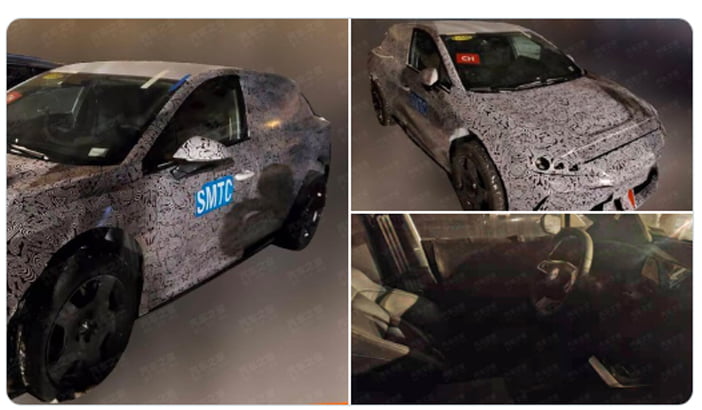
+++ MG is set to unveil a new high-riding electric hatchback in the coming months and European sales of the 5-door model are already being discussed, according to sources at parent company SAIC. Exposed in prototype form in a series of photos uploaded to Chinese social media channels over the weekend, the new hatchback is planned to join the recently facelifted ZS EV, 5 EV and Marvel R in a 4-strong line-up of electric MG models. Although the project is shrouded in secrecy, Autointernationaal understands MG is planning to preview the new model as a concept at the Beijing motor show in April before unveiling the definitive production model during the second half of the year. Chinese media reports suggest the new hatchback could replace the second-generation MG 3, which has been in production at MG’s Nanjing plant in China since 2011, offering the choice of both electric and combustion drivetrains. Among the styling details identifying the prototype as an MG is the middle section of the hatchback’s distinctive front bumper, which is shaped similarly to that of the Chinese-owned car maker’s recent Cyberster roadster concept. The new model also features a prominent shoulder line reminiscent of that seen on the ZS. Other details are obscured by camouflage wrap covering the bodywork, though images from underneath show the battery and reveal the early testing mule uses an independent rear suspension. The new MG is described as being shorter than the ZS, which extends to 4.314 mm in length. +++
+++ Electric bus maker Edison Motors has finally signed a deal to acquire cash-strapped SUV maker SSANGYONG . The 2 sides wrangled over the terms and the transparency of the investment plans till the last minute but managed to reach an agreement by the Monday deadline. Ssangyong, which is in court receivership, applied for authorization of the deal on Monday morning and a court granted it that afternoon. Under the deal, Edison has to pay Ssangyong W304.8 billion by March (US$1=W1,196). The EV maker already paid W15.5 billion when it signed a memorandum of understanding and pumped in another W15 billion when the contract was signed. Edison also agreed to loan W50 billion in operating funds to the SUV maker. The contract was supposed to have been signed last month, but was delayed after the two sides clashed over the W50 billion operating funds. Edison wanted a say in where the money will be spent, but Ssangyong refused. The two sides eventually agreed that Ssangyong will discuss it with Edison before spending the money. Now the SUV maker has to submit a self-rescue plan, including a debt-repayment schedule, to the court by March 1 that needs to be approved by two-thirds of Ssangyong’s creditors. +++