
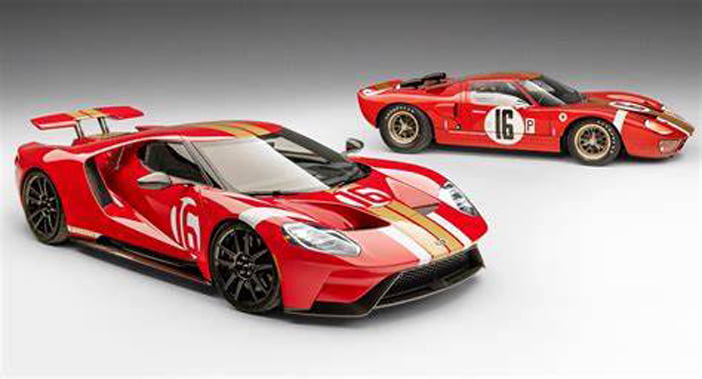
+++ When FORD loosed the latest GT resurrection in 2016, the automaker initially planned to build 1.000 units over 4 years. After more than 7.000 hopefuls applied for the chance to buy one, someone widened the production spigot a wee bit. Ford agreed to instruct Canadian contractor Multimatic to build 1.350 examples, the revised figure carrying the build process into 2022. Here we are, and the end of the GT line is maybe 10 months away. Ford spokesman Jiyan Cadiz told on the sidelines of the Chicago Auto Show that 1.100 GTs have been built, with production of the final 250 expected to end in December. Some of that 250 will be the just-revealed Alan Mann Heritage Edition that celebrates lightweight GT40 prototypes from 1966 and the 1964 Prototype Heritage Edition that recalls Ford’s original 1964 GT40 prototypes. I am not sure how many of each will make the request list, but Cadiz did share production figures for previous heritage editions. Ford sold 27 examples of the 2017 Ford GT 1966 Heritage Edition that looked back at the first of the GT40’s four-in-a-row Le Mans victories in 1966. There were 39 of the 1967 Heritage Edition sold in 2018, that car honoring the #1 GT40 Mk IV that carried the second of the 4 straight Le Mans triumphs. The Gulf Livery Heritage Editions spanning the 2018 and 2019 model years attracted 50 buyers, the coupe hearkening back to the #9 John Wyer Automotive Engineering car that won Le Mans in 1969 and the #6 car from the same team that won Ford’s final victory in 1969. There were another 50 examples of the 1966 Daytona Heritage Edition, a nod to Ken Miles winning the 1966 24 Hours of Daytona in a GT40 MkII. That’s 166 Heritage Edition cars out of the 1,100 total. Classic celebration or modern marvel, there’s no wrong answer for any of the 250 buyers sponging up the end of the GT’s run. Now that the sun is about to set, we can turn our imaginations toward what a third GT resurrection might look like. Electric supercar, anyone? +++
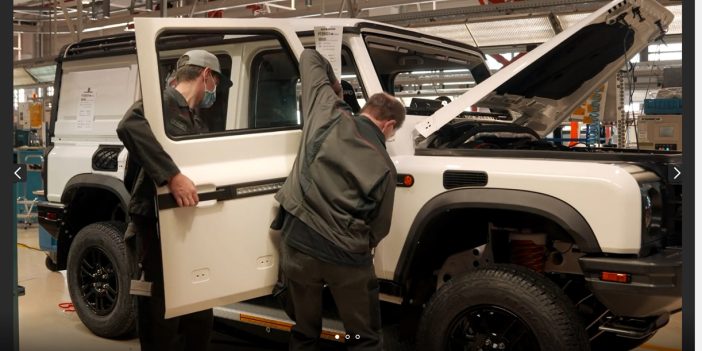
+++ Early-phase production has commenced for the Ineos GRENADIER , the rugged 4×4 designed to fill the void left by the original Land Rover Defender when it was replaced in 2020. Ineos is now in the ‘production try out’ stage at its plant in Hambach, France, where it is building batches of prototype vehicles to finalise factory process before full production begins later this year. In 2020, Ineos Automotive decided to move the Grenadier’s production from a proposed facility in Wales to one in France. At the time, the move was branded a “no brainer” by the brand’s commercial director Mark Tennant, despite the fact that it scuppered 500 jobs for the UK’s post-Brexit motor industry. Ineos originally planned to assemble the Grenadier in Wales, near Ford’s soon-to-be closed Bridgend plant. However, the firm instead took ownership of the Mercedes factory in Hambach; it’s handily close to the German border and allows for easy transport of the 4×4’s BMW mechanicals. Before Ineos bought the factory, Mercedes’ parent company Daimler was due to close the Hambach plant, which only produces the Smart EQ ForTwo. However, the electric city car will now be built alongside the Grenadier in the same factory, with Daimler contracting the car’s production to Ineos. When Smart production ceases, Ineos will have access to more equipment and facilities to ramp up production of its 4×4. Trial production run Ineos has now begun production of more than 100 prototype vehicles to hone the manufacturing process and iron out any missteps before building customer vehicles. The brand has taken around 15.000 reservations for the Grenadier so far, with final specs and pricing set to be confirmed around April this year. Speaking on the production try-out phase, Mark Tennant said: “We need to get the vehicles to the customers at 100 per cent quality. We also need to be ready for problems – there will be problems, and we’re ready for that”. The Grenadier is being manufactured on an adapted Smart production line, which spans 1.000 metres across 4 factory wings. The Hambach plant is said to be the first-ever carbon neutral car factory, and employs around 1.000 workers to build the Grenadier. Since the Grenadier is significantly larger and heavier than the Smart, the carriers along the production line have been reinforced, as has the building itself. Due to the car’s body-on-frame construction, the Grenadier is built as a rolling chassis first, before being married up with its BMW derived powerplant. Ineos has invested €500 million into the factory, mainly to fund new body and paint facilities for the SUV. The company is also utilising robots that were originally intended to produce Mercedes EVs, which construct the body and frame of the car and use 600 measuring points to ensure that they are built to the nearest millimetre. For rust protection, wax is injected into the body of each Grenadier, and certain parts are e-coated to prevent corrosion. At present, defective components are taken off the production line to be inspected by hand and using ultrasonic sensors, to identify mistakes in the process so they can be rectified for full production. Aside from robot maintenance, inspections and loading componentry, the entire body-building process is automated. At the time, Tom Crotty, Ineos’s communications director, spoke to BBC Radio 5 about the company’s decision to move the Grenadier’s factory onto the continent. “We were looking to build in Wales and, in the meantime, we had an approach from Mercedes who we built a very good relationship with through Formula One and who had a ready-made factory on the Franco-German border available to us. “It’s almost brand new”, he said. They were going to use it to build a 4×4, they changed their business position and therefore we had a very simple business decision. Do we want to take the risk of building our own factory or do we want to take one that Mercedes has already built and is ready to go? And that was a very simple business decision to make. That was the driver. We’ve heard a lot of stuff about how it was to with Brexit or all sorts of other things, but that’s absolute nonsense. It was to do with a very simple business decision. Someone is presenting you with a state-of-the-art, new factory that’s ready-built versus the risk of building your own”. Crotty also commented on the comparably limited number of jobs the Welsh factory would have provided, compared to the rest of the Ineos’s operations. He said: “We would have employed 200 people in Wales. We currently employ 6.500 in the UK on our chemical plants and we’ve just acquired BP’s business, which extends that by another 1.000 or so people. So, we think that we are providing huge numbers of high quality jobs for the UK”. Tennant said that the company “understands” the adverse reaction from some UK commentators regarding the company’s decision, but revealed that taking on a pre-existing manufacturing facility was always an option under consideration. “The commercial side of the argument that I think people will absolutely get is that the whole industry has been completely knocked sideways by what happened in 2020. The commercial benefit of buying an existing factory which has received recent investment, that is suited to the product we are producing with a highly skilled workforce already in place, it’s kind of a no-brainer to go down the road that we’ve gone”, he suggested. “This allows us to get to the start line, irrespective of Covid in pretty much the same timetable as originally planned. That’s huge for us”. Q: Can you explain the financial advantage of choosing Hambach over the Bridgend plan? A: “I think that the main advantage is to hit our timing plan. We had the original plan we were happy with pre-covid to build anew with the Bridgend plant, but the world changed in 2020. So a couple of things, from our side we were getting quite nervous about the ability to break ground and put the buildings up in time with the lockdowns in south Wales. From Daimler’s side they clearly were having a rethink on their strategy for Hambach. We did look very extensively at using existing plant capacity in Europe and beyond earlier on in the project and couldn’t find anything suitable. As a result of covid they had a rethink and it came up as a possibility. So before any idea of Bridgend there was a search for a pre-existing factory to build the car in Europe? Yeah, we looked at and beyond Europe to be honest. We looked extensively: capacity is not in short supply in terms of existing manufacturing facilities, overcapacity has been a problem in the industry for a while. But we went for the choices we made because everything that was available was too big, too old, too much investment, nothing really worked. When Hambach came up as an opportunity, it had received considerable investment to accommodate a new electric SUV Mercedes was planning to build there, and therefore it suited us extremely well”. Q: Could a deepening of the relationship with Daimler be possible? A: “It’s an ongoing relationship. We were a principal partner on the Mercedes-AMG F1 team so we know them well. But this is a deal which stands on its own feet and I can’t speculate on what happens in the future”. Q: So no technology advantages for you in terms of the EV tech on site? A: “I think our focus is on making the most of Hambach generally. We are going to be contract manufacturing the Smart ForTwo for a while for Mercedes, and the focus is on delivering the best quality product that they rightly require in that time. From an alternative fuel point of view that’s clearly something we are looking at closely for Grenadier. You will know of the M.O.U we signed recently with Hyundai looking at fuel cells, and we’ve still got an open mind on what the long term future for alternative fuel techs might be”. Q: How does the move to drop Bridgend and go for Hambach affect the image of the company? A: “I think that there’s an emotional and a commercial response. The emotional one I understand particularly with Brexit going on and the negatives around our decision not to go to Wales, and we were torn as well, as we were very happy with the plan we had. The commercial side of the argument that I think people will absolutely get is that the whole industry has been completely knocked sideways by what happened in 2020 and the commercial benefits of buying an existing factory which has received recent investment, that is suited to the product we are producing with a highly skilled workforce already in place, it’s kind of a no-brainer to go down the road that we’ve gone. Above all else Ineos is a business and the owners are very commercially minded. This allows us to get to the start line with covid in pretty much the same timetable as originally planned. That’s huge for us. Of course we are torn and we understand some of the emotional outpourings as a result of the decision. What aspects of the Grenadier remain British? Ineos already employs about 6.000 people in the UK, Ineos Automotive is a British company and we employ about 100 people; that’s increasing rapidly as we get closer to production and we expect to be doubling that number in the course of the next 12 to 18 months. We are very proudly British but we are also pan-European. We have similar numbers in Germany, we have the engineering element being done by Magna in Austria, in spite of the fact we are no longer doing sub-assembly work in Portugal we have retained an office and people down there mostly on the logistics side. So I think we can still speak quite passionately about Ineos being a British company, but equally as with every larger OEM the supply base is not parochial, it is across borders and we are no different to anybody whether they are doing general or final assembly in the UK or not”. +++
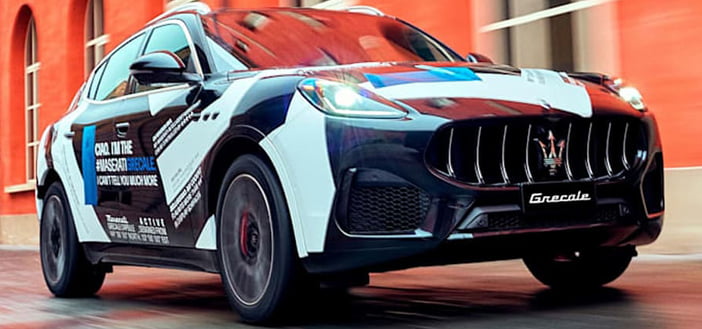
+++ The MASERATI Grecale’s final production design has been all but revealed, as the firm’s second SUV sheds its bulky camouflage ahead of a public debut on 22 March. Originally planned for an unveiling last year, the Grecale was delayed due to a shortage of semiconductors preventing Maserati from commencing series production. The company said it made the decision “in view of the background problems that have caused interruptions in the supply chains for the key components necessary to complete the car’s production process”. Production limitations imposed by the crisis mean it would not have been able to cater to the anticipated global demand for the car. Now, though, the brand has confirmed that it will unwrap its crucial second SUV in just 4 weeks’ time. The Grecale is clearly a similar size to the Alfa Romeo Stelvio, with which it will share the bulk of its underpinnings, and now we’ve had a good look at the car’s final design, the influence of the larger Levante is evident. It is named Grecale after the “fierce north-east wind of the Mediterranean Sea”. The model forms a key part of Maserati’s bold revival plan that it launched in 2020 with the reveal of the MC20 supercar. Destined to play “a key role in the brand’s development”, the Porsche Macan rival will be built on the same production line as the Alfa Romeo Stelvio in the FCA plant in Cassino, Italy. Maserati is planning an investment of around €800 million in the plant. It will also share much of its underpinnings with the Stelvio, and a fully electric version, the Folgore, is also due to arrive down the line. However, the combustion-engined models will use Maserati rather than Alfa Romeo sourced engines, likely to include the mild-hybridised 2.0-litre turbo offered in the Ghibli and Levante, and a downtuned version of the MC20’s new Nettuno V6 for the most potent variant. Maserati global planning boss Francesco Tonon told the Grecale will be “the most practical in its class, but it will also be luxurious”, adding: “It will feature the best-in-class design and features. Of course, it’s still a Maserati but it will also offer best-in-class performance and handling”. SUVs are expected to account for 70 % of Maserati’s sales by 2025, with saloons reduced to 15 % and sports cars, such as the newly launched MC20, making up 5 %. Car The new SUV was first confirmed back in 2018 by former FCA boss Sergio Marchionne as part of a total overhaul of its product line-up. Also included are the MC20 in 3 variants: coupé, Spider convertible and fully electric, plus a new Granturismo and Grancabrio, due in both combustion and electric forms. By 2023/2024, the brand will also have a new-generation Levante and Quattroporte, also both available with an electric powertrain. In top-spec form, this will use an 800V electrical system and 3 motors. +++
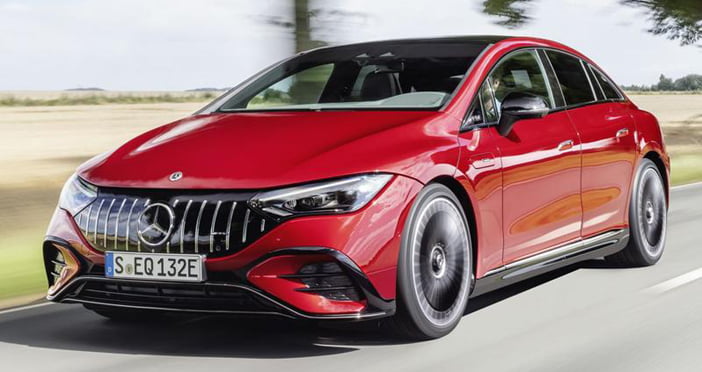
+++ MERCEDES-AMG has unveiled the new EQE 43 4Matic and EQE 53 4Matic+ ahead of their planned introduction later this year. The new 4-wheeldrive performance saloon duo joins the larger and more powerful Mercedes-AMG EQS 53 in a widened range of models based on the German car maker’s dedicated EVA electric car platform. Building on the rear-wheel-drive Mercedes-Benz EQE 350 revealed at last year’s Munich motor show, the EQE 43 adopts a second electric motor on the front axle. Similar to that used by the EQS 450, the synchronous unit boosts the new electric-powered four-door’s output by 184 hp and 300 Nm to a combined 476 hp and 850 Nm. The EQE 53 ups the ante further with AMG-specific electric motors that feature adapted windings, a higher current and a water lance for additional cooling effect, among other improvements. It develops a combined 627 hp and 950 Nm of torque as standard, or an even stronger 687 hp and 1.000 Nm with an optional AMG Dynamic Plus Package. This provides the most powerful of AMG’s EQE models with 7 hp and 150 Nm more than its prime electric-powered performance rival, the Porsche Taycan Turbo, whose twin electric motors develop a combined 620 hp and 800 Nm. Drive is channelled through a single-speed gearbox on each motor to all 4 wheels, providing both the EQE 43 and EQE 53 with a fully variable apportioning of power. A new heat exchanger has been added, allowing the transmission oil to be preheated in cold temperatures for improved efficiency. Both models feature 4 driving modes: Slippery, Comfort, Sport and Sport Plus. The EQE 53 offers an additional Race Start mode in combination with the AMG Dynamic Plus Package. Mercedes-AMG puts the 0-100 kph times at 4.2 seconds for the EQE 43 and 3.5 seconds for the regular EQE 53. With the additional 60 hp and 50 Nm brought on by the AMG Dynamic Plus Package, the EQE 53 reduces this to a claimed 3.3 seconds. The top speed of the EQE 43, like that of the EQE3 50, is artificially limited to 200 kph. This is raised to 200 kph for the standard EQE 53 and 240 kph for the EQE 53 with the AMG Dynamic Plus Package. By comparison, the Taycan Turbo has an official 0-100 kph time of 3.2 seconds and a 260 kph top speed. A 400 volt, 90.6 kWh battery with 360 individual lithium ion cells features on both models. It can be charged at 11 kW or 22 kW on an AC system and at up to 170 kW on a DC system, with the latter claimed to provide an additional 180 km of range in 15 minutes. Official range claims are yet to be revealed, although AMG says we can expect “something in the region of 500 km”. As well as upping the performance of the electric motors, AMG has given its new EQE-based models upgraded air suspension, which features a new rear axle carrier with stiffer bearings and less play than that used by the EQE 350. Further developments include AMG-specific wheel carriers and suspension links, larger diameter anti-roll-bars and adaptive damping properties. The EQE 43 and EQE 53 also ride 5 mm lower than the EQE 350. For added aerodynamic efficiency, the suspension lowers a further 15 mm in both Sport and Sport Plus modes and, at 120 kph, in Comfort mode. Upgraded brakes combine 415 mm discs and 6-piston calipers at the front with 378 mm discs and single-piston floating calipers at the rear as standard. Buyers can also specify 440 mm carbon-ceramic front discs in combination with six-piston calipers at the front as an option. To enhance braking performance, AMG has also reprogrammed the i-Booster function for what it describes as an “optimised pedal feel”. Further changes include standard-fit AMG Sound Experience; a uniquely tuned sound generator providing the EQE 43 and EQE 53 with a similar driving sound to the EQS 53 across 3 main modes: Balanced, Sport and Powerful. Both AMG models receive exterior styling upgrades. These include a new-style grille with vertical chrome-look louvres and AMG lettering, a more heavily contoured front bumper with larger air ducts, wider sills, a boot lip spoiler and a new lower section to the rear bumper that incorporates a more prominent diffuser element. Wheels range from 20 inch to 21 inch in diameter. As with the EQS 53, buyers can specify various exterior styling packages, including an AMG Night Package in black and darkened chrome. Various elements can also be had in carbonfibre. Inside, the EQE 43 and EQE 53 adopt a flat-bottomed AMG steering wheel with a rotary drive mode controller, together with unique digital instrument graphics and AMG sport seats, as well as new pedal caps, door sill trims and Alcantara upholstery as standard. As in the EQE 350, the 1.410 mm wide Hyperscreen is available as an option. +++
+++ Elon MUSK gifted almost $6 billion worth of Tesla stock to charity late last year in one of the largest philanthropic donations in history. The world’s richest man donated more than 5 million shares in the electric-car maker from November 19 to November 29, according to a filing with the Securities and Exchange Commission. The gift was worth about $5.7 billion, based on average prices the days he sold the securities. The filing doesn’t name the charity and shows an unidentified trust was involved in the transaction. The donation occurred as Musk, Tesla’s chief executive officer, sparred with politicians including Bernie Sanders and Elizabeth Warren over inequality and a proposed wealth tax. In the weeks leading up to the gift, Musk suggested he’d sell stock if the United Nations proved $6 billion would help solve world hunger, after the head of the organization’s World Food Programme called for billionaires like Musk to “step up”, A large gift to charity would help reduce what Musk has said would be the biggest tax bill in U.S. history. Days before he completed a series of stock sales worth more than $16 billion (much of which was to cover the exercise of almost 23 million options) the CEO tweeted he would pay more than $11 billion in taxes for the year. Much of Musk’s wealth is tied to Tesla, which overtook Toyota as the world’s most valuable automaker in July 2020 and joined a select group of companies with trillion-dollar valuations in October. Tesla’s market capitalization has slipped since then to about $905 billion. As his net worth has grown, Musk has bristled at criticism of billionaires and said he’d sell his homes and most of his possessions. With a $227.3 billion fortune, he’s more than $47 billion richer than the world’s second-wealthiest person, Amazon founder Jeff Bezos, according to the Bloomberg Billionaires Index. Musk has an eponymous foundation that’s become more active over recent years, with large, eight-figure gifts promised to the city near his South Texas spaceport, a $100 million competition for carbon removal and a $5 million contribution to two scientists researching Covid-19. Before then, his foundation’s largest contributions were to donor-advised funds, or DAFs, where charitable money can sit in perpetuity. The Musk Foundation, which used to count Musk’s brother Kimbal as a director, has recently added a new face to its roster. Several grant recipients Bloomberg News spoke with have said their primary point of contact at the foundation is Igor Kurganov, a professional poker player-turned-philanthropist who is active in the effective altruism space. +++
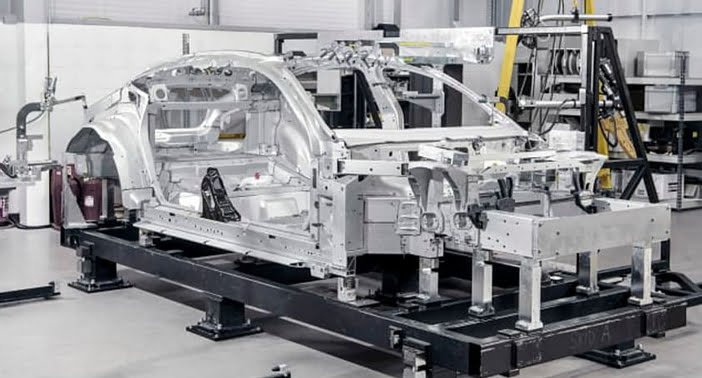
+++ POLESTAR ’s well-received Precept concept is making the transition from a design study to a production model. Now called 5, the electric 5-door fastback will ride on a new architecture made largely out of bonded aluminum that the Swedish company developed in-house. Designing a platform from scratch is a surprising move for the firm; it’s owned by China-based Geely, which has numerous architectures in its global portfolio, and one of its sister companies is Volvo, which sells several large sedans and SUVs. And yet, Polestar started from a blank sheet of paper. It explained that taking this route will help its engineers keep overall weight in check and expedite the sedan’s arrival. Bonded aluminum promises to make the 5 lighter than some smaller cars, according to Polestar, while giving it more torsional rigidity than 2-door sports cars and supercars. Both of these attributes are important: less weight means better handling and, for an electric car, better driving range while increased rigidity should make the fastback feel tighter around a turn. Polestar’s goal is to develop a true sport sedan. Engineers at Polestar’s research and development center in England had to develop a new manufacturing process to ensure that the 5 can be built relatively quickly and without quality-related issues in spite of its bonded aluminum architecture. I’m told that the production-bound model will look a lot like the concept that previewed it, though we already know that some changes were inevitably made. Photos of a prototype published in September 2021 notably reveal that the suicide rear doors have been replaced by front-hinged units, for example. Polestar plans to launch the 5 in 2024, meaning we might not see it in our showrooms until the 2025 model year. Until then, the company’s range will grow with the addition of 2 crossovers called 3 and 4, respectively. The former will be built in the United States and is scheduled to make its debut before the end of 2022, while the latter will be sportier and smaller. Both will be only offered with an electric drivetrain. It will be interesting to see what (if anything) Polestar does to offset the presumably high costs of developing this platform. It could use it to underpin other models, but it could also let some of its sister companies build a car on it in order to reap the rewards of economies of scale. There’s no word yet on whether it’s modular enough to underpin, say, a big SUV or a coupe, but we’re hoping to learn more details soon. +++
+++ Bad behavior is up all over in the UNITED STATES . Some of it is merely annoying; ask any “essential worker” about how customers have changed in the past 2 years. Some of it is a major inconvenience, such as unruly airline passengers forcing flights to turn around or land immediately; an epidemic so pervasive that the Federal Aviation Administration publishes regular data on the airborne scourge. And some of the bad behavior is killing increasing numbers of people on the roads. The number of vehicle miles traveled is marginally above pre-pandemic levels now, but the number of pedestrian deaths is setting records in states across the country. A piece in the New York Times starts by looking at a 7-year-old’s death in Albuquerque, New Mexico, then surveys various authorities to find out what’s going on. The rough consensus is, “anxiety levels, larger vehicles and fraying social norms”. The debate about larger vehicles has and will continue to rage; what part does the sales domination of the pickup, SUV and crossover since 2009 have to play in the rise of pedestrian deaths? Traffic fatalities in the U.S. from 2010 to 2020 rose more than 20 %. From 2009 to 2019, total miles driven rose by 10% but pedestrian deaths rose by 50 %. This has happened while “reported rates of walking among Americans have been on the decline”. Nevertheless, Governing.com wrote that, “In 2018, 6.283 pedestrians died by car, the most since the mid-1990s, and that’s not including the 1.500 people killed in driveways and parking lots”. However, in the European Union, where the crossover continues to climb the sales chart, traffic fatalities dropped by roughly 33 % from 2009 to 2019, pedestrian deaths dropping as well. What are we doing differently than Europe? More and more academic and government types are saying pandemic-inspired mental states are the cause. An L.A. Times piece from December wrote that “the pandemic has made U.S. drivers more reckless; more likely to speed, drink or use drugs and leave their seat belts unbuckled” and that “experts say that this behavior on the road is likely a reflection of widespread feelings of isolation, loneliness and depression”. In the NYT story, the director of Stanford Medical School’s Center on Stress and Health cited the constant presence of threats like the virus and the lack of social contact for partly creating in society “the feeling that the rules are suspended and all bets are off”. A researcher in Washington believes vehicles are providing the same sort of detachment and disconnection we usually attribute to the Internet, with drivers “given anonymity in this giant metal box around us, and we act out in ways that we wouldn’t face to face”. A scientist in Austin, Texas, said the nation being frazzled is partly from “2 years of having to stop ourselves from doing things that we’d like to do”. +++