
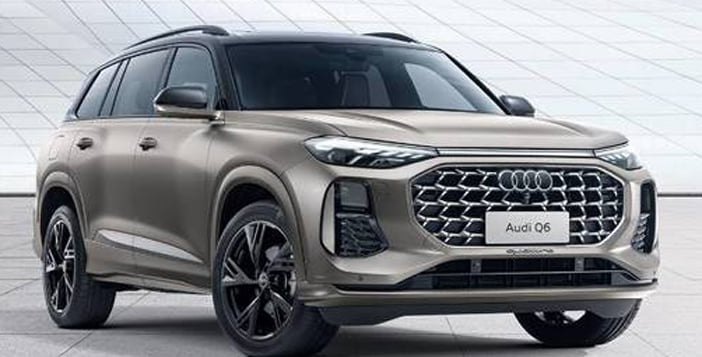
+++ SAIC AUDI has unveiled its first full-size SUV, the Q6. The unveiling which took place today was held in Shanghai and Beijing simultaneously. At the unveiling event, SAIC Audi also offered the new SUV for pre-sale reservations. The new SUV will be offered in 4 trims: 40 TFSI Quattro, 45 TFSI Quattro Qiyun, 50 TFSI Quattro Cloud type and the 50 TFSI Quattro Lingyun Edition First Release Limited. Price ranges from 500.000 yuan ($74.000) for the base model to 650.000 yuan ($96.000) the high end trim. Customers who want to purchase the car can log into the SAIC Audi app and make an initial deposit of 6.666 yuan ($990). The Audi Q6 is a full-size SUV that blends German engineering with elements of Chinese styling. Marketed as Audi’s “flagship Roadjet land plane”, the Q6 is SAIC Audi’s third model after the Q5 e-Tron and the A7L. The automaker gives users a wide range of options with 8 color choices, 6 different wheel styles, and up to 11 interior themes to choose from. The SUV measures 5.099 x 2.014 x 1.784 mm for length, width and height respectively, while the wheelbase measures 2.980 mm. Built to seat 6 or 7 passengers, the seats are covered in leather, and all front seats are fitted with a 12-way electric adjustment function. In addition, the Q6 comes with a 14-speaker Bang & Olufsen sound system and the multi-function steering wheel is draped in Nappa leather. It also comes with a triple-screen setup reserved for high-end Audi models. The displays include Audi’s 12.3-inch virtual cockpit that serves as an instrument cluster, a 10.1-inch MMI touch screen, and an 8.6-inch display. This is in addition to the head-up display system to aid drivers. The new Q6 has 2 turbocharged engine options, and 0-100 km/h takes 7.3 seconds. The first engine is a 4-cylinder EA888 2.0-liter turbocharged engine churning out 195 or 220 kW and a peak torque of 400 or 500 Nm. On the other hand, the second option is a VR6-cylinder EA390 2.5-liter turbo engine. Additionally, all models of the Q6 come standard with Audi’s intelligent Quattro system. +++
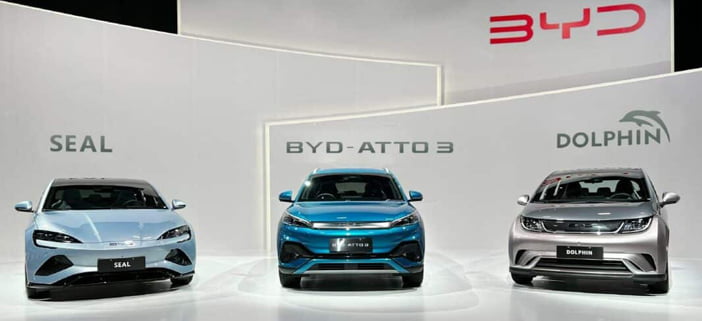
+++ BYD is all set to enter the Japanese car market and will begin by launching the Seal, Atto 3, and Dolphin models in Japan. According to a report by Autohome, these cars are expected to go on sale in Japan in January 2023. BYD Auto is a well-known Chinese automobile manufacturer with a strong domestic as well as international presence. It was back in 2003 that BYD Auto came into existence after the BYD Group acquired Qinchuan Automobile Company in 2002. BYD Auto produces electric bicycles, passenger cars, buses, trucks, forklifts, etc. BYD is the only Chinese car manufacturer that produces its own batteries. Batteries and Battery Electric Vehicles (BEVs) form a large part of BYD’s business. BYD is the largest EV manufacturer in the world. The brand has produced over 641.000 vehicles sold in the first half of 2022 and this includes EVs, Hybrids, and even some petrol vehicles. Apart from pure electric vehicles, BYD also produces plug-in hybrids. Until March 2022, BYD produced petrol-powered vehicles as well. While BYD has a strong base in China, the EV manufacturer has been on an expansion spree in recent times. BYD vehicles are available in countries like Bahrain, Dominican Republic, Ukraine, Moldova, Brazil, Hungary, Canada and America. On the American market though, BYD sold the e6 electric car and its electric bus only as fleet vehicles. BYD also retails Energy Storage Solutions, and Solar energy solutions in America. The brand has even established bus manufacturing facilities in California, Ontario, and Kumarom in Hungary. Now, BYD Auto is all set to officially launch its vehicles in Japan. Though BYD has several models in its portfolio, the Japanese market will initially get only the Seal, Dolphin, and Atto 3 models. The BYD Seal is an electric sedan based on the BYD e-Platform 3.0. It features technologies like CTB (cell-to-body) battery tech. The bottom of the Blade battery forms the floorboard of the car, therefore making the structure more rigid, thereby improving handling. It is available in 4 variants and the top of the line variant features a range of 650 kilometres. The top-spec variant features an AWD drivetrain with a total output of 390kW while 0-100km/h takes 3.8 seconds. When it was introduced in May 2022, the BYD Seal received over 22.000 bookings in just over 7 hours. The BYD Dolphin is an electric subcompact hatchback and this is also built on the same e-Platform 3.0 as the Seal. It looks properly modern and is available in 4 different drivetrain options. The top-spec variant has a range of 405 kilometres. The Atto 3 is an electric SUV that uses BYD’s patented Blade battery technology just like the Dolphin and Seal. The top-spec variant of the BYD Atto 3 boasts a 0-100 km/h acceleration time of just 7.3 seconds. It has a range of around 420 kilometres. Other features include LED lighting, 18 inch alloy wheels, seven airbags, a 12.1 inch touchscreen, etc. The 3 cars from BYD will be launched in the Japanese market in 2023. The Atto 3 will be the first model to be launched in Japan with its arrival slated for January 2023. The Dolphin will arrive in Japan in mid-2023 while the Seal will arrive in the second half of the year. To run the business in Japan, BYD’s subsidiary BYD Auto Japan was launched on July 04, 2022. A dealership network will be set up and BYD Auto Japan will provide the sales and after-sales service for the brand. +++
+++ The 19th CHINA Changchun International Auto Expo that kicked off on Friday in Changchun, capital of Northeast China’s Jilin province, has attracted tens of thousands of automobile enthusiasts. A total of 155 domestic and foreign automobile brands and 128 enterprises are vying for customers’ attention with their latest models, technology and services. The expo opened at a time when China’s automobile market is recovering from a COVID-induced slump earlier this year. It serves as a platform for automakers from home and abroad to seek new opportunities in the world’s largest auto market. The 10-day auto expo, covering a total exhibition area of 200,000 square meters, has 9 indoor exhibition halls and four outdoor exhibition areas. As of 10 a.m. Sunday, more than 26.000 consumers visited the auto show, according to its organizing committee. FAW Toyota displayed 15 vehicles spanning 13 models at the expo. Xu Jianxin, a sales manager with the company, said that despite the impact of the epidemic, mid- and high-end models have seen steady growth in sales during the event. The FAW Audi booth has 21 models displayed at the expo, drawing widespread attention of car enthusiasts. Meanwhile, 20 car models have been put on display in the Mercedes-Benz exhibition area. In June, the joint venture of Mercedes-Benz and BAIC Group in Beijing saw the 4 millionth complete vehicle roll off the production line. Arno van der Merwe, president and CEO of Beijing Benz Automotive, said the joint venture has learned from the advanced manufacturing system and technology of German factories and also fed back its own innovative technology and experience to the German factories. Since the beginning of this year, global auto companies including Audi, BMW and Volkswagen have accelerated their expansion in China, launching a number of large new energy vehicle (NEV) and other projects. The Audi FAW NEV project, with an investment of over 30 billion yuan (about $4.44 billion), broke ground on June 28 in Changchun. This is Audi’s first production base specifically for purely electric vehicles in China and is expected to go into operation at the end of 2024, with a planned annual production capacity of 150.000 vehicles. Volkswagen Group China is also accelerating the process of vehicle electrification. Volkswagen Anhui recently began working on a new project for manufacturing auto parts, with an investment of 130 million yuan. Located in Hefei, capital of East China’s Anhui province, the project has a planned construction area of around 31.000 square meters. Upon completion, it will provide auto parts including seats and accessories for NEVs produced by Volkswagen Anhui. On May 10, Volkswagen Group China announced to establish a new digital sales and services company in Hefei. The new company is expected to complete Volkswagen Anhui’s entire value chain in terms of manufacturing, R&D, testing, marketing, and customer services. China is the world’s largest automobile market. In 2021, retail sales of automobiles and related products accounted for 9.9 percent of the country’s retail sales of consumer goods. Thanks to the effective containment of Covid-19 resurgences and strong policy stimulus, China’s auto sales regained strong momentum in June after declining for three consecutive months. In June, a total of 2.5 million vehicles were sold, up 23.8 percent from a year earlier, according to the China Association of Automobile Manufacturers (CAAM). The automobile association expects steady growth for the entire year and has predicted annual vehicle sales to reach 27 million units, up 3 percent year on year. June’s NEV sales hit a record high of 596.000 units, jumping 1.3 times from the same month of last year and accounting for 23.8 percent of the entire auto sales, CAAM data showed. In the NEV sector, Chinese brands have leaped to the forefront of the market and even outperformed joint venture enterprises in certain technical fields. Han Zhuoxuan, a salesperson with China’s leading NEV manufacturer BYD, deemed NEVs the new trend and fashion. “Consumers are eager to learn more about and try out new NEV models”. +++
+++ In their first rollouts of ELECTRIC VEHICLES , America’s automakers targeted people who value short-range economy cars. Then came EVs for luxury buyers and drivers of pickups and delivery vans. Now, the companies are zeroing in at the heart of the U.S. auto market: The compact SUV. In their drive to have EVs dominate vehicle sales in coming years, the automakers are promoting their new models as having the range, price and features to rival their gas-powered competitors. Some are so far proving quite popular. Ford’s $45,000-plus Mustang Mach E is sold out for the model year. On Monday night, General Motors’ Chevrolet brand introduced an electric version of its Blazer, also starting around $45,000, when it goes on sale next summer. Also coming next year: An electric Chevrolet Equinox, with a base price of about $30,000, whose price could give it particular appeal with modest-income households. There’s also the Hyundai Ioniq 5 and Volkswagen’s ID.4 in the $40,000s and Nissan’s upcoming Ariya around $47,000 with a lower-priced version coming. All start off considerably less expensive than Tesla’s Model Y small SUV, the current top EV seller, with a starting price well into the $60,000s. The new models, which can get about 300 miles per electric charge, are aimed at the largest segment of the U.S. market: Modest-size SUVs, representing about 20% of new-vehicle sales. Industry experts say entering the smaller SUV segment, with its reach into a broader demographic of buyers, is sure to boost electric vehicle sales nationally. “Going to the smaller SUV segment gives you the opportunity to access the most customers in one market segment”, said Stephanie Brinley, principal analyst for S&P Global Mobility. “To make a transition from (internal combustion engines) to electric, you have to be in more space. You have to be in more price points. You have to be in more sizes”. Brinley noted that the small and midsize SUV segments meet many people’s needs, something that previous electric vehicles did not. “If it’s a price you can reach but it’s a product that you can’t put your kids and your dog in, you’re not going to buy it”, she said. Chevrolet says the Blazer will get a minimum of 400 km per charge. Pricier high-end versions could go up to 515 km. The Blazer will be available with Chevrolet’s SS performance package with a 0-to-100 kph time of 4 seconds. There will be a police version, too. “Early on, the demographic composition of an EV buyer was certainly someone that perhaps had higher education, higher household income”, said Steve Majoros, Chevrolet’s marketing director. “That’s very indicative of early adopters. But as we move up that curve, the intention and where we’re pricing this product is to certainly make it more available for more mainstream buyers”. To attract buyers of modest means, EVs need to be priced even lower, in the $30.000-to-$35.000 range, GM CEO Mary Barra said in an interview this week with The Associated Press. Electric vehicles, she said, also have to have the range and charging network so they can be the sole vehicle that some people own. “Most electric vehicle owners today own multiple vehicles, so they have an internal combustion vehicle to jump into depending on their needs”, Barra said. Automakers have been pushing to fully restore a $7.500 tax credit for people who buy EVs to jump-start sales. But the measure is stalled in Congress. It’s especially important for GM, Tesla and Toyota, which have maxxed out the number of credits they are allowed and can no longer offer them to buyers. Other automakers are approaching the limit, too. Money for the credits, as well as funding for additional EV charging stations, was in president Joe Biden’s $1.8 trillion “Build Back Better” social and environment bill, which is all but dead because of the objections of Sen. Joe Manchin, a West Virginia Democrat. Last week, Manchin also rejected a slimmed-down version that included provisions to combat climate change. He indicated his support for just two items from Biden’s broader agenda: Reducing prescription drug costs and bolstering subsidies for families to buy health insurance. His vote in an evenly split Senate would be needed for anything to pass. Even without the tax credit, the industry’s march toward electric vehicles is moving apace. Edmunds.com says electric vehicles now account for about 5% of U.S. new vehicle sales with 46 models on sale. S&P’s Brinley foresees the market share rising to 8% next year, 15% by 2025 and 37% by 2030. “It seems like the number of choices are growing exponentially for electric vehicles as we move forward”, said Erich Merkle, Ford’s top U.S. sales analyst. Demand for battery-powered vehicles and gas-electric hybrids has grown as gasoline prices skyrocketed this year. Dealers report that every vehicle delivered is typically already sold or gone soon after it arrives. Jonathan Chariff, CEO of South Motors, an 11-dealer group in South Florida, said it’s impossible to assess just how big the demand for electric vehicles is. There’s huge interest, especially in electric SUVs, and vehicles are selling fast. But the supply is constrained because automakers don’t have enough computer chips to build as many vehicles as they want. Given the enormous consumer interest in EVs, Chariff said he expects the vehicles to continue to sell even if their prices don’t fall. “The real question”, he said, “is if and when the supply chain can meet the market demand, what is the true price point?” +++
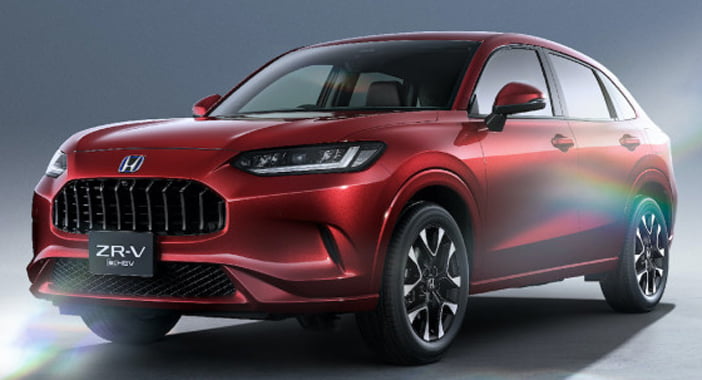
+++ HONDA announced Thursday that it will launch a new SUV named ZR-V this autumn. The SUV market has grown around the world, and the automaker intends to aggressively promote the model in Japan. 2 models of the SUV can be pre-ordered from September. A twin-motor hybrid version will be available, combining a 2.0-liter direct injection engine as used in the “Civic” model. A gasoline-powered version equipped with a 1.5-liter turbo engine was also unveiled. Prices will be announced shortly. The size of the new SUV is between Honda’s CR-V and Vezel (HR-V) compact models. The ZR-V went on sale in the United States in June, receiving about 6.000 orders. Honda has seen strong sales of its Vezel since its launch in 2021. In the same year, the automaker discontinued the production of the Legend high-end sedans and the Odyssey minivans. The company plan to strengthen sales of the ZR-V in the United States and China. Based on the grand concept of “Unleash your potential”, the all-new ZR-V was developed as a model to uplift the spirit of customers, like a favorite “special day” piece of clothing, and bring out their individuality. Key features include beautiful and sophisticated design, developed under the key words “glamorous & elegant,” and dynamic performance, achieved with a goal to realize driving at the will of the driver. These attributes will enable the driver to enjoy the vehicle with more confidence and in a relaxing manner, a value new to SUV models. All-new ZR-V adopts smart and elegant design which makes this model fit well in urban environments. The exterior design features flowing proportions characterized by large, smooth surfaces that flow from front to rear. The design of the front-fascia features a vertical grille, designed in concert with surrounding areas, and sharp-looking, wide-set headlights that flow horizontally. These features create a highly sophisticated expression, yet with stature and a strong presence. The rear of the body is shaped to emphasize the vehicle’s wide tread by adding volume around the bottom of the body, with a smooth, upswept look. The interior design realized a spacious cabin by adopting an instrument panel that stretches out horizontally in a linear fashion. Moreover, the interior design features a functional and precise finish on all parts to accentuate the beauty of the form, creating a high-quality interior space that is one class above the competition. In addition, a high-deck center console separates the front seats to create personal space for the driver and front passenger. The hybrid model of the all-new ZR-V will be the first Honda SUV to be equipped with the Sports e:HEV that combines a 2.0-liter direct injection engine that debuted on the Civic e:HEV and the advanced 2-motor hybrid system (e-CVT). The all-new ZR-V e:HEV will offer a high-quality, exhilarating and one-class-above driving experience in various driving situations including driving on city and suburban roads, highways and winding roads. The all-new ZR-V also will be available as a gasoline-powered model equipped with a 1.5-liter turbo engine with CVT, which offers highly-responsive and sporty driving. Both hybrid and gasoline models offer a real-time AWD variation, which enables customers to drive on snowy roads with greater peace of mind by realizing outstanding performance in making turns and climbing up snowy roads. Starting on Saturday, August 13,, Honda will hold pre-launch showcasing of the production models of all-new ZR-V at various locations in Japan. +++
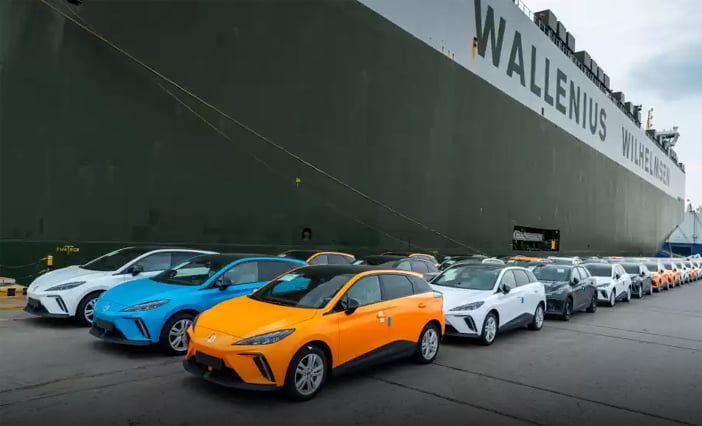
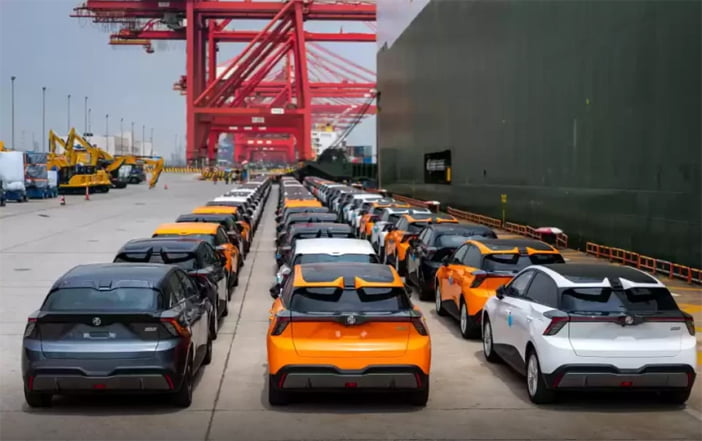
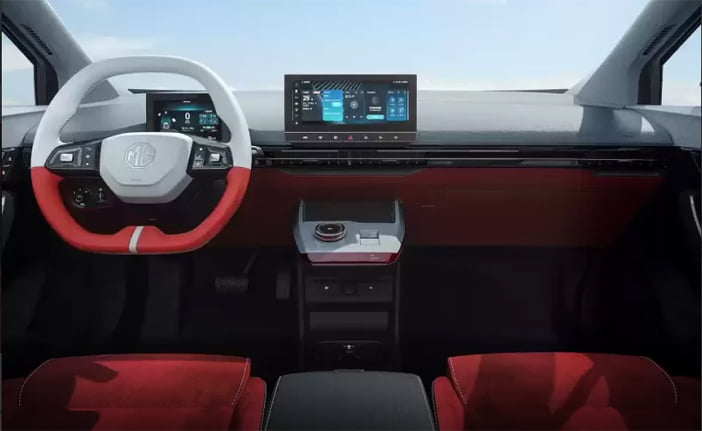
+++ On 21 July, 1.000 units of the MG4 EV were spotted at the Shanghai Haitong Wharf, as the company prepared to move them to Europe. This is the first batch of the MG4 models to cross over to the European market. The MG4 EV is a small pure electric family car, built by Chinese automaker SAIC Motor under its MG marque, and the models will be wearing an MG badge. Making its debut in June 2022 as the MG Mulan on the Chinese market, the car is the first vehicle to be built on SAIC’s battery electric Modular Scalable Platform (known as Nebula platform in China). Appearance-wise, the new MG4 EV maintains the same sporty looks as the MG Mulan, and it has a length/ width/ height of 4.287 x 1.836 x 1.516 mm and a wheelbase measuring 2.705 mm. For power, the EV will initially be offered with 2 battery options; a 51 kWh and a 64 kWh battery. The 51 kWh battery pack has a 350 km battery range, while the 64 kWh option comes with a 450 driving range. Both batteries should be able to churn out 125 kW and 150 kW of horsepower respectively. Another high-end AWD model is also expected later on and will be fitted with a high-power permanent magnet synchronous motor, capable of spitting 330 kW and churning out a max torque of 600 Nm. This model will be able to do the 0-100km/h in 3.8 seconds and have a limited top speed of 160 km/h. Furthermore, the interior sports a double D-shaped steering wheel, full LCD instrument panel, and a suspended central control screen. It is expected that the MG4 will come in different variants for left and right-hand drive configurations to satisfy different countries. With its European debut pegged at the fourth quarter of 2022, the MG4 EV will also hit dealerships across New Zealand, Australia, Mexico, South America, and the Middle East. It will then go on to other regions and countries in the early parts of 2023. The EV will have the likes of the Nissan Leaf and VW ID.3 for competition. MG officials claim that the brand sold over 45.000 cars in Europe alone between January and June 2022. +++
+++ Established premium carmakers are stepping up efforts to vie with local Chinese startups for buyers as the electric vehicle sector continues to boom in the world’s largest vehicle market. NEW ENERGY VEHICLES sales hit a record in June, with 596.000 units sold; up 132 percent year-on-year, according to statistics from the China Association of Automobile Manufacturers. The association estimates that sales for this year could reach 5.5 million in China; up from 3.5 million in 2021. In the premium segment, NEV sales in June accounted for 27.5 percent of total vehicle deliveries, according to the China Passenger Car Association. But this was still much lower than among Chinese brands, where the figure was 45 percent in the same month. The potential of the segment has triggered ongoing competition, mainly between conventional international giants and local startups including Nio, which has positioned itself to rival BMW and Mercedes-Benz. BMW said sales of its electric models in China in the first half of the year soared 74.6 percent from the same period of 2021. It did not give the specific EV sales figure in China. Globally, BMW’s EV sales more than doubled to 75.891 units from January to June. In comparison, Chinese startup Xpeng delivered 68.983 units in the first half in China alone and Nio, whose production was temporarily halted due to Covid-19, sold 50.827 units. Edward Wang, managing director of syndicated research at J.D.Power China, said Chinese brands are expected to lead in this age of smart EVs. He explained that Chinese carmakers have a better understanding of what local customers want and are quicker to adopt new technologies and launch new models. “Such innovation is injecting momentum into Chinese brands in a rapid, effective and continuous way”, said Wang. BMW is enriching its lineup of EV models to win customers back. By the end of this year, there will be five electric models for Chinese customers and the figure will rise to 13 by 2023. “We are stepping up our e-mobility efforts, aiming for more than a quarter of our sales in China to be all-electric by 2025”, said Jochen Goller, president and CEO of BMW China. BMW has started production of its electric i3 sedan at its Lydia plant, which opened in June in Shenyang, Liaoning province. The German carmaker said the mid-sized sport sedan was designed exclusively for the Chinese market, the largest worldwide for the carmaker. “The expansion of our production footprint in China shows we are preparing for further growth in the world’s largest electric car market and are confident in China’s long-term prospects”. “With BMW’s expanded and upgraded production base in Shenyang, we are now fully prepared to serve the growing market demand for e-mobility in China”, Goller said. Mercedes is stepping up its electrification efforts in the country as well. It said the EQ series saw their sales in the second quarter grow 28 percent from the first quarter, without giving the sales figures. It now has electric models including the EQA, the EQB and the EQC SUVs. Mercedes said the China-made EQE sedan has rolled off the assembly line at its Shunyi plant in Beijing and will be launched later this year. Another electric model, the seven-seat EQS SUV will be unveiled in China within months, it said. Mercedes said it is launching 21 models in China this year, of which 8 are NEVs. Audi kicked off construction of its first EV-only plant in Changchun in Jilin province in late June. The plant is set to be completed by the end of 2024. It is designed to produce more than 150.000 vehicles a year based on the PPE platform that Audi has developed with Porsche, another premium brand of Volkswagen. “We are bringing the Premium Platform Electric(in short: PPE) to China. This means, electric Audi models, from China for China”, said Markus Duesmann, chairman of Audi’s board of management. The first models expected to roll off the assembly line include the A6 e-tron sedan and the Q6 e-tron SUV, said Duesmann, who is also responsible for the carmaker’s China business. The plant is owned by Audi’s joint venture with China FAW Group. Called Audi FAW NEV Company, it is the first Chinese joint venture in which Audi holds a majority stake. Audi said it is investing around 2.6 billion euros in the overall project, including the creation of the joint venture and construction of the manufacturing facility. “Audi has a clear roadmap for the electric future. And the Audi FAW NEV Company is an important part of our strategy for China”, said Duesmann. Audi said it will offer 5 China-made electric models in the Chinese market by 2025. The carmaker estimated that NEVs will account for more than half the total premium vehicle sales in China by 2030. +++
+++ TESLA ’s Gigafactory in Shanghai has become the world’s largest factory by annual production volume, exceeding that of its California plant, news outlet The Paper reported. According to the Q2 financial summary of Tesla released Wednesday, recent equipment upgrades in its Shanghai base enabled the auto manufacturer to continue to increase production rate further, with the installed annual capacity exceeding 750.000 units. In comparison, the production capacity of Tesla’s factory in California reached 650.000 units, followed by Gigafactories Texas and Berlin, with the figures both surpassing 250.000 units. Statistics from the China Passenger Car Association, or CPCA showed Tesla China delivered a total of 295.000 vehicles in the first half, with 78.900 units in June, hitting a record high. Starting construction on Jan 7, 2019, the Shanghai Gigafactory delivered the first batch of China-made Model 3 in December that same year. In 2021, it has delivered 484.130 units of cars, an increase of 235 percent from a year earlier, accounting for 51.7 percent of Tesla’s global production capacity. Over 160.000 units of cars had been exported overseas last year, meeting the demands of more than 10 countries from Europe and Asia. Tesla is expected to produce more vehicles in China than in the United States, as its Shanghai plant has become the carmaker’s largest manufacturing facility across the globe. Tesla’s first-quarter report showed that as of the end of March, the Shanghai plant’s annual capacity was over 450.000 units. The carmaker made the Shanghai plant a major global export hub in the middle of 2021. In the first half of this year, the carmaker sold 294.800 Shanghai-made vehicles, including Model 3 sedans and Model Y SUVs in China, of which 97.182 were shipped overseas, according to the China Passenger Car Association. Tesla’s exports accounted for 48 percent of China’s new energy vehicle exports from January to June, said the association. Grace Tao, vice-president of Tesla, told reporters in June that the Shanghai plant is the carmaker’s most important production center and export hub, calling Shanghai-made Tesla vehicles a “business card of Chinese manufacturing”. Tao said over 50 percent of Tesla’s global deliveries in 2021 were made at the Shanghai plant, which is also the first wholly foreign-owned car-producing factory in the country. Tesla vehicles are among the most popular cars in China’; the world’s largest market for electric cars and plug-in hybrids since 2015. Popular domestic NEV makers in China include BYD and Wuling. “Few seem to realize that China is leading the world in renewable energy generation and electric vehicles. Whatever you may think of China, this is simply a fact”, said Tesla CEO Elon Musk in a Sina Weibo post in late May. Over 2.6 million NEVs were sold in China in the first half, and the total is expected to reach 5.5 million for the full year, said the China Association of Automobile Manufacturers. Answering questions from investors on Thursday, Musk said Tesla is the best carmaker in China, but added he has a lot of respect for Chinese manufacturers and electric vehicle manufacturers in particular. “They’re smart and hardworking, and I think any company that’s not as competitive as them will obviously suffer a market share decline”, he said. Edward Wang, managing director of syndicated research at J.D. Power China, said Chinese brands are likely to lead in this age of smart EVs. Wang said Chinese carmakers usually have a better understanding of what local customers want and are quicker to adopt new technologies and launch new models. “Such innovation is injecting momentum into Chinese brands in a rapid, effective and continuous way,” he added. +++