
+++ BMW has already put an M badge on an electric vehicle, first on the i4, then on the iX, but neither is actually what in the industry has come to be known as “a full M car”. Both those vehicles are certainly really quick and sporty to drive, but we have yet to actually see a proper Motorsport-badged EV, and the first ones may be the iX3 M and iX4 M that we are pretty sure BMW is working on right now. I don’t have a lot to go by, but through one of the Bavarian automakers’ parts suppliers, I learned that the 2 hot electric SUVs may be revealed as early as next year. Interestingly, on the list of models the supplier was providing parts for, the iX3 and iX4 had other code designations compared to the M models, strongly suggesting that they are definitely more than just M Sport variants (like the aforementioned i4 M50 and iX M60). In fact, I didn’t even know the automaker was planning on launching an electric X4 (which will come to be known as the iX4), so this was also new to me, on top of the fact that it’s also getting an M version. And I don’t know how powerful these new M EVs will be, but they will surely surpass the i4 M50, with its 544 hp. BMW recently revealed an EV prototype running a quad-motor setup. It was based on the i4 M50, but it had wider wheel arches, wider tires and some similarities to the current M3 and M4. The automaker didn’t say how much power that setup produces, especially since BMW engineers have made it clear that the new setup with 4 motors is completely different to what powers the current i4, so I have no idea what to expect. I have been told by BMW that the wait will be worth it, although we don’t know when the first proper M EV will actually debut. But now we are pretty sure that it will be hot versions of the iX3 and the yet-to-be-revealed iX4 that will be the public’s first contact with such a vehicle. And it would make sense, given that BMW has done this before. We are referring to the fact that the automaker first revealed the X3 M and X4 M (and the special S58 engine) that later also showed up in the M3 and M4 saloon and coupe models. Furthermore, SUVs are all the rage now so the Bavarian automaker probably expects to sell more high-riders than it would hot electric saloons and coupes. +++
+++ The numbers are in, and the news isn’t all good. Overall CUSTOMER SATISFACTION with cars fell by 1.3% from 2021 to 2022, according to a study conducted by the American Customer Satisfaction Index. Many luxury carmakers gained points, while some mainstream brands fell behind. After interviewing 4.708 customers chosen at random between July 2021 and July 2022, the American Customer Satisfaction Index concluded overall customer satisfaction fell to a score of 77 out of 100, down from 78 in 2021. Here are the numbers published by the AMSI. For the mass-market nameplates, the index is: Subaru (80), Toyota (80), Chevrolet (78), Hyundai (78), Mazda (78), Ram (78), Honda (77), Buick (77), Nissan (77), Volkswagen (77), Ford (76), GMC (76), Jeep (76), Kia (76), Dodge (74), Chrysler (72) and Mitsubishi (72). For luxury nameplates, the index is: Lexus (84), Acura (82), Audi (82), Infiniti (82), Cadillac (80), Tesla (80), Mercedes-Benz (79), BMW (77), Volvo (76) and Lincoln (75). The study found that drivers who own a so-called mass-market car are most satisfied with comfort, dependability, driving performance and safety; these areas all scored 81 out of 100. Drivers are least satisfied with warranties (75) and fuel economy (74). In the luxury segment, drivers are happy with comfort (84), interior (83), and safety (83), though warranties and fuel economy sit at 79 and 76, respectively. Some car companies are celebrating as you read this: Toyota, Chevrolet, Chrysler, Acura and Infiniti rose by 1%, 3%, 3%, 8% and 9% respectively compared to 2021. Others are likely rethinking at least some aspects of their business model: Hyundai and Mazda both dropped by 1%, Honda fell by 6%, Dodge dropped by 5%, while Volvo and Lincoln each lost a percentage point over the past year. Japanese and South Korean manufacturers collectively gained a percentage point, meaning they’re tied for first with European brands at 79. American carmakers posted a score of 77; General Motors rose by 1% to 78, Ford fell by 1% to 76 and Stellantis posted 75 after losing 1%. +++
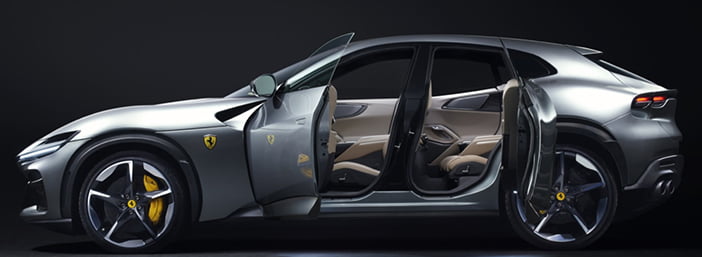
+++ Surrendering your cell phone is hard enough under any circumstance, let alone when you’re about to lay eyes on FERRARI ’s long-awaited, first-ever SUV which, incidentally, Ferrari absolutely refuses to call an SUV. Welcome to the world of so-called black box previews, where a journalist’s impressions are limited by his or her first hand powers of observation. In the curious case of the Ferrari Purosangue, we’re looking back at 75 years of both flirting with, and resisting, possibilities that would eventually become the brand’s first-ever 4-door, 4-seat car. Though the prancing horse has long been associated with relentlessly focused race cars, supercars and hyper cars, Ferrari has also straddled the line with a smaller selection of more GT-like 2+2s. Enzo himself enjoyed driving a 4-seater of his creation, and in fact considered a 4-door concept by Pininfarina in the 1980s before it was eventually shelved. Enter modern day, and the Purosangue before us marks a major turning point for the Maranello brand. Liberated from its red satin cover, the new model looks like nothing before it, despite the vaguely 296 GTB-ish front end and somewhat Roma-like taillamps. It’s a handsomely styled car that Ferrari brass say was designed with a keen eye toward the wind tunnel, though the company does not release aerodynamic drag figures for their GT models. Regardless, Purosangue comes across as more subtle and distinctive than the spy shots might have led you to believe, with flowing lines combined with novel features like an aerobridge on the hood similar to that of the F12 Berlinetta. In this case, however, the feature is designed to reduce drag, not create downforce. Design-wise, there is a lot going on, from the delicately tapered nose to the clever “floating” wheel arches to the complex curves of the rear haunches. The shape looks deceptively compact, until you consider those seemingly small wheels are actually 22 and 23 inch hoops tucked within those fenders. Interior volume is maximized thanks to relatively short overhangs, as is ease of entry due to suicide-style rear doors that open with an aperture of 79 degrees, via a power-actuated mechanism. The easy access is important, especially since there’s not a whole lot of legroom for the 2 rear occupants: For someone who is 1,80 meter, after getting comfortable in the driver seat then switching to the rear perch, he will find out that there is some space, but not a whole lot, for him to straighten his legs. However, there’s generous headroom that helps make the interior feel more vertically airy and spacious. The cabin is a combination of well-appointed, high-tech and modern, with individual rear bucket seats that echo the form factor of the front seats. Though the leather upholstery has an upscale feel, there are also contemporary touches like a more technical Alcantara carpet trim that also happens to be bulletproof. Symmetry rules the interior design, with a mirror-like dashboard that sculpts its form around the driver’s digital instrument cluster and a passenger screen that’s larger than what you’ll find in Ferrari sports cars. Though the power-operated rear doors feel fancy (and minimalist, thanks to their frameless design), there’s also an impression of functionality to the whole endeavour, but not too functional, as the sportiness of the seats is backed up by the relatively compact foot trunk. At least the rear seats fold down for added storage. Discreetly tucked between the rear seats is a flip-up leather cover for 2 cupholders; other unusual touches include a small multimedia control dial with grooved edges that raises or recesses at the touch of a button, and numerous shallow storage compartments that taper along lengthy sections of the interior. Rather than incorporate a hybrid or full-EV drivetrain, Purosangue features a delightfully old-school propulsion system: a naturally aspirated 6.5-liter V12 producing 725 hp and 716 Nm. Revised valvetrain, induction and exhaust systems enable the powertrain to realize 80% of its torque from 2.100 rpm. A dry sump system allows it to sit lower to the ground, and its front-mid-engine configuration and rear transaxle achieves an impressive front/rear weight distribution of 49/51. An all-new platform utilizes a stiffer, lighter structure that enables 30% more torsional stiffness than the late, great GTC4 Lusso, yielding a dry weight of 2.033 kilos. Mated to an 8-speed dual-clutch gearbox, the engine drives all 4 wheels and should go like stink, with a claimed 0-100 kph time of 3.3 seconds and a top speed of 310 kph. Like the now defunct GTC4Lusso, an all-wheel-drive system works up to 4th gear at 200 kph before disengaging. Subtly sleek, curvaceous and delicately proportioned, the Ferrari Purosangue exceeds expectations in the flesh. In a way it ought to, with a starting sticker price of about €470.000 in the Netherlands. More important, this difficult-to-classify 4-door breaks a new mould for Ferrari, one that I was told is the product of many customer requests. No doubt there will be haters, in much the same way Porsche fanatics distrusted the Cayenne when it debuted. As it turns out, the folks in Züffenhausen couldn’t have orchestrated a better anchor for the business, as sporty SUVs now command over half of company sales, a phenomenon that’s being encountered by countless other ultraluxury carmakers. In the here and now, the Purosangue presents a strong case for itself thanks to its stringent design philosophy and adherence to brand principles. It’s so focused on performance that it only offers 2 rear seats, and buyers can’t get a tow hitch attached to the tail if they wanted one. While it might be tempting to say that Enzo Ferrari would not approve of a Ferrari SUV or crossover, it’s hard to argue with the Purosangue’s execution. If this high-waisted 4-seater drives half as well as I suspect it does, Ferrari should be onto a winner. +++
+++ A German court has rejected a lawsuit from an environmental group which sought to have automaker MERCEDES-BENZ barred from selling cars with combustion engines that emit greenhouse gases after 2030. The state court in Stuttgart, where Mercedes-Benz Group is based, said Tuesday that it is up to lawmakers to decide what measures should be taken against climate change. It said that such decisions can’t be preempted by an individual suit in a civil court. The Deutsche Umwelthilfe group had sought to have Mercedes-Benz ordered not to sell cars with emissions-causing combustion engines after the end of October 2030. It also wanted the automaker to refrain from selling new cars with combustion engines before that date that would emit a combined total of more than 516 million tons of carbon dioxide. Deutsche Umwelthilfe said it plans to appeal to a higher regional court, arguing that politicians’ inaction forced it to take legal action. Mercedes-Benz welcomed the ruling. It said there is no question over the protection of the climate being one of the greatest challenges in human history, and that the company is standing by its responsibility and has long since set course toward climate neutrality. +++
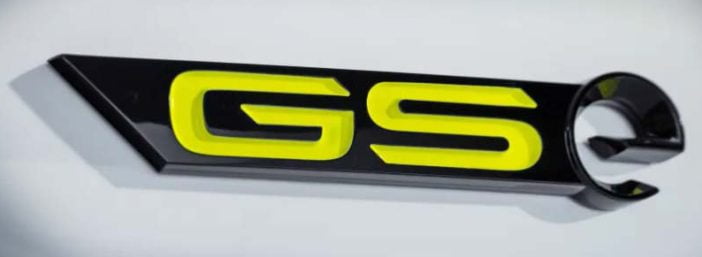
+++ Following its commitment to go all-electric by 2028, OPEL has outlined plans for the future of its sporty models, with a new GSe sub-brand that will take the place of the old OPC range. The initials stand for ‘Grand Sport electric’, and the new editions will sit at the top of their respective model lines. They will initially be powered by plug-in hybrid powertrains, before turning fully EV to coincide with the brand’s 2028 deadline. “GSe will offer sports handling and looks combined with the performance and responsibility of electrified powertrains. Sitting atop the newly simplified Opel range, the GSe name is both a nod to GSi performance models from our heritage as well being a complement to the GS Line versions in our line-up today. Opel is committed to electrifying Europe and GSe shows that performance and driving pleasure are set to be part of our electric future”, a spokesman said. It’s thought that the firm’s Astra hatchback and Astra Sports Tourer estate could be the first models to receive the GSe treatment. The Astra is already available with a plug-in hybrid powertrain offering up to 225hp, but this could be pushed further, potentially beyond 300 hp by drawing upon technology already available through parent company Stellantis. The Astra is based on the EMP2 platform, which also underpins the 360 hp Peugeot 508 by Peugeot Sport Engineered. However, while the Astra is partly powered by a similar 1.6-litre 4-cylinder turbocharged petrol engine, it’s not yet known if the car will inherit the PSE’s second electric motor on the rear axle to deliver e-four-wheel drive and the extra traction a performance-focused electrified hot hatch would need to be competitive. If it does, a sub-5-second 0-100 kph time should be easily possible. Opel’s GSe treatment is likely to go further than just the Astra. In confirming its GSe sub-brand, the spokesman highlighted that its Grandland is also available as a plug-in hybrid, pointing towards the fact that this raised-up model is ripe for performance tuning, being based on the same underpinnings as the Astra. There’s also a strong business case, with higher profit margins on performance SUVs. The German brand already sells many fully electric models, with the Corsa and Mokka both available with full-EV powertrains. An all-electric Astra-e is set to join the line-up next year too, and it’s possible that these three cars will be available in all-electric GSe form in the future. Teasing the GSe sub-brand with a badge that shows bright lettering and gloss black trim (a combination seen on the Manta GSe ElektroMOD revealed last year) it’s likely that these colors will become the GSe signature, with accents applied to cars to highlight their halo status. Opel has confirmed it will release more information on the GSe sub-brand in due course. +++
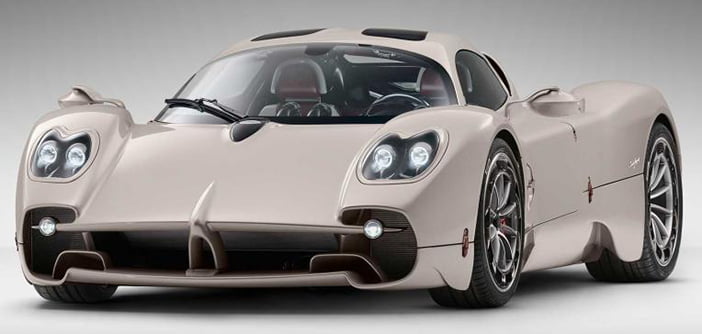
+++ PAGANI ’s latest supercar and successor to the Huayra is here, and its name is Utopia. And everything about it is about getting back to basics and focusing on the driving experience. But don’t take our word for it, that’s what Pagani said its clients wanted: “simplicity, lightness and the pleasure of driving”. So it’s delivering a light car with a big V12 and a manual transmission. In the middle of the Utopia is a twin-turbo 6.0-liter V12 from Mercedes-AMG, and it makes 852 hp and 1.100 Nm of torque. Power goes into an Xtrac-designed 7-speed manual transmission (or automated manual as an option) to a limited-slip differential and the rear wheels. Pagani also seemed to take a dig at Koenigsegg and its manually-shiftable automatic in the CC850: “Moreover, in order to best match the wishes expressed by Pagani enthusiasts, its aficionados, a virtual manual would not be acceptable so a real 7-speed manual transmission has been developed”. The chassis is a blend of carbon-titanium fiber for the body and passenger compartment with chromoly tube subframes front and rear. Suspension is double-wishbone at all four corners with forged aluminum components. The wheels are also forged aluminum and feature carbon fiber turbine covers that extract hot air. Six-piston front calipers and four-piston rear calipers stop the supercar. Design-wise, the Utopia looks like a blend of the Huayra and Zonda. It’s very curvy like the Huayra, but the low center section and raised front fenders are reminiscent of that original Zonda. It does of course have many unique cues, particularly the side mirrors that hang off their mounts and the floating taillights. Inside, Pagani has focused on a more traditional look with just a single small screen in the instrument cluster, and analog dials for nearly every other instrument. The manual shifter is fully exposed and sits prominently between the seats. It also features a steering wheel and pedals that have all been milled as single pieces from aluminum. Pagani will build just 99 Utopias in the initial run, and they’ve all been sold. No price was given, but it was surely astonishingly high. +++
+++ An even quicker TOYOTA GR YARIS , fitted with the more potent powertrain from the American market’s GR Corolla Morizo, is in development. This turbocharged 1.6-litre 3-cylinder engine means the GR Yaris will get an extra 28 hp and 30 Nm, leaving it with 300 hp and 400 Nm. Extreme levels of weight-saving are also set to be made, including the deletion of the rear seats, but a basic stereo and single-zone climate control will stay. This eye on lightness, coupled with its new powerplant, means the new GR Yaris is tipped to sprint from 0-100 kph in less than 4.5 seconds and top out at more than 260 kph. The more powerful GR Yaris is also expected to carry the new Morizo name that’s reserved for the fastest most extreme Gazoo Racing models. This moniker comes from Toyota CEO Akio Toyoda’s motorsport pseudonym. The development work has been confirmed by Gazoo Racing’s chief engineer, Naoyuki Sakamoto. The senior Toyota executive has also revealed that there’s enough space to package the GR Corolla Morizo’s special close-ratio 6-speed manual gearbox, which will replace the 6-speed in the current GR Yaris, known as the car’s weak spot. This drivetrain will now be able to cope with not only the 400 Nm the GR Corolla Morizo produces but even more torque than that. Yet there are issues to deal with. Sakamoto confirmed the supermini doesn’t provide the space for the bigger Corolla’s trick exhaust. However, he admitted that the majority of the GR Corolla powertrain development work was actually carried out by modified GR Yaris race cars competing in the Super Taikyu race series in Japan. No information was given on when the GR Yaris might be introduced or whether it has even been given the green light internally. The next generation of GR models aren’t expected to come with launch control or drift mode. Sakamoto added that it wouldn’t be his preference to add either driver aid. “We’re sticking to natural control of the vehicle”, he said. “If the vehicle is good enough to control, we don’t have to prepare any special mode”. Sakamoto also confirmed that the long-awaited 2-pedal GR Yaris remains in development. According to the GR chief, it will shun a more advanced dual-clutch automatic gearbox for traditional torque-converter unit, possibly with 8 speeds. Again, no timeline for its introduction was given, but Sakamoto stressed that the auto would match the manual GR Yaris’s character with a bespoke calibration developed by Toyota’s performance arm. +++
+++ VOLVO ’s next-generation XC90 was rumored to be called ‘Embla’, essentially doing away with the letter and number naming system Volvo has used on its cars for decades. Now, the Swedish company looks like it’ll double down on its current badging style with a host of new EVs. A flurry of patent filings have been uncovered from the European Union Intellectual Property Office, with Volvo appearing to plan all-electric replacements for its current model lineup. While Polestar sits as Volvo’s all-electric performance sub-brand, in the past few years the firm’s own EVs have been given the ‘Recharge’ badge to signify their pure-electric powertrain. It looks like the new badging won’t be a drastic change from the structure of the current lineup, with EXC90, EXC60, EXC40 and EC40 potentially being all-electric successors to the current SUV lineup. The same can be said of Volvo’s saloon and estate cars with ES60, ES90, EV60 and EV90 also registered. However, we could see the return of a smaller hatchback model with Volvo filing to protect EX30. There we also trademarks for EX40, EX60 and EX90. It’s unclear what platform would underpin all these models, should Volvo wish to bring them to production, however Volvo’s new scalable SPA2 platform can accommodate electric cars ranging from the size of the S60 to the XC90. A new platform would have to be devised for the smaller hatchback-sized models. I’ve already heard of plans from Volvo for a model to sit under the XC40, but its reveal is probably still a few years off. It’s also not known if these models will be pure-electric or hybridised but with the firm recently saying it’ll be fully-electric from 2030, developing a new platform or even a standalone car just for hybridisation doesn’t seem likely. +++