
+++ AUTONOMOUS VEHICLE companies and suppliers have collectively spent around $75 billion developing self-driving technology, with scant sign of meaningful revenue emerging from robo-car services after all that cash incineration. This has spelled disaster for Aurora Innovation, TuSimple Holdings and Embark Technology, whose shares have each plunged at least 80% this year. It’s no wonder Intel just slashed the targeted valuation for its autonomous-driving business Mobileye to about $16 billion, a fraction of the more than $50 billion it reportedly had in mind 10 months ago. Cruise, owned by General Motors, raised money at a roughly $30 billion valuation early last year. In March, GM bought out SoftBank Vision Fund at a price implying the venture was worth around $19 billion. This is what happens when long-gestating new technology meets the short patience of public markets and harsh reality of rising interest rates. Many of these companies raised tens of billions of dollars long before their technology was proven or their businesses came close to being self-sustaining. The hype of the last decade or so and crash of late is calling into question whether self-driving cars will ever work. Anthony Levandowski, one of Google’s early autonomy pioneers, who left for Uber Technologies and was later convicted for stealing trade secrets, now runs a startup developing autonomous trucks for industrial sites. He argued that less-complex use cases will be the way forward for the foreseeable future. Morgan Stanley’s Adam Jonas, who 7 years ago ascribed massive value to a Tesla mobility service that’s still nowhere to be found, said in a note recently that autonomy could be a 10- or 20-year proposition. Companies in the space are now being forced to contemplate drastic measures. Aurora chief executive officer Chris Urmson sent out an internal memo in September raising the prospect of cost cuts, taking the company private, spinning off assets or even trying to sell the company to Apple or Microsoft. Others have seen high-level turnover. General Motors CEO Mary Barra dismissed Cruise counterpart Dan Ammann late last year. TuSimple replaced founder and CEO Cheng Lu in March and its general counsel James Mullen resigned in September. Alphabet-owned Waymo lost its chief product officer Dan Chu last month to 23andMe. While executives and investors alike are in some cases heading for the exits, well-capitalized companies in the space are plowing ahead into new markets and projects. Cruise plans to replicate its San Francisco robo-taxi service in Phoenix and Austin. Waymo will start offering rides in Los Angeles and also has been hauling beer between Dallas and Houston. Startup Kodiak Robotics raised $30 million in private capital this week and ran its freight trucks 13.000 km from Texas to Florida. While there was a test driver at the wheel, the human ceded to the robot 94% of the time, Kodiak CEO and founder Don Burnette told me in an interview. The company is starting to haul furniture for Ikea. I asked Burnette if Kodiak will be ready to ditch the safety driver anytime soon. “We’re pretty close”, he said. “It seems like we always say this. It’s a couple years out”. It may take even longer, but the market getting the timing of autonomy wrong doesn’t mean it will never work. The lesson is that technology as radical as robotic driving was always better off in the incubators of daring venture capitalists, not the portfolios of trigger-happy stock traders. +++
+++ It took BMW 12 years to bring back the M Touring after discontinuing the M5 E61 in 2010. However, the smaller M3 Touring is not available in North America where you also can’t have the Audi RS4 Avant or the Mercedes-AMG C 63 Estate. The silver lining is those reports about a US-bound M5 Touring have now evolved past the gossip stage. The M man himself, Frank van Meel, suggests Bavaria is prepping a belated answer to the RS6 and E63 long-roofs. In an interview last weekend in South Africa during the M Fest held at the Kyalami Grand Prix Circuit in Johannesburg, BMW M CEO was asked about a possible return of the M5 Touring. Coincidentally, there was a purple E34 standing outside of the building, one of the only 891 units ever made: “We’ll see. Keep your eyes open, and if you see something like that on the Nürburgring, we’re going to do it”. Frank van Meel said an M Touring for North America would come as a response to more and more requests coming from dealers and customers for a high-performance wagon. The body style itself would be a breath of fresh air considering the current 3 Series and 5 Series are sold exclusively as sedans in the United States: “We listened to our dealers and our customers, and they’re coming more and more, asking for a touring. So, we are taking that into consideration”. Codenamed G90, the next M5 Saloon has already been spotted testing at the Nürburgring, so it’s only a matter of time before the more practical body style will arrive at the Green Hell. The estate is believed to carry the G99 codename and enter production near the end of 2024 or a few months after the saloon. Both will employ a plug-in hybrid V8 adapted from the XM, which in next year’s Label Red will deliver a combined output of 750 hp and 1.000 Nm. +++
+++ The world’s top automakers are planning to spend nearly $1.2 trillion through 2030 to develop and produce millions of ELECTRIC VEHICLES , along with the batteries and raw materials to support that production, according to an analysis of public data and projections released by those companies. The EV investment figure, which has not previously been published, dwarfs previous investment estimates and is more than twice the most recent calculation published just a year ago. To put the figure in context, Alphabet, the parent company of Google and Waymo, has a market cap of $1.3 trillion. Automakers have forecast plans to build 54 million battery electric vehicles in 2030, representing more than 50% of total vehicle production, according to the analysis. To support that unprecedented level of EVs, carmakers and their battery partners are planning to install 5.8 terawatt-hours of battery production capacity by 2030, according to data from Benchmark Mineral Intelligence and the manufacturers. Leading the charge is Tesla, where chief executive Elon Musk has outlined an audacious plan to build 20 million EVs in 2030, requiring an estimated 3 terawatt-hours of batteries. Musk in late October said Tesla already is working on a smaller vehicle platform targeted to cost half as much as the Model 3 and Model Y. While Tesla has not fully disclosed its spending plans, such exponential growth (a 13-fold increase over the estimated 1.5 million vehicles it hopes to sell this year) will come at a cost of hundreds of billions of dollars, according to an analysis of Tesla’s financial disclosures and forecasts for global EV demand, and battery and battery mineral production. Volkswagen, while lagging behind Tesla, has ambitious plans through the end of the decade, targeting well over $100 billion to build out its global EV portfolio, add new battery “gigafactories” in Europe and North America and lock up supplies of key raw materials. Toyota is investing $70 billion to electrify vehicles and produce more batteries, and expects to sell at least 3.5 million battery electric models (BEVs) in 2030. It plans at least 30 different BEVs and expects to transition the entire Lexus range to battery electric over that span. Ford keeps boosting its spending level on new EVs, now at $50 billion, and at least 240 gigawatt-hours of battery capacity with its partners as it aims to produce around 3 million BEVs in 2030; half its total volume. Mercedes-Benz has earmarked at least $47 billion for EV development and production, nearly two-thirds of that to boost its global battery capacity with partners to more than 200 gigawatt-hours. BMW, Stellantis and General Motors each plan to spend at least $35 billion on EVs and batteries, with Stellantis laying out the most aggressive battery program: A planned 400 gigawatt-hours of capacity with partners by 2030, including 4 plants in North America. +++
+++ The MX-5 sports car is no longer the only rear-wheel-drive MAZDA sold in Europe as the CX-60 has landed on the Old Continent. Should you need more space, the automaker’s European branch has announced the 3-row CX-80 will be launched at some point in 2023 as a bigger variant with 7 seats. Technical specifications have yet to be revealed, but the 2 SUVs will likely be identical, save for the size difference. Not only does the CX-60 ride on an RWD-based platform, but it’s also the first Mazda to use a new family of inline-6 petrol and diesel engines complemented by a plug-in hybrid setup. The CX-80 will probably inherit the powertrains and the choice between rear- and all-wheel drive linked to an 8-speed automatic transmission. Much like the MX-5 we mentioned in the beginning, the midsize SUV has something called Kinematic Posture Control, which diminishes body roll by applying the brake to the inner rear wheel while cornering. How big is the CX-80 going to be? Mazda doesn’t say yet, but I’ll remind you the standard 2-row CX-60 is 4,740 millimeters long and has a wheelbase measuring 2,870 mm. In its heaviest configuration, which would be the PHEV, the CX-60 weighs nearly 2.100 kilograms. Needless to say, the CX-80 will be slightly heavier as a result of extending the body to fit the third row of seats. +++
+++ MERCEDES-BENZ ‘ efforts to electrify its lineup will include the G-Class. The automaker previewed the production version over a year ago with the Concept EQG. While specific details remain elusive, company officials’ comments are beginning to paint an intriguing picture of what the real EQG will offer when it arrives. Ola Källenius, Mercedes-Benz Group’s chairman of the board of management and someone who drove an early prototype, told that the SUV will have “phenomenal performance on and off the road”. He called it “competent” and “easy to ride in”. Mercedes hasn’t provided much information about the powertrain, but the concept did debut with 4 electric motors that will make it to the production version. They operate independently of each other and work with its shiftable 2-speed gearbox. Earlier this year, Mercedes released a video showing the EQG performing a tank turn; a 360-degree spin on its own axis. At the time, the automaker also revealed that the SUV would feature a specially designed rigid rear axle and an independent front suspension. The company has a new platform underpinning its EVs called EVA2. However, the electric G-Class won’t use it. The SUV will ride on a dedicated platform. “It is its own vehicle, full stop, and it will remain its own vehicle”, Källenius told. Another EQG difference will be the optional silicon anode battery that Mercedes will offer in the model. It’ll deliver a 20 to 40 percent boost in energy density but come at a premium. However, that’s not the only battery technology Mercedes is working on. The automaker is also developing lithium-iron phosphate batteries for entry-level vehicles and Mercedes is co-developing a new battery cell with Stellantis and ACC. The Mercedes-Benz EQG will launch sometime in 2024, giving the automaker plenty of time to fine-tune the product. We expect Mercedes to offer the SUV with various powertrain and battery configurations. Starting price is also unknown, but the G-Class remains quite a popular model. In 2021, sales reached a new record, and this demand will only help Mercedes make more money. We hope to learn more about the model in the coming months. +++
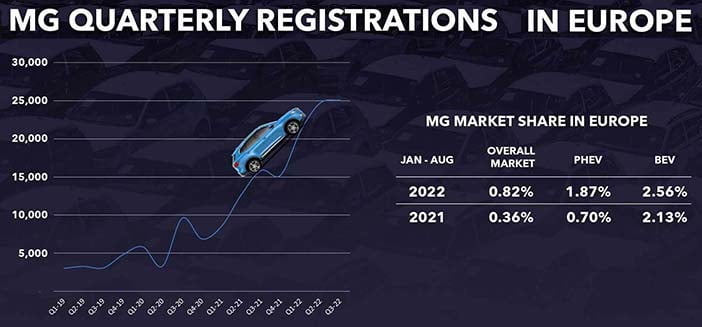
+++ If there is one car brand that can be a good example of economies of scale, good marketing, and profitability, that’s Dacia. It was revived by the Renault group after taking it over in 1999, and since then it has become the cash cow of the French manufacturer. They are appealing, no-frills cars that are the perfect choice for those drivers looking for private means of transportation that is both good (quality) and affordable (low maintenance cost). The success in terms of sales is also attributed to the lack of direct competitors, at least in Europe, where it sold 90% of its global volume last year. Despite the evident reasons for the popularity of its cars, Dacia is still the only low-cost brand available in the continent. Neither Volkswagen nor ex-PSA developed a stand-alone brand to compete against it. However, this could change soon, and the player is coming from far away. MG is slowly becoming an important player within the European EV market. By making use of its British origin, the Chinese from SAIC, its current owner, is expanding its presence all over the world. They offer very competitive products that include saloons, SUVs and even hatchbacks and estates. Their focus is on bringing affordable electric cars that are both appealing and modern. And the formula is paying off. Their registrations doubled during the first 8 months of this year in Europe, totalling 58.300 units. This is more than the volume registered by Honda, or Mitsubishi, and is 70% of the volume registered by Suzuki. MG was able to hit the European top 25 by brands, with the highest percentage increase. It is important to notice that MG is still not available in all European countries (by August, it was still missing in Switzerland, Poland, Czech, Portugal, Slovakia, Romania, Hungary, Estonia, Lithuania, and Latvia). These markets combined represented 13% of the European total volume. But if MG’s market share within the overall European market is still very low (0.82% through August), it has a more comfortable position within the pure electric market. According to the data provided by JATO, this make made up 2.6% of the registrations of pure electric cars between January and August. MG is applying the same formula that allowed Dacia to outperform over the last years, but in the electric car market. The average price of its electric lineup was lower than those of the majority of mainstream brands in Europe. For example, the MG ZS EV, its electric B-SUV, is cheaper than its rivals from Opel, Peugeot and Hyundai. The MG5, an electric estate in the C-segment, is the most affordable choice within the segment. The same happens to the MG Marvel R, the flagship of MG in Europe. Its direct rivals are more expensive. Consequently, MG is attacking the emerging electric vehicle market from below, just as Dacia has been doing it in the internal combustion engine market. +++
+++ The RENAULT Zoe, first released in 2012, will not be replaced, Renault boss Fabrice Cambolive has confirmed, ending its life as one of the best-selling electric cars in its home country. Instead, the Clio and Captur will continue so they can supplement Renault’s new electric compact car line-up, headed by the Renault 4 and 5, both arriving by 2025. Cambolive described this as a dual approach where its hybrid and electric models co-exist for the foreseeable future. He said: “It depends on the market. If a market is fully electric, okay, but most markets will have pure electric for the compact segment, and until 2035, if needed, we will have Clio and Captur too. They will have hybrid technology because that’s our solution, the technological choice we made to replace the normal of the combustion engine”. The decision to cull the Zoe brings to an end a lifespan of more than a decade, during which it was the top-selling EV in Europe for 2 years running (2015-16) and achieved more than 100.000 sales in France alone. A final date for the end of its production has yet to be confirmed. Talking about the broader range, which will gain the new Mégane and Scenic imminently, Cambolive believes the perfect line-up in the European market is four electric and four hybrid models. Within those models, there should be a maximum of one engine and two or three equipment levels, he said. The firm is focusing on the Mégane and Scenic first because it has prioritised its mid-sized models over compact ones. Cambolive said: “Within this ‘enovation’ phase, we have said we will make more turnover per unit. For that, we decided to focus on our product line-up in the C-segment. We will have the Mégane shortly and the Scenic after that. And after that, we will come on to the compact segment”. +++