
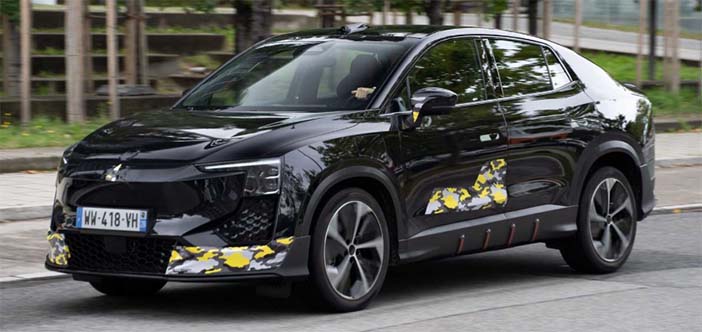
+++ AIWAYS is a relatively small company by Chinese standards, having only been founded 5 years ago, but it already has a full range of electric vehicles, some of which it’s also offering in Europe. The Chinese startup made its European debut with the practical U5 and now it is adding a second model, a more rakish coupe-like SUV called the U6. The 2 vehicles share a platform and have the exact same 2.800 mm wheelbase, but the U6 is almost 100 mm longer and also slightly wider. Its front and rear fascias are quite different and from the side roofline looks very dramatic: the concept had an unusual spoiler that went around the lower part of the glass, quite an unusual location, but it’s not present on the production version. Aiways says the U6 has a very low drag coefficient of just 0.26 Cd, which is exactly the same as one of its direct rivals from Europe, the Volkswagen ID.5. And even though the company still has camouflage on the prototypes it is testing in Europe, the vehicle has actually been fully revealed. The U6 has a 63 kWh battery pack (with cells from CATL) that Aiways says is good for 400 km and it can charge at a maximum 92 kW, enough to take it from 20 to 80 percent in 34 minutes. Its claimed electricity consumption is between 15.9 – 16.6 kWh/100 km, all calculated according to the WLTP test procedures. Only a front-motor, front-wheel drive configuration is offered with 218 hp and 315 Nm, which in Aiways’ view is “all the power you need”. It’s not a slow vehicle, though, with a claimed acceleration time from 0 to 100 km/h in 7 seconds and a limited top speed of 160 km/h. Its brisk acceleration from not that much power comes primarily thanks to the vehicle’s relatively low mass (for a big electric SUV) of 1.790 kg. Aiways will build the U6 alongside the U5 at its factory in Shangrao, China and deliveries will begin in the first half of 2023; pricing will start at around €45.000 in the Netherlands. +++
+++ ARGO AI , an autonomous vehicle startup that burst on the scene in 2017 stacked with a $1 billion investment, is shutting down; its parts being absorbed into its 2 main backers: Ford and Volkswagen, according to people familiar with the matter. During an all-hands meeting Wednesday, Argo AI employees were told that some people would receive offers from the 2 automakers, according to multiple sources who asked to not be named. It was unclear how many would be hired into Ford or VW and which companies will get Argo’s technology. Employees were told they would receive a severance package that includes insurance and 2 separate bonuses; an annual award plus a transaction bonus upon the deal close with Ford and VW. All Argo employees will receive these. For those who are not retained by Ford or VW, they will additionally receive termination and severance pay, including health insurance. Several people told that it was a generous package and that the founders of the company spoke directly to its more than 2.000 employees. “In coordination with our shareholders, the decision has been made that Argo AI will not continue on its mission as a company. Many of the employees will receive an opportunity to continue work on automated driving technology with either Ford or Volkswagen, while employment for others will unfortunately come to an end”, Argo said in a statement. Ford said in its third-quarter earnings report released Wednesday that it made a strategic decision to shift its resources to developing advanced driver assistance systems, and not autonomous vehicle technology that can be applied to robotaxis. Ford noted that Argo was unable to attract new investors. The company said it recorded a $2.7 billion non-cash, pretax impairment on its investment in Argo AI, resulting in an $827 million net loss for the third quarter. Ford made the decision because “large-scale profitable commercialization of Level 4 advanced driver assistance systems will be further out than originally anticipated”, the company stated. Although it should be noted that Level 4, a term used by SAE to describe a level of autonomy, are not advanced driver assistance systems. Ford went on to state that the “development and customer enthusiasm for benefits of L2+ and L3 ADAS warrant dialing up the company’s near-term aspirations and commitment in those areas”. Argo was founded in 2016 by Bryan Salesky and Pete Rander. The company came out of stealth in February 2017 when Ford announced it would invest $1 billion over 5 years into Argo. Since then, the company has raised more than $2.6 billion, primarily from Ford and VW, in a pursuit to develop, test and eventually commercialize its automated driving system. The initial Ford investment came at a particularly hype-y time for the nascent autonomous vehicle industry. Startups, many founded by early pioneers of Google’s self-driving project, were landing eye-popping venture capital deals. A string of acquisitions followed: GM bought Cruise for $1 billion in 2016; Delphi, which is now Aptiv, acquired nuTonomy for $450 million; and Amazon bought Zoox. The promises around commercializing AV technology have proven more difficult than expected. A wave of consolidation washed over the industry with companies folding, being absorbed into other companies, including Apple, and others turning to SPACs in hopes of gaining the capital it needs to continue its mission. Argo seemed to be gaining ground in the past year. The company’s self-driving Ford Fusion vehicles, and now Ford Escape Hybrids, were frequently seen testing on public roads in Austin, Detroit, Miami, Palo Alto and Pittsburgh, where it is headquartered. In the EU, Argo was using the all-electric Volkswagen ID. Buzz for its testing programs in Hamburg and Munich. Argo also has several pilot programs underway in Austin, Miami and Pittsburgh with Lyft, Walmart and 412 Food Rescue. Just last month the company revealed an ecosystem of products and services designed to support commercial delivery and robotaxi operations. The products (a list that includes fleet management software, data analytics, high-definition mapping and cloud-based communication tools) stretches far beyond the self-driving system that allows a vehicle to navigate city streets without a human driver behind the wheel. Argo appeared to be telling the world it was open for business. “We are incredibly grateful for the dedication of the Argo AI team, and so proud of our achievements together,” Salesky and Rander said in a statement. “The team consistently delivered above and beyond, and we expect to see success for everyone in whatever comes next, including the opportunities presented by Ford and VW to continue their work on automated driving technology”. +++
+++ FORD said on Wednesday it would exit Russia, the latest automaker to leave in the aftermath of Russia’s invasion of Ukraine. Mercedes-Benz also said it would withdraw from the Russian market and sell shares in its industrial and financial services subsidiaries to a local investor. Ford said it has finalized a deal to sell its 49% stake in the Russia-based Sollers Ford joint venture for a “nominal” undisclosed price. The U.S. automaker took a $122 million writedown connected to its suspension of Russian operations earlier this year but will not take additional writedowns in connection with Wednesday’s announcement, the company said. “Ford shares will be transferred to the Joint Venture for a nominal value”, the company said, adding that it retains the option to buy them back within a 5-year period “should the global situation change”. Ford sold around 20.000 vehicles in Russia in 2021, according to analyst estimates. It announced a suspension of its operations in Russia in March. Ford in 2019 said the joint venture was closing 2 assembly plants and an engine factory in Russia, exiting the country’s passenger vehicle market. Ford restructured its investment in Russia in 2019 and ceded control the venture to Sollers. Ford follows U.S. companies including Cisco Systems and Nike in announcing an exit from Russia, after Western countries imposed sanctions on Moscow over its invasion of Ukraine, making it nearly impossible for manufacturers to do business there. +++
+++ MERCEDES-BENZ finance chief on Wednesday told the automaker’s pricing of its cars in China is “well-supported” after U.S. electric vehicle giant Tesla slashed prices. “We definitely see the demand being well but also we see the pricing levels we put into the market being well-supported in the market in China”, Harald Wilhelm, CFO of Mercedes-Benz group told in response to a question on Tesla slashing prices. “We are not shooting for the mass, we are shooting for the top end, for the luxury segment, and this one usually proves to be more resilient also in times of macro uncertainties or troughs”. China is the largest market for Mercedes-Benz. The German auto group sold 222.641 cars in the country in the third quarter of this year, up from 132.579 units in the same period last year. The CFO’s comments come after Tesla on Monday slashed the price of its Model 3 and Model Y vehicles in China, one of the company’s most critical markets. That was after Elon Musk’s company raised the prices of its vehicles earlier this year as a result of rising raw material costs. Tesla did not give a reason for the price cuts. But the Chinese economy, which did see a bump in the third quarter, is still facing a number of challenges including the country’s strict Covid containment policy which has weighed on consumer appetite. Tesla’s price cut comes as competition ramps up in China from domestic electric car firms such as Warren Buffett-backed BYD as well as upstarts Nio and Xpeng. While Mercedes-Benz still relies heavily on sales of traditional combustion engine cars, it is ramping up its electric vehicle capabilities, which is likely to put it in more direct competition with Tesla. In the third quarter, Mercedes-Benz sold 84.850 electric vehicles, up 39% year-on-year. But they still only account for around 16% of the company’s total volume. Mercedes-Benz’s Wilhelm also addressed the supply chain issues that have been plaguing automakers, in particular a shortage of key semiconductors. Wilhelm said the supply chain situation has “improved” but he remains “cautious”, saying that demand is “being constrained by supply” of semiconductors in particular. He said that some of these issues will remain in 2023. Mercedes-Benz reported third-quarter earnings of 5.2 billion euros, up 83% year-on-year. +++
+++ MERCEDES-BENZ EQ SUBBRAND is the future of the brand. The EQE SUV’s world debut ahead of the Paris Motor Show was a milestone for the brand: it debuted new sound technologies, like the native integration of Apple Music and a heavy focus on the Dolby Atmos suite of tech. But most importantly, it’s the final EV model to complete the EQ lineup. With the EQE SUV, Mercedes claims that it now has an EV model for every mainstream vehicle segment it sells, barring any sports cars or commercial vehicles. What next, though? Is that it for the EQ brand or EV2 platform? What happens to EQ when Mercedes eventually phases out its ICE efforts? During the EQE SUV debut in Paris, I got some time to sit down with Christoph Starzynski, the vice president of Electric Vehicle Architecture, and chief technology officer Markus Schäfer to ask some questions. And the first was what the EQ brand looks like when Mercedes phases out combustion power. “That’s the $1 million question, isn’t it? It’s a question for the marketing and sales team, but the brand itself is more than just a battery; it’s a technology, its intelligence”, Starzynski said. “The question is, what will be the nomenclature in the future? But right now, we’ll still be parallel, until later this decade. The brand is more than just the badge on the rear of the car, you know?” We also asked Starzynski about the future of the EV2 platform, which currently underpins not just the EQE line, but the EQS family. With rumours that they’ll be the smallest products on EV2, what does the future of the architecture hold? “The MMA platform is the successor of the current compact cars. The A, B, CLA, GLA, GLB, EQA, EQB; the MMA platform will be the successor”, Starzynski said. “The only real thing we’re going to do here is go down from 7 models to 4. Then, the MB.EA platform will do middle and upper-class vehicles. The EV2 platform will run parallel for a while”. In another roundtable discussion, Markus Schäfer, did hint briefly that there could be some more things in store for the EV2 platform before its replacement. “Our Tuscaloosa-built models EQE and EQS SUV will hit the market early next year, and it will be our 4th model on the EV2 platform”, Schäfer said. “We have further ideas, more to be announced yet, that we could do on this platform, but definitely, the SUVs will be, for us in terms of volume and sales expectations, an important part of our EV strategy”. So, it looks like Mercedes is already gearing up for the next generation of EVs, even as it explores the possibilities of new models on its current EV architecture. It’s making new modular platforms, in order to phase out its EQ-series converted gas cars, namely the EQA, EQB, and EQC. The EV2 platform, which underpins the EQE and EQS in both sedan and SUV form, will eventually be phased out, as well, to be replaced by a new modular platform that will likely underpin everything from the C-Class on up. Whether or not that means the EQ brand will usurp the traditional Mercedes-Benz naming scheme when the brand stops making ICE vehicles, well, it seems like the brand is still figuring that out. It’s exciting times for the future of Mercedes-Benz, that’s for sure. +++
+++ The future of SEAT is safe for the time being, despite being unprofitable and positioned alongside the meteoric rise of its sibling brand Cupra. Seat chairman and Volkswagen CEO Thomas Schäfer told: “We are not killing Seat. We just need to decide on its future”. The Volkswagen Group-owned Spanish brand enjoyed much success with models such as the Ateca and Leon, but it has been struggling in recent years while the more expensive, higher-margin Cupra line-up has been a triumph. Seat’s European sales dropped 45% in July and 42% in August year on year, because it appears last in the queue at the VW Group for semiconductor supply. It has no electric cars on sale, a stark contrast to the rest of the group. While Schäfer insisted Seat will continue, he also said: “Cupra is the future of Seat. Cupra is the reinvention of Seat going forward. Cupra will move much faster into electrification. We are still working on a plan for Seat. It is fine until 2028 or 2029. It’s an entry-level brand for young customers. It really plays to Europe, particularly Spain, United Kingdom and Austria”. One idea for its future mentioned by Schäfer is as a mobility brand. This would ensure Seat neatly fitted into the broader VW Group line-up while not conflicting with other marques, namely Skoda. Seat is already testing the water in the mobility space, having showcased its Renault Twizy-esque Minimo, plus a number of electric scooters such as the Mo 125. Meanwhile, Cupra “is not a volume player” said Schäfer, but has “a sharp positioning” within the group, appealing to a more “rebellious, young audience”. +++
+++ After starting production of mega casts and structural battery packs for the Model Y built at Gigafactory Texas, TESLA plans to offer the same technologies on vehicles produced in Giga Berlin before the end of this year. By implementing front and rear mega casts, as well as structural battery packs on the Tesla Model Y made in Germany, the automaker will see production costs decrease as the number of parts and assembly operations will be lower. Tesla announced the move in its Q3 2022 Shareholder Deck last week. “At Gigafactory Texas, we have begun production of Model Ys since early this year that use front and rear body castings in conjunction with a structural battery pack. Castings of this size have never been mass-produced before in any industry by anyone except Tesla in our Fremont and Shanghai factories. We plan to introduce front castings and structural battery packs at Gigafactory Berlin-Brandenburg before the end of this year”. Tesla uses 6.000 ton Giga Press machines built by Italy’s IDRA to produce the massive castings for the Model Y’s front underbody and rear underbody. The EV maker noted that part of the challenge of making such large castings and thus eliminating more than 170 separate components is that “all the aluminium needs to be injected into a die in about one-tenth of a blink of an eye, through a single point of entry, without solidifying or distorting”. As for the structural battery pack’s introduction to Giga Berlin, it suggests that Tesla is also preparing to start rolling out 4680 battery cells at the German plant for use in Model Y vehicles, although the source of the cells is unclear. During the last earnings call, the EV maker said that 4680 cell production tripled in the third quarter of 2022 and continues to improve. For now, Tesla is focusing on expanding 4680 production capacity in North America and will start to incorporate 4680 cells in Model Y vehicles made at Giga Texas. Meanwhile, the vehicle production ramp at Giga Berlin continues, with Tesla announcing in its Q3 earnings report that it reached a production capacity of more than 2.000 Model Ys per week. The automaker has set a target for 5.000 units per week before the end of 2022-beginning of 2023. +++
+++ Late last year, TOYOTA and Lexus previewed 15 electric vehicles and announced a plan to introduce 30 of them by the end of the decade. However, a new report says that the automaker is in the process of revamping its roadmap and has halted production on some of the proposed models. According to the report, Toyota has allegedly suspended development on the electric Crown and the FJ Cruiser revival. It’s unclear if other models are affected. The automaker is allegedly taking the time to rethink its EV plans, which could slow down the rollout of new products. However, the move would make Toyota more competitive with an improved manufacturing process, reducing costs. The automaker is also working with suppliers to cut costs. Everything is apparently on the table to achieve this, and Tesla is the benchmark. The company could develop a successor to its e-TNGA platform, prolong the platform’s life with new technologies, or design a new EV-dedicated platform. However, the new architecture would take around 5 years to spawn new models. Those working on updating the plan have until early next year to reevaluate the roadmap. Toyota launched its first EV earlier this year, which some have considered late to the game compared to other automakers. However, the model’s rough rollout certainly did not help. In June, Toyota recalled the BZ4X electric crossover for wheels that could fall off, urging owners not to drive their vehicles. Toyota also launched the BZ3 in China recently, expanding the BZ brand. The industry is facing mass upheaval as automakers invest billions into EVs. Governments are also making huge financial moves by incentivising battery factories, charging stations, and purchases that encourage EV adoption. The end of the decade might seem far away, but it’s quite close for automakers. They are already developing the models they plan to launch in the decade’s second half. There isn’t a lot of time before 2030 is here. +++
+++ The global chip shortage in the automotive industry is still here with no signs of slowing down. As a result, the crisis leads to many automakers having issues with vehicle production and TOYOTA is not immune to disruptions. The Japanese manufacturer now releases an official statement to announce it has to adjust its production estimations for this year. Toyota states the spread of Covid-19 continues to cause “considerable inconvenience” to customers and disruptions in the production chain. The chip shortage forces the automaker to adjust its production plans for November when the company will produce around 800.000 vehicles, of which 250.000 will be built in Japan and about 550.000 in factories in Europe, North America and other regions. These numbers may still look impressive (imagine how big the imaginary parking lot that could fit all 800.000 vehicles would be) but Toyota says this is a decline over its initial forecast. The reduced production capacity for November will result in a lower annual production forecast of 9.7 million units. It’s important to note, however, that this forecast is for the fiscal year 2023. “It remains difficult to look ahead due to the impact of semiconductor parts and other factors. However, we will continue to closely examine the supply of parts and work with related parties to consider all possible measures to ensure that we can deliver as many vehicles as possible to our customers at the earliest possible date”. Toyota says in the statement released to media representatives. We’ve also reached out to the automaker for more details and will update this story when, and if, we hear back. Toyota also releases a list of suspensions of production in November at its Japanese plants. There will be production pauses at 8 plants and 11 production lines out of a total of 28 lines in 14 plants. The Toyota Auto Body Fujimatsu Plant will see the highest number of days without production activities, but this is the plant where the automaker builds just the JDM Noah and Voxy models. +++
+++ VOLKSWAGEN ’s electric SUVs could be called ID.X in the future, as the firm looks to ensure its model line-up is easily understood in markets around the world. For example, the upcoming compact SUV version of the Volkswagen ID.3 would be called ID.3X, under the plans. VW boss Thomas Schäfer said the maker is assessing a number of avenues, but on using X for SUV models, he commented: “It’s one option and not an unlikely option that the SUV part is an X but it’s not 100%. It has to be consistent across the range, and because our range is still quite big and overlapping here and there, we need to sort it out. But it looks as if it would make sense with the numbering and X”. Schäfer said the firm is pondering how to use well-established names such as Golf and Polo in the future when combustion-engined models are being phased out. “The Golf name specifically has huge value”, he said. “But at the same time, the ID brand has gained huge momentum. The recognition it receives at customer clinics, people absolutely understand what we are talking about. So to change the name to something completely different doesn’t make sense. We are really working out now for the next 10 years how we see the names developing. This is happening right now, this process of what we do with the name (Golf, Polo or whatever) what do we do to transform key names differently”. Currently, Volkswagen has 2 electric ID SUVs on sale in Europe: the ID.4 and the ID.5, while the ID.6 (also a SUV) is on sale in China. The arrival of an ID.3X to sit alongside the hatchback, mooted by 2025, could be the first example of the new nomenclature if it gets the green light. With a SUV version of the ID.3, Volkswagen can capitalise on the still fast-growing small SUV market. Schäfer has confirmed that the company is “working hard to develop an additional compact SUV based on the ID.3 so that we can also launch a Volkswagen product in this fast-growing vehicle segment”. He told that the model would look dramatically different to the ID.3 when it arrives before 2026, rather than being a Russian-doll approach to styling. The ID.4 is currently the German brand’s smallest electric SUV, sharing the MEB platform with the ID.3, but its footprint is significantly bigger than its hatchback counterpart. Volkswagen will also introduce 2 versions of its highly anticipated entry-level EV, which is billed to cost around €27.000 in the Netherlands, described as “a small car and a sporty crossover variant” by Schäfer. They will be in a similar, albeit electric, vein to the combustion-engined Volkswagen Polo and Volkswagen T-Cross. These are among 10 new EVs to be launched by 2026, which includes facelifts of current models, which Schäfer claimed means Volkswagen will have the broadest electric portfolio in the automotive industry. “From the entry-level e-car with a target price of €27.000 to the ID.Buzz and the new flagship ID.Aero, we will have the right offer in every segment”, he said. He added that the Volkswagen Group’s MEB platform, which is currently the base du jour for EVs, continues to make “significant advances, for example in terms of range, performance and helpful features”. The MEB platform will bow out later this decade, to be replaced by a new architecture called SSP (scalable systems platform), on which all volume-selling Volkswagen Group models will be based. Schäfer said that Volkswagen is “shedding old habits” in terms of its product line-up, focusing on core models in the future and “noticeably simplifying our model range and packages over the next 10 years”. Inevitably that will mean some well-known ICE models will be no more and there will be significantly fewer specification options. Schäfer said: “In each segment we compete in, we want to live up to our Leading Volume motto: do less but get it right”. He was talking as he marked 100 days in the CEO role, in which he said there are three key focuses: best brand, best team, best results. Talking about the latter, Schäfer said, in what appeared to be a subtle dig to the previous management: “Admittedly, in the past, this was more a snare than an impetus. That’s finally over now. Volkswagen, Seat, Cupra, Skoda and Volkswagen Commercial Vehicles: we’re leveraging the huge potential of the brand group volume to give us a competitive edge”. He said the brands were clearly positioned and differentiated to address different customers, while there was a “lean engine room working behind the scenes on synergies and efficiencies”. He reconfirmed that Skoda will develop the new Skoda Superb and Volkswagen Passat, as well as hold responsibility for India and the entry-level MQB A0 platform, while Seat and Cupra are leading the charge for small EVs. Volkswagen Commercial Vehicles meanwhile is running its autonomous driving development and Volkswagen is in charge of developing the new SSP platform. Across its 23 production plants, Volkswagen is shifting the focus from individual models at each factory towards grouping by platforms. Schäfer said that by applying a principle of “develop once, implement worldwide”, it will save €220 million this year. Its overall goal is to ensure 20% efficiency gains in synergy, 8% return on investment across its volume brands and that those brands account for 80% of entire group volume. Schäfer also repeated his previous comments on the strength that he believes there is in the Volkswagen brand, saying: “People have smiles on their faces and pull out their smartphones when they see a Volkswagen Beetle, Bulli (Microbus) or Golf GTI. To us, our heritage is not a burden but a real asset. “And that’s exactly what we want to build on again. Internally, I said to my team: “VW has to become a love brand again!”. A friendly brand that people like. A brand that listens and offers exactly what our customers want, especially in the electric and digital age of mobility”. +++