
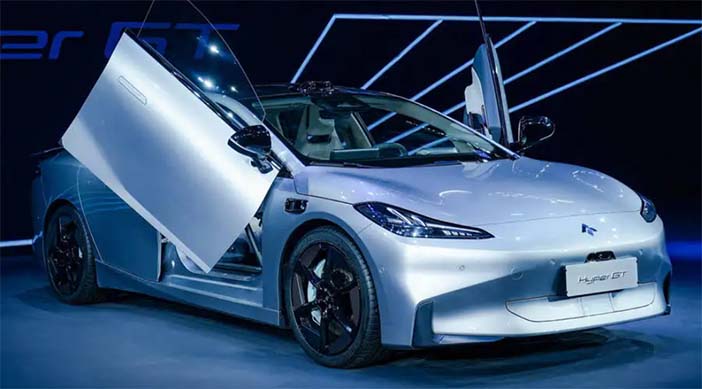
+++ Chinese car maker AION has revealed its new Hyper GT at the 2022 Guangzhou motor show, claiming a production car record 0.19 drag coefficient for the liftback-style saloon. Set for sale in China by the end of 2023, the electric-powered 4-door is set to become the second model in Aion’s newly announced Hyper electric car sub-brand, after the Hyper SSR sportscar unveiled in September. Pricing is yet to be announced, although Aion officials hint the Hyper GT is set to compete against the likes of the Xpeng P7 and Hozon S with a subsidised price starting at around RMB300,000 in China (€45.000 in the Netherlands). The styling of the new saloon is based around what Aion describes as its “wind and water” design lineage first aired on the Hyper SSR. Smooth surfacing is combined with round forms, heavy tapering and flush door handles to create an aerodynamic exterior. Further elements include active air ducts within the lower section of the front bumper and an active rear spoiler measuring 1.465 mm in width. Aion says the scissor action front doors, which open at an angle of up to 43 degrees and provide a 573 mm wide aperture, will be retained for the definitive Hyper GT production model, which is claimed to possess a drag co-efficient of 0.19. If verified, this would make it more aerodynamically efficient than the Mercedes-Benz EQS, which boasts an official drag co-efficient of 0.20. It would also better the 0.208 drag co-efficient claimed for the Tesla Model S. No official dimensions for the new saloon have been announced. Power for the Hyper GT, which is based on Aion’s new AEP 3.0 electric car platform, comes from a rear-mounted electric motor developing 340 hp and 425 Nm of torque. Aion claims a 0-100 kph time of 4.0 seconds, but it is holding back on details of the battery and range until closer to the Hyper GT’s Chinese market introduction during the second half of 2023. Further variants of the new 4-door liftback are planned, including a dual-motor 4-wheel drive performance model. A total of 39 different sensors are claimed to provide the Hyper GT with advanced autonoumous driving functionality. Included are stereo cameras, millimeter-wave radars and ultrasonic radars as well as 3 LiDAR units. Established in 2018, Aion is operated by Guangzhou Automobile Corporation (GAC). +++
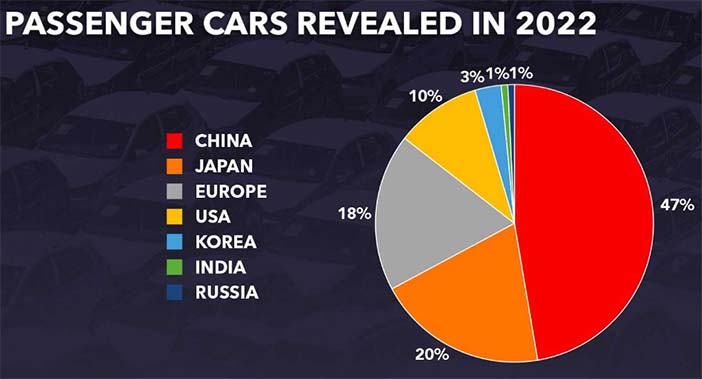
+++ A total of 131 new cars were revealed or presented throughout this year. The count excludes most of the rebadges, deep facelifts and concepts. They include all production cars that were shown to the public all over the world: from Europe to the Americas, passing by CHINA , Japan, Korea, India, Southeast Asia, and Russia. The most interesting figure from the count is that the new cars produced by Chinese manufacturers made up 47 % of this total. My coverage since January 1st 2022 indicates that the automakers from China presented 62 new cars, or an average of 5 every month. SAIC was the OEM to bring more new cars to the market, with 10 different models. It was followed by Geely with 8, and Great Wall with 6. Toyota was the automaker to show more new cars throughout the year. According to my research, the Japanese OEM revealed 11 different models that include 4 SUVs, 3 Saloons, 3 MPVs and 1 city-car. That’s the same quantity of new cars that Toyota (which includes the Toyota brand, Lexus and Daihatsu) revealed in 2021. The Japanese automaker was followed by SAIC with 10 models that include 6 SUVs, 2 Saloons, 1 Hatchback and 1 MPV. General Motors followed with 10 new cars from its brands Buick, Cadillac, Chevrolet and GMC. Honda was next with 8 new cars that include new generations of the Accord, CR-V and Pilot, among others. Stellantis was the European automaker with the highest quantity of new models revealed. They presented the Alfa Romeo Tonale, Citroen C4 X, Fiat Fastback, Jeep Avenger, Maserati Grecale and Peugeot 408 (the new Maserati Granturismo was excluded as the official interior pictures have not been released). The Volkswagen Group also showed 6 new models that include 1 Audi for China, the Skoda Enyaq Coupe, 2 Volkswagens for China and the new Amarok plus ID.Buzz. Further down, BMW and Mercedes both revealed 4 new cars each. Suzuki, Ford, and Hyundai-Kia with 3 each. As expected, SUVs continued to take the lead in reveals. They made up 51% of the total new passenger cars reveals in 2022. SAIC, Geely, Honda, and Stellantis were the manufacturers to lead this ranking. Far behind were the saloons, which are still alive thanks mostly to the demand in China. In 2022, a total of 23 new saloons were revealed, and 12 of them are expected to be available in China only. Surprisingly, MPVs welcomed 16 new models, despite the dropping sales in markets like Europe and North America. Regarding saloons, half of these reveals correspond to models that won’t leave the Chinese market. Finally, there were 8 new city-cars revealed, 7 pickups, 6 hatchbacks and 4 sport cars that include the new Ford Mustang, the GAC Aion Hyper SSR, the Pagani Utopia, and the Rolls-Royce Spectre. +++
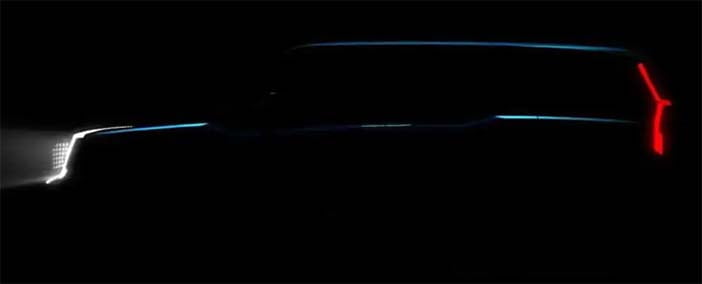
+++ KIA is getting ready to reveal its flagship electric model, the EV9 SUV, which should be unveiled in the first quarter of 2023. This upright and quite boxy 3-row SUV rides on the same E-GMP platform as the EV6, but it has a much larger footprint and a considerably more spacious cabin, with its wheelbase that is 20 centimetres longer than the firm’s Telluride model, its ICE equivalent in the line-up. The Korean automaker recently published a teaser video showing an obscured production EV9, revealing its side profile. Interestingly, the company posted the video on its Indian website and Twitter account, announcing that the model would be fully uncovered during the Auto Expo, which will be held in New Delhi between January 12 – 15. It’s not yet clear if this will be the vehicle’s official global debut or if it will be revealed beforehand and this will just be the first time it is shown in India. The production EV9 will retain the concept’s overall dimensions, although its design will be different and more toned down. The concept was almost 5 metres long and it rode on a 3.1-metre wheelbase, which should give it ample room inside for all 3 rows of seats, as well as plenty of headroom given the vehicle’s height. Battery capacity is expected to be increased compared to all current E-GMP models whose largest pack has a nominal capacity of 77.4 kWh (of which around 74 kWh is usable). Rumours suggest the EV9 and other larger E-GMP-based vehicles (like the Hyundai Ioniq 7) will have around 100 kWh, good for a range of just under 500 km on 1 charge. The EV9 is expected to enter production towards the end of 2023 and there’s a strong chance Kia will offer more than one battery pack option, as well as a rear-wheel drive base version as the most affordable entry point. +++
+++ Car model names are important to auto companies because they provide identity to their products, making them relatively unique amid the sea of automobiles in the market. While some automakers use specific words (or sometimes phrases) as model names, others, like LEXUS , prefer to use letters to represent the rationale behind each of their cars. Lexus bares the real meaning behind those letter designations; maybe something worth pointing out to your buddies during the holiday festivities. Here’s the list in alphabetical order. Lexus CT The Japanese marque named its 5-door hatchback the CT, which stands for Creative Touring. According to Lexus, Creative was used as the car used a hybrid powertrain in a segment dominated by diesel-powered models, while Touring was used to counter the myth that hybrid cars meant sacrificing luggage and passenger space. Lexus ES The ES was launched side-by-side with the LS. The ES stands for Executive Saloon, meant as a smaller version of the flagship model. Lexus GS Following the footsteps of the LS in using Saloon as a suffix, the GS, which means Grand Saloon, is the automaker’s midsize model. Its name represents its position as the middle child in Lexus’ saloon lineup. Lexus GX The GX stands for Grand Crossover. Just like the GS, the GX stands as the middle child in the automaker’s SUV lineup. Lexus IS While you might think that the S in the Lexus IS stands for Saloon, it’s actually not. IS stands for Intelligent Sports. The model was meant to represent Lexus’ traditional qualities in a smaller, more mechanically dynamic package to entice younger customers. Lexus LC/LC C Meant to combine the premium offering of the Lexus LS in a “seductive” coupe body, the LC, or Luxury Coupe, is the automaker’s flagship coupe that is “engineered in every dimension to deliver a very special and rewarding driving experience”. The other C suffix stands for Convertible in some markets. Lexus LFA While Lexus’ V10 supercar was born as the LFA concept which stood for Lexus Future Advance, it was later changed to Lexus F-Sports Apex in its production form. This was meant to represent the LFA’s position as the benchmark of the F series performance brand. Lexus LS The flagship model, the LS, stands for Luxury Saloon, and befittingly so as this is the car that launched Lexus back in 1989 as a luxury automaker. It was the culmination of work by 60 designers, 1.400 engineers, 2.300 technicians and over 200 support workers. Lexus LX LX stands for Luxury Crossover. As the model isn’t actually a crossover (it’s a fully-fledged SUV based on the Toyota Land Cruiser) some importers use Luxury Four Wheel Drive to represent the letters. Lexus NX The NX, which stands for Nimble Crossover, was named so to represent the vehicle’s smaller size, ergo, more nimble nature that’s perfect for both urban and country routes. Lexus RC/RC F The RC, or Radical Coupe, was designed to challenge perceptions about what a self-charging, petrol-electric hybrid should look like. The F suffix represents high-performance models in the Lexus range, used in reference to the Fuji Speedway in Japan, where hundreds of hours of testing were done on the RC F. Lexus RX/RX L The Radiant Crossover, or the RX, represents the automaker’s envisioned future when it was launched at the start of the new millennium. The L suffix is used to denote the larger, seven-seater versions. Lexus SC Offered from 1992 to 2010, the SC, or Sports Coupe, fits the midsize luxury coupe market. Lexus UX The UX is the smallest in the brand’s crossover lineup, marking the first time the automaker has produced a real compact luxury crossover. UX stands for Urban Crossover, “aimed to embody a free-spirited style that would appeal to modern urban explorers,” according to Lexus. +++
+++ The city-friendly second generation MITSUBISHI Space Star has reached the end of its career on the Japanese market. The company’s consumer website notes that production has ended, and the news fuels speculation that the hatchback will soon retire from the European market. “Due to the end of production of the Space Star, we may not be able to meet the customer’s request for body color, options, etc. Please contact our sales staff for details”, the message reads. Interestingly, the end of production isn’t announced on Mitsubishi’s Dutch website. While the Space Star is overshadowed by Mitsubishi’s crossovers and SUVs, it’s relatively popular in several Asian markets and nothing suggests slow sales caused its demise. The current-generation model received a new-look exterior design and additional tech features for 2021, but it entered production in April 2012 as a hatchback (and in June 2013 as a sedan) so it’s fairly old in car years; it sounds like the Space Star has simply reached the end of its natural life cycle. Mitsubishi will soon revive the heritage-laced Colt nameplate on a hatchback related to the Renault Clio. The Clio stretches about 20 centimeter longer and 12 centimeter wider than the Space Star so the Colt won’t land as a direct replacement. +++
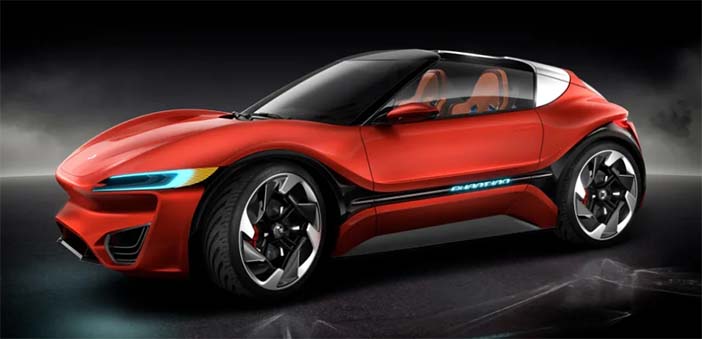
+++ NANOFLOWCELL , a London-based company working on bringing a new and innovative type of electric powertrain to the market, has set up its American headquarters in New York City. It also introduced a concept car that demonstrates the technology it’s been working on for years. While it’s not a household name, NanoFlowcell has appeared in these pages before: it regularly traveled to the Geneva auto show in the 2010s to unveil a series of futuristic concepts. It hasn’t said much in the past couple of years, and there’s no longer a Geneva auto show to unveil concept cars at, but work on the electrolyte fuel-powered electric drivetrain continued behind the scenes. Executives hope that its American division will develop market-specific applications for the technology, and they ultimately plan to produce cars and fuel here. Producing fuel is crucial because NanoFlowcell’s concept cars and prototypes aren’t regular EVs: they’re notably not fitted with a battery pack. They’re instead powered by an electrolyte fuel called Bi-Ion that uses seawater or wastewater as a base. Regardless of where it comes from, the water gets purified and becomes a fuel thanks to nano-structured Bi-Ion molecules. They’re described as “charge carriers developed to portably store regenerative energy”. The electricity that this liquid generates is what zaps the electric motors into motion. On paper, the results are impressive: the Quantino 25 concept (pictured) is a 2+2 roadster powered by 4 electric motors each rated at 80 hp. The company quotes a 0-100 kph time of 2.5 seconds and a maximum driving range of almost 2.000 km. Fuel is stored in a pair tanks installed under the floor, a configuration said to improve handling by lowering the center of gravity. Visually, the design study looks like an evolution of the Quantino unveiled in 2015, though it’s now fitted with what looks like a removable roof panel. NanoFlowcell stresses that its American division has already started looking for ways to roll out Bi-Ion fuel here, but there’s no word yet on when (or even if) a Bi-Ion-powered EV will be available. The company adds that it has already tested its technology for 500.000 km. +++
+++ Wondering what car manufacturers, who sell cars on the American market, suffered from the most recalls over the course of 2022? Wonder no more, as a list from the U.S. Department of Transportation tells us exactly what transpired throughout the year. Coming in at number one on the list in both number of RECALLS and number of cars potentially affected is Ford. In 2022, Ford issued 67 recalls. So no, you’re not imagining things if it felt like there were an unusual number of Ford recalls in the news. At that rate, Ford was averaging one recall every 5.4 days. In total, Ford’s recalls potentially affected 8.63 million vehicles this year, which is well over double that of any other manufacturer. Now is the time that we remind you that recalls are not always a terrible thing! Yes, it means there was some sort of error made in the process of your car becoming the car it is today, but it also means that the manufacturer has found the problem and is fixing it for you free of charge. On the other hand, nobody likes spending extra time at the dealership and dealing with their car being down for some indeterminate amount of time. Additionally, not all recalls are on the same level of panic. Some of them, like the Takata airbag recall, are worthy of all your attention and panic. Meanwhile, some recalls are to fix small things like rearview cameras that stay on for too long, or in other words, not five o’clock fire alarms. After Ford, Tesla came in second for most cars potentially affected by a recall at 3.76 million vehicles. The total number of recalls was much lower at just 20 total recalls (and it’s also fair to point out that a large number of Tesla’s recalls were fixed with over-the-air updates) but Tesla had some big ones in there that caused the number to skyrocket. GM’s recall story for 2022 was similar to Tesla’s, in that it only had 32 recalls, but the total number of cars potentially affected was high at 3.37 million. Stellantis was right there, too, at 38 total recalls and 3.04 million cars potentially affected. If you’re curious about the rest of the list, we’ll put the highlights for you below for the top 10 manufacturers with the most recalls in 2022. Ford: 67 recalls (8.636.265 vehicles), Volkswagen Group: 45 recalls (1.040.885 vehicles), Stellantis: 38 recalls (3.041.431 vehicles), Mercedes-Benz: 33 recalls (969.993 vehicles), General Motors: 32 recalls (3.371.302 vehicles), Kia: 24 recalls (1.458.962 vehicles), Hyundai: 22 recalls (1.452.101 vehicles), Tesla: 20 recalls (3.769.581 vehicles), BMW: 19 recalls (1.000.455 vehicles) and Nissan: 15 recalls (1.568.385 vehicles). Lastly, how about the manufacturers with the least recalls? Predictably, it’s a weird list. There are 5 OEMs tied for the least with 1 recall each: Bugatti, Maserati, Ferrari, Polestar and Mazda. Bugatti is the big winner here with only one car recalled. Unfortunately for Ferrari, its single recall potentially affected 23.555 vehicles, which is a monstrous recall for a company that produces such few vehicles. +++
+++ Because of Porsche’s IPO earlier in September, the VOLKSWAGEN GROUP needed to convene an extraordinary general meeting to approve a special investor dividend. Volkswagen Group and Porsche boss Oliver Blume used the meeting to discuss what he and his teams have been working on during his first 100 days in charge, and his plans for getting the conglomerate going in a more profitable direction. That profit isn’t simply about money, either: he wants to maximize the power of the group brands as part of increasing revenue and profit. “Nothing and no one is more important than the brands. People buy brands”, he said. “They are one of the most important criteria for our customers. That is why we will position our brands even more effectively and sharpen their profile even further”. Blume says the strategy requires eliminating overlap. He told the audience that “product strategies have been significantly revised” that will result in “clear design languages … to boost the identity of the products”. We’ve heard this before, the concept differences always seem to get watered down to incremental change by the time production sheetmetal is approved. The only exception is Seat, whose latest range is vastly more distinct when comparing models within the Seat lineup and when compared to the Volkswagen models Seat builds its range on. The design initiatives are going to roll out as VW’s Scalable Systems Platform proliferates throughout group brands over the next 7 years. Further breathing room will come from dedicated output ranges for individual brands. Blume’s translated words were, “we have allocated power ranges to the brand groups so that there will be no more overlaps in future.” We’d love to see the chart for this; are brands grouped into something like economy, mainstream, and luxury segments? As in, would Seat and Skoda be walled off together, those 2 sharing an output range that doesn’t infringe on the mainstream Volkswagen brand? Or do all 3 get their own non-overlapping power bands? And does this apply to ICE and EV powertrains? Any way it goes, seems like at least one tranche of brand customers will be asked to take a step down in power. Call me crazy, but I suspect it won’t be Porsche customers. Or maybe everyone gets to go up! Indisputable good news for everyone comes with Blume saying there’s a new quality offensive at work. The effort involves hardware and software, the initiative touched on last month in interviews with Volkswagen brand head Thomas Schäfer about VW’s infotainment system. Beyond that, with software being a Volkswagen Group bugbear since before the ID.3 launched, Blume said creating the in-house CARIAD software unit was the right move, and that it’s at the center of the improvement push, too. Benefits will mean better software in general, EV driving ranges up to 700 kilometers on the WLTP cycle, and fast-charging up to 200 kW. A glimpse of the future comes with the debut of “a high-performance software for [the]premium brands next year”. The full speech outlined 10 initiatives distilled from “75 fields of action”, each initiative overseen by a Volkswagen Group board member. +++