
+++ We first saw the DB11 back in 2016 so an update for ASTON MARTIN ’s grand tourer has been a long time coming. But now the British firm is working on a comprehensive redesign of the DB11. Aston Martin’s range currently consists of 4 cars: the DBX, the entry-model Vantage, the range-topping DBS and the DB11. The oldest car in the lineup, the DB11, replaced the DB9 and was the first Aston Martin to receive technology from the partnership with Mercedes-Benz. In terms of design, the DB11 was certainly an evolution of the DB9, with plenty of traditional Aston Martin stylistic touches. It will retain the same grille shape, although the chrome detailing within might be altered. When it comes to the headlights and side air intakes, some changes can be expected too. Huge brakes are visible behind this car’s 21 inch wheels and behind the front wheel arch the DB11’s vent will be retained. We could see much of the DBX’s interior technology make its way over the DB11 for this facelift. As for the drivetrain, Aston Martin currently offers up a 639 hp 5.2-litre twin-turbocharged V12 or a 510 hp 4.0-litre twin-turbocharged V8 from Mercedes. Aston Martin claimed in early 2022 that it will continue with V12-powered cars until 2026, so I expect both of the DB11’s powertrains to continue with the facelift. +++
+++ The current generation of BMW M3 will gain a new range-topping CS model and I suspect it will make its debut at this year’s 24 Hours of Daytona on the 28 of January. The event will also stage the competition debut of BMW’s M Hybrid V8 race car in the 2023 World Endurance Championship. CS stands for ‘Competition Sport’ in BMW-speak and as with the previous F80-generation M3 CS, the new model will bring a few performance and visual tweaks to stand out from the existing M3 Competition model. The old M3 CS launched in 2018 as a special run-out version, adding an extra 10 hp and 50 Nm of torque, more extensive use of carbon fibre, a tweaked damping setup and a much higher price tag. We expect the new CS to follow a similar brief when it hits the road later this year. The M3 CS will borrow styling details from the new M4 CSL, with the same kidney grille and lower air intake design and a more aggressive splitter. Unlike the M4 CSL there’s no ducktail bootlid spoiler at the rear however. The headlights have a yellow hue to them, just like the M5 CS’s units. BMW has shown us that it can extract 550 hp and 600 Nm of torque from the M3’s 3.0-litre twin-turbo straight-6 in the M4 CSL and I expect the CS to make use of this same tune. A remap of the M3’s 8-speed automatic gearbox will be in order and standard-fit carbon ceramic brakes should be expected. The CS name isn’t as iconic as the CSL in BMW parlance so we don’t think it’ll reach the heady heights of the M4 CSL’s price tag, but it’ll certainly be a lot more than the M3 Competition’s starting price. +++
+++ The demise of the SUV is inevitable, insists CITROEN chief executive officer Vincent Cobée. “The world of SUVs is done”, he claims, although he admits that right now the “numbers are not telling me I’m right”. Sure enough, such vehicles have accounted for 50 percent of all new car registrations in Europe for the last few years, but Cobée points to the emergence of saloon cars “called SUVs just because they’re a bit higher” as evidence for his view. The launch of one such car, the Citroën C4 X, is the venue for our chat with Cobée, who joined the company at the start of 2020. One major reason for the industry pivoting away from SUVs to cars like the C4 X is aerodynamics, he says. “On a battery EV, if your aerodanymics are wrong, the penalty in terms of range is massive. You can lose 50 kilometres between good and bad aero, and between an SUV and a sedan you’re talking 60 to 80 kilometres very easily”. The current solution is to increase the battery size, something we already see in various manufacturers’ ranges. For instance, a BMW iX has a much larger pack than the smaller, slipperier i4. But this won’t always be possible, Cobée reckons. “People will start limiting weight and battery sizes, either through tax, through incenstives, through regulation, through naming and shaming”, he said. France, it’s worth noting, is set to go down the route of taxing vehicles by weight. “The A-segment has been killed by regulation and the SUV segment will be killed by aerodynamicism and weight”, he concluded. Finally, it’s a simple case of changing perceptions, with SUVs likely regarded to be increasingly problematic in years to come as the climate crisis deepens. “If you live in a big city, 5 years ago if you drop off your kids with a big SUV you’re a man. Now, if you do this, you’re a ‘terrorist’ ”. The weight gain simply isn’t acceptable, says Cobée. “In the 1970s, a car was weighing 850 kg. Today an average car is weighing 1300 kg. Tomorrow an average car will weigh 2 tonnes. So we’re using three times more resources to deliver the same service, just to be ‘green’ ”. He likens buying a car whose large battery is only occasionally utilised to taking a giant backpack intended for a multi-day hike to the office. “Do you go to the office with that backpack? The answer is no. So why would you go to the office with a car with 1 ton of battery?” Instead there should be a greater emphasis of a better charging experience on the move, he says, something Citroen is intending to make easier via route-planning tools and as an interim measure, short-term loans of combustion-powered cars for its EV customers. It has started offering the latter service in France, with plans to expand to other markets. Citroën is generally moving in a different direction to other manufacturers with its EVs by tending to stick with smaller batteries of 50 kWh capacity, while the radical Oli concept of 2022 shows the French company’s commitment to staying light even as it transitions to a fully electric future. Cobée doesn’t deny there’s a risk in moving away from the kinds of cars customers are wanting now, but suggests it could be a bigger problem by failing to change tactics early. “If we stick to ‘SUV boxes’ until 2030 and discover there’s no customer, it’s going to be a hard landing. You don’t want to be the last one to leave the dancefloor”. +++
+++ Car manufacturers in EUROPE are to produce fewer electric vehicles than expected as buyers look to cheaper models, experts have predicted. The Advanced Propulsion Centre (APC; a joint venture between the British Government and automotive industry that funds research into low-emission powertrains) has published its latest quarterly review of the car market. In its report, the APC has predicted the UK will produce 1.1million cars and vans in 2025, of which 280.000 (little more than a quarter) will be fully electric. This is a downward revision, with the previous suggestion being that 360.000 out of a total 1million vehicles (more than a third) would be EVs. This, the APC explained, is because an “uncertain economy” will drive customers towards cheaper new cars, with reduced EV production predicted as a result of that expectation. It acknowledged that overall production is expected to increase, however, with more hybrid and plug-in hybrid vehicles to be built. A similar trend is predicted on the continent, with the APC forecasting 12 million European EVs being built in 2025; a downward revision of 1 million from its previous estimate. Again, this is due to uncertain economic conditions, as well as potential supply chain issues. The report makes mention of silicon carbide wafers (a type of semiconductor, first used in the automotive industry by Tesla) with excellent electrical and thermal properties. These types of semiconductor have the potential to improve EV efficiency and performance, and the APC says they will dominate the market by 2030. Europe will need a supply of 600.000 to 800.000 wafers by then. +++
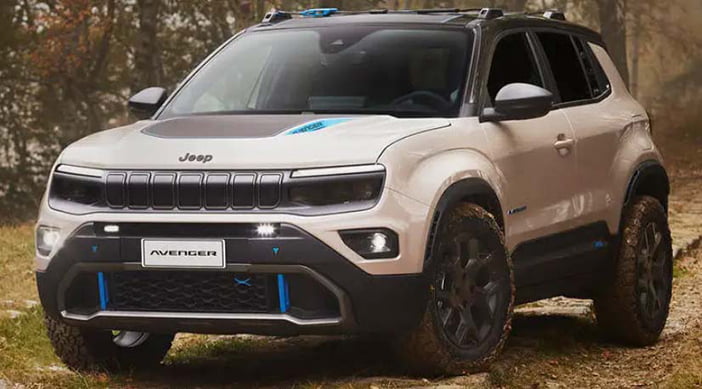
+++ The 4-wheeldrive edition of the newly launched JEEP AVENGER will arrive next year rather than in 2023, according to firm’s European boss. The American brand has launched its first European-specific model in front-wheeldrive form, and as a pure-electric model in the vast majority of markets, including the Netherlands. The company has, however, openly admitted that it has a 4-wheeldrive Avenger in the pipeline, supporting the policy that every Jeep should have that off-road focused set-up in its range. It revealed a concept previewing the car that was said to feature a dual-motor EV powertrain at the 2022 Paris Motor Show. The regular front-drive Avenger has already attracted 7.000 pre-orders across Europe; more than for any previous Jeep. The company’s European boss Antonella Bruno said that this strong early demand, and the 2-wheeldrive car’s ability off road, mean that the firm can be “patient” with the 4-wheeldrive edition. “It’s another strength of the Avenger”, Bruno said. “The 2-wheeldrive edition is as capable off road as a Renegade. But yes, the 4×4 will arrive, and when it does, it will deliver the ultimate capability. There is a plan: we’re going to launch the fully electric Avenger and then the 4×4 will arrive in 2024”. That distinction could be a reference to a non-electric powertrain. Despite the fact the Avenger is being launched as an EV nearly everywhere, executives have been coy on whether the 4×4 concept’s all-electric powertrain will make it into production. A hybrid set-up, incorporating an electric motor on the back axle, could be another potential solution. The Avenger is based on an evolution of the e-CMP platform that also underpins front-drive SUVs like the Opel Mokka-e and Peugeot e-2008. But Jeep engineers have worked on the revisions to the architecture to allow 4-wheeldrive, and the Paris show car was designed to demonstrate how a more extreme off-roader version of the Avenger could look. The concept has a wider track and stretched wheel arches to help accommodate chunky all-terrain tires, and the approach, breakover and departure angles have been improved compared with those of the regular Avenger, at 21 degrees, 20 degrees and 34 degrees respectively. Other tweaks include a lightweight cargo system that uses belts to fix loads above the roof, which has scratch protection, extra cladding and more floodlights in the front bumper, and an bonnet sticker designed to minimise reflection and glare through the windscreen. Jeep confirmed that the Avenger “will be added to the range of 4xe models coming in the future” but beyond saying that the powertrain had been “enhanced by electrification”, it declined to provide details on whether a combustion engine is involved. +++
+++ MAZDA still wants to make a rotary sports car, but such a model remains a long way from production. Rotary technology returns to Mazda with a plug-in hybrid version of the MX-30 R-EV. The tech is scalable and able to be used on other applications beyond its 830 cc single-rotor application on that car. “Rotary is our symbol”, said Yoshiaki Noguchi, assistant manager of Mazda’s powertrain development division. “It’s a dream of engineers at Mazda to have a sports car with rotary. Now is not the time for that. When the company situation is a lot better (in regards to completing its roll-out of electrified models), we can think about that dream another time”. Wakako Uefuji, Mazda program manager, product division, added: “We need to keep the electrification of models for this era. This is the first thing we do but maybe in the future”. Her quote illustrates the product roll-out for Mazda: its first focus is to electrify its core range, of which rotary hybrid plays a part, but it is not ruling out sports car applications in the future. It’s now 11 years since the Mazda RX-8, Mazda’s last rotary-powered sports car, went out of production. It raised hopes of a return of the technology with the Mazda RX-Vision concept car in 2015, but it’s on a small crossover where rotary has made its comeback. Mazda has made huge improvements to the rotary engine since it was last used, improving efficiency and reliability. “There are 3 big challenges with rotary”, said Noguchi. “The economy is number one. At the same time, you need to make it lighter to improve the range. Then improve reliability”. Mazda now uses direct injection rather than port injection, which improves economy by as much as 25%. This in turn reduces CO2 emissions, while rotary engines have always been low NOx pollutants. Aluminium side housings reduce weight by around 15 kg alone. A higher compression ratio of 11.9 features, and a change in thickness to the apex seal and a new coating for this improves reliability. Noguchi said that the new rotary engine would still perform well at high engine speeds which makes it well suited for a sports car, though in the MX-30 R-EV it runs between 2.450 – 4.500 rpm as it is used as a generator for the battery. +++
+++ MERCEDES-AMG is working on a refreshed GT 4-Door. The new car will receive a redesigned exterior alongside expected technology updates. You might question why Mercedes is updating the GT 4-Door so soon after it gave the model a facelift in 2021. Well, that facelift 2 years ago was limited to the six-cylinder 53 and 43 variants of the AMG GT 4-door, whereas this round of updates is expected to be restricted to the more potent 63-badged models. Expect a larger lower air intake with a more protruding lower splitter, plus a redesigned grille. The rear features 2 single-exit exhaust pipes (expect a quad set-up for the production car) and a charging flap on the rear bumper, indicating the E Performance’s plug-in hybrid system. On this car we can see a fixed wing, although the outgoing car offered an active aero spoiler as well. The range-topping 63 S E Performance’s 840 hp and 1.400 Nm of torque are still sensational numbers, but AMG typically likes to add more power for notable updates like these so we could see the 4.0-litre, twin-turbocharged V8 and rear-mounted electric motor tuned further. Mercedes-AMG tweaked the adaptive air suspension of the lower-rung 43 and 53 versions during their 2021 update so don’t think the 63 model’s suspension will go unchanged. The interior of the GT 4-Door has been a little left behind by the likes of the EQS and new S-Class with their latest MBUX infotainment systems and gigantic Hyperscreen options, but it’s unlikely we’re going to see drastic interior changes with this update. Instead, the brace of dash-mounted 12.3-inch screens should be retained – although with an infotainment software refresh. +++
+++ MERCEDES-BENZ is working on a saloon version of the EQA. I suspect the current EQA will become ‘EQA SUV’ to bring it in line with Mercedes’ existing all-electric SUVs, freeing up the EQA name for the saloon. The new car will sit as an entry-level model into the Mercedes EQ range when it launches in 2024. In terms of its electrified future, Mercedes has already shown most of its hand by declaring it will launch 3 new electric vehicle platforms by 2025 in the form of MB.EA, AMG.EA and VAN.EA. Mercedes also said in 2021 that it will have a pure-electric alternative for every model it made at the time. The EQ lineup is currently made up of the EQA, EQB, EQC, EQE SUV and its EQE saloon variant and the EQS and its GLS-rivalling EQS SUV and also the EQV van. The entry-level EQA was launched in 2021 on a tweaked version of the MFA2 platform shared with the internal-combustion engined GLA. As I’ve said, the new EQA saloon will launch in 2024, meaning it’ll miss out on the Mercedes MB.EA platform. In 2022, Mercedes CEO Ola Källenius said: “The entry point to the Mercedes brand in the future will be a different one than today”. This was in reference to a new MMA architecture Mercedes plans to debut by 2024, when it’s likely to launch on the EQA saloon. The MMA platform will be able to underpin pure-EV and internal combustion engines, which could allow for another generation of A-Class. Holger Enzmann, Mercedes project manager for the EQE and EQS EVA2 platform, told: “we have talked about the A-Class and we’re looking at a replacement. It won’t feature on EVA2 as that is for larger vehicles but you can be sure we’ll see a vehicle in this segment”. This vehicle is almost certainly the EQA saloon we’ve spied, but as we’ll see with the upcoming CLE (which will replace 2-door versions of the C-Class and E-Class), Mercedes isn’t afraid of streamlining its range. With this in mind, the EQA saloon could sit as an all-electric alternative to the C-Class as well. Mercedes has also stated it will reduce its ‘portfolio positions’ from 7 to 4, suggesting a new car will replace the C-Class and A-Class segment. I don’t know what charging speed will be offered by the new EQA but Mercedes’ own charging network will have the capacity to deliver speeds of 350 kW when it rolls out over the coming years. Mercedes has claimed its new MB.OS infotainment operating system will roll out on models from 2024, so we’re likely to see this technology in the EQA saloon. MB.OS will be able to receive over-the-air updates and features like streaming video, plus a revised infotainment design. +++
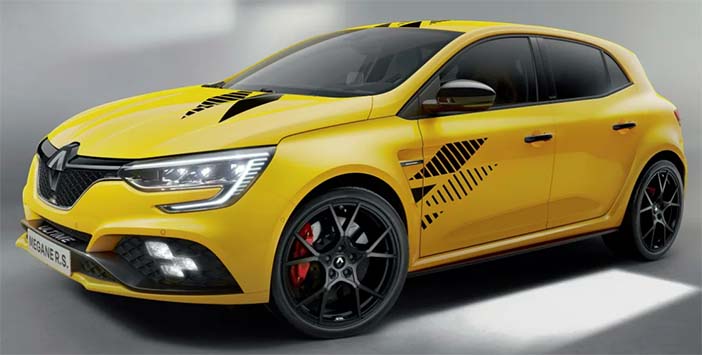
+++ In 1976, Renaultsport became the sporty sub division of RENAULT and since then it’s produced some of the world’s best hot hatches, plus a few iconic race cars in Formula One, WRC and even Formula E. Defunct in 2021, the brand has somewhat belatedly launched a final fling in the shape of the new Megane R.S. Ultime. Based in Dieppe, France, Renaultsport’s final product is based on the Mégane R.S. Trophy and only 1.976 will be built (a nod to the year the company was founded). Unveiled at this year’s Tokyo Auto Salon, the Ultime features some cosmetic changes to help it stand out, although its mechanicals are unchanged over the Trophy. New graphics appear on the roof, bonnet, side and rear bumper are inspired by Renault’s new logo and 1976 is inscribed on the right hand side of the car. Four paint finishes are available on the Ultime, Star Black, Pearl White, Tonic Orange and Sirius Yellow. The wheel arches have been tweaked with a 60 mm wider front and 45 mm wider rear, to give it an even more imposing stance. New side air vents coupled with R.S. Vision headlights and that huge central exhaust also add to the Ultime’s look. Some influence has come from the hardcore Megane Trophy-R, although only in the form of track-focused Bridgestone Potenza S007 semi-slicks. There’s also Renault’s ‘Fuji Light’ 19 inch wheels, lowered Cup suspension and the Trophy’s 4Control 4-wheel steersystem. The engine remains unchanged over the Trophy’s with a 1.8-litre turbocharged 4-cylinder producing 300 hp and 420 Nm of torque. Only the automatic EDC gearbox will be available in Europe, sending power through a mechanical differential resulting in a 0-62mph time of 5.7 seconds. Inside the Ultime there are Recaro bucket seats with Alcantara upholstery (the same as what you’ll find in the Trophy) but what is different is the numbered door sills and signature of Laurent Hurgon on the centre console. Hurgon was Renault’s development driver for the Mégane R.S. and broke the front-wheel drive lap record at the Nürburgring in the Mégane Trophy-R. Sadly, Renault has said the Ultime isn’t coming to the Netherlands. There’s no word on pricing but expect a price tag significantly higher than the the old Trophy demanded. +++
+++ VOLKSWAGEN recently announced a hefty set of upgrades for its ID.3 all-electric hatchback, but the company isn’t about to give up on its more famous family model, the Golf. And now, brand boss Thomas Schäfer has said that the iconic badge might be applied to an EV after the combustion-engined versions cease production. The current Mk8 Golf is due for a facelift this year, and this is likely to bring further mild-hybrid tech. Recent spy shots have also shown that VW is tweaking the controversial infotainment system, while increasing the size of the central touchscreen display. This is likely to be the last generation of the Golf to feature a combustion engine. But after this model reaches the end of its life, in around 2025 or 2026, VW boss Schäfer says that the Golf name could continue on an EV, and potentially one that will be sold alongside the successor to the current ID.3. Schäfer said that both the ID and Golf names would continue. “Both have a reason to stay”, he told. “ID is already a really well known logo for electrification. We created it, and the connection of Volkswagen and ID works; there’s no need to cancel it or redo it. “Secondly, we have iconic brand names like Golf and GTI. You’d be crazy to let them die. At the moment we’re working out our future line-up and naming logic. We will probably stick with ID, but at the same time iconic models will also carry their name, like we have with the ID.Buzz. It works”. Asked whether this means Volkswagen could potentially have a vehicle called ID. Golf, Schäfer replied, “We might”. He added that the Polo is less likely to continue than its larger stablemate. “The Polo is pretty iconic”, Schäfer said, “but is it iconic enough to carry on? That’s not clear yet. Golf is definitely one we’ll keep, there’s no way we’d let that go”. The ID.Golf will be based on the ID.3’s MEB all-electric platform. This architecture had been expected to die in around 2026, when VW was planning to integrate its principles, and those of the more expensive PPE platform, into a single chassis and battery set-up called SSP. But rumours suggest that VW is now preparing to extend the life of MEB by investing around 1.3 billion Euros to allow the platform to accept the firm’s forthcoming ‘unified battery cells’ and charge more quickly, at more than 200 kW. These elements would deliver cost savings for VW, at the same time as improving the ID. models’ competitiveness against key rivals. Schäfer also revealed that the GTI name will be heading into electrification, possibly at the expense of the still-new GTX badge. “The discussion we’re having now is to get the electric vehicles into performance and then carry the GTI name forward”, he said. “GTX was an idea on the way to electrification; we came up with a different name. In future, whether we’ll need this or not, we’ll see. But GTI is so strong”, Schäfer confirmed that a new small all-electric Volkswagen is on track to be the entry point to the company’s EV range, and he admitted that work has started on an even cheaper, more compact model. “The smallest one that we’re coming with is our ID.2”, he confirmed, “and that will be well below €27.5000 Euros in the Netherlands. Is that the end point? No, it can’t be. The reality is that we need to get something below the 20,000-Euro mark. The team’s now working on ideas for how we get there. We haven’t found the solution yet, but I personally think it can be done, although you have to talk about range and what’s really necessary in such a vehicle. Battery cost is, at the moment, the deciding factor”. This confirms that VW is looking to tap into a project. Skoda boss Klaus Zellner said that his team is in charge of the exploratory work on an even cheaper EV. “Skoda has to be the brand that has the easiest access into the VW Group,” he told us. “And we’re tasked to find the right solution for that”. +++