
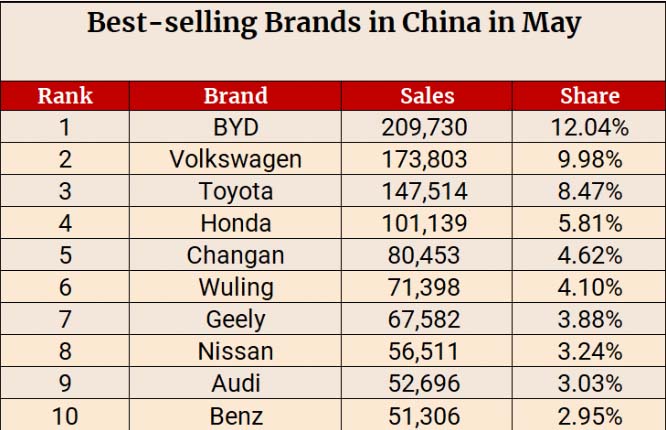
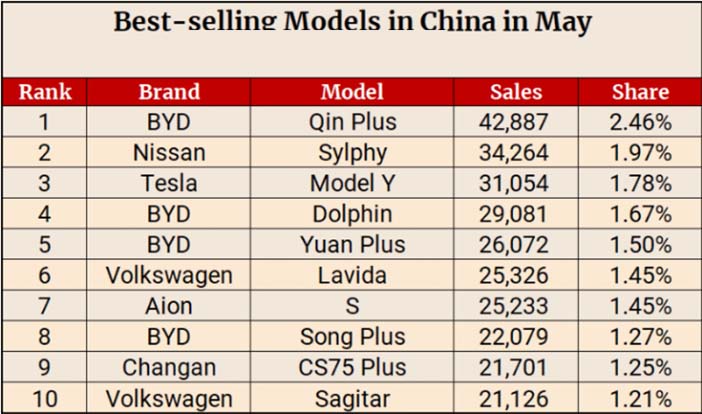
+++ According to the data released by the CHINA Passenger Car Association (CPCA), the Chinese market witnessed the sale of 1,742 million new cars in May 2023. This represents a 7% increase compared to the previous month. Notably, among these sales, 388.000 were electric vehicles (EVs) and 192.000 were plug-in hybrid electric vehicles (PHEVs); collectively known as new energy vehicles (NEVs). NEVs accounted for 33% of the total sales. It is important to note that while China’s overall car sales have shown a growth rate of over 28% compared to May 2022, this increase is primarily influenced by the impact of the Covid-19 outbreak in China last year, which resulted in reduced production by many enterprises. Therefore, this growth rate should be interpreted cautiously and may not hold significant reference value. In terms of market share, BYD secured the first position in China, selling 209.730 vehicles and holding a market share of 12.04%. Among the top-5 bestselling auto brands, Volkswagen ranked second with 173.803 cars sold and a market share of 9.98%. Toyota secured the third position, selling 147.514 cars and holding a market share of 8.47%. Honda followed in fourth place, selling 101.139 vehicles and having a market share of 5.81%. Changan occupied the fifth spot, selling 80.453 cars and holding a market share of 4.62%. In the Chinese NEVs market, BYD has established a significant market presence in both EVs and PHEVs segments. As for the pure EV market, BYD maintains its leadership position, selling 101.065 vehicles and holding a market share of 26.05%. GAC Aion ranks second with 45.003 cars sold and a market share of 11.60%. Tesla secures the third position with 42.508 vehicles sold and a market share of 10.96%. The fourth and fifth best-selling pure electric brands are Wuling and Changan respectively. Analyzing the bestselling models, the top-3 models in the Chinese market are the BYD Qin Plus with 42.887 units sold, the Nissan Sylphy with 34.264 vehicles sold and the Tesla Model Y with 31.054 cars sold. +++
+++ GAC has replaced an unwilling joint venture partner with a more promising one and has reorganized its business structure. It also took the first steps towards a self-owned car brand, but it also has other joint venture partners. GAC added a few international brands to its portfolio and also dabbled with some domestic car manufacturers. After exchanging Peugeot with Honda, GAC experienced for the first time what great commercial success tastes like. It opened the door for more joint ventures, now that GAC had become a credible partner to international manufacturers. Surprisingly, GAC turned to Honda’s main competitor for its second joint venture project, namely Toyota. Toyota’s ascend in the Chinese market had been very cautious, maybe even slow. They were a late entry to local production, creating their first joint venture with Tianjin Automobile in 2000. Of course, Toyota had already some technical cooperation with several small Chinese manufacturers, but these were mostly for commercial vehicles. Tianjin merged into FAW in 2003, which strengthened Toyota’s position in the Chinese market and the Japanese saw room for another joint venture. While FAW-Tianjin-Toyota mostly concentrated on smaller vehicles like the Vios and Corolla, the GAC-Toyota joint venture, which was established after long negotiations in 2004, first produced the Camry model. Again an interesting choice, because the Camry is, of course, a direct competitor to the Honda Accord, made by GAC-Honda. A big battle emerged between the Accord and Camry for the top spot in the sales charts, surpassing the VW Passat and Nissan Teana in the process. The top spot went back and forth a few times. GAC-Toyota’s second car became the Yaris in 2006, related to the FAW-Toyota Vios. The Yaris however failed to capture the heart of the Chinese buyer. Its soft, curvy looks were too feminine and the car was significantly more expensive than most of the competition. Toyota held higher hopes for its third offering, the Highlander. This was a Camry-sized SUV, deemed to be much more advanced than the generic Chinese SUVs that dominated the segment in 2009. In 2008 and 2009 the brand encountered some unexpected difficulties in the marketplace. First, the Camry was hit with brake failure. The main brake cylinder could start to leak, reducing the brake force. Although this was a clear safety problem, Toyota’s response was clearly lacking. Instead of issuing a nationwide recall, the company relied on its regular service intervals to spot potential problems and rectify them only when they appeared. While the problem gained traction in the media, Toyota’s corporate image of technical reliability and excellent customer care took a hit and it forced a recall after all. While Toyota replaced the master cylinder on all the Camry’s it had produced in China, the Honda Accord regained the lead in sales charts. A second problem emerged when a man took his brand new Highlander for a ride on some dirt roads in the country site. He and his friends encountered a fairly steep incline and while his friends’ cars all made it to the top, the Toyota failed to get up the hill. It was first reported in the local news but got national attention when a TV station took the Highlander for a test drive on that hill. They found out that the car indeed didn’t make it to the top, unless it took a long run-up and negotiated the incline at speed. Toyota didn’t respond to the incident, which then turned slightly farcical when people tried (and succeeded) to get up the hill in supercheap minicars like the Chery QQ (a sort of Daewoo Matiz). The 2 incidents affected GAC -Toyota and Toyota sales, but in the end, the effects were short-lived. Toyota pressed on with the E’Z (Verso), a major facelift for the Yaris and a new generation of the Camry. The large saloon also gained a hybrid option. By the end of 2011, the turmoil of the late 2010s was largely forgotten. A new generation of the Yaris arrived in 2013 and more importantly, a year later GAC-Toyota started manufacturing the Levin as well. The Levin is of course a rebadged version of the Corolla, that was already in production with FAW-Toyota. By then, the line-up of GAC-Toyota and FAW-Toyota largely overlapped and that strategy continues until today. Both joint ventures make mostly the same cars, albeit under different model names and commercialized through different sales channels. Most of the larger international brands with more than one joint venture practice this strategy nowadays. Toyota renewed the Highlander in 2015, this model being the only SUV in the GAC-Toyota line-up. It would stay that way until 2018 when Toyota added the C-HR. After that, the SUV line-up quickly expanded. The Wildlander (RAV4) arrived in 2020, followed by another new Highlander in 2021 and the Venza (RAV4 Coupe) and Frontlander (Corolla Cross) in 2022. In between, Toyota also introduced new generations of the Camry and Levin (adding a long-wheelbase version called Levin GT). After a 4-year hiatus, following the discontinuation of the E’Z, Toyota re-entered the MPV segment with the Sienna in 2021. Toyota’s electrification effort has always concentrated on hybrid vehicles since they pioneered that type of car in the late 1990s. For the most part, this also holds for China, although hybridization went a bit slower than in the EU or US. But today, Toyota offers a hybrid option on all of its cars, except the Yaris. China does have some specific regulations about electrified vehicles though, including the need to gather some NEV regulatory credits. These NEV credits are only available for BEVs, PHEVs or fuel-cell vehicles. If a manufacturer doesn’t generate them itself, they must buy them from others or face a fine from Beijing. So Toyota needed to put some effort into electric cars and the first attempt was creating a sub-brand called Lingzhi (or Leahead in English, which stood for Leap Ahead). I’ve covered this brand in an earlier article and it produced only one car in 2015: the Leahead i1, an electric Yaris. GAC-Toyota sold a couple of dozen. When the NEV credits really started to become a problem, Toyota did the same as Honda: rebadged GAC cars. They rebadged the exact same cars, the Trumpchi GS4 and the Aion S. Although initially announced as Lingzhi again, these cars sell or sold as GAC-Toyota. Toyota also converted the C-HR to a BEV. This was the usual ‘aftermarket’ conversion, with a battery pack bolted below the floor of the car. Early Chinese EV makers did that years before, but the C-HR BEV appeared in 2019. It was sold by FAW-Toyota as well, as the Izoa. Both cars have been discontinued in favor of Toyota’s real electric car, the BZ4X. Now this car has experienced a very troublesome global debut, with a 4-month production break due to problems with wheels and airbags, and following that, very critical test reports from several media about low range and slow charging. How all the bad news will affect the Chinese sales of the BZ4X remains to be seen. Toyota however, has a backup strategy. In April 2020, the Japanese formed a new joint venture with electric powerhouse BYD, called BYD Toyota EV Technology. It’s not a car manufacturer, but a R&D company. It means BYD Toyota will develop and design Toyota BEVs for China. The first car has just been released and is called BZ3. It’s a midsize sedan, based on Toyota’s e-TNGA platform, but with a complete drive train and battery from BYD. Toyota wants it to become the “electric Corolla”, so it’s surely an important car. The Japanese brand is doing very well in the Chinese market. It seems relatively unaffected by the global supply issues troubling the industry post-covid and it slowly moves in on Volkswagen for the top spot in the sales charts. The only obstacle in the way of dethroning the Germans is Toyota’s electric partner. BYD might just pass both before Toyota can claim the crown. Fiat was quite successful in China with commercial vehicles (Iveco) and agricultural tractors (New Holland), but passenger cars? Not so much. The Italians had a joint venture with Nanjing Automobile since 1999 and produced a range of cars based on the Palio series. This design sold quite well in many developing countries, but in China, the 100.000-vehicle factory only made 30.000 or so cars per year. In 2006, Nanjing Auto acquired the remains of MG Rover and Fiat believed their partner became distracted. In 2007, just before Nanjing Auto and SAIC merged, Fiat withdrew from the joint venture. Instead, Fiat turned to Chery Automobile. In the summer of 2007, both brands announced a joint venture for the production of Alfa Romeo cars, the 147 and 159, and an engine project led by Chery. There were documents signed, but these were declarations of intent. Not much later, GAC approached Fiat about its new self-developed brand. GAC was looking for some technology transfer to get things rolling quickly and Fiat sold them the production line and platform from the Alfa Romeo 166, which had just been taken out of production. Apparently, one thing led to another and in March 2009, Fiat called off the proposed joint venture with Chery. The Italians cited economic reasons, as the global credit crisis had just broken out. Just 3 months later they signed on to a joint venture with GAC instead, and construction of a new factory started in Changsha, Hunan province, in late November. It would take until the summer of 2012 for the factory to be finished. Meanwhile, interesting developments were taking place elsewhere. In the US, Chrysler Corporation got in trouble during the credit crisis and Fiat participated in preventing bankruptcy. In 2009 the Italians acquired 20% of the Chrysler shares, which rose to 59% in 2012 and in January 2014, they were allowed to wholly acquire the American automaker. The new global company was revamped Fiat Chrysler Automobiles (FCA). A slightly restyled Dodge Dart thus became the first Chinese Fiat, called Viaggio. The Dodge in turn was the sedan version of the Alfa Romeo Giulietta. The car came with modern T-Jet engines and optional DCT transmission. In 2014, Fiat also launched a hatchback version of the car, called Ottimo. Both models were sold until 2017 and were the only 2 Fiat-labeled products by GAC-FCA. The company saw better opportunities by bringing back an iconic name in Chinese car history: the Jeep Cherokee. The Cherokee had been produced by Beijing Jeep for many years and was a well-known sight on the streets. GAC-FCA’s Cherokee was of course a much more modern generation and appeared in 2015. A year later, GAC-FCA added the smaller Renegade and Compass models, switching the line-up entirely to Jeep. The model range was completed by the large Grand Commander in 2018. GAC-FCA’s bet on the Jeep name paid off handsomely. Car production rose to over 200.000 vehicles in 2017, but that proved to be the best year of the joint venture. The way down took a little longer than the way up, but in 2021, Jeep only sold just over 20.000 cars. Ever since Covid hit the country, there has been a booming outdoor lifestyle hype in China. And what brand would you associate with that lifestyle? Yes, Jeep. But instead, the Chinese buyers flocked to pickups and all-wheel drive SUVs from domestic manufacturers. Developments overseas once again determined the fate of the joint venture. In 2020, FCA and Peugeot SA (from France) entered into merger negotiations. The process was completed in January 2021, and the combined company would be known as Stellantis. Former Peugeot CEO Carlos Tavares was put in charge. In the West, the merger was seen as the creation of a strong global player in the car industry, but its operations in China were problematic. GAC-FCA was in decline and also the Dongfeng-PSA joint venture was just a shade of their former glory. Tavares is not a man known for subtlety. Early in 2022, he said Stellantis would raise its stake in GAC-FCA to 75%. For the GAC directors, this announcement came out of blue air and they were not amused. What followed was months of arm wrestling and bickering. Production at the joint venture was halted in July. Both parties couldn’t come to an agreement and in October, GAC-FCA was put up for bankruptcy. In a case of history repeating, Peugeot (well, Stellantis) managed to run a GAC joint venture into the ground. Again. While GAC prepared for the launch of its self-owned car brand, the company interacted with 3 smaller domestic car manufacturers. One of themw as Changfeng Automobile. In 2012, GAC wholly acquired Changfeng and the joint venture with Mitsubishi the small brand had. GAC detached Changfeng and Mitsubishi and formed a joint venture with the Japanese brand themselves. In September 2012, GAC (50%), Mitsubishi Motors (30%) and the Mitsubishi Corporation (20%) finalized the contracts. During the transition period, the Pajero model was the only Mitsubishi-branded car in production, but it disappeared shortly after. Despite the reasonable success of the Pajero, GAC Mitsubishi had different plans. Instead, the company put the ASX into production, a compact SUV replacing the large off-roader. This proved to be a wise move, production doubled from 30.000 to 60.000 cars. In 2017, when GAC-Mitsubishi had just launched the Outlander model, production doubled again. In the next 2 years, the joint venture enjoyed its glory days with sales numbers of around 140.000 cars. Mitsubishi also had a Chinese joint venture with Fujian Motors at the time. The product line-up was nicely separated: Fujian Mitsubishi produced sedan cars, mostly Lancer-based models, and MPVs, while GAC-Mitsubishi made the SUVs. The ASX is still in production today, after numerous refreshments and facelifts. But the old car can’t hide its age and its appeal has diminished in the last couple of years. So the Outlander accounts for most of the sales, still only half of the best years. In an attempt to turn the downward trend, Mitsubishi has added the Eclipse Cross to the line-up, and a new generation Outlander will follow soon. Mitsubishi Motors got in trouble in the home market, when it was revealed that the company had cheated on emission and fuel economy tests for years. It got so bad, that Mitsubishi had to be saved by Nissan, who took a controlling share. Later almost all other Japanese brands were caught for similar offenses, but Mitsubishi suffered the most. Nissan didn’t inherit a thriving brand. Mitsubishi had been known for sensible, reliable and affordable cars for years, but well-known nameplates like Colt, Lancer or Galant were fading in the market. The Pajero was gone and the rally successes of the Lancer seemed forgotten. Mitsubishi survived on a range of Kei-cars in Japan, low-budget MPVs in South-East Asia and some moderately successful SUVs elsewhere. In 2020, Nissan decided that all future models would share technology with Nissan cars. The new Outlander is derived from the X-Trail. Mitsubishi sold the Outlander PHEV quite well in some markets, but not in China. The brand’s electrification efforts followed the example of Honda and Toyota. Create a sub-brand and rebadged some GAC Trumpchi cars. Mitsubishi’s sub-brand was Qizhi (Eupheme in English) and like Honda and Toyota, it rebadged the Trumpchi GS4 as Qizhi PHEV. Qizhi didn’t electrify one of its own gas cars but rebadged the Trumpchi GE3 (a small hatchback and predecessor of the Aion brand) as Qizhi EV. I can’t find if Qizhi’s actually sold, but if they did, then just in small numbers. The brand disappeared again in 2020. To remain relevant in the Chinese market, Mitsubishi developed a China-only model. Again, GAC Aion technology underpinned the car, in this case, the platform and drive train of the Aion V-series. But in contrast to the Qizhi effort, this time Mitsubishi designed its own body. This Airtrek has similar dimensions as the Outlander but comes as BEV only. The car went on sale in January 2022 but hasn’t found 1.000 buyers yet. In a turn from bad to worse, the diamond-logoed brand announced a suspension of production earlier this year. Initially, it was announced for a few weeks, ending in May. However, May has come and gone and the production suspension is extended, indefinitely. Mitsubishi officials have said that they are not planning to leave the Chinese market, but the future looks very difficult at least. +++
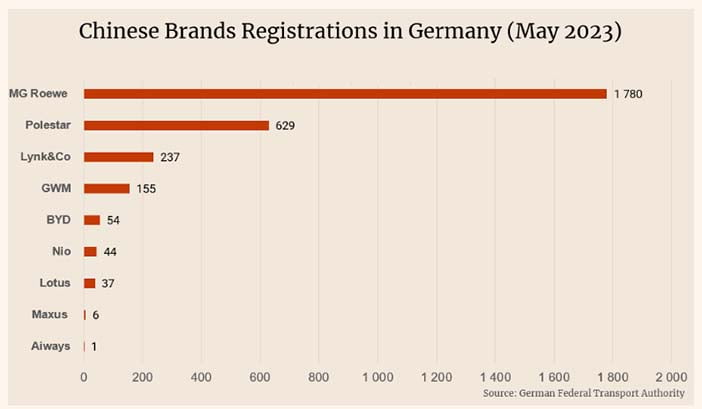
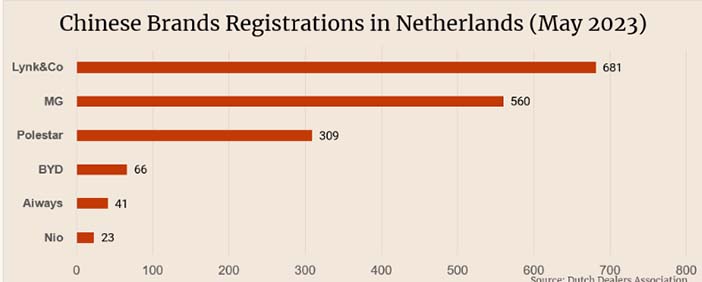
+++ The Federal Motor Authority in GERMANY has published a vehicle registration report for May. Last month, 246.966 passenger cars were registered in the most populated European country, +19.2% compared with the same month last year. All-electric vehicles (BEV) share was 17.3%, which is 46.6% up from last year. The first place went to MG, a former British brand now under state-owned SAIC Motor. MG registered 1.780 cars in May, which is 117.6% up year-on-year and 53% up month-on-month. Year to date (January – May), MG sold 6.766 vehicles in Germany. The report doesn’t break down registrations into particular models. Still, looking at the neighboring Netherlands, we can tell the sales are driven mainly by electric MG 4 hatchbacks, MG 5 station wagons (or, as Germans say, kombi) and MG ZS EVs. Second place goes to Polestar, with 629 sold units. Sales are driven mainly by the ‘2’, which became Germany’s most popular company car in 2022. Polestar has a positive trend as their May sales are 15% up compared to April and 36.6% up compared to May last year. In the periode January to May, they sold 2.208 EVs in Germany. Third place goes to Lynk & Co, which is pretty successful with their subscription model (for 550 euro/month, you get the 01). They registered 237 units of th is PHEV SUV, which is 22% up MoM and 8.7% up YoY. January to May registrations are 1.546 units. Fourth place goes to Great Wall Motor, which sold 155 units of their Funky Cat EV hatchback; up 53% MoM. Year-to-date sales are 432 units. BYD sold 54 cars, mainly the Atto 3; up 15% MoM, and Nio registered 44 EVs; up 76% MoM. Geely’s Lotus sold 37 cars, and Shanghai-based EV startup Aiways registered only one car. For comparison, Tesla showed an increase of 1.696% in May and registering 5,265 EVs. The overall bestselling brands were a German trio: Volkswagen (43.831 cars, +13%), followed by Mercedes-Benz (27.911 cars, +55%) and BMW (27,489 cars, +60%). It’s great to see MG finally having its breakthrough and increasing its sales in Germany. The MG 4 has excellent reviews and a great price-quality ratio, so I guess this car is the backbone of the sales, and management is not worried about the upcoming months in Germany. Polestar is consistently and slowly increasing, which is good in the conservative market. Lynk&Co is an example of how difficult the German market is. For example, in the much smaller Netherlands, Lynk&Co registered 681 cars in May, almost triple what Lynk&Co registered in Germany (237 units). But in Germany in May, nearly 250.000 passenger vehicles were registered vs. 33.000 in the Netherlands. Nio registered 44 vehicles, slightly up MoM, showing off how hard the company is fighting against all odds. Germany is an ultra-conservative market in general, but when it comes to luxury cars, even the word ultra-conservative is not enough to describe what Nio is facing. Their strategy is to offer community (Nio Houses) and unique product differentiation (battery swap). As Nio says, their competition is BBA (Chinese term for Benz, BMW, Audi). In China, their market positioning is already settled to be on the same level as BBA. In Germany? I will keep an eye on how successfully they will persuade the German owner of Mercedes-Benz to switch to a Chinese premium maker. There is no drama in terms of cash and financing for the Shanghai-based EV maker, so they have relatively enough time to earn respect in Berlin. +++
+++ Toyota and Hyundai have put their weight behind HYDROGEN fuel-cell vehicles (FCVs) in the push to reach net zero emissions, but dismal sales suggest customers remain extremely wary. Such vehicles accounted for only 0.02% of global passenger vehicle sales last year, making any long-term projections is difficult until they reach 0.1%, or about 80.000 vehicles. On paper, hydrogen offers faster refueling and longer range, but the absence of refueling infrastructure and mass-market applications makes wider adoption a slim prospect in the near term. Most research suggests battery electric vehicles are the quickest, cheapest way to slash emissions from passenger cars. “We are not able to make a long-term outlook for passenger FCVs while sales are so low, show limited momentum and are highly concentrated in a few markets and models”, market researchers said. The Toyota Mirai and Hyundai Nexo accounted for most of the 15.391 passenger FCVs sold last year. Sales fell globally from the previous year. Most noticeably in Japan, where they dropped to 844 from 2,440 in 2021. Most shipments went to South Korea, where the government provides generous vehicle-purchasing and hydrogen-fuel subsidies. Toyota and Hyundai are both invested in hydrogen as the global automobile industry shifts away from fossil fuels. In a race last month in Shizuoka Prefecture, Toyota chairman Akio Toyoda sat in the driver’s seat of the world’s first liquid-hydrogen race car to promote the so-called carbon-neutral fuel. +++
+++ The HYUNDAI MOTOR GROUP seems to be further bolstering its ties with China’s CATL, the world’s largest battery maker for electric vehicles, as part of its renewed strategy to diversify battery suppliers amid increasingly protectionist policies in the US and Europe, according to industry sources. The latest development comes after the world’s third-largest carmaker by sales has recently been stripped of EV subsidies in the all-important US market under the Inflation Reduction Act, which offers American consumers a hefty tax credit for purchasing EVs whose material sourcing and manufacturing took place in the US or in a partner country with whom the US has a free trade agreement. Now the carmaker is taking a 2-track strategy: speeding up the construction of its EV plant in the US, while enhancing its partnership with CATL for other markets to elevate sales. “Hyundai is looking to use CATL batteries for cheaper models sold mainly in Korea and China, the markets that are minorly affected by protectionist measures in the US and Europe”, an industry source close to the matter told. Unlike Korea’s top battery makers (LG Energy Solution, Samsung SDI and SK On) that only supply battery cells, CATL supplies batteries with its own management system, which means less room for carmakers to control product quality, according to the source. “In order to reduce risks, CATL batteries will be used first for smaller, cheaper models in the early stage”, he said. In April, TechWeb, the China-based tech news site, reported that Hyundai was planning to buy $1 billion worth of EV batteries from CATL this year following a similar deal signed last year. Hyundai’s executive chairman Chung Euisun and CATL boss Robin Zeng Yugun reportedly met twice in March and April, the report said, possibly to discuss the new purchase deal. Hyundai’s Seoul office declined to comment on the matter, citing its sensitivity. The new mega deal comes amid Hyundai’s growing battery purchases from the Chinese company in recent years. Hyundai placed orders worth 25 trillion won ($18.6 billion) between 2019 and 2021, of which CATL is believed to have won a sizeable portion along with its Korean rivals. Although the exact amount was not revealed, a slew of new Hyundai and Kia cars, mostly compact EVs such as Hyundai’s Kona Electric and Kia’s Niro EVs, are known to be released with a CATL battery pack. Industry watchers say Hyundai is seeking to expand its presence in emerging markets such as China, India and Southeast Asia, which are less affected by subsidy programs in the US and Europe aimed at countering China’s influence in key technology areas. “In China, India and the Association of Southeast Nations countries, there’s more room for Hyundai to boost its profit margin by using cheaper batteries from China”, said Yang Min-ho, an energy engineering professor at Dankook University. “For EVs, reducing the battery cost is the single most decisive factor in profitability. For Hyundai to narrow the gap with Toyota, the world’s No. 1 carmaker, it should increase its margins in EVs, a segment where the Japanese rival has not yet gained a competitive advantage”, he added. India, in particular, is expected to be Hyundai’s target market, according to Yang. Currently, India is the Korean carmaker’s third-largest market with some 800.000 unit sales last year after the US and Korea. Hyundai recently pledged to inject 200 billion rupees ($2.4 billion) for the next 10 years into the burgeoning EV market there. Kim Pil-su, a car engineering professor at Daelim University, also noted that Hyundai is enhancing its risk management by diversifying its battery suppliers. “Relying too much on Korean battery makers could pose a risk when there are supply glitches in them”, Kim said. “Also, the US and Europe are not the only global markets for Hyundai. They are friendly for now, but we don’t know how the situation will unfold in terms of international affairs”. +++
+++ KIA , Korea’s second-biggest carmaker by sales, said it has hired a former BMW exterior designer in the latest move to strengthen its design capabilities. John Buckingham began serving as head of Kia Next Design Exterior Group on June 1 after spending 18 years as exterior designer at luxury car brands, such as BMW, Bentley Motors and Faraday Future, the company said in a statement. “Drawing from his extensive experience designing electric vehicles, Buckingham will make a significant contribution to the exterior design of Kia’s next-generation vehicles, including all-electric models”, the statement said. Buckingham reports to Kim Teck-koun, vice president and head of Kia Global Design Group. “I look forward to working with the hugely talented design team to help further define the brand’s Opposites United progressive design philosophy and apply this approach to the next generation of Kia vehicle exteriors”, said Buckingham. “Together, we will build on the hugely impressive current products and work towards the next generation of design expression”. Buckingham studied automotive design at Coventry University and joined BMW Group in 2005 before moving to Bentley Motors in 2018 and to Faraday Future in 2022. He conceived the new 8 Series concept at the BMW Designworks studio north of Los Angeles. At Faraday Future, he was responsible for the final development and launching of the FF91, the brand’s flagship EV, in the market. +++

+++ A veritable parade of overseas CEOs including Tesla’s Elon MUSK and Goldman Sachs’ David Solomon have made their way to a reopened China in the last few months. One notable common strand: they’ve not talked much in public about their trips which have mostly consisted of meetings with government officials, local staff and business partners. Media events and other public engagements, once frequent before the pandemic, are now rare. Even Musk, known for his unreserved banter on Twitter, was uncharacteristically silent on a whirlwind trip last week. In 2020, the billionaire celebrated the delivery of the first cars made at Tesla’s Shanghai plant with a dance on stage that was open to the media. This time around, media were not invited to cover his plant visit. And while Musk has mentioned the trip in 2 posts since leaving, he didn’t tweet once while in China because of legal and security reasons. +++
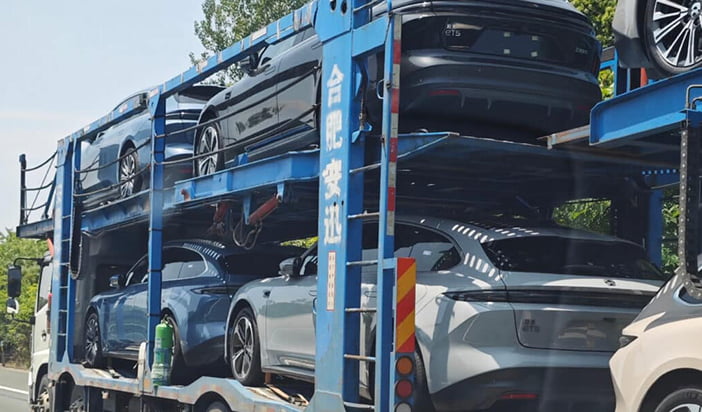
+++ The NIO ET5 Touring was spotted on a trailer in China. Its official launch is scheduled for June 15. As for the deliveries, they will first start in China later this month. Later, it will also reach European customers. As you can see, long-awaited ET5 Touring cars are on their way to stores. A trailer loaded with ET5 Touring EVs was spotted on the Hurong Expressway in the Hubei region, heading to Chongqing city. We will remind you that Nio has a large 2-storey Nio House there with an area of 1.420 square meters. It is located right in the city’s shopping centre. On a trailer, we can see a total of 8 cars in 4 colors: Airspace Blue, Deep Black, Star Gray and Sunlight Gold. It looks like Nio has already started the shipping process of ET5 Touring to stores, getting ready to the official launch on June 15. Maybe, Nio will start first deliveries right after the actual launch, similar to the Nio ES6 NT2. In this case, its market strategy can become more efficient. Speaking about deliveries in Europe, I am not sure when they will actually start. Moreover, the name of the Nio ET5 Touring for these markets is also unknown. There were rumors that it will be called “Nio ET5 Orion”. Anyway, it isn’t a proved fact just yet. The Nio ET5 Touring can possibly hit the European market in late 2023 or early 2024. There, it will accompany the EL7 (ES7), the ET7 and the ET5. The ET5 Touring is the very first stationwagon from Nio. Its dimensions are similar to the ET5 sedan: 4.790 / 1.960 / 1.499 mm with a wheelbase 2.888 mm. It is 77 mm longer, 133 mm wider and 57 mm higher than the BMW 3 Series Touring. The ET5 station wagon can tow up to 1.400 kg. As for the power output, it reaches 490 hp. Speaking about battery options, the ET5 Touring got 3 of them: hybrid ternary-LFP (NMC-LFP) 75 kWh, ternary for 100 kWh and semi-solid state battery for 150 kWh (to hit mass production in July). Prices of the ET5 Touring have yet to be revealed. But it looks like it will be slightly more expensive than the regular ET5. I will remind that this sedan starts form 62.700 euro in the Netherlands. +++
+++ TESLA has set up a public relations team in South Korea, which is unprecedented for a company that does not have a PR department even at headquarters and relies on CEO Elon Musk making announcements on Twitter. Only 424 Teslas were sold in South Korea last month, down 77 percent on-year, and cumulative sales from January to May this year totaled 1.841 cars, down 46 percent. Over the same period Tesla’s sales in China surged 142 percent. The main reason is stronger competition from electric-car lineups by Mercedes-Benz and BMW. Mercedes sold 2.723 EQE and EQS sedans in Korea in the first 5 months of the year to top EV sales here. BMW saw better sales than Tesla with the iX3s and i4s, and the i5, the electric version of the BMW 5 Series, is expected to improve sales even further. Tesla seems to have failed to read the tastes of Korean consumers, who like fresh models. Unlike rival automakers that roll out face-lifted models every 3 to 4 years, Tesla has been selling the same models for the last 6 years except for some software updates. Now Tesla worries how the Model Y, which is manufactured in China, will perform here when it hits showrooms in the second half. Previous models are manufactured in the U.S., but the rear-wheel-drive Model Y is made in Tesla’s Shanghai factory. One staffer at an import-car dealership said: “Attitudes to Chinese-made EVs have improved, but it remains to be seen how well consumers will receive a Chinese-made Tesla”. Kim’s firing was reported in late April, only a day after Tesla CEO Elon Musk met with president Yoon Suk-yeol here. Yvonne Chan, the carmaker’s regional director in Taiwan and Thailand, has stepped in as interim head. +++
+++ TOYOTA says it will spend nearly $50 million to build a vehicle battery testing laboratory at its North American research center in Michigan. The company said Thursday that the lab in York Township south of Ann Arbor will test batteries made for hybrid and electric vehicles at a new factory in North Carolina, as well as from battery suppliers. No new jobs will be created because Toyota will reassign workers from other areas and provide training as needed. The company says the lab is expected to begin work in 2025 and could be expanded as more electric vehicles are made. The lab will do performance, quality and durability testing, as well as testing of charging capabilities. “This new facility also enables us to experiment and pursue new opportunities as technology and business needs advance”, Jordan Choby, group vice president of powertrain, said in a statement. Last month Toyota said it would invest another $2.1 billion in the battery factory that’s under construction near Greensboro, North Carolina. It brings the total investment in the Randolph County plant to $5.9 billion to meet the company’s goal of selling 1.8 million electric or hybrid vehicles in the U.S by 2030. Toyota broke ground on the plant in 2021. To start, it will supply batteries to Toyota’s huge complex in Georgetown, Kentucky, which will build Toyota’s first U.S.-made electric vehicle, a new SUV with 3 rows of seats. Toyota’s new president Koji Sato has promised what he called an aggressive shift on “electrification” of vehicles including hybrids. The company has been criticized by environmental groups for falling behind in electric vehicle sales and relying on hybrids, which burn gasoline, for future sales. +++