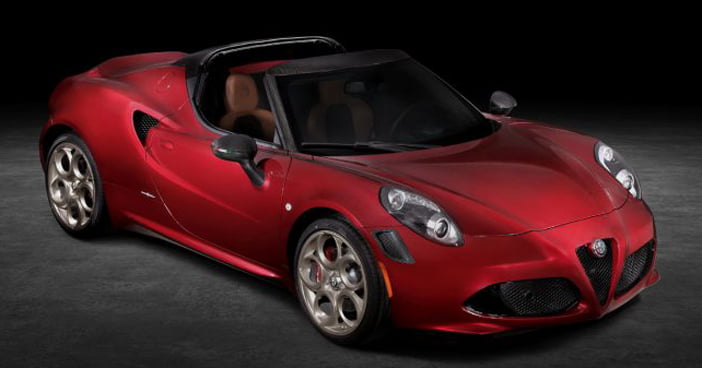
+++ The ALFA ROMEO 4C brought the Italian brand back to the United States, not counting the handful of 8C Competizione supercars in the country. The 4C entered production in 2013, and Alfa Romeo decided to celebrate the now-defunct sports car for its 10th anniversary by showing off three Designer’s Cut project ideas. The company will sell a commemorative one-off in the future using these vehicles as inspiration. Alessandro Maccolini from the Centro Stile Alfa Romeo will create the unique 4C. He was the head of design for the original model when conceiving it over a decade ago. “To make this one-off based on the 4C, I have identified 3 aesthetic features to take inspiration from”, he said in the announcement of this project. The red 4C Tributo expresses the brand’s “premium sportiness”, according to the company. The crimson colour also has a long legacy of appearing on the brand’s performance vehicles. The bronze-coloured wheels add an exciting contrast to the bright body. Maccolini’s inspirations appear to take the 4C and apply different colour and wheel combinations. There are no body modifications or mentions of the cabin or powertrain tweaks. Whether the Designer’s Cut production vehicle would have more extensive changes or stick with these simple tweaks is unclear. Alfa Romeo isn’t saying when the unique 4C premieres. Alfa Romeo showed off the concept for the 4C at the 2011 Geneva Motor Show. Maccolini wanted to evoke the classic 33 Stradale while taking elements from the more recent 8C Competizione. He left elements of the carbon-fibre centre cell exposed to emphasise the vehicle’s low eight and technology. The 4C exclusively came with a 1.75-litre turbocharged 4-cylinder. In the United States, the engine made 240 hp and 340 Nm. The only gearbox choice was a 6-speed dual-clutch gearbox. The coupe and convertible reached 100 kph in the mid-4.0-second range. Alfa Romeo retired the 4C Coupe after the 2018 model year, delivering over 1.700 examples during the production run. The company announced the 4C Spider’s death in 2019. +++
+++ AUDI and Shanghai Automotive Industry Corporation (SAIC) have agreed to co-operate on electric vehicle development in a move aimed at strengthening their respective positions in the Chinese car market, according to a statement made by the Chinese state-owned car maker on Thursday. The announcement of the agreement comes after Audi entered into talks with SAIC (parent company of MG Motor) on plans to source an electric vehicle from its IM Motors brand as an alternative to its parent company the Volkswagen Group’s delayed Scalable Systems Platform (SSP) architecture. “All stakeholders agree that the Chinese auto market is in the midst of the biggest transformation in its history, therefore we will jointly work on a strategic approach that guarantees our future success”, SAIC was quoted. Audi’s plans to base future electric vehicle models on the SSP architecture have been thrown into disarray by continued delays in software development, including a new operating system, which goes under the internal working title E3 2.0. The E3 2.0 software is considered a key component of the SSP architecture, which is planned to offer Level 3 autonomous driving technology. As an alternative for models to be sold in China, Audi is considering using the electric vehicle platform developed by SAIC for the IM L7 saloon and IM LS7 SUV. It supports an 800 volt electric architecture and was conceived for models with wheelbases ranging from 2.800 to 3.200 mm in length. Audi, under pressure to improve sales in China, announced Gernot Döllner would replace Markus Duesmann as CEO last month in moves aimed at restructuring the German car maker. +++
+++ All hope isn’t lost for enthusiasts who prefer the BMW M3 with a sonorous straight-6 engine under the hood. Although the sport sedan was supposed to switch to electric power near the end of the 2020s, the German firm hasn’t ruled out designing a new gasoline-powered model. “Well, the logic is quite easy. The next M3 or M4 has to be better than the current one. And if that can be done in an electric way, then it will probably go electric. If not, we will stay with combustion engine. It’s quite easy”, BMW M boss Frank van Meel told. Some parameters are fairly straight-forward to improve. The current-generation M3 uses a 3.0-liter straight-6 that’s twin-turbocharged to 480 horsepower in its standard configuration. If its successor lands with 510 horsepower, it’ll tick the ‘better’ box; on paper, at least. However, straight-line speed and horsepower aren’t the only appealing ingredients in the M3 recipe, and handling has helped make the model a force to reckon with on and off the track for decades. This is where making an electric M3 that’s better than the current car gets tricky, as batteries add a tremendous amount of weight. BMW M has tested electric prototypes for years, but as of writing it hasn’t unveiled a full-blown electric M car. M-branded models, like the i4 M50 and the iX M60, are positioned a notch below cars like the M3 and the X5 M. “Of course, we’re trying to make the next M3 happen as pure electric”, clarified Van Meel. What’s seemingly certain, at least at this stage, is that the next-generation M3 won’t be available with multiple powertrain types. “I don’t think all 3 options. That will be a little bit too far. Actually, we would like to offer just one, but you never know”, Van Meel replied when asked about the possibility of seeing gasoline-burning, battery-powered and plug-in hybrid variants of the next M3 and M4. BMW’s next-generation M3 and M4 likely won’t arrive until 2027 at the earliest, so the brand still has time to decided which drivetrain to use. +++
+++ CHROME PLATING is set to be banned, potentially forcing car makers to rethink one of the most exploited materials for giving cars a premium look. The ban has been proposed as a result of health issues associated with the creation of hexavalent chromium, which is a known carcinogen. In particular, it is a source of chronic lung cancer, with the airborne emissions given off during the plating process said to be 500 times more toxic than diesel. Chemical fume depressants can reduce these emissions, but contain Perfluoroalkyl and Polyfluoroalkyl Substances (PFAS), another highly toxic substance. The EU has proposed a ban from 2024, with other parts of the world (most notably California) following suit. As both are high volume car markets, it is expected to impact substantially on car design unless an alternative material with the same qualities is identified. As well as giving a silvery finish to car parts, chrome has been widely used in everyday homelife including kitchen sinks, light fittings and on components that are required to be rust resistant, such as landing gear on aeroplanes and fishing tackle. However, Gilles Vidal, chief designer at Renault, said that even if alternatives are found, he hopes that new materials will be explored. “There are non-polluting solutions being investigated, but I hope there are reasons we can intuitively get away from it”, he said. “It’s time we changed the game a little bit and opened our minds beyond chrome, there are more sustainable alternatives”. He highlighted Renault’s use of slate and cork finishes as examples, as well as 60% recycled Alcantara. +++
+++ JEEP has backtracked on its EV strategy in Europe, where the new Avenger was supposed to be sold as a battery-powered vehicle in most of the Old Continent, adding a petrol option in more countries than originally intended. The city crossover debuted at the 2022 Paris Auto Show as a European-only affair, set in motion by a 156 hp front electric motor and a 54 kWh battery pack. It’s the same setup found in other EVs made by Stellantis, such as the Peugeot e-308 and Opel Astra Electric, and enables an estimated driving range of 400 kilometres on the WLTP test cycle. When the order books opened late last year, the Avenger was only available as an EV in most of Europe, with only Italy and Spain set to also get an internal combustion variant powered by a 1.2-litre petrol engine that makes 100 bhp. Back then, the American brand argued that EV adoption is not up to par in these 2 countries, so it offered more options for its dealers. However, after the crossover went on sale, the list of countries where the Avenger will also be sold with petrol-burning power sources has increased to 6, with Poland, Germany, France, Belgium, the Netherlands and the United Kingdom getting the 1.2-litre engine in addition to the EV variant. The brand’s European CEO, Eric Laforge, told that the decision to expand sales of the ICE Avenger was “pragmatic” and that it doesn’t change the marque’s long-term plan to only sell battery-powered vehicles on the Old Continent by 2030. Jeep’s European head honcho added that the move is intended to protect its franchised dealers who were losing potential sales, as well as customers who will need to service their petrol-powered Avengers. Another issue, however, might be the pricing. In Germany, the base Avenger EV starts at €37,000, while the least expensive petrol version costs €27,000. +++
+++ LOTUS has confirmed proposals to cut up to 200 jobs at its Hethel and Warwickshire base, mainly focused at engineering and administrative roles. This announcement come just days after it posted losses of £145.1 million, which followed an £86.6 million loss in 2021, caused by a significant fall in sales. The Geely-owned manufacturer maker sold just 576 cars in 2022, down from 1.566 in 2021, which it blamed on supply chain issues in the second half of the year. Last year, Lotus sold just one model, the Emira, having ended production of the Elise, Exige and Evora in 2021. The Eletre entered production this year. However, the proposed cuts, which Lotus has confirmed as affecting engineers and those within ‘group functions’ (no production roles are at risk), are not as a result on the losses. Instead, the brand says, it is a separate decision which is part of a move by the Norfolk-based brand to “restructure its workforce”. Those affected workers will be found new roles “where possible”. In a statement, a Lotus spokesman said: “Lotus Cars’ proposal for a reorganisation of its business is to ensure that the right organisational structure is in place for us to achieve our business goals and to build a strong, sustainable future. This includes a restructure of its workforce, which may involve the loss of up to 200 jobs. Wherever possible, we will look to support the redeployment of staff and plan to look for ways to retain specific skills and knowledge within the business, despite the proposed cuts. We believe this is vital to ensuring the organisation is leaner and more competitive long term”. Lotus boss Matt Windle said the car maker “understands the concerns that this proposal will create”, adding that it “deeply regrets the potential impact” any reshaping of the business may have “on our employees and their families”. He added: “We have worked very hard to avoid the need to make the proposal but do believe that it is now essential. It is in no way a reflection on our employees who have shown nothing but dedication to us and have worked tirelessly to support Lotus. “Once the reshaping has been undertaken, and with its strong and experienced management team, Lotus should be a leaner, more competitive organisation, focusing on both producing class-leading sports cars and innovative engineering solutions. “Our shareholders have made a clear commitment that the UK will remains at the heart of sports car operations, and we continue to focus our efforts on production of the Emira sports car and Evija hypercar”. Windle also said that, despite the losses, he and the brand expect 2023 to be “a record year” for production, driven by the new near-€100.000 Eletre, both its first EV and first SUV. +++
+++ Elon MUSK is prioritizing sales over profits in hopes that Tesla’s elusive full self-driving software would eventually burnish margins, a plan that could deepen an already fierce price war in the electric-vehicle industry. Shares of the automaker fell 3% before the bell on Thursday after Musk signaled there might not be any let-up in price cuts that have already sent gross margins to a 4-year low. Getting more cars on the road would help Tesla maintain its dominant U.S. market share in “turbulent times” and give it access to precious usage data needed to train the artificial intelligence models behind its self-driving technology. “The short-term variances in gross margin and profitability really are minor relative to the long-term picture. Autonomy will make all of these numbers look silly”, Musk said. The billionaire believes full self-driving (FSD) could one day account for most of Tesla’s value and give it a cushion rivals lack as they try to turn their EV operations profitable. But that focus risks sacrificing current profitability for technology that has for years missed Musk’s targets to achieve full self-driving capability and is in the crosshairs of regulators after a number of crashes involving Tesla vehicles. “That margin outlook may be a disappointment for some, present company included, that were looking for margins to slowly improve this year”, said Gene Munster, managing partner at Deepwater Asset Management, a Tesla investor. In the second quarter, the company’s automotive gross margin, excluding regulatory credits, fell to 18.1% from 19% in the first, according to Reuters’ calculation. It also marked a sharp decline from the 26% reported a year ago. Analysts said the margin weakness would likely weigh on the stock, which has more than doubled this year thanks to the growing adoption of the company’s charging system. Yet, most were positive about Tesla, with more than seven analysts upgrading the stock on optimism about FSD after the company said it was in talks with a major automaker to license the technology. “One of Tesla’s biggest assets is its substantial advantage in accumulated miles generated via its current FSD fleet that it can use to be the first to market with a truly autonomous vehicle driving system”, said John Tomlinson, Global Director of Research at research firm M Science. Tesla saw a spike in the usage of FSD Beta in the second quarter, with cumulative miles driven with the technology coming in at more than 300 million miles. “They’re not an AI play the way Microsoft or Nvidia is an AI play”, said Thomas Martin, senior portfolio manager at Tesla shareholder Globalt Investments. “They’re more of an AI play the way a regular business is an AI play, except that this race to full self-driving has always been an AI issue, and it’s always been based on data. And I would like to see the capex spent that way”. Tesla plans to spend over $1 billion through next year on Dojo, its supercomputer to train AI models for autonomous cars, which it said will be put into production this month. Still, many other challenges remain for the technology. Wells Fargo analysts said FSD’s adoption could be impeded by its price, which Musk said was low. At $15,000 per car, the technology is about half the cost of the cheapest Tesla vehicle after a $7.500 federal tax credit. Musk, who on Wednesday called himself “the boy who cried FSD”, said “it is one of the hottest problems ever. You see a lot of AI companies doing LLMs (large-language models) and whatnot. And I’d say, if they’re so great, why can’t they make a self-driving car? Because it’s harder”. +++
+++ When PORSCHE unveiled the facelifted Cayenne, the lineup was once again topped by the Turbo GT. Going forward, this high-performance version will have its twin-turbo 4.0-litre V8 massaged to deliver an extra 20 hp (14 kW) for a grand total of 670 hp. It’s enough muscle for a 0 to 100 km/h in 3.3 seconds and a top speed of 305 km/h. There’s one problem: you can’t buy it in Europe. Why? Due to stricter emissions regulations. The good news is that Porsche is planning an indirect substitute with a plug-in hybrid V8 model. It doesn’t have a name yet, so it’s unclear whether it’ll be once again called the Cayenne Turbo S E-Hybrid or not. I do know it’ll become the most powerful Cayenne ever made by offering a combined output of over 700 horsepower. For the sake of clarity, it’ll have more than 700 PS, which works out to 710 hp. That’s still about 20 electrified ponies more than the Cayenne Turbo S E-Hybrid had. As far as torque is concerned, the total output will exceed the 900 Nm offered by the old Cayenne Turbo S E-Hybrid. The ICE will be good for over 500 hp while the e-motor is going to deliver 204 bhp. The latter will feed off an upgraded battery with a capacity increased by over 30 percent and support for faster charging. It’ll do over 300 km/h, or slightly more than its predecessor (295 km/h). While the 0 to 100 km/h sprint time isn’t mentioned, the old one needed 3.8 seconds. One must wonder whether the upgraded plug-in hybrid setup is earmarked for the electrified Lamborghini Urus coming in 2024 considering the 2 SUVs are mechanically related by sharing the MLB Evo platform. It seems we’ll have to wait a bit until the official reveal. With IAA Munich set for early September, Porsche could decide to bring the plug-in hybrid V8 Cayenne there to showcase the pricey crown jewel of the European variant. +++
+++ TESLA will finally allow owners to transfer ownership of the so-called Full Self-Driving (FSD) Beta driving assistance software, according to company CEO Elon Musk who gave the news yesterday during a conference call about the firm’s second quarter 2023 financial results. Customers who bought the $15,000 option have been asking for the right to transfer ownership of the feature to a new car for a while on social media, and now the Austin-based EV maker has come around and is giving the people what they want. But there’s a catch. Tesla will only allow the transfer for owners who trade in their old EVs and order a new one during the third quarter, so until the end of September. “We’re excited to announce that for Q3 we will be allowing transfer of FSD”, said Musk during the conference call. “This is a one-time amnesty, so you need to take advantage of it in Q3, or at least place the order in Q3 within reasonable time frames. So, yeah, I hope this makes people happy”. It’s worth noting that owners who bought a second-hand Tesla or those who didn’t buy FSD Beta when speccing a new EV can opt for a monthly subscription that costs $199 for cars with Basic Autopilot and $99 for vehicles with Enhanced Autopilot installed. Additionally, cars that have FSD Beta installed keep it installed when it’s traded in or sold on the private market. The issue is that Tesla seems to undervalue the feature when accepting trade-ins for used EVs, with multiple users saying that the estimates they got revealed a sub-$10.000 value for FSD Beta, chipping away at the final price and ultimately making people pay more for the upgrade to a new car. This strategy is contrary to what Elon Musk has said in the past about the so-called autonomy service, describing it as an “appreciating asset” and suggesting that its value could be as much as $200.000 once fully autonomous. Another problem is that people who bit the bullet and paid $15.000 to buy FSD didn’t exactly get what they were promised, with the company’s driving assistance systems still being labelled as Level 2 on SAE’s Levels of Driving Automation list.+++