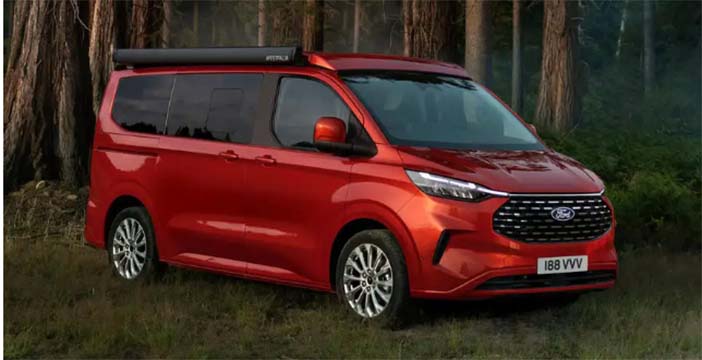
+++ The new FORD NUGGET is a luxurious Transit-based camper van with a roomier interior, improved dynamics and more advanced technology than its predecessor – plus the option of plug-in power for the first time. Revealed at the Caravan Salon exhibition in Dusseldorf, the latest Nugget is based on the upcoming Transit Custom: the latest generation of the most popular Van in Europe. Like the Transit, the new Nugget is tipped to be a strong seller, given the market for leisure vehicles in Europe doubled between 2016 and 2021, with more than 180.000 motorhomes now sold in the region each year. Hans Schep, boss of the Ford Pro commercial vehicle division, noted that “the compact camper van, within that, is actually the largest-growing portion of the leisure market – so the Nugget, which has been in this market for quite a while, is obviously a central piece of our strategy”. Ford sells around 30.000 Nuggets per year, he said. Available to order now in certain markets, the Nugget is priced from €76,500 in Germany, which suggests an entry price of around €98.000 in the Netherlands. Being based on the new Transit Custom, it has a completely fresh look to match its sharply styled commercial sibling, plus all the improvements in usability and functionality that come with the switch to a new platform. It is “an entirely new product for an entirely new era”, said Schep. The interior, for example, is said to be easier to move around in, courtesy of a lower, flatter floor and a new, more compact dashboard design. There’s an integrated side step for easy access, too, and the Nugget boasts “class-leading sliding side door and rear tailgate apertures”. The 5-seat, 4-berth cabin has been designed and engineered with conversion partner Westfalia, which has worked on every Nugget since the first generation launched in 1986. Ford says the Nugget has been “reinvented for the digital age”, and that it has worked extensively with existing Nugget owners to determine where the formula could be best improved. Heavily reworked over the previous Nugget, the new camper’s cabin hosts an all-new arrangement with separate cooking, living and sleeping zones. Ford says that even when the 2 double beds are deployed, people can move around the cabin (and even cook in the kitchen) without disturbing each other. The rear seating area can be quickly (and much less strenuously, Ford says) transformed into a sleeping or eating area when parked, while the front seats can be fully rotated to face the rear. All seats are heated, and the rear passengers now benefit from upgraded speakers and standard-fit USB-C charging ports. Further back, the L-shaped kitchen unit houses a taller, easier-access drawer fridge, an integrated hob and sink (with hot water as standard), soft-close latches and a worktop that’s 20% larger than before. There is now more head room in the kitchen when the roof-top bed is deployed, too, because of a new flip-up mattress design. The roof bed itself is said to be easier to take down in the morning, thanks to the use of a new ‘self-folding’ fabric for its walls, and there are new roller blinds in place of curtains for a quicker, easier transition from night mode to day mode. Other innovations introduced for the latest Nugget include a new camping chair storage cubby inside the bootlid, a pull-out awning above the side door, 350W solar panels to charge the leisure battery and a 7.0 inch colour touchscreen for all interior controls. There is also now an inclinometer built in, so the van levels itself when parked up to make for easy set-up and a comfortable night’s sleep, and a 5G modem to give fast internet access in the wild. But importantly, Ford bosses note, many Nugget owners use their camper van for daily driving purposes, too, so the improvements for 2024 go well beyond the kitchen and bedroom. The Nugget’s new chassis has independent rear suspension, for example, to improve refinement and handling, while accommodating the option of all-wheel drive for the first time “to help get out of the mud at festivals”, bosses suggest. Plus, the new-look cockpit hosts the latest generation of Ford’s Sync 4 infotainment interface through a 13.0 inch touch screen, with smartphone mirroring as standard, while the seating position is said to be much more ‘car-like’, “even for drivers more used to smaller cars”. The new Nugget will also be offered with a plug-in hybrid powertrain for the first time, pairing a 2.5-litre 4-cylinder petrol engine with an electric motor for a combined 233 hp, while an 11.8 kWh battery will supply an EV range in the region of 30 km. The first Nuggets on the market, due to land in spring next year, will, however, use a 170 hp diesel engine paired with a new 8-speed automatic gearbox. Ford would not confirm whether the Nugget will join its Transit and Tourneo siblings in gaining a pure-electric variant, but the brand has promised a ‘comprehensive’ powertrain line-up. +++
+++ JLR will give a second life to JAGUAR I-PACE batteries to help create one of the largest energy storage systems in the United Kingdom. The new Battery Energy Storage System (BESS), created in partnership with renewable energy firm Wykes Engineering, will harness solar and wind power and store the energy in the cars’ former batteries. This will reduce pressure on the National Grid ahead of the country’s mass push towards buying electric cars – especially during charging peak times, the companies said. This is because the BESS and systems like it can deal with rapid peaks in demand and collect solar and wind energy that would otherwise be lost when the grid reaches capacity. Taken from prototype and engineering test vehicles, these Jaguar batteries can, at full capacity, store enough energy to power 250 homes for a day. JLR, formerly Jaguar Land Rover, has vowed to supply batteries to power 750 homes for a day by the end of 2023. Another key aspect is that the BESS has been created so the batteries are simply removed from the I-Pace models and slotted into racks in the containers on site, helping to maximise the sustainability of the project. The car maker said this move is important because reusing vehicle batteries will “create new circular economy business models for JLR in energy storage and beyond”. It adds that, in the future, it will also look to reuse batteries from current production vehicles. Once the battery health falls below the required level for these second-life use cases, JLR will recycle the batteries so that raw materials can be recovered for reuse as part of a true circular economy. “Our sustainability approach addresses the entire value chain of our vehicles, including circularity of EV batteries”, said François Dossa, executive director, strategy and sustainability at JLR. “Our EV batteries are engineered to the highest standards and this innovative project, in collaboration with Wykes Engineering, proves they can be safely reused for energy sector application to increase renewable energy opportunities. Using the 70-80% residual capacity in EV batteries, before being recycled, demonstrates full adoption of circularity principles. Working together with industry-leading partners, we are developing a complete EV ecosystem, from batteries to charging, supporting our net-zero transformation”. Reuben Chorley, JLR’s sustainable industrial operations director, said developing second-life battery projects is “crucial to helping JLR adopt a new circular economy business model and drive us toward achieving carbon net zero by 2039”. David Wykes, boss of Wykes Engineering, said the move will help to drive the UK forward towards its EV ownership goal. “One of the major benefits of the system we’ve developed is that the containers are connected to the grid in such a way that they can absorb solar energy that could otherwise be lost when the grid reaches capacity”, he said. “This excess energy can now be stored in the second life I-Pace batteries and discharged later. This allows us to ‘overplant’ the solar park and maximise the amount of power we generate for the area of land we are using”. +++
+++ Kia will offer more electric models in the not-too-distant future. Among them is the new KIA EV4 : the baby crossover caught by spy photographers for the first time. While Kia’s disguise is extensive, there’s no mistaking the underlying shape as a member of Kia’s growing EV crossover family. While the EV4 is essentially a clean-sheet design, neither Kia nor its sister company, Hyundai, are new to the baby EV game. Kia’s Soul EV arrived long before the company embarked on its broader electrification strategy; meanwhile, Hyundai is in the process of rolling out a replacement for its Kona Electric. We suspect the EV4’s powertrain will borrow from the Hyundai parts bin. If so, it should be offered with at least 2 battery packs: a bigger 64.8 kWh unit (good for 420 km of range in the Kona, Hyundai says) and a smaller, 48.6 kWh pack good for just 320 km of range. Like the Soul EV, the Kona is offered exclusively in front-wheel drive. Like its battery packs, the Kona’s motors come in two flavors: small and less small, each corresponding to the appropriate battery size. The big battery pack version has a single electric motor good for 204 horsepower and 250 Nm of torque; the smaller motor is rated at 136 horsepower and 250 Nm. While this may sound like precedent for FWD-only offerings, I’m certainly not in a position to rule out rear- or all-wheel drive options. Kia has remained fairly tight-lipped on the EV4 thus far, but if there are running prototypes on the street, it’s only a matter of time before we see some official details. Stay tuned. +++
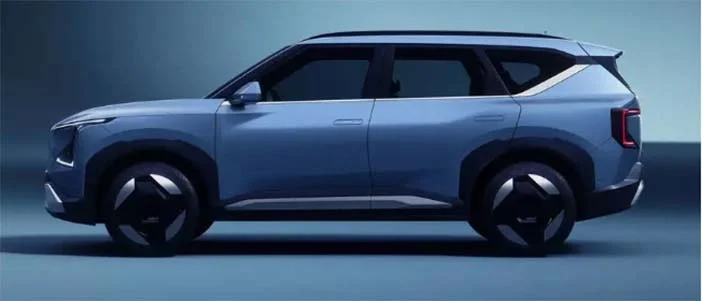
+++ The new KIA EV5 has been revealed as a sharply styled, 5-seat electric SUV which majors on practicality and space. It was previewed in near-production concept form earlier this year, and leaked images of the final car recently gave strong clues as to its design and positioning, but Kia has only now revealed official details at the Chengdu motor show in China, albeit primarily about the car’s design. Full technical specifications will come closer to launch. The car has been designed for China, and will initially be built there for sale in that market, but a European launch is highly likely. Kia promises more details of a launch in “select global markets” at an event in October. The EV5 is the third of Kia’s expanding family of bespoke electric cars, following the EV6 and EV9, and it is this larger car to which it is most obviously related. When it arrives in dealerships, it will serve as an electric alternative to the similarly sized Sportage, much as the larger EV9 sits alongside the combustion-engined Sorento. Rivals will include the Skoda Enyaq iV and Mercedes EQB, as well as the upcoming Ford Explorer and Fisker Ocean. The influence of the flagship 7-seat EV9 is obvious in the EV5’s upright, two-box silhouette, chunky lower body cladding and distinctive, angular alloy wheel designs. So too does the EV5 share its sibling’s aggressive ’tiger nose’ front end design and kinked rear beltline; hallmarks of the electric Kia line-up. Kia said the EV5 “seamlessly blends transformative design, exceptional versatility and outstanding comfort to deliver a harmoniously balanced vehicle”. It said the EV5 aims to “eclipse the accepted aesthetics of the existing compact SUV sector”. Stand-out features of the design, according to Kia, are the set-back D-pillars, which “highlight the EV5’s family-friendly practicality” by emphasising the space available in the rear seat and boot, while the rear wing is said to boost aerodynamic efficiency while “signifying the EV5’s status as a ground-breaking electric vehicle”. The interior has been designed around the idea that “millennial households now regard the interior of their EV SUV not just as a place to sit safely and comfortably when travelling from A to B, but as an additional ‘room’ to live life in”. The dashboard, steering wheel and infotainment suite look to be largely carried over from the EV9, with a wraparound digital panel housing the driver display and central touchscreen, and a raft of physical buttons and switches retained for core functions. As with other new Kia models, the EV5 will be kept fresh after launch through over-the-air system updates, and owners will be able to activate features on demand, as required. It is said to be much roomier than a traditional car cabin, but Kia has yet to reveal exact dimensions. For now, it highlights stand-out features like the 64-colour ambient lighting with dimming function, easy-access infotainment and climate controls and the broad array of upholstery colours, patterns and materials. The swivelling seats from the concept are gone, as are the reverse-opening rear doors, but notably the EV5 does have a bench-style front seat arrangement, with the passenger’s seat base extending out over the centre console in place of a traditional armrest, though there is no third seatbelt up front. The rear seats, meanwhile, fold completely flat to give a cavernous load bay, complete with hidden under-seat storage cubbies. Kia has offered no technical details of the EV5 yet, but widely reported specifications uncovered by Chinese media reveal that it will launch with a rear-mounted single motor producing 218 hp and 310 Nm. No details of its battery capacity have yet surfaced, but reports suggest it will use a 400 Volt wiring architecture instead of the EV9’s 800 Volt system, in a bid to keep its entry price down. The brand has promised every entrant into the ‘EV’ family of electric cars will ultimately be offered with a hot GT range-topper, which means a suitably potent, 4WD version of the EV5 is on the cards for a debut soon after the standard car. With a European launch anticipated to be at least a year away, it is early to speculate on pricing, but landing at around the €60.000 mark would line it up neatly against its direct rivals in the Netherlands. +++
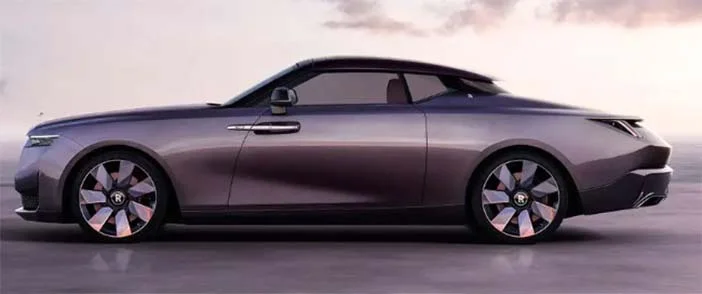
+++ ROLLS-ROYCE has revealed the second of 4 customer-commissioned versions of its new Drop Tail roadster: a striking, ultra-luxurious 2-seater said to cost more than €30 million apiece in the Netherlands. The new commission, called Amethyst, follows in the footsteps of La Rose Noire (the first of the Drop Tails) which was revealed in Monterey last week. In total, the Goodwood-based firm will build just 4 highly bespoke cars, having worked intensively with the buyers over the past 4 years to create the most exclusive proposition possible. The Amethyst has been named by its owner, who has grown a gemstone boutique into a multinational business (but wants to stay anonymous). The car’s purple and silver colour scheme (named Globe Amaranth and inspired by a flower that blooms near the customer’s home) has been strikingly enhanced by aluminium flakes. Unusually, it has also been used for the wheels as well as the bodywork. Meanwhile, the Amethyst’s grille (which on the Drop Tail features curved bars that end at chamfered rather than right-angled corners) gets a bespoke finish which, according to Rolls-Royce, took 50 hours to complete. Below the grille, the lower air vent features 202 stainless steel ‘ingots’ finished in the same colour as the bodywork. At the foot of the Spirit of Ecstasy mascot is a rounded amethyst gemstone, in reference to the customer’s business. Each Drop Tail represents the “absolute pinnacle” of Rolls-Royce’s in-house coachbuilding capabilities. The creations build on 2017’s Sweptail and 2021’s Boat Tail as the latest in a series of ultra-exclusive, multi-million-pound specials. Rather than being simply a reworking of the now-retired Dawn convertible, the Drop Tail commissions are underpinned by an all-new monocoque chassis constructed from steel, aluminium and carbonfibre, in a first for the Coachbuild division. For the second Drop Tail commission, this carbonfibre has been finished with a layer of Amethyst-tinted lacquer, which is hidden until the car is “closely scrutinised”. The removable roof panel is also carbonfibre, which makes it easier for the driver to remove and replace it. It also features a large section of electrochromic glass, which, in the Amethyst, has a subtle purple tint when deactivated and, when switched on, is translucent with a brown hue to match the interior leather. Aerodynamics played an important role in shaping the Drop Tail. Rolls-Royce said the car’s swooping rear end is “not ordinarily conducive to producing downforce”, which is to say the car was deemed insufficiently stable at high speeds without additional assistance. Rather than mount a spoiler, the firm tweaked the design of the rear deck to produce the necessary downforce without compromising the aesthetics; a process that took 2 years and 20 iterations. The Amethyst’s deck, according to Rolls-Royce, is “the most extensive wooden surface area in the brand’s history”. It is finished in Calamander Light open-pore wood trim, which matches the tone of the car’s secondary brown leather; an effect that apparently took 6 months to achieve. This was done using a completely new veneering process to make it look like one continuous piece of wood. Each component in the car was stress-tested over 8.000 hours at temperatures ranging from 80 degrees C to -30 degrees C. +++
+++ As TESLA nears production, and closes in on its delivery event for the Cybertruck which is planned for September), an old foe rears its ugly head: quality. Yesterday afternoon, CEO Elon Musk proudly showed off a “production candidate” of the Cybertruck from Giga Austin on his social media site X. Generally speaking, production “candidates” or “builds” are early models rolling off the production line that automakers use to check assembly systems, and the quality of the production line. Though these vehicles are not meant for sale, their presence may indicate the line is operational, and possibly nearing the beginning of production. In a later reply to the post asking about timing for the truck’s release, Musk said “When we are ready to do so, we will. While I think it is our best product ever, it is an extremely difficult product to build. We are in uncharted territory, because it is not like anything else”. Musk followed up with a new post of the Cybertruck just this morning: “Users online and on Tesla message boards were quick to point out some irregularities with fit and finish, like inconsistent panel gaps, in the Cybertruck photo posted by Musk yesterday. The concern being Tesla (notorious for production issues like irregular panel gaps and ill fitting parts) was having similar issues with the Cybertruck”. The “extremely difficult product to build” line in Musk’s X post is a notable one, because it reflects an email he sent internally to his Tesla team. Musk also wrote: “Due to the nature of Cybertruck, which is made of bright metal with mostly straight edges, any dimensional variation shows up like a sore thumb. All parts for this vehicle, whether internal or from suppliers, need to be designed and built to sub 10 micron accuracy. That means all part dimensions need to be to the third decimal place in millimeters and tolerances need be specified in single digit microns. If Lego and soda cans, which are very low cost, can do this, so can we. Precision predicates perfectionism”. The stakes are clearly high considering the Cybertruck’s importance to the Tesla growth story. It has already been delayed 2 years due to various issues. And the already existing competition from Ford and Rivian underscores the need for Musk and the Tesla team to get everything right for Cybertruck’s eventual release. The Cybertruck’s unique shape that features no curves, and stainless steel sheetmetal that readily shows any imperfections due to its unfinished nature, pose challenges for Tesla to mass produce, compared to its other vehicles like the Model 3 or Model. For Tesla fans and its army of investors, the hope is Musk and the Giga Austin Tesla team can solve these issues ahead of the Q3 delivery event that many are waiting to see. Musk has gone on record during the Tesla’s most recent Q2 earnings call, claiming demand for the Cybertruck was “so far off the hook, you can’t even see the hook”. +++
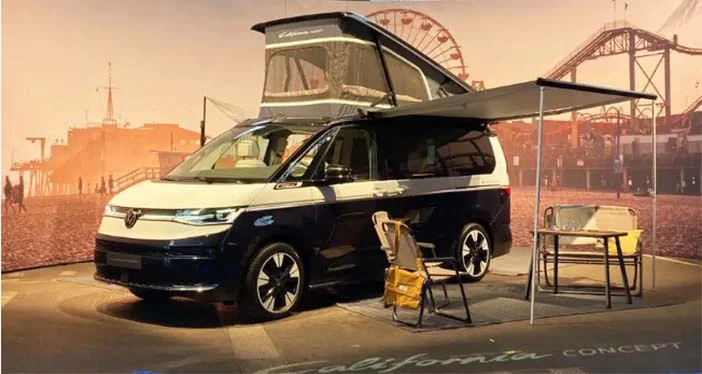
+++ The new VOLKSWAGEN CALIFORNIA concept previews the “future of the camper van”, showcasing a raft of extensive upgrades that will feature on the seventh-generation model which launches next year. Based on the Volkswagen Multivan, the concept was revealed at the Caravan Salon trade fair in Düsseldorf. Its near-production form showed off significant changes (such as a plug-in hybrid powertrain shared with the Multivan) that will be introduced to the campervan as it moves over to VW’s car-derived MQB architecture. The concept shares the Multivan’s plug-in hybrid powertrain, which pairs a 150 hp 1.4-litre petrol engine with a 115 hp electric motor, for a combined 218 hp, and draws EV power from a 13 kWh battery, which should give an engine-off range of around 40 km. One of the big updates to the Ford Transit Custom Nugget rival (itself revealed this week) is a second sliding door, which resolves a key grievance for current California owners in right-hand-drive markets because the outgoing T6.1 model only opens on the right-hand side, which can complicate kerbside drop-offs. Having the pair of sliding doors also allows for the kitchen (with larger worktops, a hob, a cool box and a sink) to be accessed from outside the vehicle for the first time. This gives owners “the feeling of more living space”, the brand says. Built-in extendable awnings give a further increase to this living area. The concept brings with it modern touches including colour-adjustable LEDs that light up the cupboards and the awning arms to “bathe the vehicle’s terrace” in light. A removable camping light is also fitted. There’s even a built-in shower that attaches to the boot’s open hatch. But the key feature (one that the brand says makes the concept “the ideal camper van for the modern age”) is a new removable tablet device. This controls “all of the features relevant for camping”, such as raising the pop-up roof and providing information on the fresh and waste water levels, the interior lighting functions, power supply status, refrigerator and auxiliary. It can even be used to watch movies and television. The California Concept also benefits from its Multivan sibling’s flexibility. This includes the ability to vary the interior layout with easy-to-move lightweight chairs (the T6.1’s rear bench has been replaced by 3 individual seats) and tables, and there’s a fold-out double bed. Like its predecessor, the California Concept gets rotating front seats and the traditional pop-out rooftop sleeping area, with space for another two to sleep. The Multivan’s platform means the standard California is the biggest it’s ever been, growing in overall length by 412 mm to 5.304 mm and in width by 40 mm to 1.941 mm. That extra size offers more living space, comfort, safety and flexibility, its maker says. It is expected to be called the Multivan California, given how closely related the pair will be. The increased size also opens up new storage possibilities. Much of this is because the Multivan uses an electronic parking brake instead of a manual handbrake, leaving space for drawers and a removable dry-composting toilet in the space left behind. Production of the next-generation California will begin at Volkswagen’s Hannover plant in Germany next year, the firm confirmed in a statement. When it arrives, prices are expected to open at a significant premium over the T6.1. As for the long-awaited all-electric California based on the Volkswagen ID.Buzz, Volkswagen Commercial Vehicles CEO Carsten Intra confirmed that this will arrive in 2025. He said: “We want to expand the range around the business with our camper models and offer what people really like in our products, what we call the ‘California feeling’. It includes digital services for the California community, new services to complement the purchase of a vehicle and the presentation of a new California vehicle based on the Volkswagen Multivan. This is what we are planning for later this year”. +++