+++ BYD ‘s executive vice president, Stella Li, confirmed the company’s unwavering commitment to driving strong growth in Europe despite the European Union’s initiation of a countervailing investigation into Chinese electric vehicles. Li, currently leading a BYD delegation visiting the Chilean capital, Santiago, emphasized that BYD, as a publicly listed company, prioritizes transparent and open management to share information. Consequently, the company remains unfazed by ongoing developments in Europe. This week, the European Union officially launched an investigation into subsidies for Chinese-made electric vehicles, a process set to span a year and potentially result in measures such as higher import tariffs on Chinese EVs. To address any concerns or misconceptions regarding its car production, BYD is committed to collaborating with EU authorities and providing them with all requested information. Li emphasized that the growth of electric vehicles constitutes a revolution that some individuals may not fully grasp, leading to anxiety. However, she believes that sharing accurate data will dispel these apprehensions, asserting that there’s nothing to question once the facts are known. In addition to Chile, the BYD delegation plans to visit other Latin American countries. The delegation, which includes BYD’s founder and chairman, Wang Chuanfu, marks Wang’s first visit to Latin America since the onset of the pandemic. BYD already markets its Seal electric sedan in Chile. Li underscored that Wang Chuanfu’s visit to Latin America signifies BYD’s concern for the region. During his visit, Wang Chuanfu met with Chilean president Boric to discuss strategies for accelerating electrification and developing the local lithium industry. As of September this year, BYD has sold over 2 million clean energy vehicles globally, with half being pure electric vehicles and the rest being hybrids. In Q3 2023, BYD came close to surpassing Tesla, emerging as the world’s largest seller of pure electric cars. Li emphasized that there’s no intention to compete with Tesla to determine who’s the more significant player. Rather, they wish Tesla’s continued success, recognizing that it contributes significantly to promoting electrification understanding. Chile presently boasts the world’s largest lithium reserves. BYD is actively engaged in discussions with the Chilean government, Mining and Chemicals of Chile (SQM), and other firms regarding new refining technology. Furthermore, BYD is constructing a battery cathode factory to be operational within 24 months. This factory will source lithium from Chilean Companies at a discounted price. Following their visit to Chile, the BYD delegation previously visited Mexico to explore the potential construction of a passenger car factory. Their next destination is Brazil, where BYD is establishing its first electric vehicle factory outside of Asia, aligning with the company’s regional manufacturing and innovation center initiative. +++
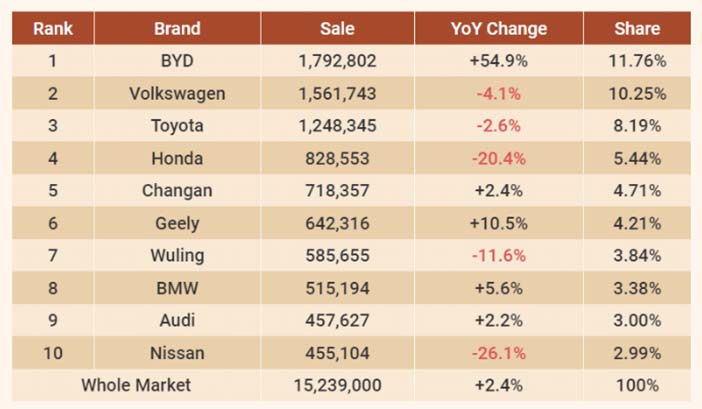
+++ In the first 3 quarters of 2023, 15.239 million passenger cars were sold in CHINA . This figure represents a 2.4% increase compared to last year. Notably, the market witnessed significant activity in the new energy vehicle (NEV) sector, with 3.513.000 electric vehicles (EVs) and 1.678.000 plug-in hybrid electric vehicles (PHEVs) finding buyers. NEVs accounted for 34.1% of total vehicle sales. Regarding market dominance, BYD emerged as the top-performing automotive brand in China during the first 3 quarters of 2023, securing remarkable sales figures by selling 1.792.802 vehicles and commanding an 11.76% market share. Volkswagen maintained its second-place position, selling 1.561.743 vehicles and occupying a 10.25% market share. Toyota secured the third spot, selling 1.248.345 cars and capturing an 8.19% market share. Honda followed in 4th place, with 828.553 vehicles sold, capturing a 5.44% market share. Changan rounded off the top-5, recording sales of 718.357 vehicles, which accounted for a 4.71% market share. In the electric vehicle sector, BYD maintained its dominance, selling 893.754 vehicles and securing a 30.15% market share. Tesla claimed the second position with 433.729 cars sold, constituting a market share of 14.63%. Aion secured the third spot with 355.960 vehicles sold, capturing a market share of 12.01%. Wuling and Nio completed the top-5 list as the best-selling pure electric brands. On the individual model front, the 3 top-performing vehicles in the Chinese market for the first 3 quarters of 2023 were: 1) Tesla Model Y: 320.109 units, 2) BYD Qin Plus: 317.115 units and 3) BYD Song Plus: 276.140 units. +++
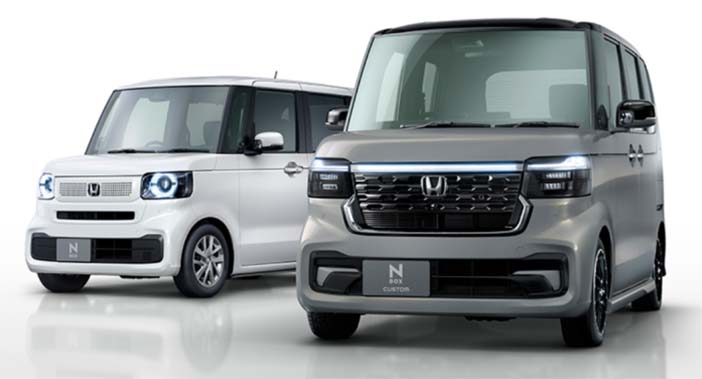
+++ HONDA on Friday began sales in Japan of the all-new N-Box. The all-new, third-generation was developed with the aim of creating a vehicle which provides a joyful time for everyone who uses it, enabling customers to fulfill their broad range of purposes, including what they want to do for the happiness of everyone, not just for themselves and their families. In addition to a refined exterior design that exudes a greater sense of high quality, the all-new N-Box features an easy-to-drive and comfortable interior space achieved by carrying forward the spacious cabin which has always been a popular feature of the N-Box to realize an uncluttered field of vision with enhanced sense of openness. Moreover, the all-new N-Box became the first Honda mini-vehicle model to feature Honda Connect, an in-vehicle communication system equipped with new-generation connected technologies, which enables customers to enjoy the use of their vehicle with greater peace of mind and comfort. Furthermore, the all-new N-BOX continues to feature the Honda Sensing advanced safety and driver-assistive technologies as standard equipment on all types, but with 2 newly added functions, namely Low Speed Brake Function and Unintended Acceleration Mitigation. +++
+++ HYUNDAI has dropped the price tag of its car factory in Chongqing, China by another 30 percent after failing to find a buyer in the course of its pullout. The carmaker “has cut the minimum asking price for its auto plant in the southwestern Chinese city of Chongqing by almost 30 percent to 2.58 billion yuan… after putting it up for sale in August”. it said. Hyundai had 5 factories in China before an unofficial boycott on Korean products in 2017 and increasing local competition sent its sales there into a tailspin. It sold its plant in Beijing and put the Chongqing and Changzhou factories up for sale as well. The Chongqing plant is capable of producing 300.000 vehicles a year and costs Hyundai around 6.2 billion yuan, but Hyundai is having a tough time finding buyers because China’s car market has reached saturation. +++
+++ KIA has sold only 4.136 units of its new EV9 over the 4 months since the all-electric car came out, less than 10 percent of its sales goal of 50.000 for this year. When it released the model in June, Kia called it the “most epoch-making car we have ever made”, but sales lagged behind Hyundai’s conventional Palisade SUV, which sold 13.115 units. The EV9 is Hyundai’s first large electric SUV with 3 rows of seats, but Koreans seem to be losing their appetite for very big cars in these straitened times. The main hurdle is the high price. 80 percent of buyers bought the 4-wheeldrive version of the EV9, and without bells and whistles the starting price is W80.41 million. The price went up because many batteries were installed to increase mileage to 501 km on a single charge and various new technologies are used so that customers can buy options online. The problem is that there is no reason to buy such a huge electric SUV with the inconvenience of having to charge it while there exist more prestigious internal combustion engine-powered cars like the Mercedes-Benz E-Class or the Genesis GV80 in the price bracket. Another drawback is that the EV9 is not ideal for daily use. It is about 5 meter long and about 2 meter wide, which makes it difficult to park or even drive in downtown areas. The Palisade with a similar wheelbase costs between W40 and W50 million. An executive of another carmaker said: “Electric car buyers are sensitive to price. An SUV that costs some W70 million is a burden both for wealthy people who would like it as a second car and for early adopters of new technology”. +++
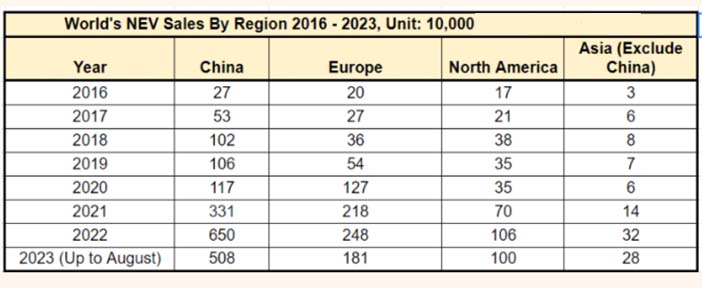
+++ From January to August, China accounted for 61% of the world’s NEW ENERGY VEHICLES (NEVs; plug-in hybrid and full electric cars) sales. Specifically in the month of August alone, China’s share rose to 65%. In terms of Chinese NEV exports, Southeast Asian and European markets remained the strongest, according to Cui Dongshu, Secretary-General of the China Passenger Car Association. It is worth mentioning that China exported 83.000 NEVs in August, a month-on-month increase of 53.6% and a year-on-year increase of 82.3%. In 2023, the world’s NEV sales reached 8.23 million units from January to August, a year-on-year increase of 40%. In August alone, 1.22 million NEVs were sold worldwide, a year-on-year increase of 35%. By regions, since 2021, China’s NEV sales have surpassed that of Europe and North America. From January to August 2023, China’s NEV sales were 5.08 million units, continuing to significantly exceed sales in Europe (1.81 million units) and North America (1 million units). At the same time, the penetration rate of NEVs around the world is generally increasing, reaching 13% in 2022 and 14.6% from January to August 2023. In particular, the NEV penetration rate in China reached 28%, Germany reached 20%, and Norway reached 72%, while the United States was only 8.9% and Japan 3%. In the European market in terms of pure electric vehicle sales, Chinese brands including SAIC and Geely are among the top-performing brands from China. Furthermore, China accounted for 60% of the world’s pure electric vehicle market in 2017-2018; then dropped slightly to 48% in 2020, and eventually rose back to 60% in 2021. From January to August 2023, the share was 59%. Judging from the share of pure electric vehicles among Chinese car companies, BYD’s share is on an upward trend. From 2017 to 2021, the overall share level was above 7%, then rose to 12% in 2022, and 16% in 2023. +++
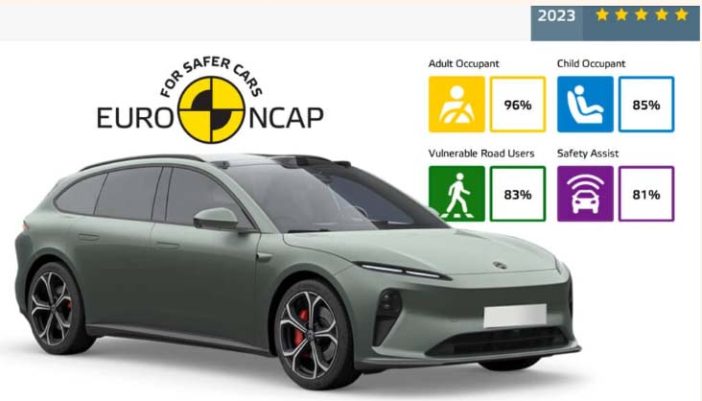
+++ The NIO ET5 TOURING has reached the top mark in the Euro NCAP safety performance assessment program. This electric station wagon’s safety performance equals the ET5 liftback tested earlier. The Euro NCAP is the safety performance assessment program formed in 1996. Nowadays, it is the most famous and respected safety rating in the world. The Euro NCAP comprises severe safety tests for adult occupants, child occupants, vulnerable road users and safety assistance. The car’s safety is evaluated on a scale from 0% to 100% in each of the tests. Then, the percentage is converted into stars. The weakest grade goes into the final result. The Euro NCAP hasn’t tested the ET5 Touring. Instead, it has added the assessment of the stationwagen into the ET5 liftback protocol. As a result, the Euro NCAP rating for the ET5 model can be applied to liftback and stationwagen body types. Here, I will remind you of ET5’s results. The Nio ET5 has also achieved the top mark in adult occupant safety among cars tested in 2023. It scored 96% in this category, surpassing Nio EL7 and Lexus RZ. The child occupant safety of the Nio ET5 is 85%, which is slightly less than the Lexus RZ’s result. Euro NCAP representatives have pointed out that “The passenger compartment of the ET5 remained stable in the frontal offset test. Protection of the driver dummy was good for all critical body areas”. The ET5 scored 83% in the vulnerable road users category, mainly because of the stiff windscreen pillars that caused poor results during the collision with a pedestrian cyclist. And the safety assist performance of the Nio ET5 is 81%. Euro NCAP representatives pointed out that “Nio was unable to verify the car’s performance in Euro NCAP’s ‘head-on’ tests, and no points were awarded”. All in all, the overall result of the Nio ET5 is excellent. The ET5 Touring stands on the NT2 platform. Its dimensions are 4790/1960/1499 mm with a wheelbase of 2888 mm. For comparison, it is 8 mm longer, 34 mm wider and 50 mm higher than the Audi RS4 Avant. The powertrain of the ET5 Touring is represented by 2 electric motors with a total power output of 490 hp. It has two battery options: 75 kWh and 100 kWh. The ET5 Touring has yet to start sales in Europe. In China, the Touring outsold the regular ET5 liftback in August with 4.083 versus 2.882 units. +++
+++ The power structure of the electric vehicle market could be in for a massive upheaval if the collaboration between TOYOTA and Idemitsu Kosan produces the all-solid-state battery it claims is possible. That’s a big if. The 2 companies announced at joint press conference on Thursday that they will join forces to develop the technology, with a goal of commercializing the battery between 2027 and 2028 before going into full-scale mass production. All-solid-state batteries use a solid electrolyte instead of the currently available liquid types, and are considered to be the next generation of batteries. The all-solid-state version has a higher capacity and is easier to make more compact, and has high expectations for vastly increasing the driving range of electric vehicles. There are also claims that danger of a fire is lower, making it a safer option. The goal is to achieve low-cost, mass production that puts the companies at the forefront of the industry as manufacturers around the world race to develop the next generation of batteries. The companies explained that their joint effort involves developing solid electrolytes that conduct ions in batteries. Combined, Toyota and Idemitsu Kosan hold a total of 195 related patents, which is among the highest in the world. The 2 companies will first form a working group of several dozen people, who will work on improving quality and reducing costs using testing equipment installed by Idemitsu. Toyota plans to use all-solid-state batteries in next-generation electric vehicles currently under development, with the aim of a recharging time of under 10 minutes and a driving range of over 1.000 kilometers; about twice that of current electric vehicles. After introducing the all-solid-state battery to the market between 2027 and 2028, the companies will look to start mass-production of tens of thousands of units in the 2030s. Toyota has revealed plans to increase global sales of its electric vehicles to more than 3.5 million units in 2030, which represents a 140-fold increase on actual sales in 2022. The battery plays the most influential role in determining commercial viability. One of Idemitsu’s strengths is its manufacturing technology of solid electrolytes based on sulfur components, which the two companies aim to use to propel their plan and realize the practical application and mass production of all-solid-state batteries. “By making the battery smaller and more powerful, we can address a wide range of needs, from sports cars that require high performance to commercial vehicles that need to recharge quickly and more often”, Toyota president Koji Sato said at the joint press conference. Idemitsu president Shunichi Kito noted, “We will be able to support everyone’s lifestyle by providing a stable supply of the necessary materials and energy”. As a major oil wholesaler, decarbonization efforts have been a major challenge for Idemitsu. The company began research on sulfur components as a byproduct of petroleum refining in the mid-1990s and has been conducting joint research with Toyota on electric vehicle batteries since 2013. Through the collaboration, Idemitsu hopes to develop a new revenue stream that does not rely on fossil fuels. High costs are a major barrier to the mass production of all-solid-state batteries. According to a study by the Japan Science and Technology Agency, these are anywhere from 4 to 25 times higher than those for conventional lithium-ion batteries. Toyota has been continuing to research ways to lower costs. “Our aim in the future is to price vehicles the same as those with liquid-based batteries”, Sato said. Seiji Sugiura, a senior analyst at Tokai Tokyo Research Institute, said all-solid-state batteries have the potential to be a game changer in the industry. “Manufacturers all over the world are relentlessly battling to develop them”, Sugiura said. “Automakers need to refine the performance of vehicles equipped with the batteries, and create products that people will want to buy”. +++
+++ The XPENG G9 was launched on September 19 and has received 15.000 orders in the following 15 days. Xpeng announced today that 80% of buyers chose the version equipped with the automated driving system XNGP. The G9 will start deliveries in 4 European countries this month: Norway, Denmark, Netherlands and Sweden. In the first quarter of 2024, the G9 will also hit the German market, where Xpeng hasn’t yet established a presence. The new G9 is underpinned by the new Smart Electric Platform Architecture (SEPA) platform, the same as the G6 compact SUV feature. That is a significant move, as the previous generation G9 was based on the E/E platform. And yes, that is the E/E platform Volkswagen bought from Xpeng and will use for 2 new EVs for the Chinese market. Xpeng G9 dimensions are (L/W/H) 4891/1937/1680 mm and wheelbase 2998 mm. Thanks to 800 Volt architecture, it enables 315 kW fast charging, capable of filling the battery from 10% to 80% in 20 minutes. The G9 offers 5 variants with 78.4 kWh and 98 kWh batteries, an a RWD variant with 230 kW of power or an AWD variant with 405 kW and a peak torque of 717 Nm. The 2022 version offered 8 versions, and customers complained the lineup was too confusing. There are about 100 EV brands in China now, and most won’t make it as there is simply no market for so many car brands. And when you purchase the car, you think twice if this company is strong enough to fulfill the 5-year warranty they promise you. But in the case of Xpeng, this sceptism was all gone in July when Volkswagen bought 5% equity and announced they would use the E/E platform for their EVs. Xpeng is now backed by one of the world’s largest automotive companies and this brings a lot of confidence to the company, also from customers who have dozens of options when it comes to EV purchases in China. +++