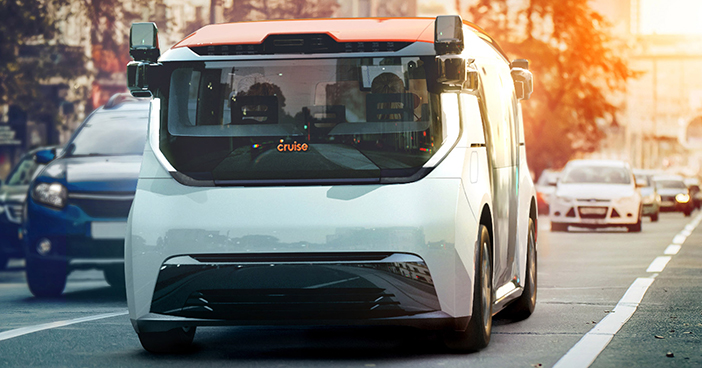
+++ HONDA and General Motors said Thursday they will launch a driverless taxi joint venture that will be operational by early 2026 in Tokyo, as the auto industry rapidly shifts to vehicles that use autonomous and zero-emission technologies. The 2 automakers, along with GM’s autonomous driving car unit called Cruise, will set up the venture in 2024 in Japan with Honda taking a majority stake. The ride-hailing service will use self-driving Cruise Origin electric vehicles (photo) jointly developed by the 3 partners, the automakers said. The venture will start in central Tokyo with a few dozen EVs and is set to become the first driverless taxi service to operate in urban areas in Japan. It will then later be expanded beyond the central capital, with the fleet boosted to about 500 EVs. The vehicles, without a driver’s seat or steering wheel, feature spacious cabins with 2 rows of seats allowing up to 6 passengers to sit face-to-face. Customers will use a dedicated smartphone app to hail and pay. “The self-driving taxi service will offer a new transportation option that people have never experienced”, Honda president Toshihiro Mibe said at a press conference. “We will offer freer and more meaningful human mobility”. Advanced technologies and new automobile services are increasingly vital for global automakers at a time when vehicles are expected to become more connected, autonomous, shared and electric, known as CASE. Japan has been falling behind in introducing driverless taxis. The United States and China (the world’s 2 biggest auto markets) are among the front runners, with driverless taxi services being already available in some parts of both countries. Japan is grappling with driver shortages in the transportation sector. Bus and train operators are scaling back their services in rural areas in particular, with the number of taxi drivers also dwindling following the Covid-19 pandemic. The Cruise Origin vehicles will be classified as Level 4 autonomous driving vehicles, the second highest of 5 scales for the technology. Level 4 means the vehicles are fully automated under certain conditions. “Japan is famous for its quick embrace of new technologies. With Honda’s leadership in the region, we are confident these vehicles can be safely deployed for consumers”, the CEO of General Motors, Mary Barra said while attending the press conference online. Honda and GM agreed in 2018 to jointly develop self-driving vehicles and the Japanese carmaker launched a vehicle test on public roads this year in Tochigi Prefecture for a self-driving taxi service. Honda will display its Cruise Origin at the Tokyo auto show, scheduled to open to the media on October 25 and to the public from October 28. +++
+++ HYUNDAI and Kia set an annual sales target of 550.000 vehicles in the Middle East by 2030 by gradually introducing more electric vehicles and stepping up more specialized market activities there, the automakers said Friday. The 2 firms also shared their plans to achieve a 20 percent market share there by the same year, identifying the region as their next major growth area. They will focus on launching more electric vehicle (EV) models and increasing their portion. According to Hyundai, the company sold more than 160.000 vehicles in the Middle East in the first 3 quarters combined this year. The figure for Kia also topped 118.000 during the same period. This was an increase of 17.7 percent and 9.7 percent, respectively, from the previous year. Saudi Arabia is the largest market in the region. Data compiled by the company showed that more than 2.29 million cars were sold there last year. The country accounted for over 27 percent with auto sales of around 640.000 during the same period. The Hyundai Motor Group aims to tap deeper into the lucrative Saudi market where auto sales have been on a gradual rise since 2018, except for 2020 when the Covid-19 pandemic pummeled global markets. Demand for automobiles there is forecast to reach more than 3 million each year from 2030, so the 2 automakers are sharpening their sales strategy by launching more diverse segments of vehicles and widening the sales portion of EVs. They will also launch a connected vehicle service there, and strengthen activities on corporate social responsibility, Hyundai said. Hyundai is selling 6 electric models, with the Ioniq 5, Ioniq 6 and Genesis GV60 among those, in the Middle East this year. This accounts for 20 percent of all of Hyundai’s sales there. The company also unveiled its ambition of doubling the number of its EV lineup by 2027 and ensuring EVs account for more than 15 percent of its total sales in the Middle East by 2032. Kia also sells 4 electric models and is set to increase the number to 11 over the next few years. “We will keep coming up with detailed ways to increase our market share in the region, and raise awareness of our brand there”, an official from Hyundai said. Hyundai Motor Group executive chairman Chung Euisun will also promote its efforts to expand its presence there by accompanying president Yoon Suk Yeol in his upcoming state visit to Saudi Arabia, which will last 5 days as of Saturday. Hyundai Motor CEO Chang Jae-hoon is also joining the delegation to display the automaker’s strong willingness for sales expansion there. +++
+++ In JAPAN , imported electric vehicles accounted for 9% of all domestic imported vehicle sales in the first half of this fiscal year, according to the Japan Automobile Importers Association (JAIA). The JAIA figures showed total sales of 10.968 EVs for the period, representing a year-on-year rise of 94.5%. Imported EVs are an increasingly familiar sight in Japan, reflecting a rise in the number of different models, and smaller vehicles better suited to Japanese road conditions. From October 2020 to September this year, the number of EV models available in Japan increased from 20 to 101. Though the association did not disclose model-specific sales figures, it said Volkswagen’s ID.4 and Audi’s Q4 e-Tron were popular. Overseas EV manufacturers are increasingly targeting the Japanese market. China’s BYD (which began selling EVs here in January) plans to increase the number of its Japan-based sales outlets to 60 by the end of the year. Meanwhile, the Mercedes-Benz Group launched a world-first base that deals exclusively in EV sales in Yokohama last year. With foreign automakers expanding into this country’s market, Japanese automakers only offer a total of around 10 EV models. According to the Japan Automobile Dealers Association, in the first half of this year, 21.317 EVs (excluding minicars) were sold in Japan, accounting for just 1.7% of total vehicle sales. +++
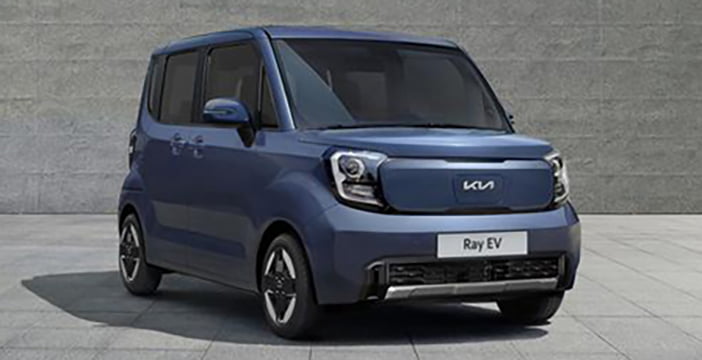
+++ KIA wants to make electric vehicles more popular by embracing the global trend toward smaller, cheaper cars. Last week, the automaker unveiled 3 new concept EVs: the midsize EV5 (a SUV), the compact EV3 (also a SUV) and the EV4 (a sedan). All are smaller and cheaper than the giant EV9 that has flopped, costing between W20 million and W40 million after subsidies when they become available in a couple of years ($1=W1.339). Kia president Song Ho-sung said, “High price tags are hindering the popularization of EVs, so we will introduce EVs with lower prices from next year”. Kia’s plans follow the global trend, where smaller electric cars fare better. The sales growth of EVs has slowed recently as state subsidies for bigger, more expensive models dwindle. Initially, customers shunned small EVs because they tended to look ridiculous and could only travel less than 200 km on a single charge, but the technology has progressed by leaps and bounds. Kia received 6.000 pre-orders for the Ray EV (photo) that hit showrooms last month and costs around W20 million, already surpassing this year’s sales target of 4.000 cars. After sales of the midsize Model Y slowed, Tesla replaced the battery with lower-priced Chinese lithium iron phosphate (LFP) batteries and lowered the price tag by W20 million. That increased its sales in Korea 10 times in September compared to the previous month and Tesla rose to the top spot in the imported car market. But sales of the EV9 totaled just 408 cars in August and 1.163 in September, which is less than 10 percent of the sales targets, because the starter version costs a hefty W70 million. Affiliate Hyundai has managed to sell fewer than 1.000 of the Ioniq 5 and Ioniq 6. Kim Pil-su at Daelim University, said: “EVs are more expensive than combustion-engine cars now and consumers have tended to choose smaller models”. The new EV5 was originally developed targeting China, but sales were diverted to Korea in light of the trend. Starting next year, Hyundai plans to roll out an electric version of the cheap Casper subcompact that is produced by Gwangju Global Motors, a joint venture with the city’s government and only sold online to save showroom costs. Tesla is developing the Model 2, which will cost around $20,000, while Volkswagen announced last month plans for the ID.2 small electric crossover. General Motors will start selling the Equinox electric SUV at the end of this year costing in the mid-$30.000 range. BYD of China started selling the Seagull compact electric hatchback in April for 73.900 yuan or around W13.6 million and sales have surpassed 20.000 cars each month. +++
+++ Chinese carmaker NIO might buy the 2 Jianghuai Auto (JAC) factories it uses to manufacture its models and apply for a production license. The 2 factories are part of several previous deals between the 2 companies. On Thursday, JAC Motor announced it will sell part of its factory assets for 4.498 billion yuan ($614 million). The 2 factories refer to JAC-Nio factory and Nio factory, also known as F1 and F2 production facilities. JAC’s decision will not affect Nio’s business and production activities. Local media reported that an unnamed insider has said that the EV maker might be buying JAC assets and acquiring its production license. This will have a major positive impact on Nio and its long-term business and efficiency, the source added. The Thursday statement follows JAC’s announcement last December saying the manufacturer planned to acquire some of the assets held by Nio Anhui for 1.704 billion yuan ($232 million). Neither of the 2 companies explained the move at the time. Nio initially planned to build a factory in Shanghai, but Tesla’s arrival made the EV maker realize that with the American carmaker around, the Shanghai government would not be motivated to invest in it. In 2016, Nio signed a manufacturing agreement with JAC. Next year, the F1 plant started with producing cars. In March 2021, Nio signed a deal with JAC to establish the joint venture company. The following month, Nio and the Anhui government jointly announced the start of construction of NeoPark. Nio’s F2 factory is the first project of NeoPark and the first model produced is the ET5, which started deliveries at the end of September 2022. +++
+++ The government of SOUTH KOREA is being urged to impose more environmental charges on Chinese electric vehicles (EVs) mostly equipped with non-recyclable lithium iron phosphate (LFP) batteries, as local EV manufacturers are feared to fall victim to a planned influx of low-priced Chinese EVs, experts and industry officials said. This reflects escalating concerns voiced by domestic carmakers as BYD prepares to enter the Korean market. Last year, the Chinese EV and battery manufacturer applied for trademarks in South Korea for 6 EVs. As customers still remain sensitive to EV prices, BYD’s price-competitive EVs are expected to pose a threat to Korean competitors. According to a report by the Korea Automobile & Mobility Association (KAMA), more countries are considering introducing diverse policies centered on protecting their own EV industries from the potential threat posed by Chinese carmakers. The report said the European Union is considering punitive tariffs on imports of Chinese EVs to protect carmakers in the region. Japan is also scheduled to adopt a policy of cutting corporate taxes on local companies producing EV batteries and semiconductors, according to the report. But no specific policy-wise measures have so far been introduced here to support Korean carmakers as protectionist policies are being considered abroad. Experts and industry officials underscored the importance of Korea’s characteristic as an export-driven economy. They argued that the government should not introduce overly nationalistic policies, such as a sales quota system, which could end up triggering trade conflicts with bigger economies. “The government should consider imposing environmental improvement charges on Chinese EVs equipped with LFP batteries, as they are not recyclable”, said Kim Pil-soo, an automotive technology professor at Daelim University College. He also stressed the need to preemptively enhance communication with the World Trade Organization (WTO) to give local companies competitive edges in their EV export strategies. “The worst thing is to introduce some overly nationalistic policies, because such a stance does no good to boosting carmakers’ exports”, he said. An official at one domestic carmaker also said the government should follow the moves of other countries taking legal and administrative measures to back up their local companies. “For instance, the government needs to consider offering more subsidies for locally-made EVs and batteries”, the source said. Korea International Trade Association (KITA) data showed Chinese EV battery imports topped $4.47 billion between January and August of this year, up 114.6 percent from 2022. Other data from the Korea Automobile Importers & Distributors Association (KAIDA) also showed that sales of imported EVs here rose 54.8 percent for the first 8 months of this year compared to the same period of 2022. The figure for August also marked a 72.2 percent increase from a year ago. EVs with price-competitive LFP batteries are gaining more traction with customers. More than 4.000 units of the Tesla Model Y, equipped with LFP batteries from China’s CATL, were sold in Korea last month. This is up almost 10 times compared to August. The proportion of LFP batteries in the global EV market is on the sharp rise, according to data from the International Energy Association. The figure surged to 27 percent in 2022, up from 6 percent in 2020. +++
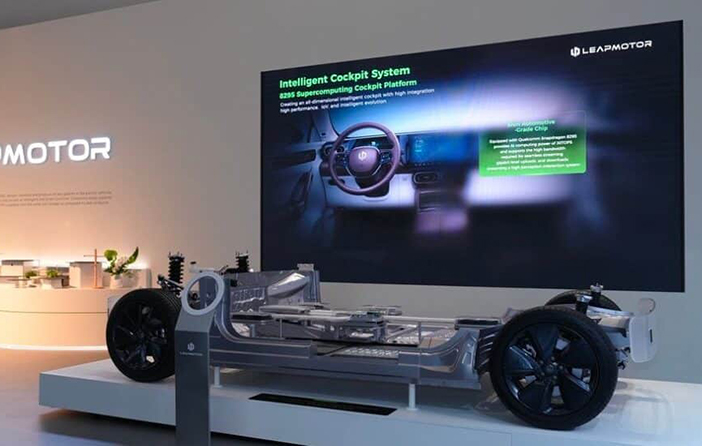
+++ STELLANTIS , the French-Italian car manufacturing group, is on the verge of sealing the investment agreement with Leapmotor, a Chinese EV startup, including licensing their EREV LEAP 3.0 platform, according to 3 sources familiar with the matter. Zhejiang Leapmotor Technology launched the new EV platform in July. It was initially called by Chinese translation “Four Leaf Clover” or LPEE 3.0, but the official English name is LEAP 3.0. It supports both BEV and EREV vehicles. The company wants to use the LEAP 3.0 architecture for its products and license it to other car makers. “We want Leapmotor to be not only an EV brand but also a supplier of core EV technologies”, Zhu Jiangming, CEO of Leapmotor, said during the launch ceremony. Zhu also teased that the company is already in talks with 2 automakers without further elaborating. Later, it was revealed that one of them is Volkswagen’s China-only brand, Jetta, and the second is Stellantis. In September, Leapmotor unveiled the first EV based on the LEAP 3.0 platform. It is a C10 mid-size SUV, and the company calls it their first global model. It is typical for Leapmotor to offer their vehicles in 2 versions, all-electric and with a range extender and the C10 is not an exception. The electric range extended vehicle (EREV) is an EV equipped with a small ICE that is not connected to wheels and works only as a power generator for the battery. The leading promoter of this concept is Li Auto, whose lineup consists exclusively of EREVs. Their sales are skyrocketing in 2023 and in September Li Auto delivered 36.060 vehicles in China, up 212% from the same period last year. Stellantis, on the other hand, is struggling in China. In July last year, the automotive giant pulled the Jeep brand out of China and closed its only factory there. The loss-making factory was operated by a joint venture between Fiat Chrysler Automobiles and GAC and sold only 20.000 vehicles in 2021, about 6% of its capacity. The Stellantis closed the plant after a failed attempt to take complete control of the joint venture with GAC. Stellantis blamed it on increased meddling by Chinese politicians in business. “We have been seeing more and more political interference in the world of business in China over the last few years”, the group’s CEO, Carlos Tavares, told Bloomberg in July last year. “Leapmotor is enjoying they have 2 applicants and push to sign the deal quickly”, a source familiar with the talks told. “The Chinese market is over-competitive and without a significant win, they can quickly become one of the dozens of EV makers that won’t make it”, the insider added and concluded that partnering with a global automaker can be such a win. Leapmotor sold 15.800 vehicles in September in China, up 43% compared with the same period last year and 11% up from last month. Global automakers licensing Chinese EV makers car architectures is recently becoming pretty popular. In July, Volkswagen acquired 5% of Xpeng and licensed their Edward architecture to build 2 EVs for the Chinese market. Edward is a platform that underpins the G9. The facelifted version of this SUV launched last month, however, is based on the latest Xpeng platform SEAP 2.0 and the compact SUV G6 launched in June. Audi announced in July that it teamed with SAIC’s brand IM to license their iO Origin platform and will launch EVs in China based on it rather than their own PPE architecture. +++
+++ VOLKSWAGEN ’s pure electric sport utility vehicle ID.4 has been gaining traction in South Korea, especially among drivers in their 30s and 40s, as one of the most reasonably priced premium EVs. According to Volkswagen Korea, its competitive pricing sets the car apart from other EV rivals. The 2023 all-electric ID.4 is priced in the range of 50 million won ($37.000), but with a government subsidy of up to 5.8 million won, the price can be further lowered to the upper 40 million won range. In August alone when deliveries of the 2023 model began, a total of 277 units were sold, becoming the second most popular EV among imported cars in the country, according to the Korean unit. The new model has come back stronger, with an enhanced driving range and energy efficiency, features most EV drivers consider paramount. The new ID.4, equipped with an upgraded regenerative braking system and electronic brake booster, can go 421 kilometers on a single charge. The 82 kWh high-voltage battery supports rapid charging of up to 135 kW, with charging time taking as little as 36 minutes. Equipped with a permanent magnet synchronous motor, or PMSM, it produces a maximum output of 150 hp. From a standstill, it takes 8.5 seconds to accelerate up to a speed of 100 kph. Switching to the B mode allows for brake energy recuperation to maximize driving efficiency and enable strong regenerative braking. Among EV drivers, complaints abounded about a sense of discomfort or nausea, caused by aggressive regenerative braking. The new ID. 4, however, proactively addresses this problem, with its premium regenerative braking system that supports a comfortable and serene ride even for first-time EV users. In terms of the exterior, the latest ID.4 features a futuristic design, enhancing appearance and convenience, simultaneously. Its aerodynamic vehicle body gives it a drag coefficient of 0.28. Meanwhile, the short overhangs and long wheelbase measuring up to 2,765 millimeters also help maximize space inside. With the rear seats up, the boot space comes in at 543 liters, and with the seats folded, this increases to 1.575 liters, offering ample room for storage. Some highlights of the car’s safety features include a 360-degree camera for an aerial view, front assist that detects passengers and bicycles, and an active blind spot monitor, among others. ID.4 was named EV of the year, separately, by the Automobile Writers’ Association of Korea and the Ministry of Economy. +++
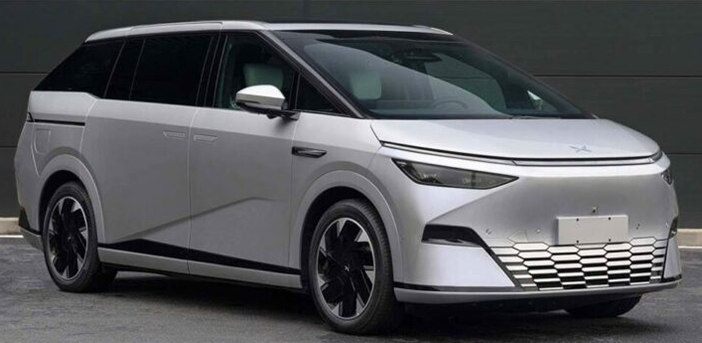
+++ XPENG will hold its Technology Day on October 24 and shared the invitation with new render images of the X9 MPV, thus sparking discussion that the latest Xpeng car will have its debut there. MIIT filing showed that the X9 is enormous: almost 5.3 meters long. The dimensions are 5.293/1.988/1.785 mm respectively and the wheelbase is 3.160 mm. It will have three rows and 6-7 seats. It will come in 2 variants with single or dual motors. The single FWD model will have 320 hp and be equipped with a lithium iron phosphate battery (LFP) from Eve Energy. The dual motor version has 320 hp in front and an additional 184 hp in the rear; maximum power is 496 hp. CALB supplies the battery, which will be a more expensive Nickel Manganese Cobalt (NMC) chemistry. Xpeng made headlines in July due to a significant investment by Volkswagen, resulting in a 5% ownership stake. This strategic move allowed the German automaker to gain access to Xpeng’s E/E architecture called Edward, which serves as the foundation for their flagship model, the G9 SUV. By utilizing this platform, Volkswagen also declared its intention to collaborate with Xpeng in launching new electric vehicles in the Chinese market. Additionally, in August, Xpeng announced its acquisition of the electric vehicle division of Didi, often referred to as China’s equivalent of Uber. This acquisition aims to develop affordable electric vehicles under the Mona brand for the ride-hailing market. In September, reports emerged indicating that Xpeng would shift away from its direct sales model and opt for a more conventional dealership-based approach, looking for third-party partners to manage sales for them. The X9 will be Xpeng’s 7th model and first tap into the MPV market. In China, MPVs have become pretty popular in the last few years, and in the electric field, there is lots of competition waiting for X9. Li Auto recently teased its futuristic Li Mega, Zeekr already sold its 009, and BYD has had lots of success with the Denza D9. +++