
+++ BMW appealed to the European Union Intellectual Property Office (EUIPO) and to Germany’s Deutsches Patent und Markenamt (DPMA) office to reserve the term ‘iM3′. Everyone’s best guess is that this will be the name of the electric M3 that further breaks open the Neue Klasse era that begins with the next-generation X3 SUV and i3 sedan due in 2025. The new trademark applications fall in line with a raft of other requests covering all manner of BMW products. BMW plans to continue selling combustion-, electricity- and possibly hydrogen-powered variants of the same model requires a way to tell the powertrains apart. Gasoline-powered models will get a naming structure that consists of ‘X3’ followed by 2 numbers, electric models will follow the same system but receive the ‘i’ prefix. Assuming this is what happens, there’d be an X3 and an iX3, an M3 and an iM3. To those headed for the exit at the talk of an electric M3, M boss Frank van Meel says: “I respect that”, and wishes you well. M development chief Frank Weber supported the stance in telling about M customers: “Some come to me and say ‘No, the M guys don’t want this’. I say no, be careful, because we do a lot of customer studies here. M customers want, simply, the best and highest performance you can get”. However, the gas-powered M3 is expected to remain on sale until 2030 or so. The one word describing BMW’s performance target for what we’re going to call the iM3 is: “Crazy”, as when van Meel said of his expectations for the coming products, “They will be so groundbreaking that you will say: ‘This is crazy, I didn’t see that coming’ “. One enabler will be the “Heart of Joy” controller, the highly advanced offspring of the “Hand of God” controller BMW put in the i8. The Heart is an ECU containing a database of roughly 30 years of M’s knowledge of dynamics and handling. “It’s almost the history of how you control a vehicle that is in that thing”, he said. “Everything that is driving-performance related, chassis-control related, propulsion- and powertrain-related is now in one integrated control unit”. This single unit in direct communication with wheel motors can translate dynamic commands up to 10 times faster than the current system of multiple ECUs communicating with one another. So what should we expect? It’s impossible to know for sure, but the ceiling is high. Last year, BMW revealed it’s testing a quad-motor powertrain making a combined megawatt of output, translating to 1.360 horsepower. Talking about that prototype last year, Weber said: “The M3 can also be the dual-motor architecture, and this can be 4-motor architecture with 4 times 250 kW motors for up to 1.000 kW (1.360 hp)”. I don’t expect an M3 with 4-figure horsepower; a source within BMW predicts an output of around 700 hp in the iM3. We’re a few years away from knowing, the M3 anticipated to debut not long after the new 3-Series production starts, and hit the market around 2027. +++
+++ Recently, used cars haven’t been the money-saving alternatives to new models they used to be, as dips in new vehicle inventory and delays have made pre-owned vehicles a hot commodity. Used electric vehicles and hybrids are selling slower than they were a year ago, but some have joined the list of the FASTEST SELLING USED VEHICLES in October in the United States. Used vehicles took an average of 49.2 days to sell in October, much faster than the 54.9 days seen in October 2022. Breaking out EVs and hybrids paints a different picture, however, as electrics took 52.4 days and hybrids 46.7 days to sell. Both were significantly worse than the averages in 2022, which were 37.5 and 34.3 days, respectively. Despite that, 3 hybrids and 1 EV hit the list of fastest-selling used models. The top 10 include: BMW X5 Hybrid: 26.8 days, Toyota Highlander Hybrid: 29 days, Cadillac XT6 30.1 days, Lexus NX 350: 31.8 days, Toyota GR Supra: 31.8 days, Hyundai Elantra Hybrid: 31.8 days, Porsche 718 Boxster: 32.4 days, Cadillac CT5: 33.3 days, BMW M2: 34.4 days and Rivian R1T: 35.5 days. Some buyers are in the sweet spot of avoiding the effects of inflation and higher interest rates, which is why we see performance cars like the BMW M2 and Boxster on the list. At the same time, many are looking to save money on fuel with more efficient hybrids. While some EVs, including the Rivian R1T, the Chevrolet Bolt and the Tesla Model 3, are selling quickly, others are not. The Kia EV6, Ford F-150 Lightning and Polestar 2 made the list of slowest-selling vehicles, with the Kia and Ford taking 2 or more times the average number of days to sell. Some petrol vehicles also took forever to move, including the expensive Maserati Quattroporte, which took a whopping 137.8 days to sell, almost 3 times the average for used cars. +++
+++ Clearly frustrated with its languishing share price, GENERAL MOTORS on Wednesday announced a massive stock buyback plan, raised its dividend and told investors it can absorb increased labor costs from a 6-week autoworkers strike. The Detroit company said it lost production of 95.000 vehicles due to the United Auto Workers walkouts, costing the company $1.1 billion. But due to $2 billion worth of annual efficiency gains and cost reductions expected by the end of next year, the company said it can can handle $9.3 billion in labor cost increases from U.S. and Canadian union contracts through April of 2028. The deals, GM said, will increase costs per vehicle by $500 next year and $575 by the end of the contracts, but analysts say competition will limit the company’s ability to raise prices. “We are finalizing a 2024 budget that will fully offset the incremental costs of our new labor agreements, and the long-term plan we are executing includes reducing the capital intensity of the business, developing products even more efficiently and further reducing our fixed and variable costs”, CEO Mary Barra said in a prepared statement. On a conference call with analysts, Barra called GM’s stock price “disappointing to everyone” even with record profits and cash flow. The shares, which were trading around $28 before Wednesday, were priced 15% below the 2010 initial public offering price when the company emerged from bankruptcy, she said. The company said it plans to buy back $10 billion of its shares over the next year, about one quarter of its $44 billion market value, with $6.8 billion coming immediately. A spokesman says GM expects the stock buyback to end up at about 20% of the company’s outstanding shares, based on an expected price increases. In January, GM will raise its dividend by a third to 12 cents per share, another maneuver aimed at boosting the share price. The plan worked, at least on Wednesday. At midday, GM stock rose almost 13% to $31.71. But the shares are still down over 20% in the past year. GM also reinstated its full year earnings forecast that was withdrawn after the UAW began targeting the factories of Detroit automakers with strikes on September 15. Those strikes continued at GM until October 30. The company now predicts full-year net income of $9.1 billion to $9.7 billion, down from its previous outlook of $9.3 billion to $10.7 billion. But GM expects to generate more cash for the full year. It expects free cash flow of $10.5 billion to $11.5 billion, an increase from a previous forecast of $7 billion to $9 billion. To get there, GM plans to cut capital spending, including a slowdown in spending on electric vehicles and at Cruise, its troubled autonomous vehicle unit. California regulators revoked the San Francisco-based subsidiary’s robot taxi license last month after one of its vehicles dragged a pedestrian to the side of a street after the person was hit by another car. Barra blamed some of the stock price slide on problems at Cruise. She expects the pace of Cruise’s expansion to slow when driverless taxi operations resume, with spending down hundreds of millions of dollars next year compared with this year. GM had big plans for Cruise, which it bought 8 years ago. The company had predicted $1 billion in annual revenue by 2025; a big jump from the $106 million last year. During the first 9 months of this year Cruise posted pretax losses of $1.9 billion. GM has replaced Cruise’s management after allegations that it wasn’t forthcoming with regulators about the pedestrian crash. Barra said she’s awaiting the results of independent reviews of Cruise’s technology and response to the crash before announcing further action. Barra also told investors in a letter that she’s disappointed in the pace of GM’s electric vehicle production, which she attributed to difficulties in assembling batteries. But she wrote that GM has made organizational improvements, and the company expects higher EV production and improved margins next year. “While the rate of growth for EVs is slowing in the near term, it is projected to accelerate and grow substantially in the long term as customers have more EV choices, and the public charging network expands”, Barra wrote. Earlier in the year GM delayed electric pickup truck production at a factory north of Detroit until 2025 as the growth rate in electric vehicle sales slowed. In June of 2022, electric vehicle sales were growing about 90% year over year, but by the same month this year, the growth rate had slowed to about 50%. Automakers fear sales will slow further with consumers having reservations about EV prices, how far they can travel and whether charging stations will be available. Barra wrote in a letter to investors that GM has a strong cash balance due to record profits from selling gas-powered vehicles and more efficient internal combustion and electric vehicle operations. “We have a clear path forward that includes greater operating and investment efficiency”, she wrote. Barra also tried to allay investor concern over the cost of new labor contracts that she said were higher than the company expected, but not significantly. GM, as well as rivals Ford and Jeep maker Stellantis, agreed to new contracts with the UAW that raise top assembly plant worker pay by about 33% by the time the deals expire in April of 2028. The new contracts also ended some lower tiers of wages, gave raises to temporary workers and shortened the time it takes for full-time workers to get to the top of the pay scale. At the end of the contract top-scale assembly workers will make about $42 per hour, plus they’ll get annual profit-sharing checks. UAW President Shawn Fain said during the strike that labor costs are only 4% to 5% of a vehicle’s costs, and that the companies were making billions and could afford to pay workers more. +++
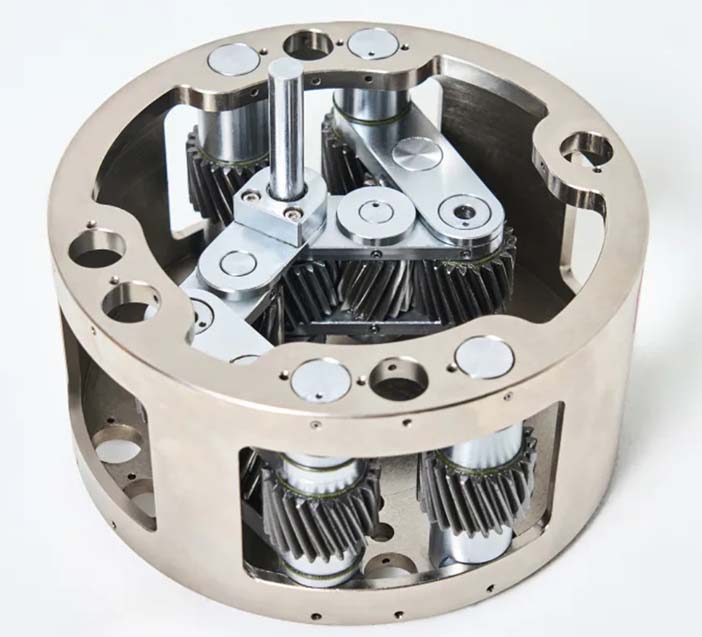
+++ The massive worldwide focus on electric vehicle technology has already introduced noteworthy changes to automobile design, notably due to the flat floor design with one large battery pack popularized by Tesla and thereafter adopted by nearly every other major automaker. The reduction in size of drive components has made the term “frunk” part of our regular vernacular, as well. And now HYUNDAI and Kia have introduced the world to what they say is the next major paradigm shift in EV architecture: the Universal Wheel Drive System, or Uni Wheel for short. Basically, the Korean automaker conglomerate has figured out a way to replace the standard constant velocity (CV) joint with an arrangement of gears that reside directly inside the wheel hub. I could do my best to explain the arrangement (the short version: a single sun gear transfers power through a pair of packaged pinion gear arms that can move independently to an outer ring gear in a unique and flexible planetary design) but it makes the most sense after looking at the picture. Hyundai/Kia highlight many benefits to this Uni Wheel drive system. Claims include reduced packaging size, improved ride quality, greater durability and, importantly, increased efficiency. All of that means a smaller battery could provide similar range to today’s EVs, that a similarly sized battery could provide greater range, or even that the space that’s freed up by Uni Wheels would allow greater battery size and therefore range without requiring a larger vehicle platform. In addition to electric cars and trucks, the automaker group says that Uni Wheels can be used for a large variety of mobility applications. These would include vehicles with fewer than 4 wheels, like scooters and motorcycles, and even wheelchairs and delivery robots. The automakers have reportedly applied for and registered 8 patents related to Uni Wheel in South Korea as well as the United States and Europe. +++
+++ After an internal review of customer data, Stellantis is issuing a recall of the 2021-2024 JEEP WRANGLER 4XE . The company said it “discovered 8 vehicle fires” involving the plug-in hybrid that happened when each of the vehicles was parked and turned off. 6 of the Jeeps caught figure while plugged into chargers, 2 were not charging at the time. The automaker appears to know the cause of the issue since it’s saying the fix is to have new software installed, and that “if a certain error code is observed, the battery pack will be replaced”, However, Stellantis hasn’t said what the issue is. Only 1% of the total figure is expected to be afflicted with whatever indignity is causing the fires. Stellantis says it is not aware of any accidents or injuries resulting from the issue. Owners are being advised that it’s all right to drive the Jeeps, but also being advised not to charge the hybrid battery and not to park in or near structures or near other vehicles until the Jeep’s software has been flashed. I’d guess owners want this rectified ASAP, since it not only means inconvenience, it means losing out on 35 km of all-electric driving. The automaker says it will notify customers when the window opens to schedule a service visit to the dealer, but did not say when those notifications will go out. Owners with questions in the meantime (which I expect will be quite a few) can visit Stellantis’s recall page. +++
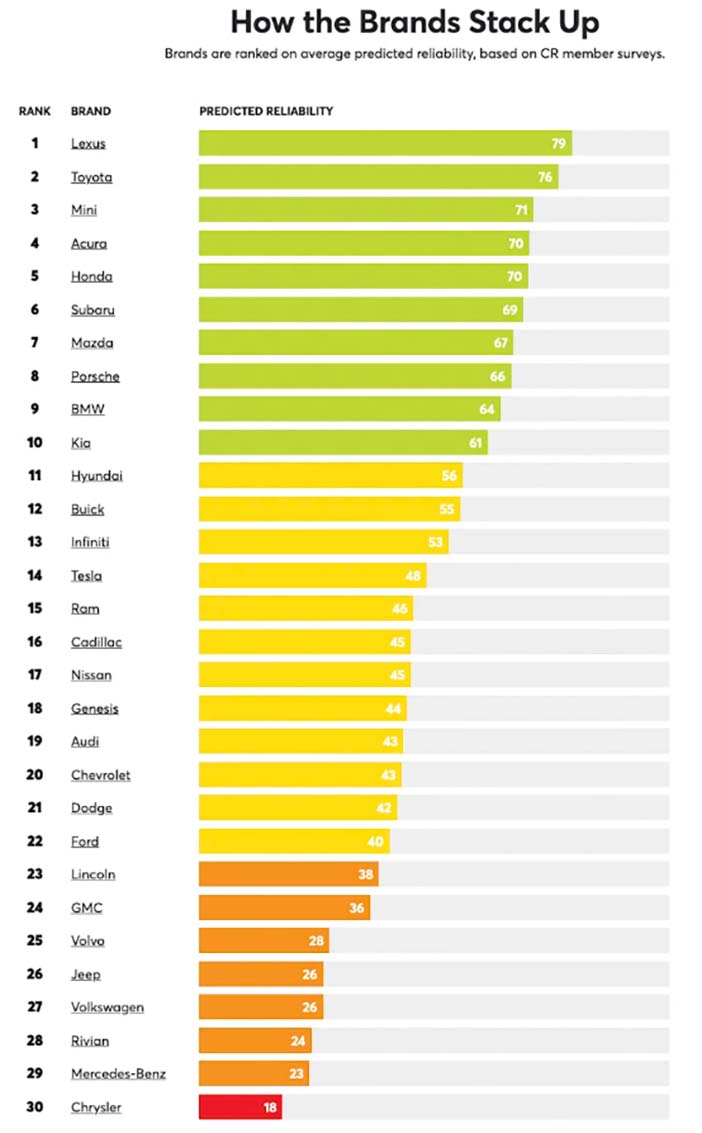
+++ Consumer Reports (CR) reworked its methodology for deriving predicted RELIABILITY ratings and updated the questions about problem areas to address issues specific to electrified and electric vehicles. The results still bear out clichés, such as: vehicles that have been on the market longer being generally more reliable; and sedans being generally more reliable than SUVs and pick-up trucks. There are exceptions, of course, like the Chrysler Pacifica Hybrid scoring the lowest of any rated vehicle with a score of 14 on a 100-point scale, and the Toyota RAV4 Hybrid being among the most reliable vehicles in the survey. There’s unwelcome news in the results for the fast-growing world of battery-electric vehicles and plug-in hybrids, though: EVs suffer 79% more problems than ICE vehicles, and PHEVs are much worse with 146% more reliability issues than ICE vehicles. Let’s start with how the rankings were won. CR created problem categories ranging from mild (squeaks) to major (EV battery trouble), each category given a weighting. There were 12 potential problem areas specific to battery-electrics, there were 17 potential problem areas for ICE-powered vehicles, 19 for regular hybrids (the 17 ICE problems plus the electric motor and battery pack, and 20 potential problem areas for PHEVs) the 19 from regular hybrids plus EV charging. CR polled its members about reliability issues over the past year, receiving responses on more than 330.000 vehicles from the 2020 to 2024 model years. Brands were scored on the “weighted overall problem rate for all models within a brand for each model year” combined with a brand’s average result from the 2021 to 2023 or 2024 model year depending on how much info there was for 2024, combined with CR’s owner satisfaction survey and CR’s in-house testing and safety data. 30 automaker brands made the final rank; CR couldn’t get enough responses to include Alfa Romeo, Fiat, Jaguar, Land Rover, Lucid, Maserati, Mitsubishi or Polestar. The new equation means this year’s result can’t be compared to previous reliability rankings. Now to the results: Lexus topped the charts with a score of 79 out of 100, followed by Toyota (76), Mini (71), Acura (70) and Honda (70) for the top-5. Let’s take a moment to at least acknowledge that Mini, a brand once known for terrible reliability, is now No. 3. That either requires a “bravo!” or an inquisitive eyebrow. The bottom-5 are: Jeep (26), Volkswagen (26), Rivian (24), Mercedes-Benz (23), and Chrysler (18). Buick was the top American make at No. 12 with a score of 55, between Hyundai (56) and Infiniti (53). Generally, domestic brands didn’t do well, scoring an average of 39 out of 100 when grouped as a region, coming well behind Asian makers who scored 63 and Europeans who scored 46. Individual domestic models provided some bright spots, though, CR calling out rides like the Ford Edge and Maverick, Buick Encore GX, Chevrolet Equinox and GMC Terrain for above-average predicted reliability. Consumer Reports also grouped powertrains together when discussing reliability, which is where we start to have some issues. Apparently, EVs suffered 79% more problems than gas-powered vehicles. That will undoubtedly lead to shock headlines, but it’s also misleading. Most EVs are new to the market, which goes back to the cliche we mentioned earlier. There are also a lot fewer make/models availability, meaning that simply averaging them all models together will result in a few bad apples skewing the results. Tesla, which was midpack in terms of reliability, cannot be considered one of those bad apples, but it’s hard to imagine that its enormous percentage of EVs sales and therefore ownership reporting wouldn’t skew comparisons to ICE cars given the popularity and sales volumes of those brands above it on the list. Plug-in hybrids fared even worse in this powertrain-to-powertrain reliability analysis. CR says PHEVs scored a whopping 146% worse for trouble spots than ICE-only vehicles, which sounds terrible, but again, this was because of a “few bad apples”. The Audi Q5 TFSI-e and aforementioned Pacifica Hybrid, which also single-handledly dragged Chrysler to the bottom of the pile, scored worse than their ICE siblings. Meanwhile the Toyota RAV4 Plug-in Hybrid, Kia Sportage PHEV, BMW X5 xDrive50e and Ford Kuga PHEV all posted average to well-above-average scores for reliability. In other words, this is a lot more complicated than it seems. +++
+++ Used car prices and supplies have had a rollercoaster ride over the last few years, but the picture finally appears to be improving as new car inventory grows and supply chain issues subside. Despite that, some used models sell much faster than others, and EVs dominate the list of SLOWEST SELLING USED VEHICLES . The good news for used car dealers is that gas vehicles are selling faster in 2023 than the year before, at 49.2 days to sell on average versus almost 55 days in 2022. Hybrids and EVs have fared worse so far this year, selling at an average of 46.7 and 52.4 days, respectively. Both figures are significantly higher than 2022’s days to sell, especially for EVs, which took just 37.5 days in 2022. The list of slowest-selling used cars in October 2023 includes: Maserati Quattroporte: 137.8 days, Kia EV6: 95.9 days, Jeep Grand Cherokee: 93.4 days, Land Rover Discovery Sport: 83.1 days, Audi A5: 83 days, Maserati Ghibli: 82.4 days, Mercedes-Benz C-Class Convertible: 80.7 days, Ford F-150 Lightning: 78.4 days, Infiniti Q60: 75.6 days and Polestar 2: 73.4 days. Most of the slow-selling cars are premium models or EVs. The Maserati and Kia take 2 or more times the average days to sell, while the Grand Cherokee takes 1.9 times the average. He also noted Ford’s F-150 Lightning, which is 1 of only 2 electric pick-up trucks on sale, is selling much slower than its gas-powered counterparts. While hybrids are generally selling slower than in 2022, some models are performing quite well, including the BMW X5 xDrive50e and Toyota Highlander Hybrid. Similarly, many EVs are taking much longer than the average to sell, but Tesla’s vehicles and the affordable Chevrolet Bolt are moving quickly. For Tesla, that likely comes down to price cuts and the fact that many of its cars are eligible for federal tax credits. +++