
+++ The next-generation ALFA ROMEO Stelvio will make the switch to electric power when it arrives in 2025. It will be followed by a new Giulia in 2026, and Alfa Romeo will go EV-only a year after. The duo will be the first STLA Large-based cars to use 800 Volt electricals, hinting that they will fully exploit the new Stellantis platform’s potential in hot Quadrifoglio guise. The quickest STLA Large cars will crack the 0-100 kph sprint in around 2.0 seconds; almost half the 3.8 and 3.9 seconds times claimed by the current V6-engined Stelvio QV and Giulia QV. The new Dodge Charger Daytona, the first performance car to use the platform but with 400 Volt electricals, offers outputs of up to 670 hp and so can hit 60mph in 3.3 seconds. It also packs a 93.9kWh (usable) battery pack, which delivers a range of 510 km in the 496 hp R/T model, according to the American EPA test cycle (which is tougher than the WLTP regimen used in Europe). This can be recharged at rates of up to 183 kW, allowing a 20-80% refill in 27 minutes. However, the use of 800 Volt electricals in the Alfa Romeo duo will doubtless allow for a substantially faster charging rate. It’s possible that it will rival the recently upgraded Porsche Taycan, which can now take up to 320 kW. The higher voltage could also allow Alfa to reduce the current at which the electrical system runs, allowing for thinner wiring and thus a significant reduction to the car’s weight. This could prove key to ensuring the new cars are to match the dynamic capabilities of their predecessors, given the 400 Volt Charger tips the scales at a hefty 2.648 kg. To that end, the Giulia and Stelvio will also be fitted with active anti-roll bars and a terrain-detection system. The cars will also be the first to use Stellantis’s new STLA Brain computer architecture, which promises to bring a marked upgrade to the cars’ onboard technological offerings. Alfa Romeo said this would enable greater flexibility of dynamic character, with customisation possible on the fly using artificial intelligence. The cars will also be updated over the air throughout their lifetimes, with periodical software updates for further refinement. Inside, each car will remain firmly focused on the driver, with CEO Jean-Phillipe Imparato having committed to a conservative approach to the cars’ digital offerings. In July 2023 he said: “I respect what Mercedes is doing with its digital technology, of course, but my customers aren’t looking for metre-wide infotainment screens in their cars or 200 digital assistance systems to switch on and off”. Imparato added that the cars will both retain the signature ‘cannocchiale’ (telescope) instrument binnacle while gaining a larger infotainment display. The head-up display may also provide assistance to the driver, such as projecting a ‘ghost’ car ahead to help them to pick the right line through a tricky bend. “This feels like something an Alfa Romeo should do”, said Imparato, adding: “It’s helping you to drive the car and keeping you engaged in the process. What I don’t need is to know is the weather for three weeks’ time. I don’t care: i’m here to drive”. Both the Stelvio and Giulia will be built at the Cassino plant alongside one or more Maserati models, also based on STLA Large. +++
+++ For years, we’ve heard rumors claiming that the next-generation BMW M3 will go electric. BMW hasn’t confirmed these reports, it merely explained that it hadn’t made a decision yet, but a counter-rumor claims the sport sedan will be offered with both electric and piston power. The Munich-based brand will offer 2 variants of the next-generation M3: one will keep the twin-turbocharged straight-6, and the other will switch to electric power. Allegedly called G84 internally, the gasoline-burning model will make its debut in 2027 or 2028, according to the report. It will be based on the upcoming G50-generation 3 Series, which should make its debut before the end of 2026, and it will use an evolution of the current-generation car’s 3.0-liter straight-6 engine. On the battery-powered side of the range, the first electric M3 will be called ZA0 internally and make its debut after 2027. Technical details such as the drivetrain’s configuration, driving range and horsepower haven’t been released. Another interesting question that’s up in the air is whether the two M3s will look alike. As of writing, BMW has a policy of making electric variants of gasoline-powered models rather than launching a standalone range of EVs. The electric 5 Series is the i5, for example, and the electric 7 Series is the i7. The iX is the only exception; there’s no gasoline-burning version of the SUV. There’s no word yet on whether this approach will continue. M3 fans who aren’t interested in an EV might be in luck, but those who want to see the piston-powered M4 live on could be disappointed. The report claims that BMW isn’t planning a gasoline-burning successor to the model, which is sold as a coupe and as a convertible. It adds that nothing is official at this stage and that production plans can change up until 18 months before the first car rolls off the assembly line. In the meantime, the current car will receive a round of updates later in 2024. The changes should fall in line with those recently made to the M4. +++
+++ The MERCEDES A-CLASS is set to be produced well into 2026. Plans to retire the 4th generation as soon as this year having been cancelled. News of the move comes after Mercedes-Benz confirmed it was abandoning its EV-only stance in favor of what its CEO Ola Källenius describes as a more “flexible” model strategy, under which it will continue to produce ICE models based on existing platforms well into the next decade. The firm had been preparing to make its line-up fully electric by 2030, as part of a so-called “electric first” strategy. However, Källenius has now revealed that its latest studies project PHEVs and EVs will likely make up just half of its global sales by then. “I don’t think anyone had ever thought that the once-in-a-century transformation of the auto industry will be a straight line. There will be peaks and troughs”, he said. Källenius pointed to the ongoing price disparity as one reason for the slower-than-expected take-up of EVs, suggesting they will remain more expensive than their ICE equivalents for some time. According to Mercedes’ studies, demand for EVs will mainly be in the small and medium car segments. Cost parity between EVs and ICE vehicles “is many years away”, Källenius said. “You can see that in the pricing”. In preparation for the continuation of A-Class production, Mercedes has altered its Rastatt manufacturing plant in Germany to enable it to produce cars atop the MFA compact car platform and its electric-biased MMA successor. Its platform has been conceived as a hybrid structure capable of accommodating ICE, PHEV and EV drivetrains. It will first be used for the third-generation CLA, the first prototype for which was completed in September last year. ICE variants of the new CLA are planned to be powered by Mercedes’ M282 petrol engine. To be manufactured by Geely in China, the new 4-cylinder unit is also set to be used in future Geely, Lynk&Co and Volvo models. Electric variants of the new CLA will use either a single- or dual-motor powertrain, supplied by a choice of different batteries giving ranges of up to 750 km. +++
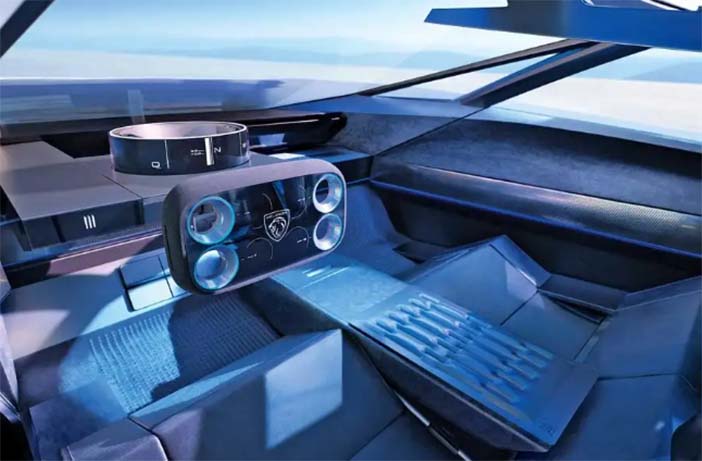
+++ PEUGEOT ’s Hypersquare steering ‘wheel’ is on track to make production in 2026 after extensive clinics showed customers are ready for the step change in interior design and technology. The Hypersquare is a rectangular-shaped ‘wheel’ that Peugeot previewed on its Inception concept car in 2023 as the next evolution of the i-Cockpit concept introduced a decade ago. It will enter production alongside steer-by-wire technology and the 2026 timing of its introduction, confirmed by CEO Linda Jackson, coincides with when Peugeot’s B-segment models (the 208 and the 2008) are due for replacement. “The next stage for us is going to be Hypersquare”, said Jackson. “We’re going to take and evolve the steering control. We’ve moved from a beautiful, round, little steering wheel, into a very ‘tech’ arena, which is more based on a gaming-type idea. Not only do we think it’s technically superior, but it’s also linked to another technology in steer-by-wire, which is important as it enhances something that is absolutely fundamental for Peugeot: the pleasure of driving. It’s agile, flexible and offers easy agility, and that’s what we want to create”. Jackson said the technology has already been installed in test vehicles and it has been trialled on “customers from across Europe”. The new steering wheel and technology will liberate more cabin space and Jackson said customers “were shocked by how much space you free up” with the new arrangement. The Hypersquare will be paired with Peugeot’s panoramic curved infotainment screen, a 21 incj display atop the dashboard, while customisable i-Toggle shortcut buttons will continue to be a feature of future Peugeot interiors. More broadly, Jackson said Peugeot will continue to focus efforts and investments on improving interiors because its data shows that this is one of the major reasons for people purchasing its vehicles. “We think it’s important as we spend so much time in our cars”, she said. “While we all love to have a car that looks beautiful, is it beautiful inside? Is it practical? Is it ergonomically designed around you? Does it give you the right infotainment? For me, the interior becomes more important than the exterior”. +++
+++ PORSCHE has confirmed the 911 will gain its first ever hybrid powertrain this summer, as part of a major model update 2 years in the making. The ‘992.2’-generation Porsche 911 receives a host of mid-life revisions, including subtly altered exterior styling, a reworked interior and updated six-cylinder petrol engines. The changes are intended to sustain the 911’s appeal through to 2027, when an all-new ninth-generation model will join the increasingly electrified Porsche line-up. The most significant change to the 911 in its 6th decade of production, however, is the adoption of a unique petrol-electric hybrid system. Set to appear in a new 4-wheeldrive model being revealed in the summer, it combines a tuned version of Porsche’s turbocharged six-cylinder engine with a specially designed electric motor housed within the front axle assembly. The petrol engine provides drive to the rear wheels, while the electric motor drives the front wheels. A 48 Volt integrated starter motor in the dual-clutch automatic gearbox will provide electric boosting properties and power for ancillary components. The new 400 Volt system is claimed to generate its own energy reserves using the engine as a generator (in a function similar to that of a range-extender drivetrain) as well as via brake regeneration, negating the need for external charging. Electric energy is stored in a specially developed lightweight lithium ion battery. With an energy capacity well below the batteries used by Ferrari and Mercedes-AMG in their plug-in performance models, it has been configured specifically for rapid energy charge and discharge properties. Secrecy surrounds the output of the new hybrid drivetrain, though Porsche is eventually expected to offer the new petrol-electric unit in a range of different performance levels. Both Turbo-E Hybrid and Turbo S E-Hybrid models have been mooted for introduction in line with the Cayenne and Panamera line-ups. Before the 8th generation 911 bows out later this decade, Porsche is also set to launch an 800+ hp hybrid successor to the fearsome GT2 RS. The new drivetrain has been developed via a technology transfer between Porsche’s production car and motorsport divisions, in combination with Rimac; the Croatian electric drive specialist in which Porsche holds a 45% stake. The standard Carrera and Carrera S will retain the existing turbocharged 3.0-litre boxer engine, but it is not confirmed whether they will adopt the 48 Volt mild-hybrid system that Porsche has been developing in partnership with Valeo. However, with tighter emissions standards looming, these models may well receive electrification and a moderate bump in reserves as part of the 911’s facelift. Sources have suggested that GTS models could adopt the naturally aspirated 4.0-litre 6-cylinder engine used by the 718 Cayman GT4 in place of today’s turbo 3.0-litre unit. But Porsche remains tight-lipped on its plans, saying only that future emissions regulations favour higher-capacity engines. Among the possibilities for the more sporting 911 models is a new 3.6-litre version of the classic 6-cylinder Porsche engine, running a single variable-vane turbo; an engine that, insiders suggest, will form the basis of the next-generation 911’s powertrain in 2027. The low production volumes planned for the successor to today’s 911 GT3 suggest it will retain its naturally aspirated 4.0-litre six, albeit with a moderate lift in reserves. A fully electric 911 is not immediately planned. Instead, Porsche envisages its long-running coupé and cabriolet progressing into the future with electrified combustion engines in combination with new e-fuel derivatives to provide net-zero emissions. Enhanced cooling: To boost cooling for the front-mounted radiators and brakes, Porsche has given the new front bumper distinctive air ducts that house five vertical louvres in place of the three horizontal louvres on each side of the existing model. It is most likely that they will incorporate some sort of active operation to better balance cooling and aerodynamic drag. There is also a larger central air duct book-ended by additional cooling channels on either side. Revised headlamps: Instead of being housed within the top section of the bumper insert, the indicators are now integrated into revised headlight assemblies that feature a new graphic design. As with the units used by the facelifted Cayenne, the new headlights are expected to offer HD matrix LED functionality with more than 32.000 pixels per unit and the capability of lighting the road for up to 600 meters. Restyled rear end: The updated 911 receives new-look brake lights, integrated into the top of a restyled rear bumper, featuring inboard-mounted tailpipes within a revised diffuser. Interior upgrades: The changes to the interior of the new 911 are more subtle. Prototypes use the existing dashboard architecture and other features, suggesting that most tweaks will involve software upgrades. Among the expected developments are new digital instrument graphics and the latest Porsche Communication Management system for infotainment functions. +++
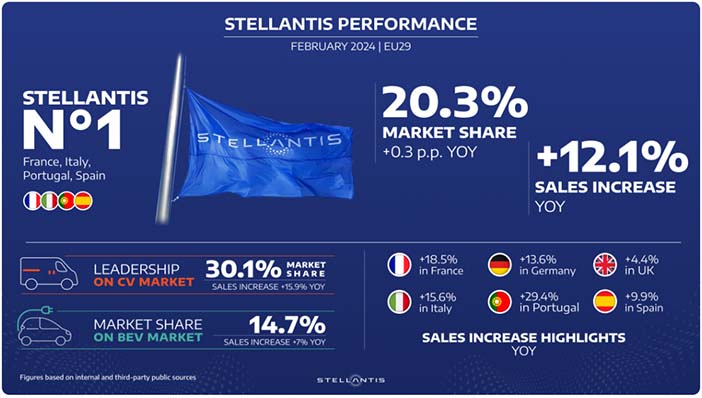
+++ STELLANTIS reports strong February and year-to-date performance in the European total and electrified car markets, growing both in market share (20.3%; + 0.3 percentage points versus last year) and volumes (+12.1%). France, Germany, Italy, Poland and Portugal record double-digit growth, with Austria, Spain, the United Kingdom and other European countries being all up year-over-year. In the Battery Electric Vehicle (BEV) market, Stellantis reports a steady increase in sales (+7%) compared to last year with significant growth in France and Portugal, recording an overall share of 14.7%, in line with January trend. In Italy, Stellantis is up 15.6% compared to last year and confirms its role of market leader as well: 6 of its models are in the top-10, including the timeless Fiat Panda in the #1 spot. In Germany, Stellantis grows 13.6%, with market share up to 13.2%. In Spain, Stellantis was market leader in February and year-to-date. “Sales in February 2024 show that our entire brands and products line-up is delivering steady growing performances In Europe,” said Uwe Hochgeschurtz, Stellantis Chief Operating Officer, Enlarged Europe. “Electric vehicle sales continue to rise, and Stellantis Pro One bolsters its continuing market leadership in commercial vehicles, all energies, leveraging on a completely new line-up. We achieve these results thanks to the unbroken trust of our customers in our products and brands and we will continue our strong teamwork in 2024, as we are ready to compete for the top spot with the arrival of many exciting new products”. In the BEV market, Stellantis keeps growing, with a 7% increase year-over-year, seizing a 14.7% market share in Europe and leading in various BEV segments, showing a steady progression compared to the last quarter of 2023 and January 2024, and giving Stellantis the podium place in several major European markets. In France, BEV volumes are increasing with double-digit growth (+76%), performing a stunning 37.1% market share. “As we work to make electric vehicles accessible to all in the frame of our Dare Forward 2030 strategic plan, it’s crucial for the entire ecosystem to support this transition. Governments, charging infrastructure providers, and automotive manufacturers must collaborate to ignite market demand. This collective effort is vital for widespread adoption and achieving sustainable mobility. Together, we can shape a greener future for the automotive industry and the environment”, added Hochgeschurtz. +++
+++ VOLKSWAGEN has confirmed it will unveil a hot ‘GTX’ version of the ID.3 imminently, posting a teaser video of the new model to social media. The electric hot hatchback builds on plans first aired by Volkswagen with the unveiling of the smaller ID GTI concept at the Munich motor show in September last year, with unique exterior styling touches, an upgraded interior and a revised drivetrain offering significantly more power and torque than existing ID 3 models. Recently spotted in prototype form undergoing cold weather testing, the upcoming range-topping ID 3 has 2-wheeldrive, like every Volkswagen that has worn the hallowed GTI badge over the past 5 decades. However, instead of being front-wheel drive, this latest sporting model will have rear-wheel drive, in line with every other ID.3. Although Volkswagen’s previous management initially hinted at a dual-motor, four-wheel-drive GTX version of the ID.3 at its launch in 2019, current CEO Thomas Schäfer has subsequently denied that the firm harbors plans for such a model. This is in part owing to the cost of re-engineering this version of the MEB platform to accept a front-mounted electric motor, as is possible in larger MEB-based EVs. Technical details remain scarce ahead of the ID.3 GTX’s planned introduction later this year. However, the new EV is expected to feature Volkswagen’s significantly more powerful APP550 motor in place of the ID.3’s existing APP310 unit. As deployed in the new ID.7 and extended-wheelbase ID.Buzz, the new APP550 motor features revised cooling measures, new windings and a more efficient inverter, among other key changes. In its initial form, it delivers 286 hp and 550 Nm of torque; an 82 hp and 230 Nm increase on the most powerful ID.3 model on sale today, the Pro S. Befitting its sporting remit, the ID.3 GTX will get a uniquely tuned chassis, with revised gearing for the steering, firmer springs and dampers and a lowered ride height, among other changes. It will also have recalibrated stability and traction control systems and a revised driving mode controller. In common with all existing ID models, it will use single-speed reduction gearing. It’s also likely to receive a 77 kWh lithium ion battery for a range of more than 500 km on the WLTP test cycle. Although it might not wear the GTI badge, it’s still expected to feature GTI hallmark design cues, including deeper bumpers with honeycomb inserts, new-look sills and unique wheel designs, and potentially even an interior with red accents and the classic Jacky plaid seat upholstery. +++