
+++ ALFA ROMEO ’s fifth model line will be a large E-segment vehicle to sit at the top of the range. Outgoing CEO Jean-Philippe Imparato confirmed the car would most likely be a SUV, meaning it would rival the likes of the Lotus Eletre and Porsche Cayenne, but he would allow his replacement, Santo Ficili, to reflect on the decision before further details are announced. “He can reflect on this E-segment proposition in the coming months”, he told reporters at the Paris motor show. This car would adopt parent Stellantis’s STLA Large architecture, which allows both combustion and electric set-ups; the latter available with ultra-fast charging (via an 800 Volt system) and able to accept a range of high-powered motors and large batteries up to 118 kWh, allowing for some 800 km of range. Previously billed to arrive in 2027, it will follow next generations of the Stelvio in 2025 and a Giulia in 2026, both of which will use that same STLA Large platform rather than continue on Alfa Romeo’s bespoke Giorgio platform. Imparato said the new Stelvio and Giulia would still “maintain and protect” Alfa’s driving dynamics despite this switch and it was “very, very impressive with the level of performance that can be achieved” with this architecture. They would be offered with hybridised internal combustion engines and electric drivetrains as part of Stellantis’s multi-energy platform strategy and the firm would be able to adapt production up to 100% in one direction or another based on customer demand. The new Stelvio and Giulia have already been shown to customers in Italy, Germany and the US in clinics; Imparato said simply “boom!” had been the reaction from potential customers. More generally on Alfa’s performance, Imparato said that Alfa had gone from “losing hundreds of millions to making hundreds of millions” in profit off the back of cutting costs and increasing the prices of its models. He said the firm was not chasing volume, rather profitability, and to that end it had strong margins on every car sold and the “stock was clean”, with every unit made being sold to a true buyer. Earlier in the day at the Paris motor show, Stellantis CEO Carlos Tavares had said that “Alfa Romeo was deeply in the red” at the start of the Stellantis merger: “it was for sale” but “we turned it around”. He said it now makes “good margins and profits”, although Stellantis does not split out the individual performance of its brands. +++
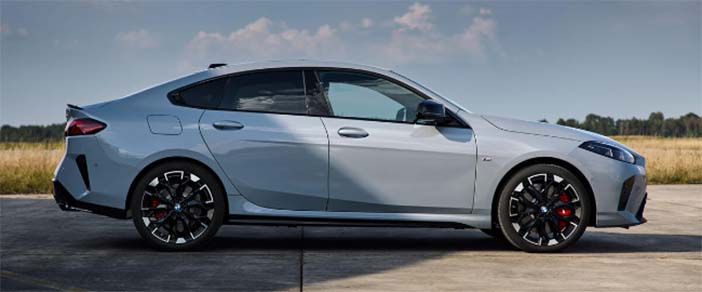
+++ The new second-generation BMW 2 Series Gran Coupé has been revealed with a major design overhaul to give the saloon a more sporting focus. It’s closely related to the recently launched new 1 Series and continues to share the hatchback’s front-wheel-drive platform, rather than the rear-driven one used for the 2 Series Coupé. Bernhard Blattel, BMW’s compact class product management chief, said the focus of the redesign was to push the design to make the car “more sporting”. He added: “The rear of the previous generation was quite polarising, so we completely changed that, and we also realigned the roof to give it a better flow. With the roof, it’s now a very nice shape”. At the front, there’s a revamped kidney grille that will be offered with a light-up LED surround. Further back, there’s the addition of a subtle ‘2’ logo on the Hofmeister kink. And buyers can option a contrasting high-gloss black roof for the first time. With the design revamp, the 2 Series Gran Coupé has been stretched by 20 mm to 4.546 mm, while it’s 15 mm larger in both width (at 1.800 mm) and height (1.435 mm). That change was made in part to maximise interior space. The interior is also entirely revamped, with many of the design changes seen on the 1 Series. That includes a curved touchscreen running the latest BMW OS9 software, with a resulting reduction in the number of physical buttons. Sporting M Sport trim will be standard on all cars. The entry-level 220 model uses BMW’s 170 hp 1.5-litre 3-cylinder turbo petrol engine, boosted by a 48 Volt mild-hybrid system. The M235 xDrive uses a 2.0-litre 4-cylinder turbo petrol engine with 300 hp and 400 Nm ft to dispatch the 0-100 kph sprint in 4.9 seconds. Both variants feature a 7-speed automatic gearbox. Diesel powertrains and other petrol options will be offered in other markets. As with the 1 Series, the saloon has received revised suspension and extra bracing to increase rigidity and boost its on-road dynamics. The M235 gains an extra strut brace in the engine department (offered as an option on the 220), larger tyres and an increase in the caster offset of the front wheels to further boost handling. BMW has also reworked the shack absorbers to reduce rolling movements. Adaptive M suspension and Sport steering is also offered on the M235. The former can lower the car by up to 8mm to aid performance further. Meanwhile, the wheel-slip limiter and braking system have both been reworked. Wheels range from 17 inch to 19 inch, depending on the trim. The new 2 Series Gran Coupé is due to go on sale in March 2025. +++
+++ DACIA is considering entering a wide range of new segments as it fleshes out its line-up over the coming years, with possibilities including a new electric city car, an estate and a Renault Twizy-esque urban EV. The firm is at the Paris motor show to reveal the new Bigster, its largest model yet and the first of 3 new C-segment models due to be added to the range in the next 2 years. Speaking to journalists at the show, CEO Denis Le Vot remained tight-lipped on what form the next 2 mid-sized cars will take but did clarify that they will be “different bodies, different names, different everything” compared with the existing line-up. Both cars will be based on the Renault Group’s CMF-B modular architecture (which can stretch up to 4.6 metres long) and are highly likely to be offered with hybrid power initially, and EV options later down the line. But as for clues to their shape and positioning, Le Vot would only say: “You can imagine, you can guess. We’ll talk soon”. He jokingly suggested that they will be “an LCV and a convertible”, but stopped short of giving any details. However, asked if one could be an estate, he replied: “Excellent idea – fantastic! Why not?”, suggesting there is a possibility that Dacia will look to take on the likes of the Skoda Octavia Combi with its own affordable wagon. Adding fuel to the fire, design director David Durand told “you can expect something different” from the next car, the design for which has already been signed off. It will, he confirmed, occupy the same C-segment as the Bigster. “The next one is finished. We tuned the last little details a few weeks ago and now it goes into the manufacturing process”, he said. “So, yes this one is ready, but we are still working on many other projects. We are trying to have a coherent range with the good product in the good position; not having too many cars in a few centimetres of one another”. Either way, the firm will give more details in the near future because it now operates on a tight 100-week development cycle for new models, and the new cars are due by the end of next year. But while Dacia is expanding its line-up upwards to better compete in Europe’s crucial C-segment, it has also not written off the possibility of extending downwards, too, with Le Vot alluding to the potential viability of a tiny city car based on sibling brand Renault’s new Twingo. Le Vot said Dacia’s C-segment push does “not mean that we’re not looking at a smaller thing”, and suggested that the firm has in the past not offered anything below the Sandero because “the equation of a classic A-segment car doesn’t really fly with ICE solutions”, given their thin profit margins. The firm does already sell an electric microcar in Europe, the Spring, and Le Vot said that car is “here to stay” for the foreseeable future. But the Spring is built in China, which significantly dents its profitability in Europe, and moving production here would be a “complicated thing to do” because of the huge work needed to rebuild the supply chain and logistics network. Engineering and producing a Spring successor in Europe would enhance its profitability and better incorporate the demands of European buyers from the early stages, and Le Vot is confident that affordability can be factored in right from the conception stage. For example, the low range requirements of a small commuter car mean that it could theoretically be fitted with a battery half the size of today’s EV city cars. The average commuter drives 37 km per day, said Le Vot, which means “you can have half the battery input, and it will still work”. One possibility, acknowledged Le Vot, is using the Ampr Small platform that underpins the Renault Twingo as the basis for a Dacia alternative. He refers to Renault’s modular architectures as the ’techno bricks’ on which Dacia can base all its models (a crucial component of Dacia’s value-focused business model) and did not write off the possibility of using any of them for upcoming cars. Le Vot even went so far as to say that Dacia is evaluating the possibility of creating its own version of the tiny 2-seat Duo from Renault’s new mobility brand Mobilize. “We are all together”, he said. “There is nothing that we don’t share. Dacia consideres the viability of a microcar to rival the Citroën Ami, and the Duo could provide a quick and cost-effective means of bringing that to reality. +++
+++ Stellantis “has a problem with MASERATI ” that needs fixing, company CEO Carlos Tavares has said. Tavares last week sacked Davide Grasso as Maserati CEO and installed Santo Ficili in the position; a role he will do alongside leading Alfa Romeo as the two Italian brands are brought closer together. Ficili most recently led Stellantis in Italy. “Maserati is in the red”, Tavares said at the Paris motor show, “and Maserati is in the red for a very specific reason, which is marketing”. +++
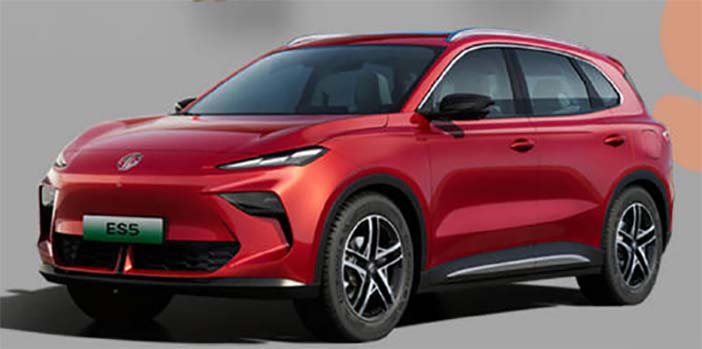
+++ MG has released the first pictures of the ES5, the replacement for the outgoing ZS. The new electric crossover is based on the same underpinnings as the 4 and is slightly longer (4.48 meter) and wider (1.85 meter) than the ZS EV. Chinese government filings previously confirmed that it will be powered by the same 170 hp motor as the standard 4. It’s possible that it will also gain the 204 hp and 245 hp motors from the Long Range and Extended Range versions of the 4, although this has yet to be confirmed. It will also use a new lithium-iron-phosphate (LFP) battery sourced from Chinese firm CATL. Although the ES5 will replace the ZS EV, it’s likely to drop the ZS moniker to better differentiate it from the all-new ZS Hybrid+. The ES5 is expected to arrive in showrooms early next year, priced below €35.000 in the Netherlands. For reference, the 4 starts at €32.285, while the current ZS costs at least €35.885. +++
+++ The new RENAULT 4 E-Tech is the 8th entrant into the brand’s SUV line-up, and its design boss says it has “more than enough” now. Joining the Arkana, Austral, Captur, Espace, Rafale, Scenic and Symbioz in Renault’s European portfolio, the 4 is a stretched, higher-riding sibling of the 5 E-Tech, with which it shares a platform, and will compete with EVs including the Jeep Avenger. Laurens van den Acker acknowledged that it’s an expansive SUV offering, but told: “You have to imagine that what you see today is the fruits of Luca’s anxiety, in a way”, referring to CEO Luca de Meo’s keenness to expand Renault’s market footprint and competitiveness in all core segments. Asked how he responds to public antipathy towards SUVs, which are growing in number as their lower-riding hatchback and supermini siblings become increasingly scarce, van den Acker suggested that such cars shouldn’t be as controversial as they once were. “When people complain about SUVs”, he said, “they pretend they are these big American, body-on-frame trucks that are heavy, but when you drive an SUV today, they’re light, they’re not so heavy, they’re spacious. I’m wondering if it’s the same ‘SUVs’ we’re talking about”. “Let the people that make the comments put their money where their mouth is”, he added, referring to declining sales of non-SUV models in Europe. While Renault’s current line-up is now complete, it has revealed the bold Emblème concept (a high-riding liftback) as a preview of a new ‘C-D-segment’ model due around 2030, showing that SUV-style models still have a future for the brand. Van den Acker said this is partly because putting a battery under the floor of a car naturally raises its profile anyway, so it makes sense to incorporate that into the design, rather than mask it. “When you switch to EVs, it means that the profile, you can see it with the Emblème, is a bit longer and like a cross-over”. +++
+++ The styling of future petrol / diesel and electric cars from VOLKSWAGEN are set to converge as the brand tries to make its ID range seem less separate. Volkswagen will also continue to invest in combustion engine architectures and technology and has put no end date on such investments, according to its new sales and marketing boss, Martin Sander. Sander said he was still convinced “the future is electric” despite slowing demand for EVs. He said he believed that Volkswagen had “done our part right, investing many billions in new vehicles, a complete line-up of vehicles on new platforms which we’re offering globally”. To that end, “I would wish for politicians to recognise that and just clearly commit to the fact that this is going to be the future and take all the doubts away from the consumers” by way of subsidies. However, Sander added that “the ICE market globally is still that big that we can’t put an end date to ICE development today”. “Of course, sooner or later, there will be an end date, determined by customer demand”, he continued. “As long as we see customers demanding ICE vehicles, we will have an offer. Sooner or later, there will be an end date, but I think it’s too early to say when that is going to be, especially from a global perspective”. When asked if that would lead to more convergence in the styling of ICE cars and EVs, Sander said: “Yes”. The first example of this is set to be the production version of the Golf-sized ID.2all concept, which has styling that’s more in line with traditional Volkswagens than the firm’s ID family. This raises the potential for 2 models in VW’s range called Golf: one a petrol / diesel car called Golf built on a traditional architecture, the other an EV called ID.Golf, styled similarly in a more “likeable” way to now but built on an EV-specific architecture. “I think it’s really important that we have a clear Volkswagen design language”, said Sander. “Going forward for the next launches, you will see much more clarity in the way Volkswagen vehicles are designed”. Sander said that were no plans to drop the ID badge completely, even if the designs and names of Volkswagen EVs converge on something more traditionally VW. “We want to build ID as the leading brand for electric vehicles”, he said, adding that ID “is becoming really a strong brand” in its own right. But at the same time, he said that “Golf is such a strong brand in itself globally, not only in Europe. I think it’s obvious that we have to find a way of reviving Golf or transferring Golf also into the world of electric vehicles”, he said. “This is what we’re going to do: the same for GTI”. Sander also confirmed that Volkswagen was now investigating extended-range electric vehicle (EREV) hybrid technology after its recent surge in popularity in China. +++