
+++ BMW M is gearing up for the debut of its first fully electric model, marking the beginning of a new era for the brand. Before that happens, a new video series gave us a sneak peek behind the scenes of the EV development, showing early BMW M prototypes and discussing their quad-motor powertrain. The first episode of the “BMW M Electrified” series is focused on the preparation of the “Board Management Drive”. This secret test drive is for engineers to share their most exciting work with BMW’s entire Board of Management. This is a crucial milestone for the team, as the future of each project effectively depends on what high-ranked officials will think about it. The video reveals that one of the early EV prototypes was based on the previous-generation BMW M2 (F87). The white model sports a slightly different front bumper and a pronounced ducktail spoiler, but looks fairly stock, setting aside the obvious lack of tailpipes. This likely allowed the development team to test the new powertrain and driving dynamics on public roads without being noticed. Of course, the star of the video is the familiar BMW M prototype which has been spotted testing since 2022. This one is based on the BMW i4 but features various components from the M3/M4, wide fender extensions, carbon ceramic brakes, and a special camouflage wrap. More importantly, it is fitted with quad electric motors featuring advanced torque vectoring functions and rides on an extensively reinforced chassis with custom front and rear subframes. Carsten Wolf, who’s responsible for Integration Vehicle Characteristics at BMW M, said that the quad-motor EV powertrain will be used by all future models. “We will see the technical concepts that we are developing here now, 4 electric motors, in all BMW M high performance vehicles at some point in the future”. In this context, Wolf said that the modular system, comprising the EV powertrain and the driving dynamics, is crucial for the future of BMW M. Speaking about EV development, Franciscus van Meel, CEO of BMW M GmbH, said: “For me it’s not about transforming, it’s about embracing new technology, and to find out how to push to the limits of what is technically possible”. According to van Meel, their goal was to “centralize all of the control units into a central control logic”, reducing the complexity of the electronics and avoiding any interference between them. Earlier this year, the BMW M boss made a bold statement about their upcoming fully electric sedan, saying it “will beat everything you have ever seen”. The production model is expected to spearhead the upcoming BMW i3 sedan’s range, which will ride on the much-talked-about Neue Klasse architecture. It will be the electric equivalent to the BMW M3, which will reportedly live on in ICE-powered form using a mild-hybrid 6-cylinder engine. At some point in the video, the i4-based prototype suffered a mechanical issue, and the team had to replace the front electric motors. Engineers cite how crucial it is to perform real-life tests from an early stage, as simulations can’t provide the same feedback on all-new technology. Thankfully, all of the issues were dealt with before members of BMW’s Board of Management sat behind the wheel of the EVs. The next episode will likely show us the outcome of the test drive. According to BMW M’s CEO, the high-ranked officials “said nothing” after experiencing the driving dynamics of the electric models. Judging from the fact that the project has received the green light for production, this was probably a good reaction. +++
+++ With a new Trump administration taking office January 20, the news is full of headlines about trade with CHINA . While Volvo CEO Jim Rowan has the Swedish automaker on pace to have record global sales for the second straight year, much of the success is largely because of the EX30′s strong debut. And where is the electric SUV built? You guessed it: China. Volvo will start selling Belgium-made versions of the EX30 next year, but it will take until mid-2025 until production is up to speed. Speaking of China, retail sales of new passenger vehicles including sedans, crossovers, SUVs and multipurpose vehicles were up 17 percent to more than 2.4 million in November, the China Passenger Car Association said. China’s new-car market has now grown for three straight months, largely behind a government vehicle scrappage program. Consumers qualify for a 20.000 yuan ($2.750) subsidy if they trade in old fuel-powered vehicles for new electrified models, or a 15.000 yuan ($2.065) subsidy if they scrap old fuel vehicles for fuel-efficient new fuel models. +++
+++ The automotive industry in GERMANY is facing difficult times, caught in a storm of strikes, internal tensions at the Volkswagen Group, cost-cutting measures at Mercedes, Ford and BMW, and shifting market dynamics putting pressure on all brands. While the new vehicle market managed to hold its ground in November with 244.544 passenger car sales (a slight 0.5% dip compared to the previous year), the real drama is unfolding in the EV sector, where sales have taken another hit. The numbers don’t lie: EVs are in deep trouble in Europe’s largest market. According to figures released by the country’s Federal Motor Transport Authority (Kraftfahrt-Bundesamt – KBA), November didn’t bring any relief, with EV sales plunging by 22% year-over-year. A total of 35.167 new electric vehicles were registered that month, accounting for 14.4% of all new registrations. While that’s still a decent share, it looks like they’ll struggle to meet the ambitious targets set just a few years ago. Much of the current slump can be traced back to the German government’s decision to end subsidies for electric cars at the end of 2023. At the time, Transport Minister Volker Wissing argued that the EV market should be able to stand on its own without public aid, claiming that permanent subsidies aren’t a sustainable solution. It seems, however, the market isn’t quite ready to walk unaided. As Germany grapples with its EV slowdown, eyes will turn to other major European markets, like France and Spain, where similar subsidy cuts are on the horizon for 2025. Will they see the same fate? If EVs are sputtering, hybrids are thriving in Germany. In November, 94.554 hybrid vehicles found new homes, marking an impressive 20.3% increase from the same month last year. Of these, 20.604 were plug-in hybrids, showing a 13.7% uptick. Hybrids now account for a solid 38.7% of all new registrations, proving that consumers are still drawn to greener options, but perhaps with a foot in both worlds. Meanwhile, traditional fuel-powered cars are showing mixed results. Gasoline-powered vehicles dipped by 5.4%, while diesel saw a sharper decline of 7.5%. LPG-powered cars, despite their niche appeal, recorded a modest 3.2% gain, though they still occupy a negligible share of the market. It’s not just the overall market that’s feeling the pressure; EV makers themselves are getting hit hard. Tesla, the top dog in the electric revolution, posted a dramatic 55.1% drop in sales in November, delivering just 2,103 units in Germany. Year-to-date, Tesla’s German sales have fallen by 43.6%, with only 33.669 units sold so far. And it’s not just Tesla that’s in trouble. Polestar, another EV-only manufacturer, saw its November sales plummet by 26%, with a massive 52.6% drop in total sales for the year. While EV makers are in a pinch this year, some traditional and import brands are seeing a turnaround. Toyota, the poster child of hybrids, for instance, had a spectacular November, with sales up 104.5%, securing 4.2% of the market share. Peugeot (+78.5%), Citroën (+16.9%), and Skoda (+16.5%) also posted impressive gains. On the flip side, several high-volume import brands are heading in the opposite direction. Fiat saw a steep 39.1% decline, while Kia (-16.9%), Mazda (-14.3%), Hyundai (-11.8%), and Renault (-0.9%) all delivered negative growth in new registrations. In sum, Germany’s automotive market remains a study in contrasts: steady sales overall, but with a marked shift away from pure electric vehicles. With the government scrapping subsidies and EV makers stumbling, the future of electric mobility in Germany appears less certain than ever. Meanwhile, hybrids are enjoying a surge, proving that the internal combustion engine still has life left in it. No doubt, it’s a confusing time for the auto industry, one that might require more than just a policy shift to right the ship. What’s more, it brings the EU’s ban on ICE-powered cars that’s set for 2035 into question, as buyers may not be ready yet for such a huge change. +++
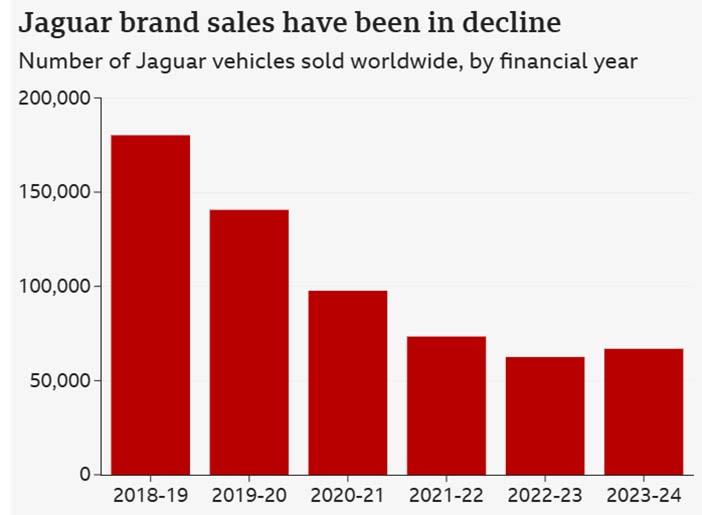
+++ “JAGUAR has no desire to be loved by everybody”, said Gerry McGovern as he strode across the stage on a slightly chilly evening in Miami last week. It was a bold statement from Jaguar Land Rover’s creative director, but it summed up the aura around the relaunch of one of the most famous British brands. On 18 November, a short teaser ad was released that ignited social media. Lasting just 30 seconds, it showed models in bizarre and brightly coloured outfits but did not feature a single car. The New York Post described it as “the latest example of idiotic and woke corporate virtue signalling”. Elon Musk took a dig on X, asking Jaguar’s official account: “Do you sell cars?” Then came the actual launch at a Miami art fair. Mr McGovern stood on stage beside two cars, resplendent in “Miami Pink” and “London Blue” shades. Both were examples of Jaguar’s new Type 00: a concept car that won’t ever go on sale, but is meant to showcase the brand’s plans for the future. Angular, aggressive, with a huge bonnet and more than a hint of Batmobile, the new design also polarised opinions. Jaguar A still from Jaguar’s relaunch campaign featuring 8 models in bright clothing and the slogan: “copy nothing”. The advertising campaign generated plenty of commentary: “Even Gen Z hate the new ‘woke’ Jaguar!” declared the Daily Mail. “Mark my words, Jaguar will go bust”, Reform Party leader Nigel Farage predicted on X. But the former Top Gear presenter James May told the BBC that the fact the ad was being talked about so widely has “got to be a bit of a result for Jaguar, hasn’t it”? Jaguar’s managing director Rawdon Glover also hit back, insisting the company needed to be “bold and disruptive” in order to get its message across. But some insiders argue that Jaguar’s problems run deeper than a 5-minute frenzy on social media. Even before the furore over the advert, “the brand was on a steady road to nowhere”, argues Matthias Schmidt, founder of industry intelligence firm Schmidt Automotive Research. “The traditional Jaguar demographic was slowly being diluted through natural attrition and customers jumping ship to other brands”. So, the publicity that the ad and the launch have drawn appear to have been welcomed within the business. As Gerry McGovern drily quipped from the stage: “We’re delighted to have your attention”, Controversy, he added, had always surrounded British creativity when it was at its best. Behind all the noise, what is happening at Jaguar is pretty simple. It is being re-launched as an all-electric brand as part of a major restructuring at JLR, instigated by its parent company, the Indian conglomerate Tata. Jaguar’s current models, including the I-Pace, the E-Pace and the F-Type, are no longer being sold new. Instead, the first of a new generation of cars will hit the road in 2026. Alongside this transition to battery power comes a move upmarket, with the new models expected to cost upwards of €120.000. The reasons for doing all this are 2-fold. Firstly, Jaguar has been struggling to sell enough cars or to make enough money. Secondly, JLR needs to build more electric cars to satisfy regulators, who are working to phase out the sale of new petrol and diesel models. It’s a far cry from the brand’s glory days, when the E-Type placed Jaguar firmly at the heart of swinging-sixties British cool. Steve McQueen owned one. So did Frank Sinatra. Peter Sellers gave one to his wife, Swedish superstar Britt Ekland. George Best, who knew a thing or two about fast cars and a fast lifestyle, had several. But for decades, the stereotype of a Jaguar buyer has been a well-to-do company boss; almost certainly male, with expensive cufflinks and a set of golf clubs in the boot. Not so long ago he might have been seen smoking a cigar as well. That might be a little unfair on Jaguar. It has has clearly tried to appeal to female buyers and to families, with offerings such as the F-Pace. Nicknamed the “She-Type”, this was praised by Good Housekeeping magazine after its launch for its seats designed with women in mind. But Jaguar continues to be perceived by many as a supplier of upmarket exec-mobiles – and this is a segment of the market where competition is fierce. “They’ve been chasing BMW and Audi sales for years and despite some decent cars have struggled to be profitable”, explains Rachel Burgess, a car market analist. “Now, they’re trying to target the likes of Bentley and Porsche, looking at high net-worth individuals, who would be spending far more on a car than the level at which Jaguars used to be priced”. The reinvention of Jaguar has been brewing for many years. Tata bought the brand from Ford in 2008, following nearly two decades under American ownership. During that period, Ford invested significant sums and overhauled its manufacturing and quality control processes. But it failed to make the business profitable and, at the height of the global financial crisis, put Jaguar up for sale. After taking control of both Jaguar and Land Rover, Tata merged the 2 brands into JLR: that brought stability and removed immediate doubts over Jaguar’s future. But while JLR has performed relatively well over the past decade, despite the downturn caused by the Covid pandemic, it is the part of the business that used to be Land Rover that has been driving recent growth. This has been largely thanks to strong demand for luxury SUVs in markets such as North America and China, as well as in Europe. In April, the company reported an increase in annual sales across its Range Rover, Defender and Discovery brands of nearly 25%, helping to drive revenues and profits up across the business. Jaguar’s sales did rise as well, by 7%, but that came after 5 years of steady decline. In the 2018-19 financial year, Jaguar sold more than 180.000 vehicles. In 2023-24, the figure was 66.866; a relatively small proportion of JLRs overall sales of 431.737.
By 2021, other pressures were mounting on JLR, not least the introduction of increasingly stringent environmental rules in Europe. At the time, JLR had only one electric model in its line-up, the I-Pace. In February 2021, JLR’s chief executive Thierry Bolloré announced a new strategy: a wholesale revamp of its range, with all models to become available in electric form by the end of the decade. But crucially, he said Jaguar would be “re-imagined” as an all-electric brand. Although Mr Bolloré would leave at the end of the following year, his plan was picked up by his successor, Adrian Mardell, who promised the company would invest 18 billion euro to turn it into reality. Within JLR, there is widespread recognition that something had to change. “Jaguar’s performance over the past 10 years has been challenging”, Rawdon Glover admitted in a previous interview. He pointed out that Jaguar had been trying to succeed in a high-volume market, where the bigger players can keep their costs down through economies of scale. “While our vehicles were highly competent, and critically acclaimed, actually the ability to commercially succeed in that environment was challenging”, he said. The move upmarket, in theory at least, gives Jaguar the opportunity to sell fewer cars, but with much bigger profit margins. “I’m fully in agreement that they had to do something”, says Andy Palmer, an industry veteran and former CEO of Aston Martin who has also been a leading executive at Nissan. “But it’s very brave to be planning to walk away from 85% of your customer base. They are going to have to find new customers to replace them. And acquisition of new customers is always more expensive than retaining existing ones”. The big question, though, is whether the changes being made are the correct ones. Arguably, one of the reasons why Jaguar’s rebrand has attracted such attention is because although relatively few people buy the actual cars, the name itself still resonates with cultural significance, thanks to a heritage going back more than 7 decades. In its early days, under founder Sir William Lyons, Jaguar was truly innovative, and it knew how to grab attention. In 1948, it launched the XK120, an elegant 2-seater sports car with swooping lines and a powerful 6-cylinder engine. As the name implied, it had a top speed of 120 mph (192 kph), making it the world’s fastest production car at the time. In a country still recovering from the ravages of World War Two, this was a revelation. Jaguar had originally planned to build just 200, but demand was so high, it ended up making more than 12.000. Victories in motorsport put Jaguar’s name in lights, especially at the prestigious 24 Hours of Le Mans, but the company continued to produce striking machines off track as well. A number of these have stood the test of time, not least the Mark II and its successor, the S-Type. First produced in 1959, this was a luxury saloon that happened to have plenty of bad-boy appeal. Arguably Jaguar’s greatest moment, however, came with the launch of the E-Type in 1961, which came with 240 kph performance, and movie-star cachet. It was the car to be seen in and gave the Jaguar badge a lustre that lasted for decades. But nostalgia alone will not sell cars. Jaguar has been harking back to former glories for a long time. “I would certainly say they’ve been trading off nostalgia for decades”, says Matthias Schmidt. Prior to the relaunch, he says Jaguar has been “like a luxury hotel that doesn’t feel the need to refurbish its brand”. He adds: “The failure to look over one’s shoulders and see what the competition is doing can be fatal”. This week’s relaunch seems designed to get the brand out of a comfortable rut and attempt to make it edgy again, while retaining at least some of its past cachet. Or, as Gerry McGovern put it from the Miami stage: “recapture the essence of Jaguar’s original creative conviction”. Under normal circumstances, the debut of a new car might gain a certain amount of attention in motoring magazines and websites, but it would rarely, if ever, get onto the front pages. The company has not said who was behind the teaser ad that went viral, generating more than 3 million views on YouTube, but JLR has been working with Accenture’s creative marketing arm, Accenture Song, for 3 years. However, branding experts have mixed views about the campaign. “What we had was a really bold advertising campaign, that has now been followed through seamlessly with a concept car that completely matches the campaign”, says Mark Beaumont, founder of branding agency Dinosaur. “It is potentially a masterclass in advertising awareness”. But Tim Parker, strategy director at Conran Design thinks it is a risky strategy. “They have indeed copied nothing that has come before in the brand’s rich heritage, but at what cost? “Few brands ever succeed by alienating their traditional customer base over the longer term”, he continues. “If the goal is to build relevance in a crowded luxury EV market, then differentiation makes sense – but only if the underlying strategy is coherent”. What we have not seen yet, however, or at least in any detail, is an actual road-going car. The concept is just that: an idea. Jaguar is in the process of developing 3 new models, the first of which is unlikely to go on sale until late 2026. All we have been told is that it will be powerful, with 600 hp and have a range of 700 miles. It has begun road-testing and a handful of leaked photos show a large boxy machine that is both similar to the concept … and very different. For any car company, trying to negotiate the transition to electric vehicles without alienating any of its customers is going to be challenging. And for a brand like Jaguar, with the scent of petrol and the sound of 6 and 12 cylinder engines built into its DNA, it likely to be even harder. But among all of this is another question that hasn’t yet been asked. That is, does that DNA even matter any more – and how useful really is it when it comes to selling cars today? Andy Palmer puts it more bluntly: Jaguar, he thinks, may well be disposable. “I think it’s a very fair question to ask: does JLR actually need the Jaguar brand? Does the world need the Jaguar brand?” We won’t find out the answer until 2026. In the meantime, we know what Jaguar’s plan is. Now it has to deliver. +++
+++ Toyota has long been regarded as a bit of a slow mover in the electric vehicle race, but it’s proving that it’s anything but predictable. At the 2023 Japan Mobility Show, the company made a splash by unveiling 2 striking LEXUS EVs, with promises of their arrival in 2026. Yet, just 14 months later, a new report indicates those plans are now on hold. According to a report from Japan’s NHK, production of the Lexus LF-ZC and LF-ZL have now be postponed until mid-2027. Unlike many of its competitors, who are slowing EV rollouts due to demand concerns, Toyota’s delay appears to stem from a more strategic reason. The company is taking extra time to refine its manufacturing processes, particularly the implementation of gigacasting. The Lexus LF-ZC and LF-ZL are important vehicles for the Toyota family and feature advanced designs and technologies that will trickle down to other models. Both are to be underpinned by a new EV architecture made from a gigacasted modular structure consisting of front, center, and rear portions. Toyota has said the special configuration means the front and rear of the EVs are structurally independent, allowing it to integrate new and improved batteries in the future. Speaking of batteries, the new Lexus EVs are set to feature cutting-edge prismatic battery cells, which Toyota promises will deliver a range of up to 1.000 kilometers. That’s impressive, especially considering that Toyota isn’t typically one to make exaggerated claims. Last year, it was also revealed that the new Lexus EVs will be produced at an advanced assembly plant. According to the company, vehicles will be able to drive themselves autonomously with just the battery, motor, tries and wireless terminal components, allowing it to ditch traditional conveyor belts on the production line. The LF-ZC and LF-ZL aren’t the only victims of Toyota’s evolving EV timeline. In October, the company revealed that its 3-row electric SUV (set to be produced at the Kentucky plant) would also be delayed. Originally planned for a 2025 launch, the SUV’s debut has been pushed back to mid-2026, adding to Toyota’s growing list of postponed EVs. +++
+++ Automakers spend countless billions of dollars in the mature U.S. market building their brands, conquering customers and developing long-term loyal drivers. That’s standard operating procedure, but these efforts get seriously diminished if the automaker can’t back up marketing with product quality. Not a problem for SUBARU . The automaker dominated the holy grail of quality ratings: the Consumer Reports annual brand report card. This ranking measures factors such as vehicle performance, safety and reliability. Brands that do well plaster the walls of their dealerships with the results. And for generations, savvy car buyers have used Consumer Reports as a key tool in making purchasing decisions. Subaru also routinely occupies top positions in customer loyalty reports produced by J.D. Power and others. Let’s face it, in mature markets such as the U.S. and Europe, automakers can’t expect any kind of rapid growth in overall sales. So if they are going to build volume and market share, they’ve got to win customers from competitors, and keep existing customers happy and loyal. Subaru seems to be doing just that in the U.S. It is headed for a banner year in 2024: Sales rose 5.5 percent to 605.854 vehicles through November. +++
+++ Manufacturers have struggled to turn profits in the B-segment of the car market for a while now, let alone the smaller A-segment where the city cars reside. TOYOTA is clearly persevering with its dinky Aygo X, however, as we’ve caught the facelifted model testing for the first time. The current-generation Toyota Aygo X arrived in 2021 and adopted the ‘X’ moniker to signify a slightly loftier profile than the second-generation Aygo, though it still retained city car proportions to go up against the Kia Picanto and Hyundai i10. Now, Toyota has some design changes in store for its smallest model. The bonnet line, for instance, will be completely different to accommodate a revised headlight unit, though Toyota will refrain from giving the Aygo X the same headlight treatment as the sleek new Prius. Lower down, the fog lights will be in the same location, but I expect a completely revised front bumper. The rear will look fairly unchanged, though the rear lights will be tweaked over the current car’s. The Aygo X is offered with either 17-inch or 18-inch alloys and together with the facelift, we can see a fresh design of 18-inch wheels for the facelifted car. There are no clear pictures of the new interior, although we could see some changes here as well. The outgoing Aygo X features a 9 inch touchscreen on lesser models or a 10.5-inch screen on the top-spec version. I wouldn’t be surprised to see the 10.5-inch unit become standard across the range. It’s unlikely that Toyota will develop an entirely new engine for the Aygo X. The city car should retain the 1.0-litre 3-cylinder naturally-aspirated unit that produces 72 hp and 93 Nm of torque paired with a 5-speed manual transmission or CVT automatic. The Aygo X is one of the cheapest cars you can buy right now. I expect the revised Aygo X will receive a slight bump in pricing when it arrives sometime in 2025. +++