
+++ Mercedes-Benz CEO Ola Källenius has been named as the next president of lobby group the European Automobile Manufacturers’ Association ( ACEA ). He will replace Renault Group CEO Luca de Meo, who won the position at the start of 2023 and has now served the maximum 2-year term. Källenius said he would focus on “improving regulatory conditions with the goal of sharpening our competitive edge in the digital and electric era”. He added that the ACEA would work towards a “market-driven decarbonisation of our industry”, hinting that it may lobby European Union officials to slow the pace at which it mandates the transition to EVs. +++
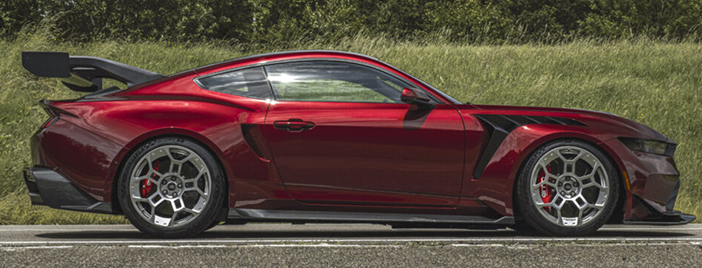
+++ The FORD MUSTANG GTD has lapped the Nürburgring Nordschleife in less than 7 minutes, making it the fastest American road car ever to have rounded the hallowed circuit. The new track-focused version of the venerable Mustang muscle car clocked a lap time of 6 minutes and 57.685 seconds around the full 20,6 km layout of the Nordschleife. That’s more than 2.2 seconds quicker than the 6 minutes and 59.93 seconds that Porsche managed with the outgoing 911 GT3 in September 2020. However, it is behind the 911 GT3 with the Manthey Racing Performance Kit (6 minutes and 55.737 seconds), the 911 GT3 RS (6 min and 49.328 seconds), the Mercedes-AMG GT Black Series (6 minutes and 48.047 seconds) and the previous-generation Porsche 911 GT2 RS modified by Manthey (6 minutes and 43.300 seconds). It’s also far behind the current road-car record-holder at the ‘Ring, the Mercedes-AMG One, which managed 6 minutes and 29.090 seconds. Ford said it would return to the circuit next year in an attempt to better the GTD’s time, no doubt foreseeing a retort by Porsche with the recently unveiled update for the 911 GT3. The GTD is the most extreme Mustang yet. The 5.0-litre V8 used in the Mustang Dark Horse has been upsized to 5.2 litres, boosting its output from 500 hp to 815 hp. That makes it more powerful than even the Ford GT, a bona-fide homologation special for the Le Mans 24 Hours. The GTD’s powertrain also packs a suite of motorsport-derived modifications, including dry-sump lubrication, an active-valve exhaust system and a carbonfibre driveshaft. The chassis, too, is radically different from the regular Mustang GT’s. It uses an unequal-length double-wishbone suspension design up front, as well as active dampers sourced from engineering giant Multimatic. This means the GTD sits 40 mm lower than the reguar Mustang GT in its road setting, and its track is nearly 100 mm wider to boot. Extra stopping power is provided by Brembo carbon-ceramic disc brakes, engineered to resist fade under the repeated high loads experienced in track use. Completing the package is an aggressive bodykit inspired by that on the Mustang GT3 race car, with steroidal wheel-arch extensions, air ducts for the engine and rear brakes plus a huge rear spoiler. The Mustang GTD could be purchased by application only, and the window for bids closed on 19 July; a week after the car made its debut at the Goodwood Festival of Speed. Ford said it would sell the GTD globally, regardless of whether it acquires approval for it to be road-legal. That means, in some markets, it might be limited to track use only, although the brand hasn’t confirmed which (if any) regions are affected. Production of examples bound for Europe is due to begin in spring 2025. +++
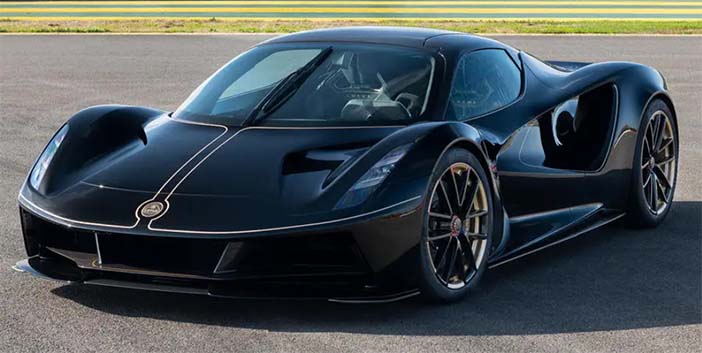
+++ LOTUS is under way with customer deliveries of its 2.050 hp Evija electric hypercar, roughly 4 years after originally planned. The brand’s halo car was revealed in mid-2019 and due to be with its first customers by the end of 2020. Shortly after its unveiling, though, Lotus pushed back deliveries to mid-2021 due to Covid-related development delays. It was only earlier this year, though, that the firm was ready to hand over the keys to the €2.8 million flagship’s first customer. The first example arrived with its owner in January, but it’s not yet confirmed how many have since been produced. Built alongside the Emira at Lotus’s historic Hethel HQ, the quad-motor Evija is one of the world’s quickest road cars, capable of getting from 0-300 kph in just 9.1 seconds and reaching a top speed of 350 kph. It was also originally claimed to be “the most powerful production car in the world”, with a target output of 2.000 hp, and that figure has since been revised to 2.050 hp, giving it an even greater edge over its 1.900 hp Rimac Nevera and Pininfarina Battista rivals. Lotus’s new European CEO, Dan Balmer, confirmed that the “Evija is now in handover mode”, attributing the 4-year delay to the global pandemic that arrived at around the point it was due to launch. “At a critical point in the project delivery, we hit Covid, and that effectively stopped any global testing on that car, and a lot of our supply base and technology partners in that car were affected by it as well, so that was critical”, Balmer told. He projected that Hethel will be producing the limited-run Evija for the next 2 years to “fulfil the demand from customers” but stopped short of confirming whether Lotus still plans to cap the build run at 130 units. Balmer said Lotus wasn’t alone in its hypercar development programme being impacted by Covid. “When you ‘re breaking the boundaries of technology, and this car in ‘X’ form was the third fastest car around the Nürburgring, you’re pushing the envelope as far as possible all the time, and when you’re doing that, there will be some unforeseens around the development of those vehicles”. “Other hypercar launches have had a similar timeframe. I was involved in one in 2016, and it’s only now coming to market 8 years later”, he continued, referencing the Valkyrie programme, which got under way while he was director of global marketing at Aston Martin. “Other well-resourced brands out there have had a challenging time in breaking the boundaries of what they’re trying to do as well”. Indeed, several recent hypercar programmes have been behind schedule: Mercedes-AMG delayed production of the One hybrid hypercar from 2019 to 2022, for example, and Rimac was a few months late launching the Nevera due to the pandemic. “The good news for our customers,” continued Balmer, “is that they’re able to enjoy those cars from now”. +++
+++ Abu Dhabi-based CYVN Holdings has agreed a deal to buy MCLAREN Automotive, with the promise of fresh cash injection for the British sports car maker. Bahrain’s sovereign wealth fund, Mumtalakat, which in April took full ownership of the McLaren Group (parent of the car firm and McLaren Racing), has confirmed a binding agreement has been reached with the ‘specialist investment vehicle’. The deal also includes a non-controlling stake in the McLaren Group. The 2 firms have been “exploring a potential partnership” since October, with CYVN promising to “drive McLaren’s growth trajectory and accelerate progress in the advanced mobility sector”. After finalising the purchase of McLaren’s sports car arm, CYVN Holdings can now be talked about in the same breath as Tata Motors, the Volkswagen Group and BMW when listing foreign firms that are investing in blue-chip British automotive brands. Unlike its peers, however, CYVN doesn’t exactly trigger the same name recognition. The deal was announced on 9 November in Abu Dhabi following McLaren Racing’s dramatic win at the country’s Formula 1 race at the weekend, sealing the constructors’ championship at the same time. +++
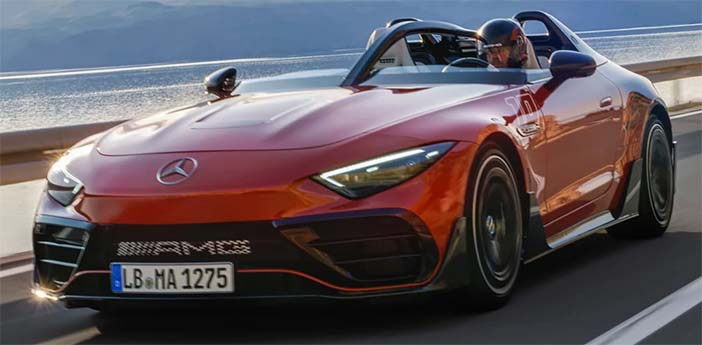
+++ MERCEDES-AMG has revealed the first of its new high-end Mythos models at the final F1 race of the 2024 season in Abu Dhabi. Called the AMG PureSpeed, the model is based on the SL 63 but comes with a range of bespoke elements, including a unique F1-inspired HALO that replaces the windscreen. No prices have been revealed, but the model will be limited to 250 units globally. Following a recent trend of windscreen-free specials like the Ferrari SP2 Monza and Aston Martin V12 Speedster, AMG’s version differs thanks to the use of a central spine that combines with two traditional roll-hoops to act as a rollover-protection structure. Made from a tubular steel structure mounted in the car’s scuttle, this doesn’t just improve the car’s safety credentials, but also draws direct inspiration from AMG’s F1 car. The PureSpeed also features a range of aero tweaks, both active and passive. Under the nose of the car is a new movable flap that helps suck the car to the road at high speeds, aided by the active rear wing found on standard SL models. There are also new underbody aero elements borrowed from the new AMG GT 63 Pro to direct cooling air to the brakes. Other external changes include a unique front-end design that swaps the traditional Panamericana grille for a lower front intake paired with a high-mounted black chrome three-pointed star. This sits above a carbon splitter with an aggressive pair of moulded end-plates. More end-plates can also be found on the unique side skirt and rear bumper designs. The 21 inch forged wheels are also new, and feature carbon-fibre aero deflectors with a more open design on the front axle so as not to restrict cooling of the standard-fit carbon ceramic brakes. The red-to-black livery is optional; other colours are available if customers so choose. Inside, there’s a bespoke 2-tone colour scheme of white and black Nappa leather, plus the inclusion of AMG’s bucket seats and a custom IWC watchface mounted on top of the dashboard. The PureSpeed shares much of its mechanical elements with the SL 63 Roadster. This means that it runs a 585 hp variant of AMG’s 4.0-litre twin-turbocharged V8 engine, powering all 4 wheels via a 9-speed wet-clutch automatic transmission. It also shares the semi-active anti-roll suspension system, plus rear-axle steering. AMG claims a 0-100 kph time of 3.6 seconds and a 310 kph top speed. +++
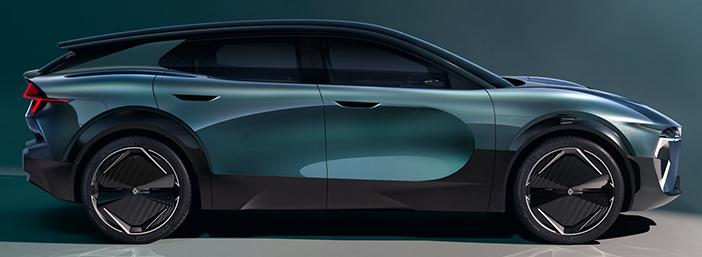
+++ The next-generation of RENAULT vehicles that will arrive starting in 2028 are set to eschew SUV design in favour of new body styles featuring “breakthrough concepts”, with new design language hinted at by the recent Embleme concept, according to the firm’s design chief. The French firm recently confirmed that it would launch a “new generation” of EV from 2028 onwards. They will sit on a new platform hinted at by the Embleme concept shown at the Paris motor show, and which are claimed to offer radical advances in efficiency and sustainability. But he also confirmed that the new Renault 5, 4 and Twingo models would retain their own distinctive designs in future. When it comes to the design of future models, Renault design boss Gilles Vidal said that “the big question is how to do you reinvent the next step in terms of concepts and silhouettes? What do they stand for? What are they for?” Vidal said that was being considered in response to “a lot of SUV bashing”, but noted that “people still want, and sometimes even need them. SUVs have replaced MPVs, more or less, and some people still buy them for practical reasons. “It makes you wonder what should we do that’s less questionable in terms of heritage, and more efficient, and therefore deserves a new kind of shape?” Vidal cited efforts to oppose SUVs in Paris, where authorities have introduced extra parking charges due to their size and weight. He noted: “there’s still a huge fight against SUVs on principal, but would you say the same thing about MPVs? They are the same weight, have the same engines, the same CO2 emissions. But no-one would ever criticise an MPV, a respectable family product. Who are we to criticise aggressive looking cars? It’s only a shape, you know, so can you critisize shapes and characters?” Regardless, Vidal said that, especially because “people will still need big cars”, the question was “what character do you give to those products? And beyond that, what are the next things? It seems like we’ve seen it all. The world invented the Espace and the Scenic, and big fat SUVs and then more respectable crossovers. Along with almost 140 years of automobile history it seems like we’ve seen it all – but surely there are new things to invent; new very meaningful concepts and silhouettes regarding society’s questions in today’s world”. The Embleme concept takes the form of a bold coupe-SUV. While a production version of it will likely arrive in a few years, Renault design boss Gilles Vidal said the concept is also a more accurate representation of its future line-up than its recent models inspired by its heritage. “The cars before the Embleme were maybe a bit misleading”, said Vidal, “because you see a 5, a 4, a Twingo. The 5 and 4 are retro-futuristic, and the Twingo never stopped production but we’re going back to the design cues of the first one. But that’s a big misleading because every design is specific to one car. We’ve done 3 of those in a row, so people ask ‘is this a new Renault thing or what?’ “The Embleme is a better representation of what’s next for the brand globally in terms of design, and maybe new silhouettes, for the future: generous shapes, not too minimalistic, but simpler than what we did lately on Scenic. “A lot of people in Europe are saying it’s a pity that estates and wagons are disappearing one by one, but for EVs having a low, streamlined, yet practical product is a very good idea. That’s exactly what we should be doing as a brand for EVs, for range, for autonomy, and so on. Yet you want them to be sexy. Sports wagons are kind of sexy. So how do we make desirable cars that are the clever thing to do in terms of dimensions, proportions and what it does for you as a user?” While the Embleme previews the future exterior design language, Vidal said that it is the earlier Scenic Vision concept that “contains a glimpse of the next-gen interior concepts for 2028”, adding “that’s when we’ll come with breakthrough concepts”. The focus for the interior of future Renault models will be on “simplification”, adding “the most important question is how do we reinvent interactions in screens in a revolutionary enough way so that it’s really a relief, a game changer, so that you’re like, ‘oh my god, it’s so simple’ ”. Despite the shift away from the design inspiration used for the 5, 4 and Twingo, Vidal confirmed that Renault still has long-term plans for this models, and they will continue to build on their current design language. “Those 3 little cars can be fairly timeless”, he said. “We’d don’t know what we will do 15 years from now, of course, but for sure in 7 years, more or less, it should be the end of the run of the current 5, and we should do a new one. But we shouldn’t do something different, because it would be weird to do something futuristic”. Vidal said that those cars would take an evolutionary approach with their basic design remaining the same. He cited the new Fiat 500; the revival of which was spearheded by now-Renault boss Luca de Meo as the approach Renault would take. “Instead of doing 3,5 years then a facelift, another 3,5 years, then a new one and so on, we can do something a bit like the 500: it’s been facelifted strongly, yet you recognise it all the time. It’s a clever thing to do with such a strong product. “It’s the same for us. We want to animate the life of those products quicker than the facelift, with collections, new liveries and trims, and freshen it up fairly often. At some point it will probably get a heavier redesign without losing the soul and the spirit, and in theory that could be fairly timeless”. +++
+++ STELLANTIS is confident about reaching the 2025 CO2 targets of the European Union as orders rise for the cheaper electric vehicles in its porffolio. The automaker has calculated that 24 percent of its new-car sales will have to be full electric in 2025 to meet the new rules, up from 11 percent through October. +++