
+++ CAR PRICES have already climbed out of reach for many Americans and now, thanks to Donald Trump, the search for a cheap car will get even tougher. The president’s levies on automobile imports has driven up costs across the industry, raising sticker prices by thousands of dollars. The effects is particularly pronounced at the low end of the market, since many of the least-expensive models from General Motors, Ford, Kia and Hyundai are built outside the US. Detroit’s automakers long ago abandoned much of the passenger car market in favor of the high-priced, oversized SUVs and pickups favored by suburban America. With the market for affordable cars that don’t guzzle gas poised to shrink even more, more working class Americans may find themselves in an automotive bind. +++
+++ The second phase of DACIA ’s strategy road map will be revealed in November, 4 years after the company revitalised its brand identity, according to CEO Denis Le Vot. Le Vot describes the new Bigster as the car that “closes the first chapter” of Dacia’s modern reinvention. That chapter began in 2021 with the third-generation Sandero, the first recipient of Dacia’s new design language, and in time the Jogger 7-seater and the latest Duster were spun off the same platform. Dacia will elaborate on this new phase after the summer, when “there will be a lot about electricity” as part of parent Renault Group’s new Futurama company strategy. Within the next 2 years, Dacia’s line-up will be bolstered by a pair of C-segment models and an €18.000 Renault Twingo-twinned car as part of a significant broadening of the Romanian marque’s portfolio. Development of that electric city car is already well under way and should arrive in the middle of next year, given its rapid, 16-month gestation process. Dacia is targeting a 100-week development window for all new cars. Asked whether Dacia might end up cannibalising Renault’s sales in the C-SUV segment, Le Vot said he was confident that, given the 3 million such cars sold in Europe every year, there was plenty of space for both brands. +++
+++ American president Donald Trump is proposing changes that are set to upend the automotive industry. He’s instructed federal agencies to revamp emissions regulations, revoked incentives for electric vehicles and proposed tariffs on imported cars. Some automakers, like HYUNDAI , are more immune to these changes than others. Its new CEO, José Muñoz, believes the company’s “localization strategy” will “help mitigate the impact of any potential policy change”. The company is heavily investing in its US production, injecting $12.6 billion into a Georgia factory that’ll soon build the Ioniq 5 and Ioniq 9 electric vehicles. It’ll also be able to build hybrid-powered vehicles there. Plus, the investment includes 2 joint battery ventures. Hyundai decided to invest in the US during Trump’s first presidential term, Muñoz said. Hyundai’s only other factory in America right now is in Alabama, where the company assembles the Santa Fe, Tucson and others. Despite its favorable position, it’s unlikely the automaker will avoid feeling some effect from the tariffs. Hyundai has many factories outside North America that could incur costs on several of its models. The president’s proposed tariffs on imported cars have automakers considering various options to mitigate their effects. Ford CEO Jim Farley predicts higher prices for consumers and job losses for workers. Audi is considering passing some of the added costs onto buyers. Meanwhile, BMW says it will “price protect” the 2 Series and 3 Series that it builds in Mexico for the foreseeable future. Hyundai is far less concerned right now. +++
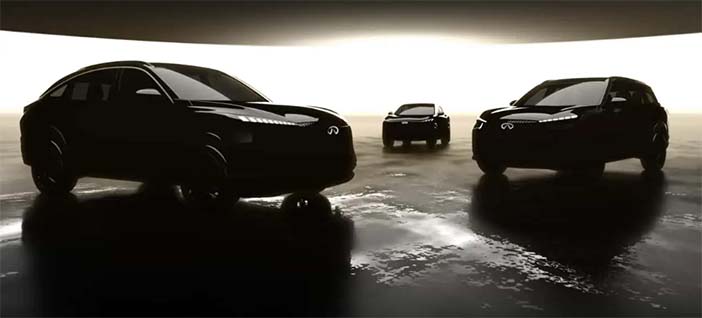
+++ INFINITI sales in the United States peaked in 2017 when Nissan’s luxury brand delivered 153.415 cars. Fast-forward to 2024, demand plummeted to 58.070 units, or 10.2 percent less than the year before. To put that number into perspective, Honda’s Acura brand moved 122.600 vehicles last year. Toyota’s Lexus outsold the 2 combined, delivering a whopping 345.669 cars. Although the numbers look bad, Nissan isn’t giving up on Infiniti. When Nissan previewed its vast product line-up this week, it didn’t neglect Infiniti. The intent is to distinguish the 2 brands further and expand the Infiniti portfolio with fresh products. The QX60 will be updated soon, and there will be a Sport package for the QX80. Not long after, a QX65 will join the crossover-coupe niche and take inspiration from the FX. A fully electric SUV derived from the Vision QXe concept will follow, and it will be made at the Canton, Mississippi factory. Speaking at the at the R&D center near Tokyo, Nissan Americas’ chief planning officer Ponz Pandikuthira made it crystal clear Infiniti is here to stay: “You don’t invest in a car like QX80 if you’re planning to walk away from Infiniti as a brand. Stay tuned for growth to the Infiniti portfolio”. The QX60 will be electrified, but without specifying whether through a plug-in hybrid powertrain or Nissan’s E-Power tech. The third-generation E-Power has only been confirmed for Nissan products: Qashqai, X-Trail (Rogue in the US) and a large MPV at home in Japan. As with the previous 2 iterations of E-Power, a gasoline engine will work as a generator to charge a battery. Developed specifically for this application, the new 1.5-liter unit won’t send power to the road. Instead, an electric motor will power the wheels, delivering EV-like behaviour. Nissan says the new E-Power is quieter and smoother while boosting fuel economy by 15 percent at higher speeds. Nissan wants to speed up new car development drastically. Based on the current modus operandi, it takes 55 months to engineer a new model, according to upcoming CEO Ivan Espinosa. For future Nissan and Infiniti models, the goal will be to finalize development in only 37 months. For derivatives, it’ll take 30 months to get the job done. The new boss says a greater focus on sharing platforms and designs will speed things up. The CEO admitted: “We are slow. This is one of the things we have to face”. Whether Infiniti has what it takes to bounce back remains to be seen, but it sure looks like Nissan is willing to make an effort. Predictably, SUVs lead the charge, although we’d like to see a production version of the swoopy Vision Qe sedan concept. +++
+++ The big-selling NISSAN QASHQAI benefited from a substantial mid-life facelift and tech boost in 2024, but later this year it will finally receive the next evolution of the Japanese brand’s unique ‘e-Power’ hybrid powertrain that we’re told will offer improvements in fuel economy, emissions and refinement. First introduced in 2022, the Qashqai e-Power is different from other hybrid SUVs because it uses its petrol engine solely to generate energy for a lithium-ion battery, which in turn powers the electric motor that actually drives the front wheels. The idea is that the system delivers a more EV-like driving experience, but without needing to plug the car in to charge. The latest version of Nissan’s e-Power hybrid technology will make its debut in the Qashqai this year, and will feature a new 1.5-litre petrol engine, plus a new electric drive unit that shares core components with the company’s latest EV powertrains. According to Nissan, the new Qashqai e-Power will feel even more like an electric car, as well as being more fuel efficient, including a 15 percent improvement at motorway speed compared to the current model. Meanwhile, reduced noise and vibration will improve refinement, and the power output should increase too. However the car’s price shouldn’t, because the new set-up is said to be 20 percent less expensive. Nissan’s president and CEO Makoto Uchida previously said the third-genERATOPM e-Power tech will allow the company to achieve cost parity between hybrid and pure-petrol cars by 2026. The updated Qashqai e-Power will be built at the brand’s plant in Sunderland, along with the new third-generation Nissan Leaf that’s now been revealed and is due to enter production before the end of the year. The next Nissan Juke, which is coming in 2026, will be built in the same plant. +++
+++ Ontario’s premier said he wants to “inflict as much pain as possible” on the U.S. The head of Europe’s auto supplier group said the decision to impose TAFIFFS “is misguided and harmful for everyone, including the U.S. itself”. The expected worldwide condemnation of president Donald Trump’s 25 percent tariffs on light-vehicle imports arrived loud and clear this morning. But even late last night, Trump’s message to the rest of the world was that he would not tolerate any coordinated retaliatory attacks on the U.S. economy. Trump, in a Truth Social post, said large-scale tariffs “far larger than currently planned” would be placed on collaborating nations in such a scenario. “If the European Union works with Canada in order to do economic harm to the USA, large scale Tariffs, far larger than currently planned, will be placed on them both in order to protect the best friend that each of those 2 countries has ever had!” Trump posted. Is all this a bluff designed to get more concessions? Trump previously threatened to double certain tariffs on Canada in response to Ontario’s plan to tax electricity exports to the U.S. Ontario backed off the next day. Meanwhile, few companies stand to benefit from the tariffs more than Tesla, which has almost zero exposure in the U.S. market. Elon Musk’s company, however, could face retaliation in Europe, China and Canada. Musk and Tesla also must grapple with the festering anger in the U.S. over his government efficiency efforts for Trump. We’ll know more about the impact on Tesla’s U.S. sales when the next batch of registration figures comes out. From Georgia, Hyundai CEO Jose Muñoz told reporters on Wednesday the company will remain flexible as it hustles to increase production capacity and strengthen its supply chain in the face of Trump’s tariffs. “We’ve been flexible before, we will be flexible now”, Muñoz said. Hyundai’s Korean parent, thr Hyundai Motor Group, won points earlier this week with Trump with plans for $21 billion in new U.S. investments. It’s a good bet that this looming trade war between the U.S. and its allies will get worse before it gets better. +++
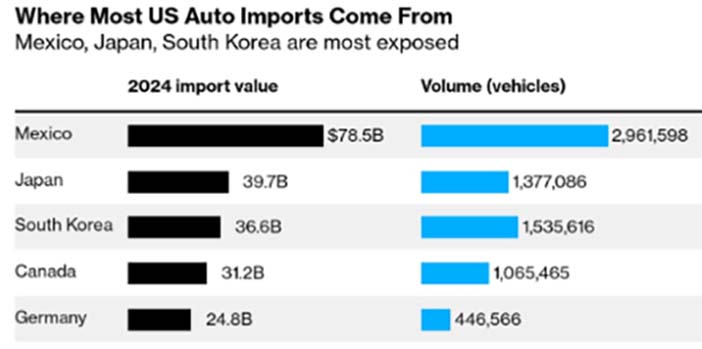
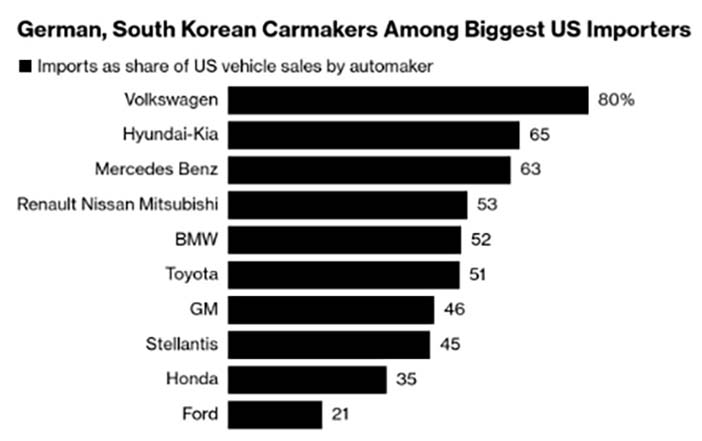
+++ One winner stands out in the wreckage of Trump’s planned tariffs on auto imports: Elon Musk’s TESLA . The EV maker has factories in Texas and California that churn out all the cars it sells in the US, insulating it to a greater degree from new levies on auto imports and key components. Ford may also face a less-severe impact than some rivals, with about 80% of the cars it sells in the United States being built domestically. “Consumers will be losers because they will have reduced choice and higher prices”, said AutoForecast Solutions’ Sam Fiorani. +++
+++ Having joined Toyota in 1984, Akio TOYODA likely knows the ins and outs of the automotive industry better than anyone. As CEO for over a decade before stepping down in 2023 to become chairman of the board, he played a crucial role in Toyota’s rise to global dominance. In 2024, the Japanese company, founded by his grandfather Kiichiro, was the world’s largest automaker for the fifth consecutive year. At 68, Toyoda is more than qualified to speak on what works and what doesn’t in the industry. In an interview, the veteran provided insight into the failed merger between Honda and Nissan. At the joint press conference held on December 23, which also included Mitsubishi, the parties involved didn’t mention what Toyoda believes is the most important: cars. “At the press conference afterwards, I was disappointed hearing what they talked about. Because they didn’t talk at all about the products”. Instead, the memorandum of understanding between Nissan and Honda was filled with buzzwords like “synergies” and “business integration”, aiming to evolve Japan’s industrial base into a “leading global mobility company”. To be fair, the MoU did mention plans to standardize vehicle platforms and share models between the 2 automakers, but without any specific details. Nissan has already addressed the absence of product talk during the press conference. Earlier this week, the company unveiled a comprehensive product roadmap, showcasing the fully electric new Leaf and Micra while teasing several upcoming models. A new Sentra sedan and an expanded Infiniti line-up are on the horizon. Circling back to the cancelled Honda-Nissan merger, Toyoda also cast doubt on the benefits of the merger had the deal gone through: “Do you know an example of where there was a consolidation of companies and they’ve made a big success for the competitiveness? Just having volume doesn’t necessarily mean that you’re strong. Short term, you may see some positive impacts. But long term, it can be quite difficult to come to a state where everyone says they’re glad they’ve combined”. One of the biggest issues that caused the deal to fall through just 2 months after the announcement was Honda’s desire to turn Nissan into a subsidiary rather than creating a merger of equals. One could argue that consolidating multiple brands largely worked out for its biggest rival, the Volkswagen Group. It’s still early days for Stellantis, but teething troubles are evident, especially following CEO Carlos Tavares’ sudden resignation. Toyota is no stranger to featuring multiple brands under its corporate umbrella, having turned Daihatsu into a wholly owned subsidiary in 2016. It also owns Lexus, which it founded in 1989. Moreover, commercial vehicle maker Hino became a Toyota subsidiary in 2001. Additionally, Toyota has alliances with several domestic automakers. In 2024, it joined forces with Mazda and Subaru to develop more efficient and electrified combustion engines. The world’s largest automaker has a 20-percent share in Subaru, a 5.1-percent slice of Mazda, a 4.9-percent stake in Suzuki, and also owns 4.9 percent of Isuzu. Toyoda points out that volume can be both a blessing and a curse. He should know, as Toyota sold 10.821.480 units in 2024, including deliveries from its Lexus, Daihatsu and Hino subsidiaries. The company remained the undisputed leader despite a 3.7 percent decline compared to the previous year. However, managing production and sales at a scale of 10 million cars annually “becomes really troublesome”. +++
+++ President TRUMP recently introduced a 25 percent tariff on all foreign-built cars. That means any vehicles assembled outside the US could see a price hike Stateside, including those built in Canada and Mexico. Even foreign-made parts for vehicles assembled in the US will be subject to the tariff, according to a statement issued by the White House. “If you build your car in the US, there’s no tariff”, president Trump said. The tariffs will take effect beginning on April 3, and President Trump suggests they could be “permanent”.
The question is: Which vehicles and brands could benefit from these new tariffs the most, and which ones may be hit the hardest? Revisiting the Kogod School of Business’s 2024 American-made index, Tesla should benefit the most from these new tariffs. Each of Tesla’s vehicles achieves higher than 80 percent in total domestic content. The Model 3 Performance sits at the top of the list, with 87.5 percent of its manufacturing and construction done domestically. The Model Y (85 percent), Cybertruck (82.5 percent), Model S (80 percent), and Model X (80 percent) are also atop the index. That said, Tesla CEO Elon Musk suggests the company will not go “unscathed” under the new tariffs. In a post on X (formerly Twitter), Musk said: “Important to note that Tesla is NOT unscathed here. The tariff impact on Tesla is still significant”. Even though the company produces motors and batteries here in the US, Tesla still imports many parts from China. Not including its American-made motors and batteries, the Model 3 Long Range otherwise “has 40 percent Chinese content”, American University associate professor of information technology and analytics, Frank DuBois, told last year. Second only to Tesla is Ford, with 3 versions of the Mustang using 80 percent domestic parts in its construction: the automatic transmission model, the GT and the GT Premium. The Mustang with a manual (supplied by Getrag in Germany) uses just 73 percent domestic parts by comparison. Honda also ranks highly with the Passport (76.5 percent), as well as the Odyssey, Ridgeline, and Pilot, which all score at 74 percent. The Jeep Wrangler uses 76 percent domestic parts. The Volkswagen ID.4 uses 75.5 domestic parts. Meanwhile, GM’s Chevrolet Colorado and GMC Canyon both score 75.5 percent. Of the Big Three Detroit automakers, GM is the “worst positioned” under Trump’s new tariffs, according to JPMorgan analyst Ryan Brinkman. With nearly 40 percent of GM’s cars produced in Canada or Mexico, Brinkman estimates that the company could face a $14 billion hit in earnings. That said, the White House has acknowledged that vehicles produced under the United States-Mexico-Canada Agreement (USMCA) will receive special considerations. Specifically, parts produced under USMCA won’t be subject to tariffs until the Commerce Secretary establishes a process for non-US content. On the opposite end of the spectrum, some foreign automakers could see a major hit to their US business under the new tariffs. Brands like Audi, BMW, Lexus, Mazda and Toyota produce multiple models that rank near the bottom of the American-made index. Specifically, some of my favourite affordable sports cars could be hit the hardest. The MX-5, the Subaru BRZ, the Toyota GR86 and the GR Corolla score just 1 percent on the American-made index. Multiple BMW performance models also rank at just 1 percent, like the M3 sedan, the Z4 and the outgoing M8. With automobiles making up 28.3 percent of all Japanese exports to the US in 2024, those automakers could be hit the hardest by the new tariffs. Japanese Prime Minister Shigeru Ishiba says they will put “all options on the table” in combating Trump’s tariffs. “Japan is a country that is making the largest amount of investment to the United States, so we wonder if it makes sense for (Washington) to apply uniform tariffs to all countries. That is a point we’ve been making and will continue to do so”, Ishiba said in a statement to parliament.
Trump’s 25 percent tariff is likely to increase prices on imported cars. But former vice chairman of Product Development at GM, Bob Lutz, says these more stringent regulations on auto imports are a long time coming. “The tariffs Trump is putting into effect merely mirror the ones our major trading partners have had in effect for decades”, Lutz told. “There is no doubt that the duties will increase the price of non-US cars, and will result in a decline in their sales volume. That’s the purpose of tariffs”. Currently, the European Union imposes a 10 percent tariff on US-imported cars, with another 20 percent in additional Value-Added Tax (VAT). Although recently, the EU has proposed lowering that number from 10 percent to 2.5 percent in an effort to ease trade tensions with the US, according to some reports. “The US needs to protect its remaining industry”. Lutz notes, “just like all other nations do. Tariff-free imports mean low consumer prices, but also, loss of manufacturing jobs, which inevitably leads to national decline. These tariffs will cause some short-term pain and dislocation, but the adjustment will be relatively rapid and to the benefit of global trade. The US living, year after year, with astronomical trade deficits versus main trading partners is not a sustainable situation”. +++
+++ The Nürburgring has reopened for the 2025 season, which means manufacturers are back at the fabled German race track testing new and upcoming vehicles. One of the more peculiar vehicles spotted in Thursday’s industry pool session was a VOLKSWAGEN GOLF R . What makes me curious are the black fender flares and the raised ride height, something you don’t see on any Golf offered for sale today. The car is also rocking a funky fuel-filler neck that bulges out of the bodywork. Could Volkswagen be working on a safari-style, rally-inspired version of the Golf R? It’s possible. Given the popularity of such cars in recent memory (911 Dakar, Mustang Mach-E Rally, Huracán Sterrato to name a few), I wouldn’t be entirely surprised. But it’s equally possible this Golf R could be a test mule for any number of chassis, drivetrain, or suspension parts. Hell, it might not even be owned by Volkswagen. There are a host of suppliers that use the Nürburgring to test parts for upcoming models, using mules like this for test beds. The Golf at the Nürburgring could also be the test bed for an entirely new car from Volkswagen. Manufacturers have occasionally used the bodies of old or current models to mask new architectures during testing. Rolls-Royce famously used a Phantom as the testbed for its Cullinan SUV, back when that vehicle was under development. Since Volkswagen won’t tell me what’s going on with this Golf, I’ll just have to keep guessing. +++