
+++ AUDI is preparing a dramatic return for the R8 as a plug-in hybrid supercar that, in its most extreme form, could become the brand’s most powerful and fastest roadgoing model to date. The new R8 is slated for a debut in late 2027. Development of the Mercedes-AMG GT and Porsche 911 rival has progressed beyond the feasibility stage and engineering is under way with the backing of Audi chairman Gernot Döllner. The new 2-seater will be twinned with the Lamborghini Temerario, reigniting Audi’s supercar alliance with its Italian Volkswagen Group sibling. This partnership was forged in 2006 with the launch of the original R8 and its mechanical twin, the Gallardo; a move that allowed Audi to step up into the supercar ranks for the first time. The collaboration was renewed in 2015 for the second-generation R8 and Huracán. Across its first 2 generations, from 2007 to 2023, a total of 44.418 units of the R8 were sold globally. A similar approach has been taken for the third-generation R8. The new Audi supercar is expected to use the drivetrain, key structural elements, electronics and chassis of the Temerario, the successor to the Huracán launched last year. Audi will again differentiate the R8 from its Lamborghini sibling with a focus on everyday usability. Both coupé and cabriolet bodystyles are likely. The resurrected Audi R8 will draw power from Lamborghini’s twin-turbocharged 4.0-litre V8. The flat-plane-crank unit produces 800 hp and 700 Nm, boosted to 920 hp by a trio of axial-flux electric motors. These are powered by a rechargeable 3.8 kWh lithium ion battery, which offers up to 10 kilometers of electric-only driving. In the Temerario, 2 motors are mounted on the front axle to create a 4-wheeldrive set-up. The third motor is positioned between the V8 and an 8-speed dual-clutch automatic gearbox to act as a starter-generator and recover energy under braking. The return of the R8 in 2027 is set to coincide with the launch of more powerful Temerario models. This means a possible successor to the R8 Performance could conceivably push the supercar’s top-end output close to 1.000 hp. With this power, it will target a 0-100 kph time well below 3.0 seconds and a top speed close to the Temerario’s official 335 kph, potentially making it the most powerful and fastest road-going Audi to date. Currently, this is the 925 hp e-Tron GT RS, with the EV able to dispatch 0-100 kph in 3.3 seconds. This new drivetrain marks a significant shift in philosophy for the R8, which has exclusively used naturally aspirated V8 and V10 power since its 2006 debut. However, the highly strung nature of Lamborghini’s new V8 engine (which develops its peak power between 9.000 rpm and 9.750 rpm and has a 10.000 rpm redline) will provide a similar response and sound to the powerplants of its predecessors. The adoption of plug-in hybrid technology will also allow the R8 to act as a showcase for Audi’s electrification efforts, aligning with recent moves by Mercedes-AMG and Porsche with the GT and 911 respectively. As such, the R8 e-Tron name is being considered. The basis for the new Audi flagship is the same aluminium spaceframe structure used by the Temerario. A completely new development, it uses 50% fewer components than the earlier Huracán and second-generation R8, along with an 80% reduction in welds. It is also claimed to bring a 25% increase in stiffness over the older spaceframe. As with its predecessors, the R8 will serve as a statement of design direction for the brand. The PB18 e-Tron concept, unveiled in 2019, hinted at Audi’s vision for an all-electric successor to its flagship supercar. However, the brand’s design team has undergone significant change since then, with former Ford, Kia and JLR designer Massimo Frascella replacing Marc Lichte as chief creative officer in 2024. The decision to revive the R8 is reportedly down to an agreement reached between the Audi board and its Volkswagen Group parent on how the brand can transition to an all-electric line-up. It will now extend the model cycles of select petrol/diesel models and expand the number of plug-in hybrids that it offers. Another key factor is Audi’s push to develop FIA-homologated iterations of the new R8 to once again spearhead the brand’s involvement in key endurance events such as the Nürburgring 24 Hours. Production of the third-generation R8 is expected to take place at Audi’s Böllinger Höfe facility in Germany, the same site as its predecessors. +++
+++ GEELY has replaced Nissan in the affections of Renault as the 2 companies collaborate on more projects, most recently agreeing to build cars together in Brazil. “I see a lot of similarities in the way the 2 companies see the future of automotive”, Renault Group CEO Luca de Meo said on his company’s recent earnings call to investors. “It’s very natural. It’s actually, I have to say, probably more natural than the different views of Renault and Nissan have had historically”. Geely will take a stake in Renault’s Brazilian subsidiary with the goal of building cars at the French company’s Ayrton Senna Complex production plant in Curitiba and distributing its cars via the network of Renault dealers there. +++
+++ The electric 4-door GT that will spearhead an all-new era for JAGUAR will be revealed at the end of the year and go into production in the middle of 2026. In an exclusive meeting at Jaguar’s Gaydon headquarters, CEO Rawdon Glover said in a wide-ranging interview that the 1.000 hp GT is “right in the midst” of prototype testing on public roads, at JLR’s Gaydon proving ground and in the Arctic Circle as it gears up for launch. Glover said the focus so far has been on the new brand and the design for Jaguar but it will soon enter “a very different phase” where the company will talk more about the engineering, architecture and dynamics of the car. He expects to win over some of the more dissenting voices about the new Jaguar at this point as the brand looks to capture the essence of the best Jaguars from history in the way the new GT drives. To date, development has been “the complete opposite of how everything used to work”, according to Glover, with total unity between design and engineering to achieve such an extreme and radically different look, instead of designing around a platform or vice versa. Given the dramatic styling, proportions and sharp angles of the new Jaguars, as previewed by the Type 00 concept, careful consideration has been given to, for instance, crash testing and the aerodynamic performance needed to achieve a targeted 700 km of range for the 4-door GT in its most efficient form. “We’ve got some incredibly talented engineers who took that challenge on”, said Glover. “Their job is to maintain the design integrity and come up with something that meets all of the current stipulations for a vehicle (homologation, safety, whatever else) and to do so in a way that brings all of the very best of what a Jaguar should be as a driving car”. On the way the car drives, Glover said the chassis team took the greatest Jaguars of all time, “spent days driving the vehicles” and then looked at “what is it about them that is unique and is absolutely inherently Jaguar, and what can we take from this?”. The goal is not to create sports cars, but rather cars “you can drive confidently at pace for extended periods and still come out feeling great”. Glover has driven the range-topping 1.000 hp version of the new GT at Gaydon at speeds of up to 260 kph and it was the “most fun I’ve had” in his 2-year tenure as Jaguar boss. “It was stunning in terms of its speed, its acceleration, its performance, but also how it delivered the power with a real sense of character”, he said. “The chassis team are really excited about the possibilities of the vehicle”. The new GT will use electric motors and a battery pack common to other JLR models as “economically, there’s no way around that”, said Glover. “But I think the interesting tech and engineering stories are how we’ve actually engineered the vehicle and how we have been able to retain the looks while meeting crash and aero requirements”. As for how the design of the production car will compare with the Type 00 concept, people will “not be left scratching their heads” and “there is strong lineage” between the pair so that “people will not be disappointed”. The proportions, long bonnet, front face and rearlight graphic of the Type 00 are particular areas that will carry over to production. Glover said: “We did an analysis of the 2 side by side and we went through the cars internally and externally. I came out of that meeting thinking there are even more similarities between the 2 cars than actually when I came in”. On the interior, Glover said Jaguar won’t be “bombarding the driver with technology”. “Most importantly, it’s got to be an amazing place to be in. The technology is there when you need it”, he said. “Jaguar is not going to win by having the best technology. That’s not a strategy. “It’s a bit like the great watchmakers. Yes, there’s innovation in there but they don’t win by having tech. I think there’s an analogy there in terms of design, craftsmanship and engineering, and how things drive, rather than pure tech. I think we’ll probably leave that for the Chinese car makers”. Despite the likes of Aston Martin, Bentley, Mercedes-Benz, Porsche and Volvo all rowing back on EV plans, Glover said “there is no flexibility” in the plan to do anything other than full EVs. All new Jaguars will be built on the EV-bespoke Jaguar Electric Architecture (JEA), with no future compatibility for hybrids. “We made the decision back in 2021 to have an electric architecture dedicated to us”, said Glover. “There isn’t the opportunity to put a V8 into it or something else. We’re committed to being electric”. Glover believes “EV will be the right platform for us and the powertrain of choice” in the industry long term. The JEA will take Jaguar deep into the 2030s and “a lot of things will change” by then around reactions to range and charging, said Glover. “Advancements in technology and infrastructure are going to make a big difference”. EV design will also get more interesting to help boost their appeal, believes Glover. Most of today’s EVs are designed to deliver range by featuring short bonnets, small wheels and cab-forward proportions and “you end up with perhaps not the most exciting or emotionally engaging” cars. “Probably more than anything, what we need to do is produce a vehicle that people think is a great car that I really want to own from a brand that I like. The powertrain should be a secondary thing”, he said. The GT will be followed by at least 2 more models, which are understood to be a large luxury saloon and an SUV. All will have the same design language and “exuberant” proportions and be built at Solihull. Glover said Jaguar has chosen to launch the GT first “as it is going to position the brand most clearly” in its new upmarket home and it is closest to the Type 00 concept that Jaguar has used to preview the brand. Glover said: “The GT’s job is to say: Jaguar is here and can command a price in excess of €120.000, because the product concept and the brand is capable of doing that. The other vehicles do different things in terms of accessing a slightly broader audience, slightly greater volume, or whatever else. They have different roles”. The starting price for the new range of models will be around €120.000 and Glover said the new Jaguars are unlikely to be the only car on a customer’s driveway. “In that context, it will be a case of ‘what car do I want for the trip I’m making today?’. Our most important job is to make a car that’s desirable, resonates with people and elicits an emotional reaction. Nobody needs a €120.000 car. You’ve got to want one”, he added. The price will not be lowered over time, as it “is not the strategy to go in at a price point and stretch the brand down. If you get a really, really compelling proposition with a uniquely crafted and designed vehicle, our price points are quite attainable”. Order books for the GT will open when it is unveiled and the car will go on a preview tour to potential customers. This will be a “very, very bespoke experience” and targeted at people who have expressed an interest in the concept car. +++
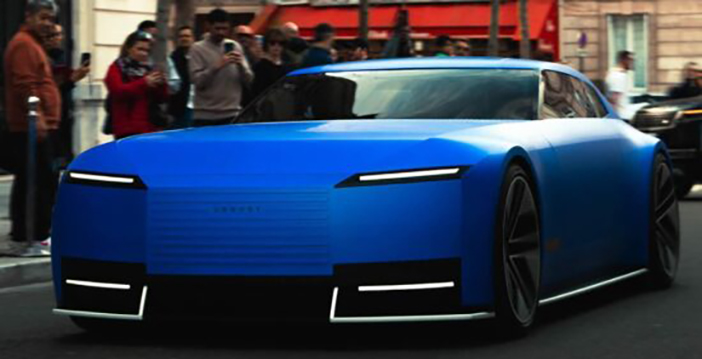
+++ LAMBORGHINI ’s first electric car, which is set to arrive before the end of the decade, could offer up to 2.000 hp, according to Volkswagen Group boss Oliver Blume. The Italian firm is currently developing its first EV, which is set to be based on the Lanzador 2+2 GT concept first shown in 2023. It will sit on a platform being honed for the Volkswagen Group’s performance and luxury brands. Asked about the Lamborghini EV at the Volkswagen Group’s annual media conference, Blume said it will benefit from the approach that the Volkswagen Group has with a joint electric kit that will benefit from synergies across brands. He added that the EV would use a platform that currently is being developed by Porsche for Audi, Bentley, Lamborghini and itself. “It will allow for up to 2.000 hp and 980 volts. It’s a very specific set-up for Lamborghini”. Lamborghini CEO Stephan Winkelmann had previously hinted that the firm’s first EV would offer “at least 1.360 hp”, citing a high power output as “one of the pillars” of an electric performance car. But he also hinted that driver feel and emotional engagement was more important. The prospect of a 980 Volt electrical architecture for future performance models from the Volkswagen Group marks another substantial step. Currently, most EVs use a 400 Volt architecture, although an increasing number use an 800 Volt system that allows for faster charging, greater power delivery and increased efficiency. Some Chinese cars, such as the Nio ET9, now use a 900 Volt architecture. Blume confirmed that the EV would be assembled at Lamborghini’s Sant‘Agata headquarters in Italy but wouldn’t comment on where the body or batteries would be produced. He added: “I promise that it will be a typical Lamborghini, something very emotional”. Blume’s comments follow recent assertions from Lamborghini boss Winkelmann that the brand has no plans to follow Aston Martin and Bentley in delaying its first EV but will keep its three new hybrid models on sale for as long as possible. In an interview late last year, Winkelmann said he was confident that the firm’s previously outlined electrification strategy was “the right one”, because when it comes to launching EVs, “it’s not about innovation, it’s about coming at the right time. When we decided to do the first step of our strategy, to have all the line-up new and hybridised, this was a big effort for the company”, he said. “For the last 4 years, we have worked very hard on this, and now we see that this was (you never know, but) the right decision. Therefore we think that to be very focused on a step-by-step approach on [electrification]was the right decision”. Winkelmann’s comments came after other low-volume car makers (including Aston Martin, Bentley and Ineos) pushed back their debut electric models in light of low demand for EVs. Lotus, meanwhile, has backtracked on plans to go all-electric and will launch a new range of range-extender hybrids, while Porsche is looking to extend the lifecycle of its current ICE cars in response to low EV uptake in the premium segment. Winkelmann said that because Lamborghini’s first EV is an all-new model, rather than a replacement for any current car, there is less risk of it impacting the company’s sales volumes, and it could even increase them. “We have enough time to decide if we need to accelerate or delay the introduction of the electric cars”, he said. “So far, we are not thinking about delaying anything: we said we want to have our first electric car by the end of this decade, and this is something which we will continue to foster, because we said it has to be an additional car – a fourth model. It’s an additional model (a new body style, a new type of car in general) so it’s also going to attract new customers to Lamborghini”. The company is therefore sticking to its plan to launch the production version of the Lanzador by 2030. Nonetheless, Winkelmann acknowledged that the curve of EV uptake is not “as steep as forecasted” and said this is “even more” true for the super-sports car segment in which Lamborghini operates, so the company’s strategy to “stay hybrid as long as possible is really the right one”. Following the launch of the Hurácan-replacing Temerario with a new electrified V8 engine, Lamborghini’s three existing model lines are now fully hybridised, and Winkelmann said the company won’t reverse its decision to go all-electrified, even if synthetic fuel proves a viable means of cleanly powering combustion engines in the future. “I don’t think that battery technology is going to step out of our cars, because at the end of the day, it is something which helps the performance, not inhibits performance”, he said. “And battery technology will evolve, and if we stay hybrid, this is going to help the performance of the cars even more”. The performance benefits of electrification are clearly helping Lamborghini’s customers to make the jump to hybrid power. The Revuelto, with its battery-assisted V12 engine, is sold out “well into 2026”, and the new Urus SE plug-in hybrid SUV is spoken for through to the end of 2025. With the Hurácan still in production, Winkelmann would not be drawn on a number of orders for the Temerario but said “we have a lot of interest and already a lot of orders”. Notably, while the Temerario is down 2 cylinders on its predecessor, it has a larger engine than its V6-engined rivals, the Ferrari 296, McLaren Artura and Maserati MC20, and Winkelmann suggested that size advantage, plus the attractive aural bonus of a 10.000 rpm redline, will be a significant selling point for Lamborghini’s new entry-level model. “When you buy a Lamborghini, it’s about the fulfilment of a dream or a childhood dream and therefore it’s a very emotional decision. And what we have to always be capable of doing is to have a balance between achieving the desire of our clients and, on the other hand, having a lasting business case for the company. We cannot do the things for just one year; it has to last over a decade, mainly. And therefore it’s very important that our engineers are clever enough to put together the thresholds of what the outer world is giving you with the desire of our clients”. +++
+++ “I have one of the most interesting jobs in the industry”, says Markus Schäfer with a smile, and even though he adds he’s “sometimes joking”, there’s absolute truth to his comment. His brief as chief technology officer of MERCEDES-BENZ is vast: He is responsible for overseeing the research and development of every car that carries the three-pointed star. “That ranges from Formula 1 responsibilities with Mercedes F1 power unit specialist High Performance Powertrains to overseeing the entire research and development side of Mercedes-Benz Cars, turning ideas into real products of the future”, he says. “That’s a unique combination”. And that isn’t even Schäfer’s only job. He sits on the Mercedes-Benz Group board and is also responsible for procurement. “I’m in charge of purchasing around 40 to 50 billion components, depending on the year, that go into cars”, he says. “It’s busy these days”. Those would be daunting briefs in any era, let alone one in which Mercedes offers one of the largest and most diverse line-ups in the industry in both model types and powertrains. And on top of that there is the swirling uncertainty of electrification and shifting sands of legislation. Schäfer admits it is “very, very challenging”. He adds: “We don’t have a crystal ball, but we’re trying to anticipate what’s happening in the world and react accordingly when developing technology for this iconic brand. But what makes me confident is that we have a unique combination of different entities that no other company has. “We have Formula 1 and motorsports. We have AMG, we have Maybach and we have Mercedes-Benz. And we have substantial funds to invest in research. That gives me the freedom to work with a great team to develop cars that do more than move you from A to B”. To use such breadth as an advantage, though, it has to be harnessed. Espousing technology transfer is easily done, but actually taking knowledge gleaned from building hybrid F1 powertrains in Brixworth, UK, and applying it to EVs being developed in Stuttgart isn’t easy. So how does Schäfer do it? “It sounds a bit cheesy, but I’m a great believer in creating a learning organisation”, he says. “I’ve spent more than 30 years in this business as an engineer, mostly in this company, and I’ve learned you need to create a network of people that work extremely close together: no silos, no hierarchy. “What we’re doing is bringing all these global people (from China, the US, Europe) together to work as one team. “You have to learn from each other and share ideas. With the F1 team, we’re learning a lot because their turnaround time is measured in hours. “They don’t have time after a crash if they need to change the chassis or figure out an engine problem. That’s how they work. So we can learn speed: chasing milliseconds, continuous improvement, getting better every race”. Schäfer cites the Mercedes EQXX, the ultra-efficient road-legal electric hypermiler built to prove that a battery-powered car could top 1.000 km on a single charge, as one example of that collaboration: “Its development was led by the way the F1 team pushes the limits. It’s way more than headlines, technology transfer, and it also works the other way round”. To illustrate that point, Schäfer says Mercedes-Benz Cars has aided the F1 team through “foundational and fundamental research” in areas such as “the basics of processes such as combustion”. He adds: “Another area is batteries. In 2026, half an F1 powertrain will be electric, and the research Mercedes has done in batteries will help the F1 team”. The acknowledgement that Mercedes is still refining its combustion engines while also developing a whole new generation of fast-evolving electric powertrains points to the massive challenge that car firms currently face. And as much as Schäfer highlights how much Mercedes invests in R&D, it ultimately still has finite resources. “These days, the future seems even more uncertain because of the number of fields you’re playing in on the mechanical and electromechanical side, on software and electronics”, he says. “And our playing field is the world: we’re a global company, so it’s China, it’s Europe, it’s the US, and customer preferences are not the same everywhere”. That can be seen in China’s love of extended-wheelbase saloons, and also screens. “They want bells and whistles on the digital side”, says Schäfer. “No buttons, only screens: give it to me. Conservative S-Class customers in Europe think differently”. That means “the differences between customers between regions are not converging: they’re getting bigger. So we have to develop different solutions. That doesn’t help efficiency, but successful products have to be tailored to the customer”. In recent years, of course, there has often been a divide between the cars customers want and the cars legislators want them to want. So flexibility is vital, as seen by Mercedes’ decision to pivot and offer the planned EV-only next-gen CLA with mild-hybrid powertrains as well. “We’re moving from a mechanical world of combustion engines to a world which is electric, digital and autonomous”, says Schäfer. “It’s happening at different speeds and being driven by regulations and geopolitics. We wish for stable regulations but this is not something we have. So the answer is flexibility. “The ultimate proof is the customer’s choice: in the end, the customer decides what to buy. So we have to tailor the right product for the right customers, and if we show the benefit of new technology, the customer will buy it. The end goal is clear for us: it’s the electric car, because it’s the most efficient way of transforming energy into movement, and a great tool for carbon reduction. “But you don’t have to force the customer: you have to convince the customer this is a great choice, because it’s a desirable car, it’s great aesthetics, it’s emotional and there’s a business case. The CLA can do 12kWh/100km so it can be a great economical benefit”. The CLA’s efficiency means that it will offer more than 650 km of range as an EV, which, notes Schäfer, is “a huge step for an entry-level car”. That efficiency has been hard-won: “3 years ago, I established an efficiency department that does nothing but drill into the last bits and bytes that impact the efficiency of a car. We’ve looked at wind resistance, aerodynamics, the rolling resistance of tyres and every moving part. We looked at heating and cooling, and at the electric motor. That’s driven us to develop our own motors, because we thought we can do better. So instead of having one gear, let’s have two gears to decouple in a four-wheel-drive car, so if you don’t need one motor, it’s intelligently switched off”. The CLA will be the first car on Mercedes’ new MMA platform, created for compact cars. The firm is also developing a new platform for medium-sized EVs and a bespoke performance architecture for future AMG models. But in an era when software is increasingly important, what exactly is a car platform these days? “In the era of EVs and autonomous cars, we have to rethink platforms and architectures because we’ve completely changed the way we create cars. In the old days, you’d start with a shell. Now you start from your operating system. “You start with software and electronics. You design the layout of your ECUs and how data is distributed around the car, which depends on the sensor set and actuators you have. This is the starting point: zone architecture, domain architecture, how many gigabits you want to transfer, how many teraflops the car needs to operate. Then how many cameras, radars and light pixels you need. We’ve made it modular so we have one software architecture, MB.OS, which we’ll see first with the MMA cars. It will be in every Mercedes car, van and AMG. We’ll scale it over two, three million cars. The second element of the platform is the powertrain: modular drivetrains, modular batteries, modular e-motors. And then, later on, you put a shell around it, a nice, beautiful aesthetic shell designed by Mercedes design chief Gorden Wagener. But that’s the last part”. Schäfer describes the shift of every future model to a single operating system as “a game-changer”, not least in how it has changed development. In the past, Mercedes would buy control units and chips from suppliers and then “put them together in a spaghetti diagram”. But now “we are the architects” defining the entire layout. In turn, that means Mercedes can more rapidly achieve “very, very big scale” with reduced complexity and (a bonus for the guy in charge of procurement) with “better supply chain resilience”. It’s a big step, though, and rivals such as the Volkswagen Group and Volvo have struggled with making the transition to software-defined vehicles. Schäfer says that success for Mercedes will come back to culture: “We have software and hardware people sitting next to each other, because a car is a super-integrated product. We’ve brought in lots of people from the software industry who have different methods of working, and with our culture of working together, we have absolute respect in implementing that”. There’s another aspect to the challenge as well: while Mercedes is breaking in to new technology, it still has more than 130 years of heritage to live up to. This is the firm, after all, that pioneered the combustion engine. “There’s a foundation this brand is carried on that should not change”, says Schäfer. “There’s fundamental pillars, trust in the brand. A Mercedes is always known for quality. Safety is a key pillar for us, which will never change, and so is desirability. It’s the aesthetics, beautiful proportions, details, craftsmanship. And it’s always been about technology. We’ll never give up the core elements that created one of the most valuable brands in the world”. +++
+++ The STELLANTIS management fence-mending efforts are underway following the December departure of CEO Carlos Tavares, but faced with new tariffs and other major North American headwinds, the automaker is also making a refreshing change back to regional leadership. Stellantis North America purchasing chief Marlo Vitous emphasized at a recent supplier gathering that regional decision- making has resumed. This also signals stability for the Stellantis North American headquarters in suburban Detroit, which has faced an uncertain future since the Covid-19 pandemic. Per a memo sent in January, Stellantis employees are required to be in the office 3 to 5 days per week beginning March 3. As for repairing strained relations with suppliers, Vitous said those looking for pricing relief must come with documentation and be willing to enter a 3-year cost savings plan with the automaker. By the way, Stellantis and Volkswagen are the European automakers most highly exposed to the new tariffs on vehicles imported from Mexico and Canada, according to Bloomberg Intelligence, which says the levies could wipe out €5.88 billion of European automakers’ earnings this year. Assuming no mitigating measures are implemented, €3.44 billion of Stellantis and €1.77 billion of Volkswagen earnings are at risk, a Bloomberg analyst estimated. +++
+++ In the UNITED STATES , car owners are missing their monthly payments at the highest rate in more than 30 years. In January, the share of subprime auto borrowers at least 60 days past due on their loans rose to 6.56%, the most since the data collection began in 1994, according to Fitch Ratings. A slowing economy and the ongoing impacts of residual inflation have made it harder for many consumers to stay current on their bills. Auto loans have been a particular pain point, with higher car prices and elevated borrowing costs driving a surge in repossessions. +++
+++ The next-generation VOLKSWAGEN GOLF , due in around 2028, will be one of the first cars to benefit from the full potential of the firm’s new software system, developed in a joint venture with EV start-up Rivian. The 9th generation car, set to be called ID.Golf, is currently in development and will be the first to be fully electric. It’s set to be one of the first models to use the Volkswagen Group’s next-generation SSP EV platform. It will be sold alongside the existing combustion-engined Mk8 Golf, with production of that model moving from Germany to Mexico in 2027. Last year, the Volkswagen Group invested £4.6 billion into American firm Rivian to form a new joint venture dedicated to developing an advanced new software architecture. Built on the system currently used in Rivian’s R1T pick-up and R1S SUV, the flexible new architecture controls all the key functions of the vehicle and allows for over-the-air updates that can even be used to adjust hardware settings. The production version of the new €20.000 ID.Every1 city car concept (which will be built in Portugal) will be the first Volkswagen model to use a version of the new Rivian-derived software platform when it’s launched in 2027. The switch to a software-driven vehicle architecture will help to reduce development and production costs for the price-sensitive car, but Volkswagen technical chief Kai Grünitz hinted that the decision was in part made to help develop the architecture for the crucial Mk9 Golf. “The ID.Every1 will be the very first vehicle with that architecture and will be the frontrunner on our side for the ID.Golf”, said Grünitz. “This reduces the risk for the Golf, because we will start with lower functionality in the ID.Every1 than will be necessary for the ID.Golf”. The new software system being developed by the Rivian-Volkswagen joint venture is termed a zonal architecture, with all the software systems consolidated onto a handful of electronic control units, rather than all running on numerous separate control units, as is the case with current vehicles. Grünitz said that will enable Volkswagen to offer different levels of functions in different types of vehicles using the same software system. “The benefit of the zonal architecture is that I can put one, two or three zones in a vehicle”, said Grünitz. “Vehicles in lower price segments will just need one zone, while a premium vehicle might need three or four, depending on functions. I can use a dedicated System-on-Chip (SoC) family for each model. So for the ID.Every1, I can use an SoC with a lower price point and complexity, but if I take the same architecture over to the ID.Golf, I can use a different SoC that costs more money but gives additional functions. But it’s still the same software. The benefit of this new software and architecture is that it’s highly flexible and highly updatable. We see it already on the road with Rivian today (which offers regular over-the-air updates and new functions). I can offer new functions to customers even after they have bought their car without touching them. So this is really the next step”. The switch to the new SSP platform will mean the ID.Golf will use an 800 Volt electrical architecture, offering substantially faster charging times and greater efficiency than current ID models. It will also offer more autonomous driving functions and gain GTI and R sports variants. The ID.Golf will also be one of the first EVs to use Volkswagen’s new unified battery cells, which have been designed to be fitted to around 80% of the Volkswagen Group’s future models and can be used to house a range of different battery chemistries and technologies. The cells allow for a cell-to-pack design, which allows more cells to be fitted into the same space, allowing for greater capacity and efficiency. Switching to a unifed cell design (which the Volkswagen Group will produce itself) will also boost economies of scale. Volkswagen has yet to confirm further details of the ID.Golf, but design chief Andreas Mindt did confirm that his team is working on the model. “I was involved in the design of the Golf Mk6 and Mk7, and right now I’m deep into the story of the ID.Golf” he said. “I see a lot of chances for a future and a lot of good things that can happen to it. The Golf is a special thing within Volkswagen, and you have to stay true to the Golf. It’s a brand on its own, but you can play with this. There’s so much nice content you can use, but I cannot say more now”. The ID.Every1 concept and the ID 2All concept, which will arrive in production form next year, both showcase a new design language that draws deeply on Volkswagen’s long heritage. As a result, it’s likely that the ID.Golf will retain many of the key styling features of the existing version. The new ID.Golf will be manufactured alongside a closely related SSP-based model (probably the ID.Tiguan) at Volkswagen’s main factory in Wolfsburg. As part of a major cost-reduction plan that will involve significant job cuts, the Volkswagen Group is revamping much of its production plans in Germany. That will include production of the existing ICE Mk8 Golf moving from Wolfsburg to the company’s plant in Puebla, Mexico. Even if it will be replaced by a new electric Golf, that will mark a significant transition, because ICE Golfs have been produced in Wolfsburg since the original model arrived in 1974. Notably, Volkswagen has hinted that the sale of existing ICE and hybrid models could be extended for as long as there is customer demand. The Golf’s predecessor, the Beetle, was also produced in Mexico, with the final version coming off production lines there in 2003, nearly 30 years after production at Wolfsburg was discontinued. Puebla currently builds the Jetta, the Tiguan LWB and the Taos (a SUV) models. Speaking during the Volkswagen Group’s annual media conference, group boss Oliver Blume said that while EVs remains the company’s ultimate focus, the speed of transition would “depend on global regions”. He added that the Group had “an entrepreneurial obligation to have a broad spread [of powertrains]that offered higher robustness” and, while he predicted that Europe could be EV-only by 2035, there was a need for “flexibility”. As part of the factory reshuffle, production of the ID.3 and Cupra Born will also move to Wolfsburg, which will switch to 2 production lines rather than the 4 currently in use. +++