
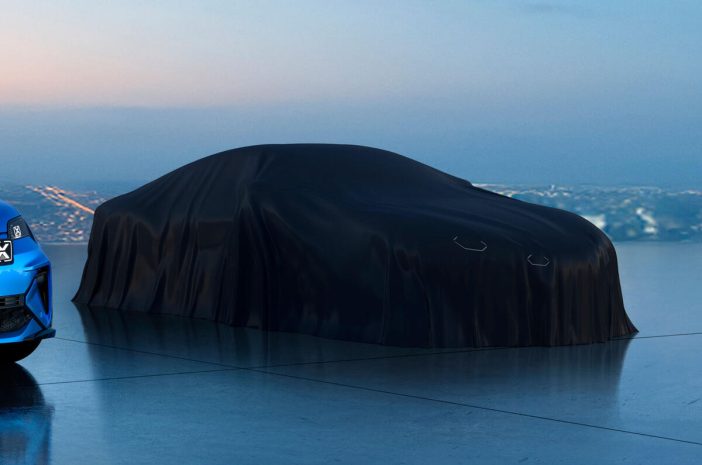
+++ ALPINE has released the first preview image of the next-generation A110, due next year. The new car, which will replace the current model’s petrol engine with a battery-electric drivetrain, appears to have a similar cab-forward design, but swaps circular daytime-running lights for a new hexagonal motif. Little else can be drawn from the image of the car under wraps, but it is possible that it features a small ducktail rear spoiler for aerodynamic purposes. Indeed, efficiency will almost certainly become a key directive with the swap to electric power. The new car will also be lighter than its combustion-engined rivals, despite the switch to EV. Renault Group CEO Luca de Meo previously told that the company had made a “not rational” decision to “invest a lot of money” in a bespoke electric sports car platform for the next A110 and its derivatives (including a likely 2+2 version called the A310) but it had “looked at Porsche for inspiration” in how to successfully build a sports brand. “Porsche has the 911 platform as their own and then they use others (Volkswagen Group architectures) for the likes of the Taycan and Cayenne. You keep the heart then as very true to the brand”, he said. To that end, the Alpine sports car platform will be uncompromising in its purpose to root the French brand in performance models, which then lends credibility to its more lifestyle-focused mainstream models, such as the new A390. “The next A110 will be lighter than a comparable car with a combustion engine but with no compromise in performance”, said De Meo. He added that making the bespoke architecture was objectively “a stupid decision” due to the likely return on investment in pure sales terms. A planned tie-up with Lotus on the architecture fell through but Alpine places such importance on bona fide sports cars that it has continued development by itself. Alpine has experimented with lightweight electric models previously, such as with the A110 E-ternité concept, an electric conversion of the current A110 that just undercut the Porsche 718 Boxster at 1.400 kg. The electric A110’s design will be only subtly evolved from the current car, de Meo suggested. It “needs to look like” an A110, he said. “Porsche doesn’t make a square 911”. More broadly, De Meo said “6 or 7” uniquely positioned models would make up the Alpine range, including “some emotional pure sports cars”. 18 months ago, the brand said its intention was to launch 7 models by 2030, starting with the new A290 hot hatchback. The dealer network will expand to around 140 globally by the end of the year as Alpine looks to break itself out of France and it has established a new flagship facility in Barcelona that also includes e-sports and sim racing areas, as well as a bar and restaurant. This format will also be introduced in London and Paris. Krief confirmed that the current A110 will end production in 2026, when a small-series exemption for GSR2 regulations ends. Some 95% of the A110 R Ultime’s production run of 110 units were sold within 2 months of its unveiling at the Paris motor show. +++
+++ Another legacy brand is about to leave the Chinese market. Former auto giant SAIC-GM, the Sino-American joint venture, is facing a shrinking market share and is preparing to make “strategic adjustments” to its 3 brands ( Chevrolet, Buick, Cadillac) in China to stop losses. CHEVROLET sales have declined for 6 consecutive years in China. In 2018, it sold over 640.000 cars in China, while in 2023, it sold only 168.588 units, according to data monitored by China EV DataTracker. But that was not a bottom: 2024 hit Chevrolet hard as it had a record-breaking sales drop of 68.7% to 52.774 cars. And that still might not be the bottom. In 2025 so far (January – April), Chevrolet sold 5.314 cars, down 75.9% from the same period last year. That is an average of 1,300 vehicles per month, with the Chevrolet Monza being responsible for 80% of sales. That is down 97.6% from the average of 54.300 vehicles monthly in 2018. All Chevrolet projects that are not SORP (Start of Regular Production) have been delayed indefinitely (read = cancelled), including models internally codenamed C223, C1YC-2 and D2UC-2 ICE. All the products in mass production will soon reach EOP (End of Production). C223 was supposed to be an all-electric SUV (Trail EV), the C1YC-2 is a flagship SUV and D2UC-2 ICE is a new Chevrolet TrailBlazer codename. All those China-adjusted models were ready to be released to the Chinese market by the end of 2023, however, due to Chevrolet’s problems in China, they were not launched and project eventually died. +++
+++ CHINA has recently gained a reputation for offering significant electric vehicle (EV) subsidies, and new figures from April show that the country’s discounts reached a record high of 16.8%, up 0.3% from March. While EV discounts are welcomed among drivers, the offers don’t appear sustainable, given that few of China’s EV makers are profitable. There are around 50 active EV makers in China, the most out of any nation globally. However, only 3 Chinese EV makers are currently profitable: BYD, Seres and Li Auto. BYD is the world’s largest automaker, Li Auto is Tesla’s closest rival on mainland China and Seres builds AITO-brand intelligent vehicles. AITO vehicles are all-electric and hybrid vehicles with advanced driver assist systems leveraging technology such as LiDAR, HD cameras, ultrasonic radars, and more. Last year, the difference between an EV’s selling price and an automaker’s production cost dropped from around 20% four years ago to 10%. Phate Zhang said: “Nearly all of them were the victims of price competition. But if any of them chooses to exit the price war, their sales will decline and make it more difficult to post a net income”. The China Passenger Car Association reported China’s average discount in 2024 as 8.3%. “Price reflects the balance between supply and demand. Price competition has turned fiercer this year. Unfortunately, we have not seen a jump in EV demand so far”, Nick Lai, head of auto research in Asia-Pacific at JPMorgan, said. Battery electric vehicles (BEVs) also saw a 10% price cut in December. Additionally, expensive development and marketing costs weigh down many up-and-coming EV brands in China. Lai highlighted strong exports as increasing Chinese EV makers’ profits since their vehicles experience bigger margins overseas. During the first 4 months of 2025, Chinese EVs represented 33% of the country’s total auto exports; up around 8% from the last 2 years. In April, BEVs and hybrids were 33% of China’s mainland vehicle exports. BYD has differentiated itself in Australia, one of Chinese EV makers’ most competitive export destinations, by promoting low-rate finance alongside price cuts, especially for its plug-in hybrid line-up. Domestically, EVs were 43% of China’s car sales between January and April, up 2% year-over-year. JPMorgan forecasts that Chinese EVs will represent 80% of the mainland’s auto market by 2030. +++
+++ For readers not familiar with the Detroit area, the region is loaded with vast parking areas that hold overflow inventories of vehicles made by General Motors, Ford and Stellantis. In hard times, the lots are usually full. In good times, the lots are usually empty. Locals aren’t used to seeing overflow lots full of Teslas. But that’s what a couple of us journalists discovered over the weekend in a parking lot of an aging shopping center in Farmington Hills, just down the street from a brand new Tesla store. The majority of the vehicles seen in this lot on Sunday were CYBERTRUCK , which through the first quarter were outsold in the U.S. by Ford’s electric F-150 Lightning pickups, according to registration data. Analysts have pointed to Tesla CEO Elon Musk’s political activism for President Donald Trump as one reason for the disappointing deliveries. Musk on Wednesday formally ended his involvement with the Trump administration’s cost-cutting blitz and he vowed over the weekend to resume being “super focused” on Tesla and his other businesses. +++
+++ Meanwhile, Antonio FILOSA isn’t wasting time getting prepared to take over as Stellantis CEO. He picked Europe to start a tour of the automaker’s factories and offices in France, Germany, Italy and Spain, before starting his new job on June 23. Filosa’s decision to begin his tour on the continent signalled an intention to start building solid relations in Stellantis’ No. 2 market after North America, having led the latter since October. +++
+++ The FORD FOCUS ST has been taken off sale ahead of production of the hot hatchback ending in November. The Focus ST had been open for orders as recently as April but disappeared from dealer price lists in an update issued on 22 May, despite remaining on Ford’s online configurator. It means the Focus can now be had only with the turbocharged and mild-hybridised 1.0-litre three-cylinder Ecoboost engine, with outputs of 125 hp or 155 hp. Trim choices are limited. All are set to go in the coming months as Ford winds down Focus production. The company has courted buyers for the plant in Saarlouis, Germany that has housed assembly of every Focus but has yet to find a buyer. Ford has committed to keeping the plant open with 1.000 workers (down from a previous 4.600) until 2032 if no sale can be made. A spokesman told Ford might launch a special edition before sending the hot hatch into retirement. The disappearance of the Focus ST is representative of a wider market trend, with the traditional mass-market hot hatch having all but died out in recent years. Business cases for such cars have been sullied by the shift to more profitable SUVs, as well as tightening fleet emissions regulations that have pushed manufacturers towards EVs and low-emission hybrids. Of the hot hatches that live on, many have either spiked in price, or remain strictly limited in number, as is the case for the Honda Civic Type R and Toyota GR Yaris. Indeed, Ford recently turned down the temperature on the Focus ST’s smaller sibling, the Puma ST. Its 200 hp 1.5-litre powerplant and manual gearbox were discontinued, leaving only an uprated version of the regular Puma’s mild-hybrid 1.0-litre powerplant with 160 hp and an automatic gearbox. This is the only ST model to survive the cull of the past few years. This doesn’t spell the end for fast Fords, though: design director Amko Leenarts last year told that there was “definitely” a future for the brand’s performance cars, referencing the popularity of Formula 1, the Dakar and the World Rally Championship, among others. “If we’re not doing that, we are making the wrong investments”, he said. “So it’s got to transition to our normal car lines globally”. +++
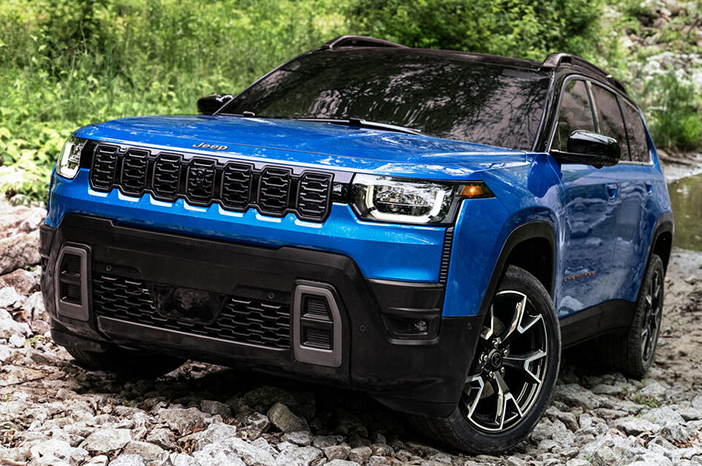
+++ JEEP has provided the first look at the next-generation Cherokee ahead of its official debut later this year and an expected European launch in 2026. The first pictures of Jeep’s Land Rover Discovery rival confirm that it will look very similar to the recently revealed Compass, above which it sits in the SUV brand’s line-up. This new version will be completely unrelated to its predecessor, swapping onto parent company Stellantis’s new STLA Large architecture, which will enable it to be offered with hybrid and pure-electric power. Jeep has not confirmed which will come first and has yet to disclose any technical details. It will be closely related to the next-generation Alfa Romeo Stelvio, which will use the same platform. The first images of the new Cherokee have been published just a day after former Jeep CEO Antonio Filosa was named as the new CEO of Stellantis, following Carlos Tavares’s exit from the role late last year. His replacement at Jeep, CEO Bob Broderdorf, said: “The all-new Jeep Cherokee headlines our efforts to deliver more product, innovation, choice and standard content to customers than ever before. The Cherokee will boast competitive pricing that strikes at the core of the largest vehicle segment and sits perfectly between the Compass and the Grand Cherokee to bolster our winning mainstream line-up”. These official images confirm that the Cherokee shares several design cues with the electric Wagoneer S, including a sloping roofline, squared-off haunches, rear doors set into the wheel arches and door handles recessed into the body. Up front, however, it features a more prominent variant of Jeep’s 7-slot grille, mirroring that on the new Compass. It’s possible that the combustion version of the Cherokee will use the twin-turbocharged 3.0-litre ‘Hurricane’ straight six from the petrol-powered Wagoneer and Grand Wagoneer, offered with outputs of 420 hp and 510 hp. An electric Cherokee is likely to be equipped with the 600 hp dual-motor, four-wheel-drive powertrain from the Wagoneer S. This is paired with a 118 kWh nickel-manganese-cobalt battery in that car, giving it a range of 485 km (according to the United States’ EPA test, which is less lenient than the WLTP regime used in Europe). The Grand Cherokee will be withdrawn from sale in Europe in the coming months to make room for the Wagoneer S. A similar decision may be made about the Wrangler when the upcoming Recon EV lands in Europe next year. +++
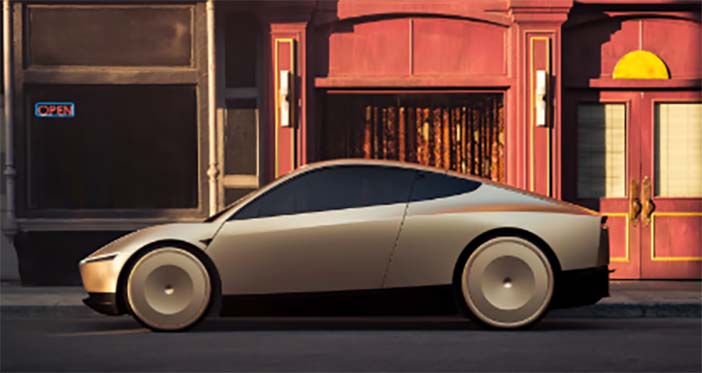
+++ Hey, taxi! Tesla is said to be targeting a June 12 launch of its ROBOTAXI service in Austin, a milestone in Elon Musk’s plan to reshape the company around driverless vehicles and artificial intelligence. In preparation, a test vehicle was operated on public roads in the city with no one in the driver’s seat for the first time. Investors will be keen to see if a robotaxi business ushers in a new phase of growth for Tesla. +++
+++ TESLA is testing a revised version of the Model S Plaid, its once-groundbreaking performance sedan. Caught lapping the Nürburgring in Germany, the updated car sports only the slightest visual changes: a new front splitter and a revised rear diffuser. Beyond those tweaks and what appear to be larger wheels, the design is largely unchanged from the version refreshed in 2021. That has left fans disappointed. Despite promises earlier this year from Tesla’s VP of Engineering that the Model S and Model X would get some “love” in 2025, this prototype suggests a minor facelift rather than a ground-up overhaul. The Model S Plaid was once the king of the electric performance hill, boasting a 1.020-horsepower, tri-motor setup. But lately, it’s been dethroned by newcomers like Porsche’s Taycan Turbo GT with the Weissach Package and Xiaomi’s surprise EV, the SU7 Ultra. These cars not only go toe-to-toe with the Plaid on performance, but do so with newer, more refined platforms and fresher designs. While the Model S’s blistering acceleration still impresses, its aging chassis and layout are beginning to show their limitations. Critics have noted that the car’s suspension struggles to keep up with its power, particularly in hard cornering and under braking. Originally launched in 2012, the Model S is now 13 years old; an eternity in automotive terms. While Tesla has updated many of the car’s components over the years, the underlying structure and dynamic hardware haven’t seen the sort of deep rework that modern performance EVs demand. Key features that are becoming industry standards, like 800 volt charging systems, 4-wheel steering, or even a suspension setup tuned for aggressive driving, are still missing from the Model S. For a flagship EV, that’s a problem. Tesla has often marketed itself as a fast-moving tech company, but when it comes to vehicle updates, its pace has been surprisingly slow. The Cybertruck took nearly 5 years to reach production, and both the Model S and Model X have seen minimal visual changes in more than a decade. Now, with more EV competitors entering the market every month, especially from China, Tesla’s slow vehicle redesigns are starting to hurt its position. Legacy automakers are now iterating faster, making Tesla’s aging line-up harder to justify, especially at premium prices. +++