+++ ASTON MARTIN has been steadily laying the groundwork for its electric future. In mid-2023, the company entered a long-term strategic partnership with Lucid, securing access to the American brand’s advanced electric motors and battery packs. While its first EV is still a few years away, Aston Martin is already considering how to make it feel distinctly its own, even exploring systems similar to those in the Hyundai Ioniq 5 N to capture that signature driving character. Currently, Aston Martin is focused on the launch of its first-ever plug-in hybrid, the limited-run, mid-engined Valhalla. It promises to rival new hypercars like the McLaren W1 and Ferrari F80, but at a fraction of the cost. It’ll likely also serve as Aston Martin’s final all-new model before it adds an EV to its range, promising to do so at some stage this decade. During Monterey Car Week, Aston Martin’s chief creative officer Marek Reichman discussed the company’s electric vision. When asked about features such as simulated gear changes and sound profiles reminiscent of internal combustion engines, Reichman did not dismiss the idea. “If it is a benefit to the driving performance capability of our cars, and therefore it is authentic and real, and we can use a system that allows the driver to have more emotion about driving, then yes”, he said. Importantly, Reichman said such systems need to feel authentic and must add to the driving experience. “If it is something that is purely artificial, then no”, he said. “Because an Aston Martin is true; it’s authentic. There are only a few companies in the world of Formula One that sell road cars. We have a massive advantage. Imagine the knowledge, the data we’re gathering and how we can use it to make a road car more exciting. Whether it’s gears or some way of using torque vectoring to generate engagement, we are fully embedded to an exciting driving experience”. As Aston Martin’s first EV is still quite far out, it’s impossible to know what form it could take. The British brand may decide to position it as a direct rival against the Ferrari Elettrica, which is shaping up to be a crossover. Alternatively, Aston Martin may decide to build an all-electric sports car or supercar. +++
+++ AUDI is priming a track-focused special edition of the RS3 as it celebrates the hot hatch’s signature 5-cylinder engine, with the unit under threat from forthcoming EU emissions regulations. The new variant has been spotted testing on the Nürburgring Nordschleife for the first time ahead of its launch, expected to take place early next year. It sports several racing-inspired modifications, including a more aggressive front splitter, new canards and a chunkier rear spoiler, intended to maximise its pace on circuit. The RS3 prototype also wears a new set of brake calibers, painted blue rather than the standard black, hinting at extra stopping power and the potential of a special colour scheme or livery. The new car is also likely to bring a significant uplift in power and torque from the 407 hp and 500 Nm of the previous RS3 Performance Edition, the punchiest version of the hot hatch yet offered. Sebastian Grams, former managing director of Audi Sport, told in 2023 that “there’s still a way to go” with the 5-cylinder engine compared with the RS3 Performance Edition. Dutch sports car maker Donkervoort previously boosted the 2.5-litre turbocharged unit to 500 hp for its F22 open-wheeler. It remains to be seen whether Audi will push it that far, but a tangible improvement in output could make the RS3 the most powerful petrol hot hatch on sale, outdoing the 421 hp Mercedes-AMG A45 S. It’s likely that the new RS3 variant will represent one last hurrah for the car and its engine, in similar fashion to 2022’s Audi TT RS Iconic Edition. The 5-cylinder unit has been the RS3’s unique selling point since its arrival in 2011, but Audi previously said the powerplant’s production would end when the current iteration of the hot hatch comes off sale. It is possible that it could be reworked to meet the rules, be it through redevelopment or by way of electrification, however. +++
+++ BENTLEY will imminently unveil a new Continental Supersports as a high-end, rear-driven model with a pure-combustion V8 packing more than 640 hp and it will serve as a showcase for a line of new “extreme” performance cars. Spy photographers recently captured the new model testing, with the prototype’s large rear spoiler and bold quad exhausts hinting at its performance edge. The test car otherwise sported standard bodywork, but my sources have confirmed that the production version, set to be revealed late this year, will receive a far more dramatic makeover from the recently updated standard Continental GT. The sporting remit of the new model is shown by the intention to revive the rarely used Supersports name, which last appeared in 2017 on a range-topping version of the previous-generation Continental, featuring a 6.0-litre W12 engine tuned to 700 hp. The new Continental Supersports is understood to be conceived to showcase how, uniquely among high-end car brands, Bentley has the heritage to offer both luxury (as demonstrated by the recent EXP 15 concept) and performance. Bentley boss Frank-Steffen Walliser has previously told of plans for “more extreme” models that would reinforce the brand’s sporting heritage and credentials. It is believed the new Supersports will be the first example of that, with other models tipped to follow. The retirement of Bentley’s W12 engine in favour of a twin-turbo V8 means the new Supersports won’t have as much power as its predecessor. It will also be less potent than the top-spec Continental GT Speed, which produces 780 hp from a plug-in hybrid powertrain. However, it’s understood that extreme lightweighting measures mean the non-electrified Supersports will be able to serve as a “pure-performance” model. The Supersports is set to retain the 4.0-litre twinturbo V8 from the GT Speed, but our sources claim the unit has been reconfigured and output boosted from 600 hp to around 640 hp, while the 190 hp gearbox-mounted electric motor has been ditched. Whereas the GT Speed is all-wheel drive, the Supersports will be purely rear-driven. The real key to extracting extreme performance from the new Supersports will be the weight-saving measures undertaken by Bentley’s development team in Crewe. Sources suggest that the car will weigh around 2.000kg, compared with 2.459kg for the GT Speed. That would make it the lightest Bentley in decades and mysources say it will be capable of matching the GT Speed’s 0-100 kph time of 3.3 seconds. Ditching the PHEV system is a fundamental aspect of the weight-saving but the Supersports is also likely to feature measures such as carbonfibre bodywork elements (including the roof), lightweight sports seats in the front and the removal of the rear seats. Other performance changes will include the use of Akrapovic exhausts, custom lightweight wheels and carbon-ceramic brakes. Weight-saving has been a feature of the previous two Continental Supersports, but the new car is said to take that approach to the next level. The bodywork will be given a major makeover for the Supersports, partly to match its ‘extreme’ focus and also to aid performance. The large rear spoiler seen in spy shots will remain and the car will also feature aggressive air channelling and extended ground effects to optimise its aerodynamics. The new Continental Supersports is understood to be a strictly limited-run model. Its production run is believed to be in the low hundreds and pricing is set to start at around €520.000. That’s a significant uplift from the €298.856 starting point for the GT Speed, and (given the high-end customers being targeted, virtually every example of the Supersports is expected to feature customisation from the Mulliner division, ranging from special exterior paint designs to interior trim offerings. The new Supersports has already been shown to a limited number of customers and several orders have been placed. The model is understood to be on track for a public reveal later this year before deliveries begin late in 2026. +++
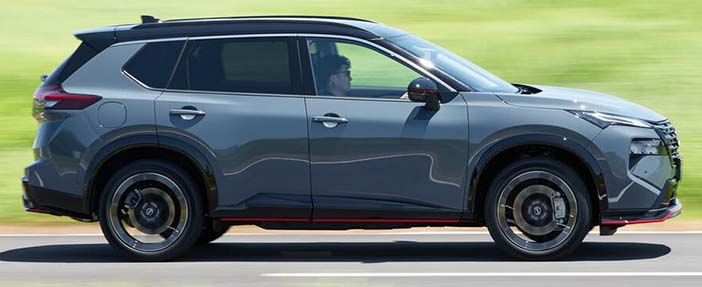
+++ The NISSAN X-TRAIL NISMO has been revealed in Japan as a sporting version of the brand’s family SUV, gaining a more aggressive look and chassis upgrades. Key to the package is a set of new swing-valve dampers supplied by suspension firm KYB, said to provide more effective bump absorption at low speeds than conventional items. These, said Nissan, provide an improved trade-off between body control and ride comfort. It rides on new 20in alloy wheels shod with Michelin Pilot Sport EV tyres, measuring 20mm wider than those fitted to other grades of X-Trail. The car’s electric power steering system has also been tweaked to accommodate the new chassis set-up. The Nismo uses the same four-wheel-drive e-Power hybrid powertrain as is offered in other grades of the X-Trail, with a 1.5-litre petrol engine and 2 electric motors. The petrol engine does not drive the wheels, but instead acts as a generator for the motors, which produce a combined 204 hp and 320 Nm. Nissan said it has tuned the car’s four-wheel-drive set-up to send a greater share of the power to the rear wheels. This, it claimed, makes it easier to adjust the X-Trail’s line through a bend using the throttle. Visually, the X-Trail is demarcated by an aggressive bodykit with Nismo’s signature red accents. The new treatment (in particular the chunkier front splitter and rear diffuser) reduces lift by 29% compared with an entry-level X-Trail, said Nissan. Inside, it also gets the option of more thickly bolstered Recaro bucket seats. Prices in Japan start from ¥5,416,400, compared with ¥3,843,400 for the standard X-TRail. The Nismo has yet to be confirmed for Europe, but the recent arrival of the Ariya Nismo here suggests it is a likelihood, albeit at a significantly greater cost. The current range-topping model in Europe, the Tekna, is priced from €50.000 when fitted with the four-wheel-drive e-Power system. The Nismo would almost certainly slot into the range above this, possibly nudging the €55.000 mark. +++
+++ Hyundai and Kia are edging closer to unseating Toyota as the best-selling automotive brand in SAUDI ARABIA . While the strong performance of the 2 brands in the local market may come as quite a surprise, they are investing heavily in the Kingdom, even recently breaking ground on a new factory there. Through the first half of 2025, Hyundai and Kia accounted for 23 percent of the 412.920 vehicles sold in Saudi Arabia. This places them narrowly behind Toyota, which accounted for 28 percent of sales. Hyundai’s Accent sedan is proving to be especially popular in the nation, with 19.080 examples finding new homes. For Kia, the Pegas sedan is its best-seller, shifting 15.530 units during the January-June period. A growing number of Chinese brands are also selling cars in Saudi Arabia. Combined, these brands have accounted for 12 percent of total sales. Saudi Arabia is becoming an increasingly important Middle Eastern market for manufacturers. The Kingdom owns a majority stake in Lucid through its Public Investment Fund (PIF) and has helped the American EV maker open a local factory that will eventually have the capacity to manufacture up to 150.000 EVs annually. Similarly, Saudi Arabia has worked to woo the Hyundai Motor Group to its shores. Thanks to a newly established joint venture between Hyundai Motor Manufacturing Middle East and the Public Investment Fund, which owns 70 percent of the venture, a large production facility will be opened in the fourth quarter of 2026. This site will have an annual production capacity of 50.000 units and be responsible for building both EVs and vehicles with internal combustion engines. Hyundai has yet to specify which of its models will be manufactured at the site, nor has it said if it will also build cars from the Kia and Genesis sister brands. +++
+++ The term ‘SOFTWARE DEFINED VEHICLE‘ (SDV) always seemed like a bit of meaningless buzz to me. Cars have been defined by software for decades, I figured, with lots of little computers to control various electronic functions. Hell, Bendix came out with electronic fuel injection in 1956 (admittedly, it didn’t work at the time, but the principle was there). But, there’s a huge difference between a vehicle with lots of electronic systems, each with its own software, and what the automotive industry considers an SDV. It turns out that “having software” is very different from being fully “software-defined”, the way things are trending. RJ Scaringe, CEO of Rivian, explained the difference well: “The way most vehicles are defined today, their software and electronics layout, is you have hundreds of little, tiny computers (the industry term is ECUs, electronic control units) that have a little island of software that performs some domain-based function. So you’ll hear this called a ‘domain-based’ architecture. So you’ll have a seat controller, you’ll have a door window mechanism controller, you’ll have an HVAC controller, each of those being a separate computer”. This all started with fuel injection. Automakers moved on from carburators to electronic fuel injection systems controlled by a computer, which aided efficiency and power. Then car companies added more and more electronic systems in a kind of piecemeal way: computers for seat controllers, climate controls, safety systems, door window mechanisms etc. But they used to be isolated, Scaringe said, and did not talk to one another. “It just proliferated in a really organic, completely unplanned way, just a system of weeds”, he said. “Nothing architected as a system”. On top of all that, Scaringe said, many of these electronic systems weren’t even made by the car companies, but rather separate supplier companies, and the software within them may have been created by another separate sub-contractor. Lots of little computers, all working in parallel to each other. This is fine, up to a point. If you were starting from scratch today, it’s not how you’d build a car. Scaringe said that, instead, you’d build a car with as few separate computers as possible. “We want very clear, centralized compute” he said. “A clear operating system designed around modern techniques of networking”. You’d want what Rivian is doing: a zonal architecture, he said. “Depending on the size of the vehicle, maybe 2 computers in the car: 1 in the front and 1 in the back. If it’s bigger, like an R1, maybe there are 2 in the back, 1 in the front, that do all the decisioning across one common software platform running on a standard in-house built [operating system], and so we built that”. There’s a downside to the traditional way of doing things, Scaringe said, where these ECUs are like little, isolated islands. They all communicate through a vehicle’s CAN bus architecture, but they are speaking separate languages. “To do something like an over-the-air update requires all this coordination amongst third parties, and you have all this unused capacity, because you have all these little computers, none of which is fully being utilized”, Scaringe explains. This helps explain why some car companies have done OTA updates better than others, but arguably, none as extensively and cohesively as Tesla or Rivian. Think about it: your car may get updates to its navigation system, but can it get a software update that adds a bunch of horsepower? Or more advanced self-driving features? Or a wholly new infotainment system? That takes a lot more doing. This is a fundamental rethink of how cars work. Rivian is arguably the leader among automakers outside of China in SDVs, but other startups, like Tesla and Lucid, have similar software architectures. Tesla, in fact, was the first to do this sort of thing. Traditional automakers have struggled with this, just because their methods (including outsourcing computer parts and code to so many suppliers) evolved from years of the industry using domain-based architectures. Institutional inertia. Zonal architecture is a huge part of how Rivian was able to get adaptive drive beam headlights in the new R1T and R1S before the rest of the industry, as an example. Its lights can talk with all the other vehicle systems, and because Rivian writes the software, it can make changes far more easily than it would if it had to work with external suppliers. Zonal architecture is also why Volkswagen made a huge investment in Rivian to create a joint venture for its cars to use Rivian software. VW’s own attempt at a software revolution failed spectacularly, so it decided it should look to Rivian to leapfrog the competition and make up for lost time. You’re seeing other traditional automakers working towards SDVs as they recognize the benefits of this approach. Ford’s coming $30,000 electric pickup will use such an architecture, and last week, Ford officials made clear that this is a major priority for this platform. The Honda and Acura EVs coming on its new electric-car platform will do the same. Ultimately, the goal is more advanced features via software, but also getting you to pay more over time for these features. Car companies have big dreams of recurring revenue through subscriptions and even one-time downloads. So far, adoption has been slow. But over time, expect them to use these systems to monetize the ownership experience over the life of the car, not just when you buy it. Right now, Scaringe argues that you can have feature parity between zonal- and domain-architected cars, though this requires huge effort, and those days are winding down regardless. “In the fullness of time, it’s like trying to ride a bike with 10 anchors dragging through the mud, if you’ve got a domain-based architecture versus a zonal,” Scaringe said. “And so I think it’s just impossible to see how those work in the end”. +++
+++ Advanced driver assistance systems are meant to make driving less stressful and roads safer, but when the technology falls short, it can create new risks instead. SUBARU ’s EyeSight suite is one example that has faced scrutiny. After years of legal disputes, some owners who took the company to court have reached a settlement, though not for the outcome they originally sought. For 4 years, the group of plaintiffs battled Subaru over EyeSight, its semi-autonomous driver assistance package. Their claims centerred on pre-collision braking, rear automatic braking, and lane-keep assist, all of which they argued were unreliable. According to them, the problems weren’t isolated but extended across nearly the entire Subaru line-up. According to CarComplaints, the lawsuit includes the Legacy, Outback, Impreza, Crosstrek, Forester, Ascent, WRX and BRZ spanning from 2013 through 2024, depending on the model. The plaintiffs say that vehicles with the defective EyeSight suite suffer from brake activation when there shouldn’t be any, and at other times, fail to engage when emergency braking is required. It goes as far as to say that lane-keep assist is defective due to poor calibration. Owners complained that it “even steers the vehicle into other vehicles”. These plaintiffs wanted Subaru to tell customers that EyeSight was defective, pay for repairs, make full restitution, and surrender “ill-gotten profits” from the system. Instead, the case ended with each of the eight plaintiffs receiving $5,000, while their attorneys collected a cool $2.5 million in fees. In addition to the cash pay-out, Subaru agreed to extend warranty coverage on the associated cars. Of course, that coverage of 48 months or 48.000 miles means that many of the cars in question are already ineligible. The automaker is allowing all cars in the class, including those over the mileage and time caps, to get work done under the warranty for four months after the settlement is official. Importantly, it’ll only pay for 75 percent of whatever work gets done under this new warranty agreement, and it doesn’t have to admit to any defect in any of the cars. +++
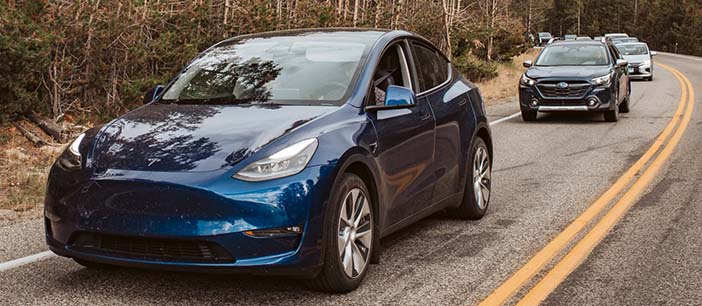
+++ TESLA Yellowstone’s 142-mile Grand Loop Road is almost ideal for an electric car, such as the TESLA MODEL Y: 45-mile-per-hour speed limits and sweeping meadows, geyser basins and wildlife. But charging infrastructure is sparse. The park has just nine slow plugs, a reminder that national parks are among the last frontiers for reliable EV travel. That’s beginning to change as rural travel centers and retailers rush to add chargers, but some of the most iconic American road trips still require planning and pauses for EV drivers. +++