
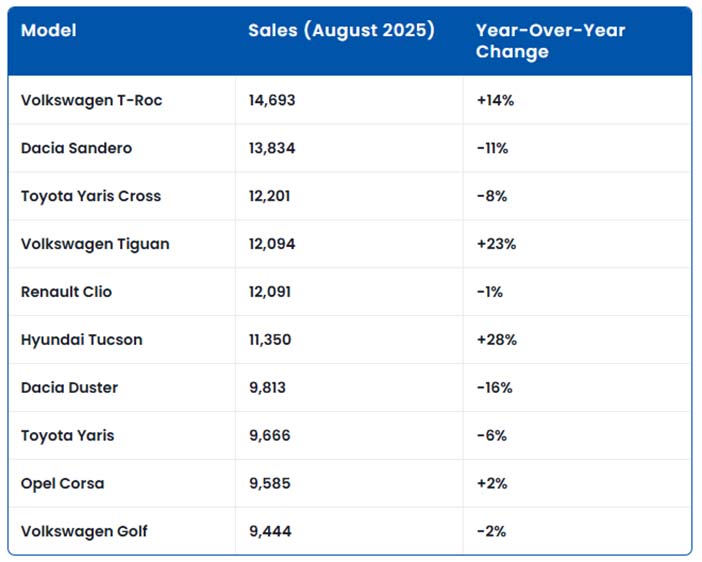
+++ A whopping 790.177 cars were sold in EUROPE last month, representing a 5 percent increase compared to the same month in 2024. Volkswagen sold 14.639 units of its T-Roc, making it the best-selling car in Europe for the month and one of the most popular cars of the year so far. This figure reflects a 14 percent increase for the outgoing generation of the T-Roc, just as the new model debuted at the end of August. Meanwhile, its closest competitors (the Dacia Sandero and Toyota Yaris Cross, which ranked second and third respectively) saw declines compared to August 2024. Following the Volkswagen T-Roc, the Dacia Sandero (13.834 registrations, down 11 percent) and the Toyota Yaris Cross (12.201, down 8 percent) secured second and third place, respectively, on the list of best-selling cars in Europe in August 2025. The Volkswagen Tiguan followed closely behind in fourth with 12.094 units sold, marking a 23-percent increase compared to August 2024. In contrast, the Renault Clio slipped to fifth place with 12.091 registrations; possibly impacted by anticipation for the new generation that debuted at the 2025 Munich Motor Show. The rest of the top 10, compiled by JATO Dynamics, includes the Hyundai Tucson in 6th place, followed by the Dacia Duster, Toyota Yaris, Opel Corsa, and Volkswagen Golf. Here’s the full list:
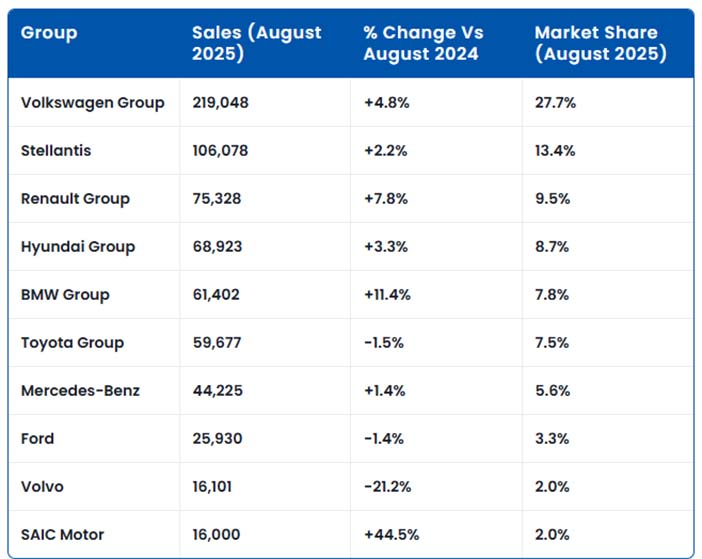
Chinese car brands made significant gains in Europe in August, with total sales exceeding 43.500 units; a 121 percent increase compared to the same month in 2024. This surge allowed Chinese manufacturers to surpass well-established brands such as Audi (41.300 units) and Renault (37.800). It’s worth noting that around 40 different Chinese brands are currently active in the European market. However, the top-5 (MG, BYD, Jaecoo, Omoda and Leapmotor) accounted for 84 percent of all Chinese-branded vehicle registrations. On a brand-by-brand basis, MG has overtaken both Tesla and Fiat, while BYD has moved ahead of Suzuki and Jeep. Meanwhile, emerging names like Jaecoo and Omoda are outperforming several established brands, including Alfa Romeo and Mitsubishi. Among the major automotive groups, BMW (+11.4%), Renault (+7.8%) and Volkswagen (+4.8%) posted solid growth in August. Hyundai (+3.3%) and Stellantis (+2.2%) also performed well. However, none matched the explosive growth of Chinese manufacturers. SAIC Motor (the parent company of MG) posted a 44.5% increase, while BYD nearly tripled its year-over-year sales with a staggering 215.7% gain. In contrast, several major brands saw declines. Toyota slipped by 1.5%, Ford by 1.4%, and Volvo experienced a sharp drop of 21.2%. Most notably, Tesla sales fell by 22.5% in August, highlighting the growing competitive pressure in the EV market. Here’s how each of those groups fared last month:
Even with electric car sales down in the United States, this type of car continued its upward trend in Europe in August 2025, recording a 27-percent year-over-year increase with 159.756 new registrations. The Tesla Model Y remained the best-selling EV model, despite a 37 percent decline in sales to 8.330 units. However, Tesla has lost its lead in overall battery electric vehicle (BEV) registrations. In August, Tesla recorded 14.753 registrations, while Volkswagen took the top spot with 16.523 units sold. +++
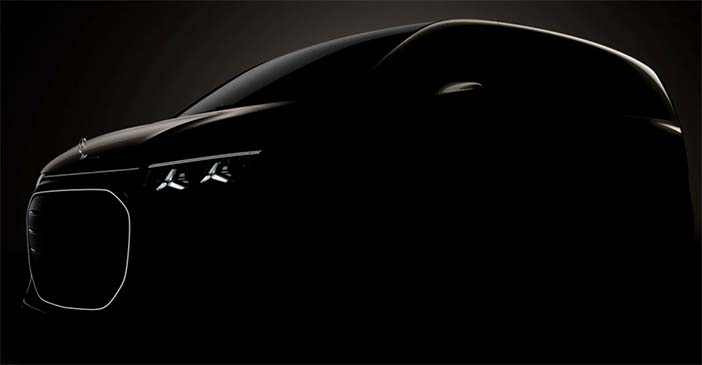
+++ Coming soon to the MERCEDES-BENZ line-up will be the new VLE, which has just been officially teased at the same time as production has begun in Vitoria, Spain. That plant has built the Vito, eVito, V-Class and the all-electric EQV in recent years, but to cater to the VLE and its new VAN.EA platform and the internal combustion-engined VAN.CA alternative, Mercedes says it has been thoroughly modernised. Production of the VLE in its ‘pre-series’ form has begun and to mark the occasion, Mercedes has given us a teaser image of its new mid-size MPV. The VLE, which will arrive in the first half of 2026, will clearly take plenty of inspiration from the Vision V concept that was unveiled earlier this year. At the front we can see a new form of Mercedes’ ‘panamerica’ grille and we wouldn’t be too surprised if it gained the same ability as the new electric GLC, which features 942 illuminated squares within its grille that can double as a charging readout. The LED signature in the headlights mimic Mercedes’ 3-pointed star badge and on the bonnet sits the Mercedes emblem. During the VLE’s development, we saw the VLE testing in a wind tunnel, showing off aerodynamics that the German brand says are “outstanding in terms of efficiency”. There are also new pictures of the VLE at the famed Nardo test track in Italy, fine-tuning its high-speed dynamics and rear-axle steering. The proportions don’t look too dissimilar to the outgoing EQV’s, although we’ll have to wait and see what other elements of the Vision V concept make production. The VLE will be the first model to sit on Mercedes’ VAN.EA platform, although the firm has also announced that it’ll be offered with petrol power later on, too. Details are slim because it’ll arrive after the electric model, but the combustion-engined VLE will sit on the VAN.CA platform, which Mercedes calls ‘state-of-the-art’. It’ll roll off the same assembly line as the electric model. I have more information on the electric VLE, which will be followed shortly after by the larger VLS. The VLE will essentially be the mid-size model, akin to an E-Class (hence the ‘E’ part of the name) with seating for up to eight people. Mercedes calls the VLS a ‘grand limousine’ and says it will “define a unique segment of its own that bestows true greatness to automotive luxury”. To back up those strong words, during testing Mercedes revealed the results of long-distance tests of the VLE. The test car’s route went from Stuttgart in Germany to Rome, Italy, covering almost 1.090 km, requiring “2 short charging stops” of 15 minutes each. That suggests a maximum range of around 400 to 480 km; a significant improvement on the current EQV’s range of 360 km. The company hasn’t said what the VLE’s battery capacity will be, however the current EQV comes with a maximum battery size of 90 kWh, and sizes of up to 116 kWh have been used in other Mercedes EVs including the EQS and G-Class. We already know the VAN.EA platform will have a bespoke construction that’s designed to get the most out of an all-electric platform: Mercedes has even gone as far to say it’ll “usher in a completely new era”. This includes a range of cutting-edge technical capability drawn from Merc’s advances in passenger electric cars, including an 800 Volt electrical system (which could allow for up to 320 kW fast charging) as well as high-end suspension and chassis technology. The new architecture will offer a single-motor layout, plus a dual-motor option with all-wheel drive. The test car was a rear-wheel-drive, single-motor VLE and, according to Mercedes, additional rear-axle steering ensured “easy and agile handling even in tight corners” on the streets of Rome. You can expect to see a similar ability to the EQS SUV, which can turn its rear wheels by up to 10 degrees. The availability of two drivetrains for the VLE will give maximum flexibility when it comes to different applications and requirements. Mercedes previously said the VAN.EA technology will allow for ‘clear differentiation’ between luxury vans and commercial models. The VAN.EA-P platform (the P standing for ‘premium’) is designed to cater for ‘high-quality family vans’ and everything from ‘exclusive VIP shuttles to spacious limousines’, according to the company. Commercial vans will use the VAN.EA-C set-up (with the C standing for ‘commercial’). The line-up of all-electric vans sitting on this new architecture will have Mercedes’ upcoming MB.OS infotainment system, and the company says the premium models will be “always on”, meaning they are connected to the internet at all times and able to receive updates. Level 2 automated driving will be available, and there are plans to roll out Level 3 automation by the end of the decade. I’ve only seen a few prototypes running the new set-up under the skin, but when it does arrive on the market, Mercedes will be able to offer more specialised products for all sorts of applications, whether it be as a family car in Europe or high-end business transport in Japan. We’ll have to wait for pricing to be confirmed, but we expect a starting figure close to €100.000, considering that the current, less spacious EQV starts from €89.293 in the Netherlands. +++
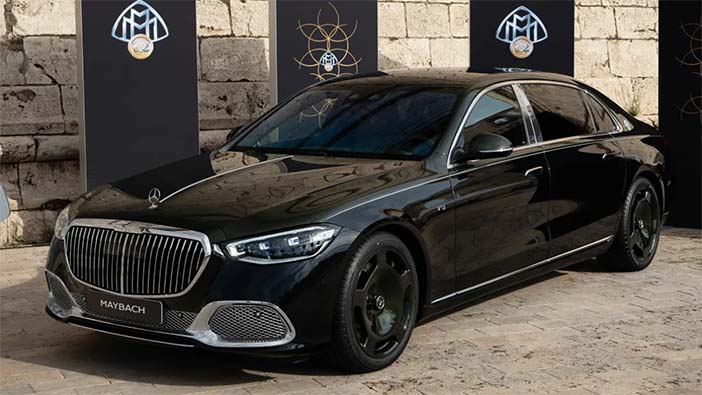
+++ MERCEDES-MAYBACH has pulled the covers off its latest luxury car masterpiece, the V12 Edition. Paying tribute to the brand’s long-standing connection with the V12 engine, the luxury saloon is limited to a mere 50 examples, and was unveiled to a select audience of VIPs and press at the historic Fort Michelangelo in Civitavecchia, Italy. The V12 Edition is based on the Mercedes-Maybach S 680, and features plenty of advanced technology, including active road noise compensation, rear-axle steering and E-Active Body Control active suspension to ensure the ride quality is suitably sublime. At its core is a 6.0-litre V12 bi-turbo engine, producing a chunky 612 hp and 900 Nm of torque and allowing the saloon to sprint from 0-100 kph in just 4.5 seconds. The electronically limited top speed is the usual 250 kph. But, it’s the bespoke design elements from Mercedes-Maybach’s Manufaktur programme that set this car apart. The 2-tone paint job in olive metallic and obsidian black takes up to 10 working days to apply, which is twice as long as the standard Maybach signature paint finish. The exterior is completed with five-hole forged wheels, also in an olive metallic hue. And, as a tribute to the iconic Maybach Zeppelin, there’s a special emblem on the C-pillar featuring a 24-carat gold and chrome medal with a “12” engraving. The opulent approach continues inside, with saddle brown Nappa leather upholstery, high-gloss brown burr walnut wood trim, and a diamond-quilted roof liner. Just to ensure that everyone who travels in the V12 Edition is aware of its rarity, there’s a ‘1 of 50’ badge in the centre console and a golden inlay with 12 golden circles, plus each vehicle comes with bespoke accessories, including silver-plated champagne flutes and a bespoke keyring. With deliveries beginning in autumn 2025 in select markets, the V12 Edition is expected to carry a price tag well above the cost of the standard S 680. +++
+++ PEUGEOT is lagging its Volkswagen Group arch rival for electric car sales and boss Alain Favey has told why. While Peugeot’s European sales are up 3 percent in the first 8 months of the year, only 15 percent of those 560.000 registrations are pure electric. In contrast, more than 20 percent of Volkswagen and Hyundai Motor Group registrations are strictly zero-emission. “It’s no secret that Peugeot is stronger in the regions where, unfortunately, EV demand is very low”, Favey explained. “So compared with the other brands you mentioned, the geographical footprint means they will have a higher BEV level than us”. Peugeot is obviously strong in France, where EV sales have dipped slightly in 2025, and Spain and Italy where EV adoption is slower. The United Kingdom and Germany are big EV markets, countries where Volkswagen and Skoda are more dominant, along with Norway and Denmark. Favey also suggested Peugeot’s ‘multi-energy’ strategy (offering one car with a choice of pure-electric, petrol and hybrid drivetrains) gave customers the option of not going electric. “Our strategy is to leave the choice to the customer as to which energy they want to use. And that’s different from other brands, because they have vehicles that only exist as a BEV. If you want an ID.4, you don’t have a choice. Our customers always have the choice: if they want a 208 or a 3008, they don’t have to take a BEV”. Favey reckons Peugeot may also be disadvantaged by its “upper mainstream” positioning; it’s yet to use Stellantis group’s lower-cost, ‘Smart Car’ platform, which underpins the Citroen ë-C3. “Some other brands having the Smart Car platform might be in a different position in the market, allowing them to be maybe a bit more aggressive in terms of pricing than we are”. Nonetheless, Favey says Peugeot is still the Stellantis brand that sells the most BEVs and that the brand, and the group as a whole, is committed to electrification to meet its environmental obligations. +++
+++ POLESTAR will unveil a concept car and more ‘Beast’ performance models in the run up to the Polestar 7 SUV, as new head of design Philipp Römers stamps his vision on the company’s design. Römers, who worked on the Audi e-tron GT’s exterior during 25 years at Volkswagen Group, outlined his vision in an exclusive interview. “The reason I quit the Audi job and took on the Polestar challenge is because becoming studio head of a design-driven company is very cool”. He admits he’s joined during “tough times” (Polestar lost more than $1 billion during the first 6 months of the year) but sales also rose to 30.289 and the flagship Polestar 5 is now entering the market. “From Polestar 5 on, I can start from scratch to develop the cars of the future. We are in the middle of the storm, executing”. The Chinese-owned, European-based EV start-up is a commercial minnow but its acclaimed design has become a lighthouse the industry watches closely. Polestar’s mix of clean surfaces and eye-catching graphics atop athletic cars with interesting silhouettes forged the high-riding Polestar 2 liftback, the 3 SUV and the 4 coupe-SUV. So how radical will he be? “When I started I thought about whether to do a revolution or an evolution. Polestar is a young brand and its awareness still has to be lifted. So it would really be a mistake to make a revolution, to do something completely different”. The Polestar 7, a compact crossover arriving in early 2028, is set to be Römers’ first all-new Polestar. A teaser image of the car under a cloth hints at a sleek, low-roofed SUV with flared wheelarches and “dual-blade” lighting. “The main architecture and the appearance will be a little more dynamic, to express performance”, explains the German-born designer. “I would like our cars to be as attractive and muscular as possible”. He thinks some Polestars look quite vertical (perhaps thinking of the 3 SUV’s pinched rear, the 5’s downturned rear lamps or the range’s deep bodysides); something Römers is keen to address with more horizontal elements. Lines could circumnavigate the car, accentuating the width and melding the sides with the ends. To him, Polestars are all about “characterful details: no traditional grille, dual blade-lighting and the Polestar 3’s bridge”, the raised section across the nose which channels air onto the bonnet to smooth its flow. “You can imagine we’ll do something striking yet very Polestar”, he hints. “The 7 is targeting a segment where we can gain growth. The Polestar 5 is our halo car but it won’t sell in huge numbers. To become more profitable we need more compact cars as well. But when you buy this smaller car, you also buy a piece of the brand, a piece of the Polestar 5”. Römers has a good track record in compact cars: the chiselled, timeless Golf VII is one of his exteriors, working alongside current VW design boss Andy Mindt. “I’m still proud of that car: it looks good, has a proper stance and expresses VW values”, he says. Polestar cabins are distinctive, with clean, elongated planes often trimmed in neutral, natural materials. “It’s a benchmark that’s been copied everywhere in the industry. But our value of performance also gives me the chance to evolve this”, outlines the design boss. Römers leans across the table in our Munich meeting room to share his inspiration board. Expect a welcome injection of colour (“we’ll do it in a Scandinavian way which fits the brand, but we’ll be more emotional with interior and exterior colours”) interior architecture that cocoons occupants, a touchscreen pivoted towards the driver and more physical switches. Römers says he has some ideas to fill the void between now and the Polestar 7, with the open-top 6 pushed back to prioritise the SUV and 2 replacement. “I’m dreaming of a show car, obviously. As a design-driven company, from time-to-time we need to reveal some show cars”, he admits. A concept could be unveiled as early as 2026. The head of design also namechecks the Polestar 2 BST (nicknamed the ‘Beast’) from 2021, which was upgraded with a maximum attack bodykit, beefier brakes, a 30 mm drop on coil suspension and dual-motor power cranked up to 476 hp. It was sold as a 230-unit limited run. “I like the Polestar 2 a lot, I like compact sporty cars”, He continues: “The 2 was available in Beast trim once. This is inspiration for the future: it has character, looks sporty and drives fantastically”. Polestar CEO Michael Lohscheller also mentioned the Beast in Munich: “People want special things, to stand out a little bit. That’s exactly what the Polestar 2 Beast did”, he said. So don’t be surprised if the Polestar 2 gets another makeover to keep it news-worthy until the new-generation arrives: or the R&D team applies the philosophy to the new 5. This Porsche Taycan rival, packing up to 880 hp for a 3.2-second 0-100 kph sprint, presents another obvious opportunity for a beastly makeover. Polestar’s CEO before Lohscheller was acclaimed ex-VW designer Thomas Ingenlath, who worked alongside head of design Max Missoni, recently poached by BMW. “I think design is what Polestar is really about”, elaborates his replacement Römers, who reckons design literacy is embedded across the company. Ingenlath established Polestar using three building blocks: design, performance and sustainability. And Römers, who joined the Gothenburg design studio in January, immediately began immersing himself in those brand values and how they translate into the cars. None of them will change but he wants to exaggerate one in particular. “Performance: we have to emphasise it more in the future, including in the design. Polestar 5 already fits into this next chapter of Polestar, because it’s our performance halo car”. What is his design philosophy, honed at Volkswagen and Audi? “Good design has to embody a brand’s values. I’m so happy that we have a clear value set that has to be expressed. Then cars must have a certain character and look good and attractive”. “I wasn’t involved in the Polestar 5’s design but it’s characterful, good-looking and resembles the Polestar 4. And it’s not just screaming for attention. The car industry is losing its design quality”. By that Römers means that much of car design is coalescing into similar bodystyles and executions, with many brands losing their distinctiveness so using motifs that shout for attention. “I think there’s currently a trend to have cleaner designs, maybe even influenced by China. In recent years, this very clean, even soapy design was quite well appreciated and has now influenced the whole car industry. I think Scandinavian design is, at its heart, minimal and clean, so it’s fitting to our brand. Then you have to add things, to create character. I think we will find a good balance”. Are rear light bars and faired-in rear windows design sacred cows? Current Polestars all have a rear light bar but it’s a device that’s become so overused it’s lapsing into cliché: will Römers abandon it? “We have some other ideas,” he muses. And the Polestar 4 and 5 share a distinctive design cue, a faired-in rear ‘window’, rather than glass. Will that be carried forward? “I would say it depends on the segment. It really makes sense on [low]cars or coupes, not so much on an SUV with huge glass surfaces. Take the e-Tron GT: the back window is really just a slot. On such cars it could be a good idea to get rid of it and save some weight”. +++
+++ For decades, “ TOYOTA ” and “reliability” were nearly synonyms. But a viral TikTok suggests that era may be over, as an enthusiast warns viewers to “run” from the newest models, then backs it up with a look under a Corolla Cross’ hood. Auto enthusiast Thomas is happy to poke some holes in the Toyota reputation, with a viral clip that’s been viewed more than 53.000 times. “It’s sad to say, but these new Toyotas, they’re just not as reliable as they used to be”, are his first words to viewers before listing the high price, transmission, and move toward thinner oil blends as some of his biggest concerns. The Corolla Cross on screen serves as Exhibit A. Thomas warns that the CVT transmission won’t last 200.000 miles, ridicules the factory-specified 0W-8 oil as “almost the equivalent of running water” and argues that Toyota’s 15.000 km oil change intervals will doom the engine to an early death. The rhetoric is blunt (“Run, far, far away”) but it struck a nerve because Toyota’s reputation has long rested on the idea that its vehicles were safe bets for the long haul. Toyota’s bulletproof image wasn’t just marketing spin. Camrys, Corollas and Prius’ have regularly topped Consumer Reports’ reliability surveys and J.D. Power’s dependability studies for years. Owners swapped stories of Toyotas lasting 300.000 km or more with routine maintenance and resale values reflected that confidence. But the landscape is shifting. In the 2025 Consumer Reports rankings, Toyota lost its overall top spot to Subaru, reflecting a decline in reliability scores across several models. Meanwhile, The Drive ran a 2024 feature describing a “Toyota reliability crisis”, pointing to mounting recalls and consumer unease. Thomas’s biggest points fall into three buckets: transmissions, oil, and service intervals. Continuously Variable Transmissions (CVTs) are designed for smoothness and efficiency, but many drivers dislike them, and their long-term durability remains a topic of debate. Nissan famously faced lawsuits over early CVT failures, and Toyota has introduced its own “Direct-Shift CVT” with a physical first gear to address reliability concerns. Even so, Corolla and C-HR owner forums remain filled with debates about whether CVTs need more frequent fluid changes than the factory schedule suggests. Thomas describes the spec as dangerously thin, and he isn’t wrong that 0W-8 is at the extreme low end of viscosity ratings. It was only introduced in 2019 under the ILSAC GF-6B standard to meet efficiency goals. Critics argue ultra-thin oils reduce protective film thickness, especially under heavy load, but Toyota and tribology experts counter that additives and testing validate performance. Torque News notes that while many mechanics distrust it, 0W-8 has passed stringent international requirements. Thomas warns that running ultra-thin oil for 15.000 km invites disaster. Toyota’s factory interval reflects industry trends toward extended service, but even enthusiasts who love the brand question whether 15.000 km is too long. On Reddit, one Corolla owner said bluntly, “15.000 seems way too long” when evaluating their dealer’s recommendation. Independent mechanics often advise shorter intervals for drivers in hot climates or stop-and-go city traffic. Even outlets that usually praise Toyota’s reliability acknowledge its weak spots. Jalopnik recently highlighted Toyota models over the decades that suffered persistent problems, a reminder that no brand is invincible. Toyota maintains that its engines, oils, and transmissions undergo rigorous testing, and it backs up that confidence with multi-year powertrain warranties. The company also continues to win praise for its hybrid systems, which have generally proven durable over hundreds of thousands of miles. Still, Toyota hasn’t been immune to reputational setbacks. In 2024, the company suspended production of certain models after acknowledging irregularities in safety certification tests. And in early 2025, a recall affected nearly 600.000 Toyota and Lexus vehicles due to malfunctioning instrument clusters. These issues don’t necessarily doom a Corolla Cross engine, but they contribute to a narrative that Toyota’s once-untouchable reputation deserves scrutiny. Ultimately, TikToks like Thomas’s resonate because they capture a broader anxiety around whether the tradeoffs required by modern efficiency standards in things like CVTs, thinner oils, and longer service intervals are compatible with the decades-long durability Toyota built its name on. There isn’t definitive proof yet that every new Toyota will falter early. But between shifting reliability rankings, recent recalls, and rising consumer frustration, it’s clear that the “bulletproof” image of Toyota ownership is evolving. For now, the debate remains unresolved. What’s certain is that more owners, mechanics, and enthusiasts are looking under the hood and asking questions Toyota didn’t have to answer a generation ago. +++
+++ Chinese tech giant XIAOMI (the maker of the fastest electric production car to lap Germany’s Nürburgring Nordschleife race track) has announced the opening of a new research and development centre in Munich. While cutting the ribbon, the brand confirmed its intention to enter the European market in 2027. The site, named Xiaomi’s ‘EV Europe Research and Development (R&D) and Design Centre’ is the maker’s first facility outside of China. The company is calling it a “pivotal milestone in Xiaomi EV’s global strategy” that is “designed to propel advancements in smart mobility and automotive innovation while further realising the company’s ‘Human x Car x Home’ smart ecosystem strategy”. I was told the Munich R&D centre will “focus on performance vehicle projects, electric vehicle technology development, design innovation, customer orientation and advanced research”. The news comes just 3 months after a Xiaomi SU7 Ultra broke the electric car Nürburgring lap record, completing the gruelling feat in 7:04.957 (beating the Porsche Taycan by more than three seconds. Later, a prototype car slashed this to 6:22.091), making the Xiaomi SU7 the third fastest car to ever lap the complex 21 km circuit. Xiaomi used the opening of its new Munich base to reiterate its commitment to regions outside of its domestic market, claiming that it is currently preparing for its “entry to Europe in 2027”. The firm currently sells two models in China: the Tesla Model 3 rivalling Xiaomi SU7, and its YU7 sibling; an SUV model not dissimilar to the Tesla Model Y in shape or size. +++