
+++ BATTERIES are taking center stage behind the scenes in Japan’s electric vehicle market, with domestic automakers striving to improve performance of their latest models by adopting lighter and more efficient packs as well as technologies popular among Chinese manufacturers. Batteries account for about one-third of the price of an EV and largely determine its driving range and durability, fuelling fierce competition for innovation. Suzuki Motor drew attention by choosing a lithium iron phosphate (LFP) battery for its e-Vitara small electric SUV, set for launch in January in Japan. This type of battery, widely used by Chinese EV makers such as BYD, is known for its safety, long life and low cost. It is, however, considered not good an extended driving range because its internal density related to energy storage is relatively low, leading to poor efficiency. “At Suzuki, safety and reliability come first”, Sumio Ono, chief engineer of the e-Vitara, said during a press event in mid-September. The LFP battery is “highly durable and less prone to catching fire”, he said. Regarding the issue of cruising range, Shunji Noda, an executive of Japanese battery supplier AESC, said that the LFP battery’s performance has improved significantly. “We enhanced energy density by optimizing the battery layout, which became a breakthrough”. Meanwhile, European and U.S. automakers have mainly relied on nickel-cobalt-manganese (NCM) lithium-ion batteries, competing for higher energy density and lighter weight. Japanese automakers also favor the NCM type. Honda adopted this battery type for its recently launched N-One e: an electric minivehicle, achieving a driving range of 295 kilometers on a single charge; the longest for an electric minivehicle in Japan, thanks to a thinner battery pack. Nissan’s third-generation Leaf also uses the same type. However, some European and U.S. makers are now shifting toward LFP batteries, suggesting that the market landscape could be reshaped. On the other hand, battery recycling is an emerging challenge. “There is no established system to collect used batteries” in Japan, AESC’s Noda said. “Nationwide regulations are essential”. Since LFP batteries use cheaper materials, some see that recycling would be slow to develop. With the spread of EVs, Japan faces mounting pressure to build an efficient framework for the collection and reuse of batteries. +++
+++ BENTLEY will reveal more details of its first electric vehicle next week, it has confirmed. The announcement will be made on 5 November, alongside the unveiling of the new Continental Supersports. What information will be provided remains unknown, but it could include details of the electric vehicle’s powertrain. The “luxury urban SUV” will be based on a version of the b Porsche and Audi developed PPE electric vehicle platform and as such is expected to be closely related to the Porsche Cayenne Electric. The new Cayenne is offered exclusively with dual-motor, 4-wheel-drive powertrains putting out between 400 hp in the base car and 810 hp in the top-rung variant (rising to nearly 1.000 hp with launch control). A 108 kWh battery is estimated to supply a range of up to 600 km in the most efficient variant and can be charged at rates of up to 400 kW. There has been no confirmation of how closely related the 2 cars will be, but at just under 5.0 meter long, the Cayenne Electric is expected to be almost exactly the same size as the Bentley electric vehicle, suggesting scope for close collaboration. A full unveiling is not due until the middle of 2026, before customer deliveries get under way in the second quarter of 2027. The news comes just a few weeks since the electric vehicle broke cover as test prototypes hit public roads for the first time. When it arrives, the unnamed newcomer will be the shortest Bentley SUV, at less than 5 metres long, and slot in underneath the Bentayga. Bentley still plans to launch a new plug-in hybrid or fully electric car every year from 2026, beginning with the urban SUV, but will pursue a balanced powertrain mix to cater to slow premium electric vehicle demand over the coming years. “There is a dip in demand for luxury electric vehicles, and customer demand is not yet strong enough to support an all-electric strategy. The luxury market is a lot different today than when we announced our Beyond100 plan”, a spokesman said. “Electrification is still our goal, but we need to take our customers with us”. The move is likely to mean the current Bentayga, Continental GT and Flying Spur will once again offer pure-petrol powertrain options in certain markets, having been planned to go PHEV-only. The new model, though, will be exclusively electric, with the slightly larger Bentayga continuing to serve as Bentley’s sole petrol SUV offering. +++
+++ MERCEDES-AMG has released the first images of its new GT Track Sport ahead of the Porsche 911 GT3 RS rival’s planned unveiling in 2026. The coupé, initially previewed in July, is based on the second second-generation AMG GT and features extensive modifications. AMG has confirmed the GT Track Sport will feature a “V8 drivetrain”, “sophisticated aerodynamics” and “intelligent lightweight construction”.
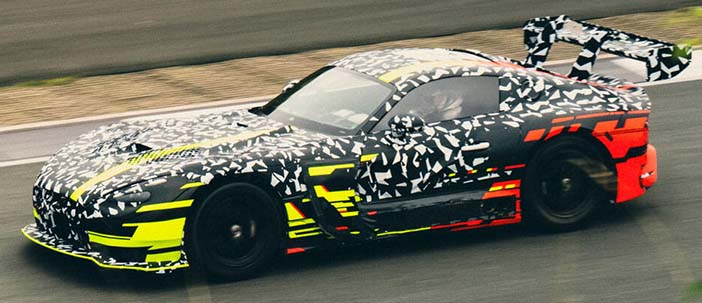
While it has been developed as a customer race car, it’s expected to provide vital clues to the next GT Black Series; traditionally the most powerful, focused and aggressively styled of AMG’s road-going sports cars. The most powerful variant of the second-generation GT at present is the 612 hp track-focused Pro. It’s plausible this new model could push beyond that.
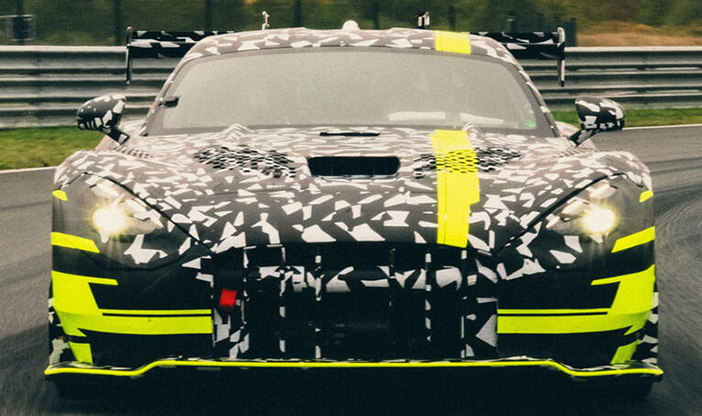
Among the modifications brought to the GT Track Sport are a larger splitter at the base of the front bumper, an altered bonnet with new ducts for extra engine cooling and twin side exhausts within more prominent sill elements. The changes at the rear are even more extensive, with a new swan-neck rear spoiler offering manual adjustment of the horizontal wing for added downforce, together with an additional lip spoiler within the rear section of the boot lid. Details of the diffuser have been cleverly hidden, suggesting developments in this area are even more extensive than those brought to the GT Track Series launched in 2022. +++
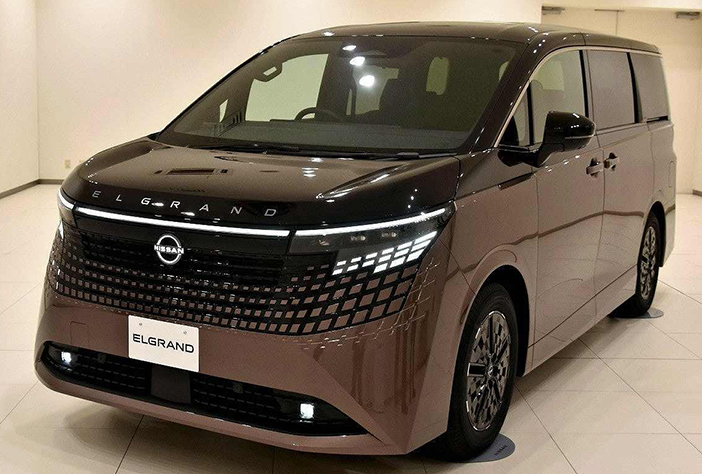
+++ NISSAN has unveiled the 4th generation Elgrand minivan at the Japan Mobility Show on Wednesday, ahead of the show’s official opening the following day. The updated model features a refreshed version of Nissan’s exclusive e-Power hybrid system, improving fuel efficiency and quietness, and is scheduled for release in summer 2026. The design creates a spacious area with enhanced visibility around the driver’s seat. It incorporates a large 14.3-inch display for showing information such as the meter readings. The speaker system promises an “immersive sound experience like being in a movie theater”. The first-generation Elgrand was introduced in 1997 and enjoyed popularity as a pioneer in the premium minivan segment. The new model marks the first launch in 16 years. Whether it can reclaim market share in the premium minivan segment, lost to models like Toyota’s Alphard, is drawing attention. +++
+++ SUBARU has given a glimpse at the future of its STI performance brand with a wild new sports car concept at the Tokyo motor show. The Performance-E STI concept “represents the future of the performance scene, spearheading Subaru’s new generation”, the company said.
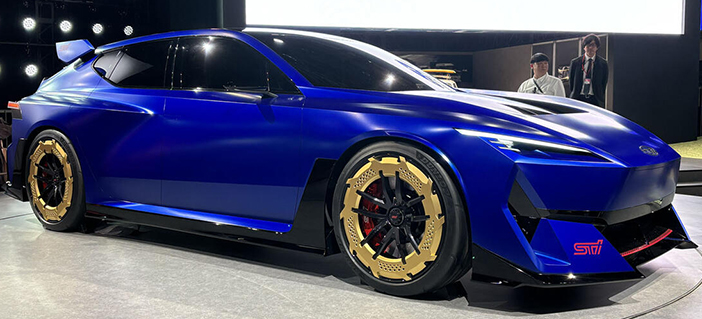
Subaru has given very few details of the concept but says it has been designed with influence from the brand’s heritage and offers a “driver-friendly layout and a comfortable, spacious interior”. It is also understood to feature 2 driven axles, in line with the STI brand’s affinity for 4WD, rally-honed performance. The concept comes shortly after Subaru Europe boss David Dello Stritto told: “There are plans to bring back the sportiness in Subaru”. He said the brand had a reputation for selling cars that were “safe, fun and tough” (SFT), but said there were opportunities to consider relaunching a performance model, with the previous Impreza WRX STI bowing out of Europe nearly a decade ago. “There’s a 4th pillar I’ve been missing to sell in Europe for the last 10 years and that’s P, for power and performance”, he said. “Ask the average person what Subaru means and they’ll say STI. You can’t disassociate this from Subaru. So we need to bring sportiness back to Subaru. Right now, we couldn’t do it: Europe says you can’t, because you have a GPF (gasoline particulate filter) that can literally choke your engine”. Primarily for that reason, he said, electric vehicles present an interesting opportunity to reinvent the STI brand because “you’ve got the power and performance, and you’ve got an all-wheel drive system”, the latter being an intrinsic element of Toyota’s performance heritage. “We’re working on more sporty models and electrification allows us to do this”, he said, and the Performance E-STI appears to be the manifestation of that ambition. Notably, it has been revealed just a few weeks ahead of the 30th anniversary of Colin McRae’s WRC title victory at the wheel of the Subaru Impreza 555 and clearly takes some influence from the iconic Group A dominator in its dark blue paint, gold wheels and pink STI detailing. It does not appear to be based on any current production model, but as a rakish, 5-door fastback, it could preview a successor to the current Subaru Legacy, which has been on sale outside of Europe for 6 years.
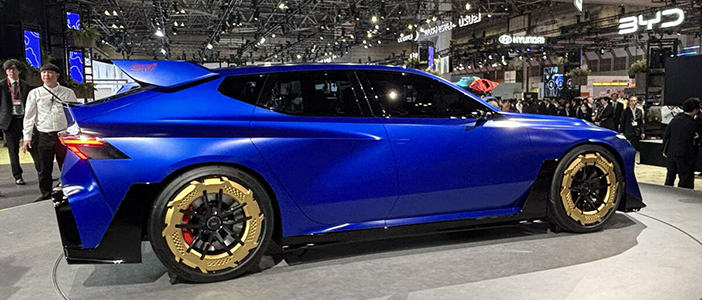
The Performance E-STI follows on from the wild STI E-RA concept Subaru revealed in 2022 as an early indication of its plans to maintain a performance car offering in the electric vehicle era. That concept, though, was a dedicated supercar (completely unrelated to any production model) with a quartet of Yamaha EV motors that produced 1.094 hp, and a carbonfibre monocoque helping to keep weight to 1.690 kg. Also on Subaru’s Tokyo stand was an STI concept version of the current production Impreza, which is more likely to enter production in the near future as a replacement for the US- and Japan-market WRX, which is effectively a stand-alone model separate from the Impreza line. Details were similarly sparing, but it was said to have a boxer engine and AWD, and had been designed to “offer more customers the chance to experience the joy of driving”. There was no word on any plans for a production version, nor any indication that it could be a global model. +++
+++ Practicality takes center stage at the TOKYO MOTOR SHOW , where many Japanese automakers showcase their latest electric vehicles set for release in the coming years as they race to catch up with overseas rivals and make environmentally friendly options more accessible to domestic consumers. A record-high 500-plus companies and organizations are participating in this year’s Japan Mobility Show, which opened to the media on Wednesday for a 2-day preview, encouraging visitors to envision the future of transportation. The event will be open to the public through November 9. Toyota unveiled an orange coupe concept version of its ultra-luxury Century at the event, positioning the model as a standalone brand alongside Lexus and its GR sports cars. “I believe the Century brand is born out of Japanese pride”, Toyota chairman Akio Toyoda said. “The phoenix, the Century emblem, only appears in times of peace. I believe the brand is built on our hope for world peace and the challenge of forging the next 100 years”. The world’s largest automaker by volume also showcased the next generation Corolla Concept, set to be available in multiple versions from electric to hybrid, while the Lexus brand unveiled its new 6-wheel vehicle. “Everyone has a love for the earth and wants to ride a cool car. Be it a battery EV, hybrid or engine, we want to create cars that people will want to ride”, said Toyota president and CEO Koji Sato. Toyota recently announced it will jointly develop cathode materials for solid-state batteries with Sumitomo Metal Mining, aiming to launch electric vehicles powered by the next-generation batteries between 2027 and 2028. Honda showcased its Super-One Prototype, a mini EV set to launch first in Japan in 2026 before expanding to other Asian markets and Europe. The vehicle comes with a “Boost Mode”, which enables the driver to accelerate rapidly and smoothly, alongside a built-in sound system that simulates an engine’s sound. “We are working on developing EV and hybrid vehicles to realize a carbon neutral world by 2050”, said Honda president Toshihiro Mibe. At Nissan’s booth, visitors can see the new Leaf released in Japan on October 17. The third-generation model of its electric vehicle can travel 702 kilometers on a single charge. The struggling automaker, which logged a 115.76 billion yen net loss in the April-June quarter, has been undergoing a restructuring overhaul to restore profitability. “Everyone at Nissan is committed to embracing change and taking bold, innovative approaches, united by a determination to redefine what’s possible, reshape our legacy and transform mobility”, CEO Ivan Espinosa said. “Together, we are forging a path to a more sustainable and inclusive world”. Chinese EV giant BYD will exhibit a prototype of its electric vehicle featuring its newest blade batteries, a type of lithium-iron-phosphate battery known for being safer and longer lasting, while South Korean automaker Hyundai is taking part in the mobility show for the first time. Japanese automakers are pushing toward EVs even though EVs made up just around 1.6 percent of new car sales in Japan in 2024, according to data from the Japan Automobile Dealers Association and the Japan Light Motor Vehicle and Motorcycle Association, with around 40 percent of those being imported vehicles. Although the global adoption of EVs has slowed down overall, some domestic automakers have targeted customers looking to replace their current vehicles, especially minicars, which account for around 40 percent of all domestic car purchases in Japan. Alongside major companies unveiling world premiere vehicles, the Tokyo auto show will feature the “Tokyo Future Tour 2035”, an area divided into 5 zones where visitors can experience what the world may look like 10 years from now, across land, sky and sea, including flying cars. +++
+++ TOYOTA is on track to launch solid state batteries (SSB) in a production car by 2028 and is set to deploy the bold new technology first in a performance electric car. Toyota is one of several mainstream car makers investing in the development of SSB technology – which has long been viewed as a crucial next step for electric vehicle development, with the potential to significantly reduce the weight and size of battery packs while increasing performance. SSBs are much more energy-dense than the lithium-ion batteries widely used in EVs today, so allow for much longer ranges while occupying the same physical footprint, and are therefore key to reducing the height of electric vehicles. Toyota announced its plans to eventually productionise the technology almost a decade ago, and more recently revealed a prototype pack, saying it would feature in a production car in 2027, and be capable of providing up to 1.200 km of range. Giving an update on the programme at the Tokyo motor show, Keiji Kaita, president of Toyota’s Carbon Neutral Engineering Development Centre, said solid-state technology is still considered “very important in the future”, for the significant improvements in usability and durability it offers compared to today’s conventional liquid-based packs. He added that the firm is “sticking on the schedule” to put its first SSB in a production car in 2027 or 2028, and is also considering commercial vehicle opportunities. Toyota says SSBs are capable of producing double the power of a current-generation battery, tripling the range and are four times more durable; characteristics that will ultimately define the types of cars they are used for. “For the all-solid-state battery, the characteristic is high power, compact and long-range”, said Saita. “The cars will leverage these attributes”. Based on that manifesto, a likely debut model for the new SSB battery tech is the upcoming Lexus supercar; a radical successor to the LFA which is thought to serve as an electric sibling model to the upcoming V8-engined Toyota GR supercar. Its ultra-low silhouette and promise of super-fast performance would make it a logical beneficiary of the new batteries. However, asked for clues as to the identity of the first solid-state car, Kaita would only say: “Whether it will be a Lexus or Toyota, we will leave that to your imagination”. Another important factor in Toyota’s development of SSP is the significant implications it could have for reducing the environmental impact of BEVs. “We will try to reduce the carbon footprint, and the key here is reducing the CO2 output in the process of manufacturing the material, but the most important thing is producing a battery whose life is longer”, said Santa. If an SSB battery remains usable for four times longer than a conventional battery, theoretically its total carbon footprint during the use cycle is 75% reduced. “We keep in mind that we want to prolong the life of batteries”, he said. Hiroki Nakajima, Toyota’s chief technology officer, said that “technically speaking”, SSB could be integrated into Toyota’s current EV platforms (where it could offer the same range in half the space) but the technology is primarily intended for use in new dedicated architectures. For existing architectures and more mainstream vehicles, Toyota is working on a lower-height lithium-ion battery for use in next-generation models (with side-mounted terminals and improved materials that help to bring its total height down, thereby increasing interior space and lowering the roofline of future EVs) as demonstrated by the sleek, low-slung Corolla concept. +++
+++ Long associated with American ruggedness, pickup trucks such as Ford’s top-selling F-150 have now become a symbol of international trade talks, showing how far countries such as Japan will go to win over U.S. President Donald TRUMP . When Trump met Japan’s new prime minister and first female premier, Sanae Takaichi, in Tokyo on Tuesday, an F-150 was parked prominently outside the Akasaka Palace venue. Burly U.S. pickup trucks are a rare sight in the Japanese capital, where the streets are narrow and turns can be painfully tight. But the placement of the F-150, which is not typically available for sale in Japan, sent a clear message about Tokyo’s willingness to buy more cars from its ally, an issue that has been a sore point for Trump for decades. Last week, Reuters reported that Takaichi’s government was working on a package to buy F-150 trucks, an idea originally floated by Trump, as well as soybeans and gas. “Well, that’s great. She has good taste”, Trump told reporters on Air Force One, when asked about the report. “That’s a hot truck”. In August, Trump said Japan was ready to purchase the “very beautiful” F-150. It was not clear how many F-150s Japan planned to buy. Japanese government sources have told Reuters the trucks would probably end up being used as snow plows, given their size. Japan and Europe, Trump has often complained, refuse to accept U.S. cars even as Japanese and European automakers sell millions of their vehicles each year in the United States. But the reluctance to buy American has little to do with trade barriers. Both in Tokyo and London, many drivers see Detroit cars as simply too big and too costly to run. The F-150 won’t be the first American car brought in to Japan to help ease trade friction. 3 decades ago, Toyota responded to U.S. pressure by selling a mid-sized General Motors car under its own brand in Japan. The Toyota Cavalier was introduced with much fanfare, sold poorly and quietly faded after a few years, said John Shook, a former Toyota manager and an auto industry veteran in both Japan and the United States. Any attempt to sell the F-150 would likely go the same way, he said. “Don’t expect to see the F-150s roaming the streets of Tokyo or hauling crops from the countryside. They are too big, too expensive, too gas-guzzling and simply a bad fit all around. Not to mention the steering wheel is on the wrong side”. A third of the 3.7 million new cars sold in Japan last year were mini or kei cars, tiny vehicles that are not produced by American automakers. Foreign cars accounted for 6% of new car sales overall, with European brands among some of the top sellers, industry data showed, while Ford itself pulled out of Japan almost a decade ago. Separately Trump said Toyota would open auto plants in the United States to the tune of $10 billion. A Toyota spokesperson was not immediately available to comment on Trump’s remarks. +++