
+++ ALFA ROMEO and MASERATI will create new “few-off” flagship models as part of the new Bottegafuoriserie bespoke programme. Similar to Bentley’s Mulliner and Lamborghini’s Ad Personam, the new division has been created to enable buyers to extensively customise their purchases and “turn their car into a unique model”. Alfa Romeo and Maserati said Bottegafuoriserie will also “become the cradle of high-emotion vehicles that push the boundaries” and pave the way for successors to the Alfa Romeo 33 Stradale and Maserati MC20 MCXtrema, as well as new range-topping models to sit alongside them. While little else about the additional new models has been revealed, Santo Ficili (who is CEO of both car makers) previously told that Maserati was working on a new limited-run super-GT that would be based on the current Granturismo, fitted with a manual gearbox and draw power from a V6 engine. He added that it would be twinned with an equivalent Alfa Romeo model; similar to the way in which the Alfa’s 33 Stradale is based on Maserati’s MC20, so it seems highly likely that it will be part of the Bottegafuoriserie programme. The programme will also incorporate Maserati’s Corse racing team, which will be tasked with developing new powertrains, aerodynamic packs and chassis designs. More broadly, the extent of customisation hasn’t been disclosed, but it can be expected to bring in an added revenue stream for the two struggling brands. For reference, around 70% of Bentleys sold feature some level of customisation from its Mulliner division. Speaking today, Ficili said Bottegafuoriserie is “the symbol of a new era for Alfa Romeo and Maserati” and one that is “the first milestone in a broader transformation that will define the future” of both brands. +++
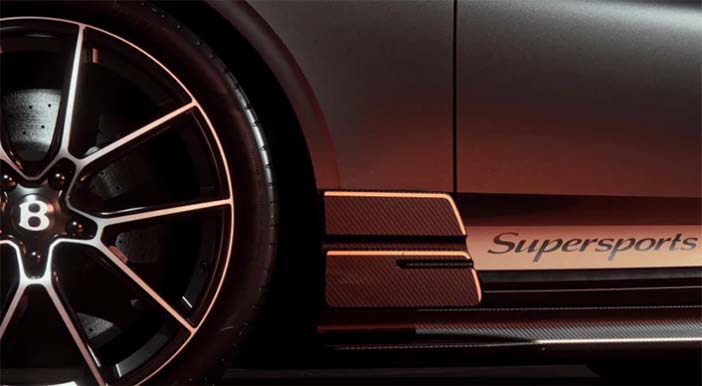
+++ A new era of high-performance BENTLEY CONTINENTAL GT is about to begin, with the British brand issuing a second teaser image of its new flagship ‘Supersports’ model as a possible rival to the Ferrari 12Cilindri and Aston Martin Vanquish. Billed as the “lightest, most driver-focused” Conti GT ever, the new car will be revealed in New York on 14 November. The first image surfaced last month and showed the darkened rear of a modified Continental GT with a large spoiler, redesigned bumper and more aggressive diffuser. This new picture shows a close-up of the car’s front wheel, plus what looks like plenty of carbon-fibre trim on the sill. It also reveals the ‘Supersports’ badge for the first time. Further to this, we can make out what looks like some matt paint and copper-coloured details, while behind the multi-spoke wheel looks to be a set of carbon-ceramic disc brakes. The rest of the car remains under wraps until the big unveiling next week. A short release accompanying the second image confirms that the new Bentley Supersports will be subject to a “limited production run”, although it’s not clear at this stage how many will be built. The Continental-based 2-door will be only the 4th model in Bentley’s history to use the Supersports name. No information has been issued on what might power this new model, but Bentley has confirmed that it will be the “first rear-wheel-drive Continental GT” ever. With the W12 dead, and the V8 now only available with a plug-in hybrid module attached, this new model is expected to offer a more old-school solution. Expect to see a highly strung iteration of the twin-turbocharged 4.0-litre V8 engine without its hybrid components. A lower-spec 550 hp version of this engine had been used in this generation of Continental for years, but the more expensive 12-cylinder above always capped its ultimate power figure. The engine will be connected to an 8-speed dual-clutch transmission. Other models that run on the Bentley’s MSB platform, such as the previous-generation Porsche Panamera Turbo S, are capable of producing up to 640 hp with this engine. This could give us a pointer as to the potential power figure of the new Supersports. I don’t have any more information at this stage, but expect the new flagship to be the most expensive two-door Bentley Continental in the range, with a price point likely to start close to 500.000 euro in the Netherlands. It’ll be revealed on 14 November. +++
+++ Up until very recently, BMW offered 2 different variants for each of its M cars: The standard M and the more powerful Competition model. Lately, however, the brand has quietly started phasing out its Competition trim. But BMW has a good reason for the shift. In a recent interview with BMW Blog, BMW M CEO Frank van Meel confirmed that the Competition trim is all but dead on future M cars. The reasoning? Buyers simply preferred the higher-performance version. Van Meel said: “More than 80 percent of our customers went straight for the Competition. So we said, let’s just make that the standard one. You could say that every M model today is a Competition”. According to Van Meel, the move will help simplify the M line-up moving forward. Buyers will soon have just 3 options to choose from: The base M, the CS and the CSL. Standard M models will now include many of the features (including power) previously reserved for Competition versions, while the CS and CSL trims will focus on reduced weight and enhanced track performance. For now, BMW still offers the Competition option on select 2026 models, including the M3 and M4. Checking the Competition box keeps rear-wheel drive and bumps the output from 480 hp to 510 hp. Opting for the Competition xDrive with all-wheel drive nets you 530 hp. The X5 M also retains its Competition trim for 2026, with an output of 625 hp. That said, newer models like the M2 and upcoming M5 no longer offer a Competition version for 2026. That change will undoubtedly extend across the entire M line-up in the near future. +++
+++ DACIA will go after the Skoda Octavia next year with a new rugged estate model that’s petrol-powered, off-road ready and priced at less than 34.000 euro in the Netherlands. Due for launch in the coming months, the new model will play a crucial part in Dacia’s expansion into Europe’s most popular car market, the C-segment, which already accounts for a fifth of the firm’s sales, following the introduction of the Bigster this year. A third C-segment model will arrive around a year later. Dacia’s new CEO, Katrin Adt, told that the success of the Bigster has inspired confidence within the company that the brand can continue to expand within the highly competitive C-segment. “Our main territory currently is the B-segment, but we have also offerings in the A-segment and we have started in the C-segment and we did that quite amazingly well with the Bigster”, she said, noting that the Nissan Qashqai rival was in the top 10 bestselling retail cars for several key markets (including France and Germany) in July. In order for this expansion to be successful, though, Adt said: “You need to watch out that every car has its own place in the segment, its own purpose, and you can be pretty sure that this will be a totally different offer to the customer than the Bigster”. Indeed, a leaked photo of what appears to be a late-stage prototype for the new model – codenamed C-Neo – shows that it will look effectively like a stretched and lifted Sandero, taking the form of a high-riding compact estate car that is expected to be around 4.6 meter long. Product performance boss Patrice Lévy-Bencheton said: “There is also a significant share of the C-segment which is ‘non-SUV’ people, who are still looking for a lower driving position, a more efficient product which is less ‘ostentatious’. For some, an SUV is a bit ostentatious”. He added that there is a significant proportion of buyers in this space who want “the performance, the comfort and the pleasure of having a slightly bigger car but who are not attracted by the SUV shape and who think: ‘We have to go for a more efficient product, more elegant”. Dacia sales and marketing boss Frank Marotte agreed and said the impending retirement of the Ford Focus and increasing prices of its contemporaries (such as the Volkswagen Golf, Opel Astra and Toyota Corolla, have opened up an opportunity for Dacia in this segment, where it plans to undercut all major competitors, just as it did with the Bigster. “What we want to do in the C-segment is what we’ve done in the B- or the B- plus”, said Marotte. “We have identified that with the C-SUV particularly. But even the C-hatch is probably a segment where the prices have gone up the most in the last 5 years. You see the increase in monthly instalment or in prices in that segment. It’s massive”. He acknowledged that “the C-hatch segment is a challenge for us; indeed, we have no customer base” but said the success of the Bigster (around 50.000 orders in its first 6 months) gives the brand confidence that its expansion into larger models is viable. Dacia will pursue a similar pricing policy with the new estate, leaving out what the company perceives to be ‘non-essential’ equipment in order to maintain a lower list price than its core rivals. The Bigster, for example, a lot cheaper than the same-sized Qashqai. The C-Neo, then, is likely to come in around the 28.000 euro mark in the Netherlands, commanding a premium over the smaller Sandero but still being significantly cheaper than the Seat Leon and Skoda Octavia estates. Being based on the same Renault Group CMF-B that Dacia uses for all its models except the Spring EV, it is expected to be all but technically identical to the Bigster, with a choice of mild- and full-hybrid petrol powertrains ranging in output from 130 hp to 160 hp, though it remains to be seen if it will follow its SUV siblings (and its Skoda rival) in being offered with 4-wheel drive. Either way, the new model will stay true to Dacia’s ‘rugged’, activity-focused ethos by virtue of its raised suspension and body cladding; a similar treatment to that on the range-topping Sandero Stepway, which design boss David Durand said “is a bit ‘outdoors’ too”, despite being front-driven. He said: “In this case, it’s just ground clearance and high tyres that make you confident to go on a rocky road with no fear, and you use it every day, and you fill it with anything you want. “It’s a tool. It’s not an object that you show off in front of your house and that represents your social level. It’s something that you are really using every day, with the kids, with adults. You have big roominess. So it’s this slightly different ‘outdoors’ way that we can explore”. Durand would not be drawn on a potential reveal date, nor commit to any firm details of the new car, but said it “makes a lot of sense” for Dacia to enter this segment, as other brands “are just abandoning this field, because everybody’s making SUVs”. +++
+++ The ill-fated electric JAGUAR XJ, previously understood to employ exclusively electric powertrains, could have used a combustion engine. XJ designer Ian Callum said the saloon “was packaged to take a 6-cylinder engine, if need be”. That would have given Jaguar crucial flexibility to respond to fluctuating demand for electric cars. That could have proven a boon for the brand, given the growth of the EV market has fallen short of forecasts made when it was cancelled in 2021. Several of Jaguar’s former rivals have been stung by the shortfall, with Mercedes among the most notable. This German brand plans to end production of the EQE and EQS saloons early, in favour of launching a new S-Class with the choice of either internal-combustion or battery-electric powertrains. Callum did not elaborate on what specifically would have powered the XJ. It would likely have used the same straight-6 offered in the Range Rover and Range Rover Sport, based on the MLA architecture that would also have underpinned the XJ. Callum also revealed that the XJ would have broken from tradition in not offering a choice of short- and long-wheelbase bodies. “We didn’t want to get into this ramble about 2 wheelbases, which seemed quite traditional, so we created something in the middle in terms of size”, he said. He added that the new XJ’s design was “more stately”; something he “fought against”. Callum revealed that alongside the XJ and the J-Pace, he also designed a new F-Pace, ”which doubled up as a new I-Pace”, as well as a “new Jaguar sports car” that would likely have replaced the F-Type. Callum left Jaguar in June 2019 to co-found his own design consultancy, Callum Design, with former colleague David Fairbairn. The XJ was cancelled in February 2021 as JLR enacted its Reimagine strategy, which has manifested Jaguar’s complete reinvention as a brand. Callum did not explicitly provide his thoughts on Jaguar’s new look, nor on its Type 00 concept car, but said: “I look at all these new electric cars and they look like they were designed 20 years ago. I don’t understand why they got long bonnets on them. Why would you build an electric car with a long bonnet on it? It’s not got a V12 in there. I can’t think of any in particular, mind you”. +++
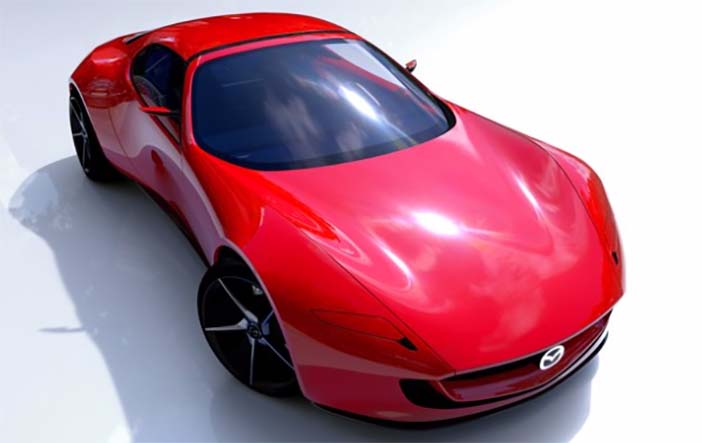
+++ MAZDA could reverse plans to build a production version of its Iconic SP sports car concept due to the financial demands of developing a bespoke architecture for a new line of pure-electric cars. Revealed at the Tokyo motor show in 2023, the Iconic SP is an MX-5-sized 2-seat coupé that theoretically uses a 360 hp range-extender EV drivetrain, with a small-capacity rotary engine serving to top up the battery on the move. Last year, Mazda design chief Masahi Nakayama suggested that the company was committed to putting the Iconic SP into showrooms, saying it was “not just one of those empty show cars”. “It’s been designed with real intent to turn it into a production model in the not so distant future”, said Nakayama of the coupé concept, which was designed and engineered with the prospect of homologation in mind. But now, 2 years on from its unveiling, Mazda is well under way with the cost-intensive process of developing its own bespoke EV architecture, which will underpin its first car in 2027, and launching a production version of the Iconic SP is not a priority. Asked for an update on plans to build the rotary-electric sports car, chief technology officer Ryuichi Umeshita said: “Let me answer personally: that is my dream car. I want to make it real. Technology-wise, it’s possible. The only outstanding issue is financial”. Since Mazda revealed the Iconic SP, it has embarked on a drastic cost-cutting strategy that has slashed its investment in future electrification initiatives by around 3 billion euro, or a third of what it had originally planned, in the run-up to 2030. The so-called ‘lean asset’ strategy is designed to help Mazda, which describes itself as “a small player in the industry”, stay profitable and competitive as global EV uptake falls well below the industry forecasts that had underpinned previous investment strategies. The firm remains committed to the concept’s rotary engine-based hybrid technology, however, and has evolved it into a 510 hp PHEV set-up for the new Vision X-Coupé, a 4-door sports GT that builds on the Iconic SP both visually and technically, and Umeshita said a production version of the smaller car was not entirely off the cards. “We have re-established the rotary engine development team, and we know that our DNA is in sports cars, so I would never say we gave it up”, he said. Mazda remains committed to using its trademark rotary technology in electrified drivetrains and says the Vision X-Coupé’s powertrain (with a combutstion engine running on microalgae and equipped with a carbon-capture device at the tailpipe) could even be “carbon-negative”. However, the firm is still working on reducing the inherent increased emissions of a rotary engine and says it needs another “2 to 3 years” of development before it can use such a motor to drive the wheels, rather than as a generator as deployed in the MX-30. It is feasible that a breakthrough in this area could pave the way for the Iconic SP to see the light of day, but with Umeshita saying the firm will continue to build the similarly sized MX-5 for “as long as possible”, it is unclear where the Iconic SP could sit in the line-up. +++
+++ RIVIAN has reported a wider net loss for the third quarter of 2025, as the US electric vehicle maker continues to invest heavily in its next-generation R2 platform, new production capacity, and its autonomy roadmap. The carmaker reaffirmed its guidance and said R2 remains on track for a 2026 launch. Rivian’s net loss attributable to common stockholders widened to $1.17 billion in the third quarter, compared to $1.1 billion in the same period last year. Meanwhile, total revenue rose sharply to $1.56 billion, up 78 percent year-on-year, driven by increased deliveries and a surge in software and services income. Automotive revenue climbed 47 percent to $1.14 billion, while software and services revenue reached $416 million; up more than 3-fold. Around $214 million of this came from the joint venture with Volkswagen Group to develop vehicle electrical architecture and software systems. The company also reported a small consolidated gross profit of $24 million, compared to the $392 million loss in Q3/2024. Rivian released its production and delivery figures in October. The manufacturer produced 10.720 vehicles and delivered 13.201 between July and September, including the first Amazon delivery vans for Canada. The company expects 41.500 to 43.500 deliveries in 2025. This further narrows the company’s expectations for 2025. When announcing its second-quarter figures, Rivian had set a target of 40.000 to 46.000 vehicles. It also reaffirmed its adjusted profit guidance of minus $2.0 to $2.25 billion and capital expenditure forecast of $1.8 to $1.9 billion. “We continue to make significant progress across our strategic priorities including preparation for the launch of R2 and development of our technology roadmap including autonomy and our vertically integrated hardware and software”, said Rivian. “While we face near-term uncertainty from trade, tariffs, and regulatory policy, we remain focused on long-term growth and value creation”. The R2 compact SUV is seen as Rivian’s key volume product. Production and deliveries are planned to begin in the first half of 2026 at the company’s Normal (Illinois) plant, which will have capacity for up to 155.000 R2 units per year. Construction has also started on a second manufacturing site in Georgia, expected to add 400.000 units of annual capacity once complete. Cash and equivalents totalled $7.09 billion at the end of September, with overall liquidity of $7.69 billion. Operating cash flow turned positive at $26 million, compared to an $876 million outflow last year. Free cash flow improved to minus $421 million from minus $1.15 billion. “We believe the future car parc will be fully electric, autonomous, and software-defined”, Rivian said in its shareholder letter. “We remain confident in the opportunity ahead for Rivian”. +++
+++ With Cupra going from strength to strength thanks to a seemingly never-ending suite of new model launches, it seemed like the Volkswagen Group was quietly shuffling SEAT off to retirement. But during a presentation at the delayed media launch of the facelifted Ibiza, Seat bosses finally addressed mounting questions about its future. Alongside the announcement that the Ibiza and Arona will get mild-hybrid powertrains in 2027, Seat also revealed the slow-selling 4h-generation Leon will gain a new electrified engine in 2028, ahead of an even bigger update in 2029. That new powertrain will be the full-hybrid system set to appear in the second-generation T-Roc next summer. We already know the set-up will comprise a 1.5-litre 4-cylinder petrol engine with an electric motor mounted to a 7-speed DSG automatic transmission. It’ll be offered with a choice of power outputs: 136 hp or 170 hp. With the ability to power the front wheels via the petrol engine or electric motor, we’re expecting big improvements when it comes to fuel economy and emissions. The full-hybrid is not only set to arrive on the Leon hatch, but the Estate variant too. Shortly after the hybrid model’s launch, Seat will bring an “updated Leon range” to market in 2029. Given the current car will be almost 10 years old by then, we expect a significant reskin. It’ll likely sit on the same MQB Evo platform as the existing car, meaning that alongside the full-hybrid, there’ll be the possibility of retaining mild-hybrid and plug-in hybrid engines; something that Seat says is “key for market penetration”. Further detail is thin on the ground for now, but I expect an evolution of Seat’s current design language, with a sharp, angular look along with updated platform technology and a major interior overhaul. Sven Schuwirth, Seat’s executive vice president for sales and marketing, told: “You will be surprised. Last year we introduced changes to infotainment and the addition of the Leon plug-in hybrid. There will be a bigger update in 2029”. The Leon will be a key car for Seat because there doesn’t appear to be a plan for a second-generation Ateca. Markus Haupt, CEO of Seat and Cupra told: “Ateca is a car we launched with lots of success, we even made a Cupra out of it. Now we have the Cupra Terramar, that is complementary to the Ateca, so we prioritise small cars; they are the ones that need an update”. Seat is now seen as an ‘entry’ brand in the VW Group, meaning pricing will be of increasing importance for the Leon and other models in the future. With the aim of undercutting VW and Skoda, I asked Schuwirth about the potential of Seat rivalling even the likes of Dacia for price. “We could be, depending on the car”, he told me. “We don’t like focusing on value alone, we are a Spanish brand and we will certainly keep some of the emotional level, because that is a real asset”. +++