+++ ABARTH is mulling a return to petrol power with a hot hatch based on the new Fiat 500 Hybrid, the boss of the brand’s European arm has told. Abarth currently sells electric cars only, having discontinued the petrol-powered 595 and 695 in August 2024 when the previous-generation Fiat 500 that they were based on was also retired. But customer feedback to the Abarth 500e and 600e has prompted the brand to reconsider its strategy: “The Abarth customer wants a combustion engine not only for the power but because Abarth customers fundamentally buy the car and then modify it with their own hands”, said Gaetano Thorel. “On the electric one you cannot, so for them it’s a limitation: they cannot put their hands on the engine and fuel, and that’s why the Abarth club are not very happy with us”. Indeed, Abarth’s sales have fallen significantly since it discontinued its petrol models. Thorel confirmed that the modified Fiat 500e platform underpinning the new Hybrid can, in theory, accommodate more power. However, the 500 Hybrid’s engine, a naturally aspirated 1.0-litre 3-cylinder producing 65 hp, “cannot do it”, said Thorel. That is in no small part due to its low output, which will make the 500 Hybrid one of the slowest-accelerating cars on sale: the city car takes 16.2 seconds to hit 100 kph from rest. Thorel hinted the engine also has the wrong character for an Abarth, pointing to it delivering the bulk of its power linearly from just 2.000 rpm, rather than encouraging drivers to chase revs. The question of what engine could be transplanted into the 500 Hybrid, or how its 1.0-litre unit could be made more powerful, poses a significant challenge for Abarth. Given it is based on a platform that was designed solely for the electric Fiat 500e, which employs a diminutive motor, there is little room to fit anything much larger or demanding much greater cooling than the existing 1.0-litre. There is also a hurdle to negotiate in the return on investment of developing a new 500 Abarth, given it is a niche product. Nonetheless, “we are trying”, said Thorel. Regardless of whether a new 500 Abarth comes to fruition, Thorel’s comments are the first suggestion that Abarth could break from its previous strategy of offering only EVs in the future. That could have significant implications for the larger 600, as well as any future models being considered for the Abarth treatment. +++
E+++ Vehicle safety body EURO NCAP is dramatically changing the way it tests cars, primarily to better evaluate the effectiveness of cars’ driver assistance systems and the usability of their cockpits. Euro NCAP says this is the biggest change it has made to its testing programme since 2009. The new procedure overhauls the way cars are tested and scored: under 4 new core pillars of safety: safe driving, crash avoidance, crash protection and post-crash safety. Importantly, the organisation says, several of these changes have been made “in response to consumer feedback”, highlighting criticism over the “annoying warnings or intrusive interventions” of some advanced driver assistance systems (ADAS). The changes will come into effect from 2026. Euro NCAP is also seeking to better evaluate the real-world utility of such systems, to ensure they function as required outside of the confines of the test track. From 2026, higher safety ratings will be awarded to cars equipped with “driver monitoring technologies that maintain attention and engagement behind the wheel”, with points awarded to “systems that monitor driver performance in real time”. The best scores will be given to cars that continuously track the head and eye movements of their drivers, and use that information to adjust the sensitivity of the ADAS functions, with special commendation to systems that can detect the influence of drugs or alcohol, and safely stop the car if the driver falls unconscious. Euro NCAP will also evaluate the “placement, clarity and ease of use” of essential controls and its new scoring system will emphasise the importance of physical buttons for commonly used functions in response to consumer feedback that suggests they can reduce distraction. Various parts of the testing process will also be updated to ensure Euro NCAP’s ratings are based on the real-world effectiveness of safety systems, not just their performance on the test track. Testers will evaluate the accuracy of speed-limit recognition functions (a common pitfall of modern ADAS suites) on the road, for example, “with the aim of improving consumer acceptance”. The focus on real-world efficacy extends to a new testing programme for crash-prevention technologies, including autonomous emergency braking (AEB) and lane keep assist. This will “reflect real-world accident patterns” by introducing new urban-focused test scenarios that include cyclists and motorcyclists as part of the simulated traffic. These systems will also be rated on their “smoothness and intuitiveness”, in response to criticism that they can intervene unpredictably and distractingly. As well as revamping its testing process for crash prevention and protection, Euro NCAP will also place more focus on ‘post-crash safety’: electric door handles must now remain functional after an accident and EVs must “correctly manage the isolation” of their batteries to mitigate any fire risk. Automated emergency response functions will also now need to be able to tell responders how many occupants are in the car, following an impact, so the correct emergency response can be organised. Euro NCAP secretary general Michiel van Ratingen said the wide-reaching changes are aimed at boosting the “rigour and relevance” of the organisation’s test procedure, while ensuring cars are tested on their performance before, during and after a crash. He said: “The updates to protocols ensure that Euro NCAP’s testing, analysis and ratings remain the definitive guide for consumers who value an impartial guide to the safety of the latest cars. Euro NCAP continues to advance safety standards across all aspects of vehicle design and the 2026 protocols embody this commitment by encouraging manufacturers to adopt and enhance life-saving technologies. The intended outcome is improved protection for vehicle occupants and all road users through more effective driver assistance, robust accident prevention, enhanced crash protection and improved post-crash management”. +++
+++ FIAT is eyeing up a new, lightweight, low-cost EV designed to offer more flexibility than the Topolino, but greater urban focus than the 500 and Grande Panda. The plans, which appear to already be in motion, will attempt to second-guess EU regulators who are expected to incentivise the pre-defined ‘L7’ class of small car within the next few months. As outlined by the European Commission, L7-approved models are vehicles “whose unladen mass is not more than 400kg, not including the mass of batteries in the case of electric vehicles and whose maximum continuous rated power does not exceed 20 hp”. Such a car would therefore sit above quadricycles like Fiat’s own Topolino, plus the Citroen Ami: offering more power, a higher top speed and more usable range thanks to a bigger battery. The limitations placed on this class of car, however, would see it undercut models such as the Dacia Spring and Leapmotor T03 – both of which are currently available in the Netherlands from under €20.000 with a battery only big enough for around 110 km of range. The news that Fiat is considering a small, lightweight EV, comes just a couple of months after then-boss of Stellantis Europe, Jean-Philippe Imparato, called for the EU to rewrite the targets for electric-vehicle adoption. Imparato suggested car makers could “revamp and revolutionise the A-segment in Europe” with a selection of 15.000 euro city cars built and engineered locally. “We need less discussions and more actions”, Imparato declared at the time. “The bottom line is that 2030 and 2035 targets in CO2 trajectory are not achievable. The market is not there, economical customers are not there, the charging infrastructure is not there, and the pricing is not there”. Revisiting the subject this week, Gaetano Thorel, Head of Fiat and Abarth in Europe, likened the opportunity to the success of Kei cars in Japan. “The car is limited in size, limited in weight, limited in space. It’s a clear choice. And now, one third of the Japanese domestic car industry is Kei car. It would be easy to take inspiration; for Fiat, it is our territory”. Thorel is “confident” EU regulators will make an announcement soon. “There are a couple of good signs”, he told. “First of all, the European Commission realises the automotive industry in Europe is in danger. Now it needs to decide how to support the automotive industry without, let me say, losing face. We are confident they will do something; there is a meeting on 10 December”. Fiat is on a roll at the moment, pushing the latest 500 Hybrid through from concept to production reality in just 20 months. The new small EV would require more extensive development, but the brand’s head of product, Guillame Clerc, said his team “can do it in 2 or 3 years”, with the aim of beating Chinese rivals to market. Thorel concluded: “Don’t forget that Fiat is the master of urban cars. Look at the A-segment in Europe: Fiat is number one, with distance”. +++
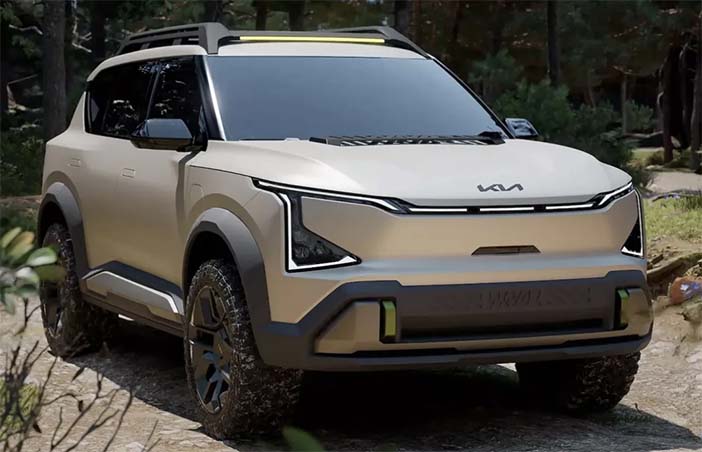
+++ The KIA EV5 is a fine family EV, but what if you want one that’s a little more off-road focused? Well, that’s where the Kia EV5 Weekender steps in. A concept revealed at the Guangzhou Auto Show in China, the EV5 Weekender is the fourth model from the brand to get an ‘off-road’ overhaul, following the EV9 Adventure and PV5 Weekender. Showing scant disregard for vowels, Kia actually calls the Weekender and Adventure ‘WKNDR’ and ‘ADVNTR’ respectively. While the EV5 might be a rather mild-mannered, electric SUV, the Weekender has been bestowed with a whole load of kit to transform it into a true off-roader. Designed by the Kia China Style Team, it gets knobbly all-terrain tyres wrapped over bespoke wheels, plus raised suspension to ensure there is sufficient ground clearance. As we’ve seen with other Weekender concepts from Kia, this EV5 gets a matt beige paint finish with lime-coloured detailing. There are also wider wheelarches, new side sills, a mounting bracket on the bonnet, a roof rack and unique bumpers front and rear with embedded ‘WKNDR’ script. The interior has been given a makeover, too, with a new one-prong steering wheel, reshaped dashboard, revised doors and centre console, plus an extra wide screen on the dash that stretches over the passenger’s side. Kia hasn’t said what powertrain the EV5 Weekender uses but it’ll almost certainly be the dual-motor version, destined for Europe in 2026. This features 265 hp or 308 hp in the flagship EV5 GT, but more importantly for the off-road focused Weekender, it powers all 4 wheels. While there are no plans yet to put the EV5 Weekender into production, Kia has a history of slightly more rugged trims, with the X-Line offered across the model range from the Picanto up to the Sorento. The Korean firm may also decide it needs a rival to sister brand Hyundai’s US-only XRT trim, which is offered on the Ioniq 5 and Santa Fe among others. +++
+++ LOTUS will definitely sell its forthcoming plug-in hybrids in Europe following the global unveiling of the first such model in January, its CEO has confirmed. The first Lotus PHEV, expected to be a version of the Eletre large SUV, will pack 920 hp and come with air suspension and an active stabiliser for “ultimate handling” ability, Feng Qingfeng said on the company’s November earnings call. Sales will start in China in the first quarter of 2026, with a European launch expected in autumn. Lotus pivoted to PHEVs after sluggish take-up of EVs in the premium and luxury segments forced the company to ditch its plan to go all-electric by 2028. “The introduction of hybrid models offers more choice for luxury vehicle buyers and will help us expand into broader markets, including regions with slower EV adoption, such as Italy and Spain and Saudi Arabia”, Feng said on the call. The move will also allow the Geely-owned company to avoid the EU’s higher tariffs on Chinese-built EVs. Luxury brands, led by Bentley and Lamborghini, have embraced PHEV technology as a way to reduce emissions while retaining customer-valued V8 engines and inject yet more performance. In the first 9 months of the year, PHEVs accounted for 68% of Bentley’s production and 90% of Lamborghini’s. Lotus has said it will launch three PHEVs, including a new smaller SUV below the Eletre in 2027 that has been dubbed Vision X. Lotus has made a series of bold claims for its so-called Hyper Hybrid technology, which features a 900 Volt electrical architecture to enable charging speeds “very similar to a battery swap”, Feng said. The combustion engine can also top up the battery on the move, Lotus has confirmed. No details have been revealed about said engine, but it’s likely to be a high-powered turbocharged 4-cylinder. Under Geely, Lotus has struggled to find a way to convert its sizeable investment into profit. The company posted an operating loss of $357 million for the first 9 months of the year, amid a concerted effort to reduce costs. The new PHEV models will help Lotus increase profitability, its CFO Daxue Wang said on the November earnings call. Wholesale deliveries (those to dealers) fell 40% in the first nine months of the year to 4.612 cars, partly hit by US tariffs. In the United Kingdom, sales fell 27% to 1.222 to the end of October after demand for the best-selling Eletre and the Emira sports car dropped. Lotus has moved its European headquarters from the Netherlands as part of wider cost cutting. The news comes after reports said Lotus was planning to shift sports car production from its base at Hethel to the US. “Returning to Lotus’s birth place helps us retell the brand story and strengthens our reach across Europe and beyond”, Feng said. +++
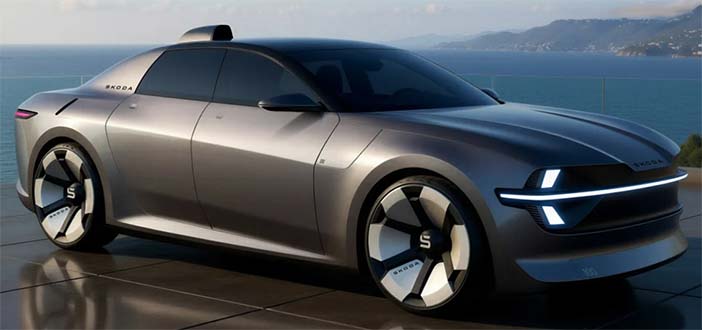
+++ Between 1969 and 1977, SKODA produced over 1 million units of its 100 and now the Czech firm has reimagined it as a modern-day EV. The 100 concept features a sharp, angular design that brings a futuristic twist to a shape from the sixties. The man responsible is Skoda exterior designer, Martin Paclt, who said, “I wanted to work with a car that people know well and that many once owned themselves. The Skoda 100 appealed to me with its clean, timeless lines, which resonate strongly with the current Modern Solid design direction”. Skoda has been looking to its classic cars for inspiration recently with several concepts as part of its ‘Icons Get a Makeover’ series. So far we’ve seen a two-door coupe, 21st Century interpretation of the Favorit and the achingly cool 110R concept. The new concept follows this trend, but there’s some influence from Skoda’s current models too. “I drew from the proportions of the Superb, and the resulting concept turned out slightly larger”, said Paclt. He also said he didn’t want to do a “retro-styled recreation”. The concept comes with a few modern design cues like the indented bonnet line leading to the ‘Skoda’ script and a four-headlight signature. The stand-out part of the concept’s design comes towards the back. The original Skoda 100 was rear-engined and Paclt wanted the concept’s rear-drive layout to have an impact on its looks. “I wanted to create a concept with a certain degree of realism”, said Paclt. That can be seen in the cooling: there’s a roof-mounted intake in the place of a back window and to the side there’s more air intakes, similar in positioning to the original car’s. Around the rear the full-width slats mimic the cooling required for the Skoda 100’s 1.0-litre 4-cylinder. As with the other creations within the Icons Get a Makeover series, the 100 sedan concept isn’t destined to make production. However, with Paclt previously getting involved with the design of the Kodiaq, Karoq, Scala and many other production Skodas, we’ll wait and see what influence he and the 100 sedan concept will have on future models. +++
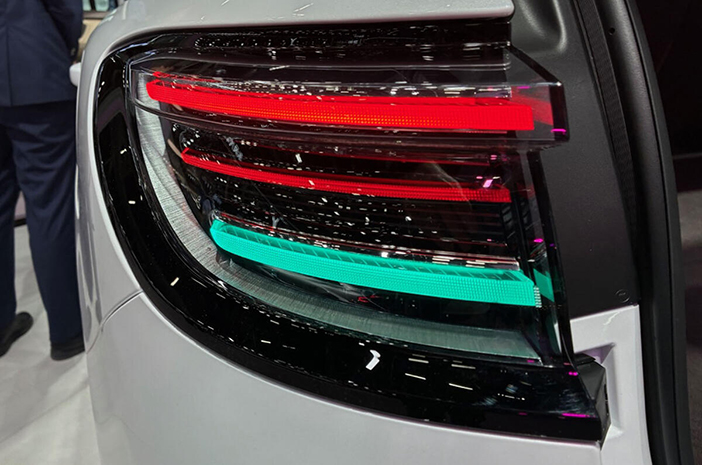
+++ If a motor show can have a signature colour, that of the recent Guangzhou event in China was TURQUOISE . Not due to a popular body colour but LEDs illuminated at various places on the exterior of multiple cars. Turquoise light indicates that a car is driving in a semi-autonomous or autonomous mode, and it has become the latest must-have to lure customers in the cut-throat Chinese car market. Bright turquoise LEDs were everywhere at Guangzhou, acting as a beacon to showgoers that these models from Xpeng, MG owner SAIC, Aito, Luxeed, Maextro or Li Auto could take control to give the driver welcome respite from the city’s traffic jams. +++