
+++ The new car market in EUROPE expanded in October for the 4th consecutive month in 2025. Sales of of battery-electric vehicles were up by a third. Car sales increased in the three largest car markets in Europe: Germany, Britain and France. Volkswagen remained the leading carmaker and brand in Europe. The Dacia Sandero was the best-selling car model in Europe in October 2025 (and year-to-date), followed by the Renault Clio and Volkswagen T-Roc. The Tesla Model Y, the top-selling car in September 2025, slipped out of the top 50 in October. +++
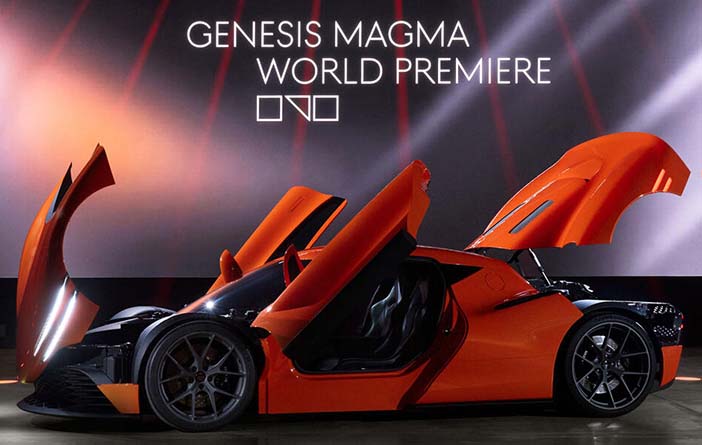
+++ GENESIS has revealed a new mid-engined Magma GT Concept that previews a future road-going “pure sports car” set to be launched sometime after 2027, and which will spawn a full range of variants. Described as the “clearest expression year” of the Korean brand’s commitment to performance, the new concept was unveiled at the official launch of the new GV60 Magma, the first in a line of ‘luxury high-performance’ machines that the brand will launch in the coming years. Genesis creative chief Luc Donckerwolke said that the model “represents the pinnacle of our performance vision and stands as a symbol of our commitment to true motorsport capability”. He added that the car, which will pitch the brand into competition with the likes of McLaren and Ferrari, was “not simply a faster Genesis” but “the most complete expression of Genesis performance to date”. Donckerwolke confirmed that the car shown featured a V8 engine, but said it had not been confirmed what powertrain the eventual production version will use, partly because that will be determined by the requirements of the GT3 racer. But Donckerwolke did confirm that the car shown was the “base car” ands that a full line-up of variants would eventually follow. “We’ll start with the base car and then add an S, GTS, roadster, lightweight, club sport, a GT3 road car, a GT3 R for track use; it’s a complete lifecycle of products that will combine performance and luxury inside”, said Donckerwolke. Asked if the Porsche 911 was a reference point Donckerwolke said that it was, but purely in terms of lifecycle management of a wide range of variants. While GT3 racing regulations require 250 road legel versions of a car are built for homologation purposes, Donckerwolke said that the Magma GT would be offered in greater volume and it will be purely a Magma model. He added: “The car is born for from from the needs to be competitive in GT3, but we saw the opportunity to create a business case out of it”. Manfred Herrer, the technical chief for the Hyundai Motor Group, confirmed that the Magma GT project was being “really dedicated” to Genesis, because the requirements for it to be used as the basis for a GT3 racer meant it was “unique”, particularly with regard the engine. Genesis will also enter motorsport this year with an entry into the World Endurance Championship with a Le Mans hypercar. It will join the US-based IMSA Championship in 2027 with its LMDh car and has indicated that it will expand its motorsport commitment with a GT3 programme sometime after that. That would hint at a likely arrival for the Magma GT of 2027 or 2028. +++
++ This is the first proper look at a significant new addition to MERCEDES ’ all-electric range: the upcoming baby G-Class. There’s still confirmation needed from Mercedes on precisely what the electric SUV will be called. Way back in 2023 at the Munich Motor Show, Mercedes CEO Ola Källenius referred to it as ‘little G’, though Mercedes also has registered trademarks of G 250 and G 300, which would make sense alongside the larger G 580 with EQ Technology. The ‘little G’ or ‘baby G-Class’ is expected to arrive in 2027, after a possible reveal at the end of 2026. Pricing for the new electric G-Class will undercut the full-size model significantly, but by how much is still to be revealed. It could be a potential rival for the Land Rover’s baby-Defender due in 2027. Whatever the new electric SUV from Mercedes will be called, thanks to this new spy shot we know it’ll draw heavy inspiration from the full size G-Class, especially in its design. Taking the current G-Class design and shrinking it into a mid-size SUV similar in size to the EQB seems to be the brief behind the ‘baby G; at least that’s what the spy shot of a prototype model suggest. The typical G-Class design cues are all there with a bluff front end featuring distinctive round headlights, a boxy silhouette, a flat bonnet and an upright windscreen. There’s also the trademark flat rear end featuring a spare wheel cover on a side-hinged rear door. It’s worth noting that the spare wheel cover on this test car will probably provide a space to store the charging cables, just like you’d find on the G 580 with EQ Technology. We can also make out some interesting details about the ‘little G’ despite its camouflage. It’ll get boxy wheel arches, rain-gutters (like the original G-Class), roof rails and chunky door handles, rather than the flush-fitting handles you get on other electric Mercedes. This test car is also kitted-out with a panoramic sunroof, which may be standard equipment on Mercedes’ electric SUV. The interior, like the exterior, should gain plenty of inspiration from the current G-Class, with squared-off turbine air vents, an oversized grab handle for the passenger and an upright driving position. It’ll also run Merc’s latest MBUX system with vast touchscreens and slick user interfaces. Sitting beneath the full-size G-Class, the smaller model will obviously have a lower and narrower body with a shorter wheelbase; the latter could actually help it provide just as much off-road ability as the larger car. We’ll have to wait and see if it becomes ‘Schöckl approved’: the mountain in Graz, Austria where Mercedes tests all of its G-Class models – from diesel and petrol to pure-electric. The baby G will enter the market to give the legions of G-Class fans a smaller and more urban-friendly option. However, to avoid diluting the G-Class magic, Mercedes has not cut corners in the new vehicle’s development. Källenius told: “The G is a very special and authentic car, so the mini G has to be authentic. So I cannot just take an existing platform; I have to create my own platform modules and that’s what’s happening”. This suggests that huge amounts of work have gone into the development of a new chassis that has similar appeal to today’s G-Class, only at a smaller scale. However, the baby G will have one important difference, Källenius explained: “It’s not a ladder frame to this extent, but in terms of wheel size and articulation, it’s a completely new development we have had to do”. Without a ladder chassis, it’s possible that the new baby G-Class won’t have the same sort of driving feel as the original, but Markus acknowledged this by telling me: “We spent a lot of time tuning this car, and over time started to develop so many unique components to make it a very good-looking car and very very capable. In fact, we designed far too many unique parts, but we believe this is what it needs”. In terms of powertrain, Schäfer was less revealing, saying: “I don’t want to go into those details, but just looking at the current capabilities and what’s needed, I came more and more to the conclusion that it has to be unique”. I expect the baby G to utilise a modified version of the brand’s new MB.EA platform which is recently put to use by the CLA. While the electric CLA 250+ is single-motor right now, a dual-motor 350 4Matic version is coming with an all-important four-wheel drive system, which should give us a better idea of the power offered in the baby G. I know the baby G which was spotted is an EV thanks to its blanked-off grille, though it’s not yet known whether the option of an ICE powertrain has been discounted entirely. In other comments, Källenius also ruled out range-extender powertrains on small to medium-sized models, which would include the new G. Details on the battery size haven’t been revealed, but it’s certain to be smaller than the huge 116 kWh battery found in the G 580 with EQ Technology. +++
+++ MG is set to hold back the launch of the second-generation ‘4’, opting instead for a facelifted version of the current model, which has proven highly successful in some European countries. The decision highlights a divergence in product strategy between Europe and China for the SAIC-owned marque, which is capitalising on the established appeal. The all-new 4, which entered the Chinese market in March, represents a significant engineering shift. It’s built on a next-generation EV platform, is 100 mm longer and moves from rear-wheel to front-wheel drive. It car also features a distinct, Cyberster-inspired aesthetic and an updated cabin, aligning it with the brand’s newer S5. When the new car’s design was registered with European legislators, expectations were that the car would be sold in Europe too. However, MG will introduce a facelifted version of the current 4 instead. “The 4 is now our oldest car, so it’s due a facelift, which will happen relatively soon”, he said. There’s another MG 4 in China; it’s kind of a second-generation car. The ‘4’ as we know it has been wildly successful in Europe, particularly in the United Kingdom. But it’s a different story in the domestic market. So they have changed the car quite quickly”. +++
+++ The RANGE ROVER EVOQUE will be reinvented for its third generation with electric power when it arrives later this decade as the final piece in an overhauled Range Rover line-up. The new Evoque will be underpinned by JLR’s Electrified Modular Architecture (EMA), which will make its debut under the new Range Rover Velar next year. Like its larger stablemate, the next-generation Evoque is expected to go on sale initially as an electric car; a move seen as vital to keeping the nameplate alive well into the next decade and beyond. However, whereas the Velar is set to undergo a radical repositioning, the Evoque will remain as the entry point in the Range Rover line-up, given its popularity with buyers. This is especially true in the United Kingdom, where it has been JLR’s best-selling model this decade, accounting for 40% of all Range Rover sales. An electric Evoque was first mooted in JLR’s radical Reimagine strategy in 2021. However, the electric version isn’t expected until at least the end of 2027, with deliveries likely to start a year later; a decade after the current model was launched. Its arrival will crown a busy renewal period for the brand, with the Range Rover Electric due in the first half of 2026, the new Velar soon after and the Range Rover Sport Electriuc at the start of 2027. The new Evoque will be totally overhauled underneath compared with the car it replaces. It will share its new EMA underpinnings with not just the Velar but also the upcoming ‘Defender Sport’ and all three will be produced at JLR’s Halewood plant on Merseyside, where the current Evoque is built. The 800V skateboard architecture has been designed with electric power as its primary focus. It will use motors built in-house and batteries from parent company Tata’s Agratas battery plant in Somerset, which is scheduled to open in 2027 after work started this summer. Specific powertrain details for the electric Evoque are still under wraps, but given that rivals such as the new Mercedes-Benz GLA EQ are tipped to offer more than 720 km of range, the new Evoque will need to be competitive with that. Quick charging times will be available courtesy of the EMA’s 800 Volt system. It is possible that the new Evoque and other EMA-based cars could also be fitted with electrified combustion drivetrains to boost appeal, given JLR’s decision last year to ramp up plug-in hybrid production amid the global slowdown in interest of pure EVs and a “surprising” rise in PHEV demand. Indeed, JLR has previously said the EMA has been designed to accommodate a range-extender unit, albeit with a small petrol engine. The British government’s decision earlier this year to extend the sale of all new hybrid cars from 2030 to 2035 is also likely to be factored into any decision. If that approach is deemed too costly, JLR could instead make the third-gen Evoque EV-only while simultaneously updating the current second-generation model to keep it on sale as the nameplate’s combustion option. Today’s Evoque is sold with mild-hybrid petrol, mild-hybrid diesel and plug-in hybrid options. A similar strategy is being employed by Porsche for the forthcoming Cayenne EV and by Mercedes for a range of new models including the GLC EQ and E-Class EQ. However, it would mark a strategy change from the inbound Range Rover Electric and Range Rover Sport Electric, which are marketed as new variants of the existing generation. While its underpinnings are set for a radical overhaul, the Evoque’s design will probably be more of an evolution of today’s. Such an approach would mirror the progression seen when the second-generation model was launched in 2018. However, the introduction of the skateboard EMA platform could change the model’s dimensions, suggested former CEO Thierry Bolloré previously. The Frenchman said EMA would “bring a unique proportion and capabilities to the cars that we’re going to manufacture”. That is very much the case for the new Velar, and test mules suggest it will sport a new genre-bending body shape and potentially a third row of seats. However, it remains to be seen what it will mean for the Evoque. There is no doubt that the EMA will increase the cabin space provided by the new Evoque, though, thanks to the platform’s flat floor design. This is likely to translate into more rear passenger space and slightly more room in the boot, which currently has 591 litres of capacity; already among the best in its class. The interior is expected to continue to feature upmarket materials and adopt a minimalist, tech-centric layout. The EMA’s 800 Volt architecture will mean driver assistance and cloud connectivity advancements will also be possible, in line with what is already offered by Audi, BMW and Mercedes rivals. +++
+++ SKODA ’s Vision O concept is a big deal, so big it’s taken over London’s Design Museum. The concept was in town, along with head of design Oliver Stefani, for an audience with Skoda’s British retailers and some members of the press. I gatecrashed for some exclusive face time with the design chief and the concept that showcases 8 ideas for the next-generation Octavia and all Skodas out to 2030, and beyond.
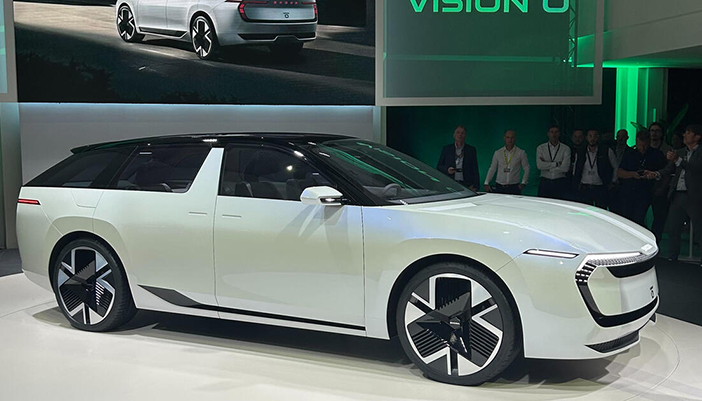
1). So far, an electric Octavia has been a pipedream, with the first 4 electric Skodas (Enyaq, Elroq and next year’s baby Epiq plus the as-yet-unnamed 7-seater based on the Vision 7S concept) all SUVs of varying sizes. The production version of the Vision O will change that. Originally planned to share the MEB architecture underpinning the Enyaq and Volkswagen ID.7, Skoda has pushed back the zero-emissions Octavia to the Volkswagen Group’s upcoming SSP platform, unlocking next-level EV technology. Superior range, faster charging, the Vision O’s new digital cockpit and more powerful autonomous driving capabilities will all feature, but it pushes the on-sale date closer to the end of the decade. 2). Its design is incredibly clean and aerodynamically honed to maximise the range, says Oliver Stefani. “Fleet customers need long-range: it’s our goal to deliver that”. So the clean sides help smooth airflow like a dolphin’s streamlined shape, before the concave rear helps chop off the air to reduce drag. Stefani references the ‘coda tronca’ (cut tail) design trend of 1960s Alfas and Zagatos as inspiration.
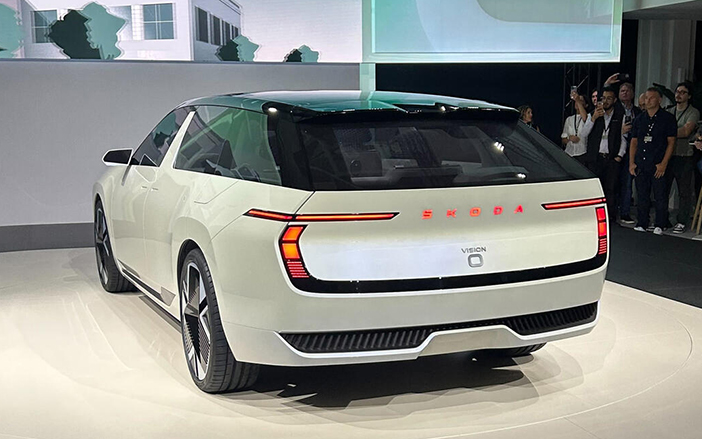
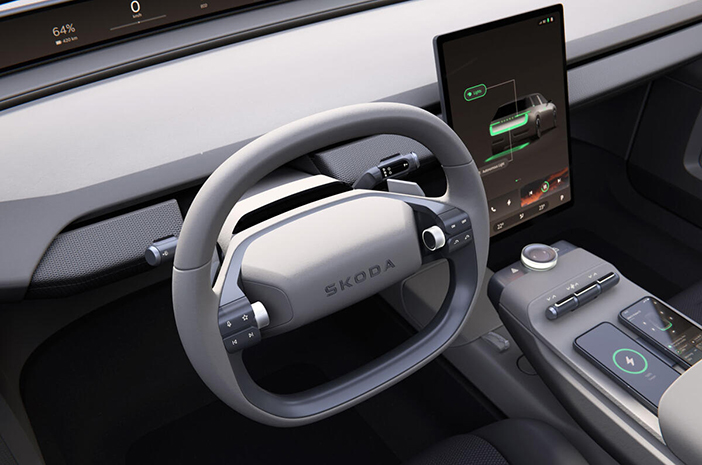
3) The 4.8 meter-long Vision O is longer than today’s Octavia but a touch shorter than the flagship Superb; tellingly it’s wider than both. “We made the Vision O a little bit wider because we believe in good proportions”, explains Stefani. “It’s also to convince our people (the finance guys and the engineers) that we need these proportions to be competitive”. That will involve a lot of horse-trading across multiple brands and stakeholders: the Scalable Systems Platform will underpin Skodas, Volkswagens, Audis and Cupras up to Porsches, Lamborghinis and Bentleys in its most premium modules. The statuesque look is enhanced by 21-inch alloy wheels: “we always say ‘1 inch bigger for a show car, or 1 inch lower ride height’ ”, is the Stefani blueprint. But the Vision O actually stands slightly higher than today’s Skoda Combis, a function of having to package the battery and preserve headroom. The boot swallows a generous 650 litres of cargo. 4) Step into the high-set driver’s seat and you look down on a shelf-like dashtop blessed with calming simplicity. Crowning it is a wide digital strip of information, called the Horizon Display, which occupants can customise with their preferred functions and readouts: it’s similar to the new BMW iX3 production car’s. The car is operated by the upright touchscreen, a rotary controller or AI-powered voice interactions, along with physical air-con switches. Doesn’t this proliferation buck the trend of stripping out switches? “You will never eliminate physical switches. That’s my opinion”, says Stefani. His argument is that voice manipulation of every seat position-nudge or temperature-toggle would cause noise pollution and irritation. There’s a big emphasis on sustainable materials, including knitted seat covers made of a single recycled yarn to ease re-use. “We see this cockpit, design-wise and technically, is really something for the next generation”, promises the head of design.
5). The Elroq ushered in Skoda’s current design language, termed ‘Modern Solid’. Its inverted bonnet ‘bulge’ and glossy black ‘Tech Deck’ grille panel (housing the Driver Assistance radar and camera) are retained by Vision O, with the ribs of vertical light reminiscent of combustion Skodas’ grilles. But it’s the minimalist surfacing that really takes Modern Solid to the next level: the Epiq and Vision 7S’s in-and-out shoulder lines are purged, though their subtle, square wheelarches remain. “I will not say they’re over-decorated, but they have some lines”, points out Stefani. “But in the future, we will go much more simple, and with the Vision O we really did the most we could. So the side section has just one line with a turning point, then nothing: it’s totally clean”. Skoda unveiled the concept at the Munich show and CEO Klaus Zellmer and Sefani were on tenterhooks awaiting the public feedback. “What was really nice is that people accept this as a Skoda, even though it’s changed quite a lot. The front and the rear, people still connect this to our brand”. 6). The minimalist design looks so upmarket it could be the work of a premium brand: does this signal Skoda trying to reposition itself? “We’re not talking about premium!” shoots back Stefani, sounding offended. “It’s our job to elevate the value of our brand. But Skoda makes value for money. It does not cost a fortune to make it like this, it’s pure design. We’re not aiming for premium but we want the cars to look modern, valuable, desirable”. It’s a formula that’s made Skoda Europe’s second best-selling car brand, overtaking BMW and Toyota. 7). ‘Flush glazing’ that sits level with the bodysides and eliminates window seals is an aesthetic popularised by Range Rovers, and now Skoda is at it. Combining it with the white-coloured side pillar creates an eye-catching side graphic, which Stefani says intentionally harks back to the late noughties Yeti and Roomster. Will the production car have flush glazing? “We have to dream sometimes”, says Stefani. “But flush glazing is something that plays also on simplicity and I hope we can achieve this. That’s the goal”. 8). Skoda had been expecting to start phasing out internal combustion engine models, but the slower transition to electric has caused a sharp revision of the product plan. Cars such as the Fabia, Scala and Kamiq will continue past 2030, but all will require design revisions to keep them modern. “I’m convinced that, design-wise, we have to connect electric cars with petrol cars in the future”, reveals Stefani. “With our theme it’s possible. We did the exercise already and I think it’s quite successful”. The design team ran a show where the top brass assessed the entire portfolio to 2030. “I saw the cars next to each other outside. We are convinced that they will work and that the customers will see this. The range looks very modern and very consistent. And this is important: we should not have 2 lines”. It means the Vision O isn’t just significant for the next Skoda Octavia Combi. It’s a design statement that will shape all future Skodas, right out to the end of the decade. +++