+++ AUDI is set to revive the A2 name for its new distinctively styled entry-level model, senior sources at the company have revealed. Due to be unveiled before the end of the year, the new model is seen as an indirect modern-day successor to the early-noughties original. It will feature (as test mules have shown) a one-box exterior design with a short bonnet and split-window tailgate highly reminiscent of that car, albeit in a package that is more overtly a crossover. The new electric model, which is likely to take the same e-Tron suffix as Audi’s other EVs, is already in the final stages of development ahead of a planned start to sales early next year. It will indirectly replace the A1 and Q2 in Audi’s line-up. Production of those two models is due to end in late 2026. With prices set to start under 35.000 euro in The Netherlands, it will also become the company’s most affordable electric offering yet, slotting into the line-up below the Q4 e-Tron, which is priced from 44.990 euro. By comparison, the A1 starts at 34.990 euro and the Q2 at 42.590 euro. The incoming A2 was originally planned to sit on the Volkswagen Group’s 800V SSP platform, but due to long-running delays with that architecture it will instead be based on the same variant of the group’s ubiquitous MEB platform as the Volkswagen ID.3. This uses a 400V system and rear-wheel drive. In the ID.3, it is offered with battery sizes ranging from 52 kWh to 79 kWh, and power spanning 170 hp to 326 hp. Given the more slippery-looking shape of the A2 (as seen on test mules). the top-end range could surpass the ID.3 hatch’s 550 km. Within Audi, the new A2 is not simply regarded as a premium mini-MPV to rival the likes of the BMW 2 Series Active Tourer. Instead, engineers talk about it filling a void in the market left by the BMW i3, which was produced between 2013 and 2022. They also point to the first- and second-generation Mercedes-Benz A-Class, with their space-efficient flat floor ‘sandwich’ platform, as an example of where and how the new A2 will be positioned. +++
+++ Skoda is warning car buyers that some of the CHINESE CAR BRANDS that have come to Europe in the past few years are not going to survive, which could leave owners in the lurch when the weakest of the bunch disappear. Approximately 1 in 10 new cars sold in Europe last year was by a Chinese brand such as BYD, Chery, Jaecoo, Zeekr or Geely and that ratio is only expected to increase when more marques like Denza arrives on our shores in 2026. However, in an interview, Skoda’s board member for sales and marketing Martin Jahn warned: “Everybody knows there will be a consolidation. There are about 150 electric brands in China. That is not sustainable”. When asked how Skoda is responding to the Chinese firms challenging it, Jahn admitted “we know we have to become faster”, but he couldn’t see the brand adopting such a rapid product launch and refresh strategy as those new arrivals from China. “The question is, what is financially sustainable?”, Jahn explained. “I think there will be a consolidation of the Chinese car industry and the question is, how long can you keep so many brands and launching new cars at this pace? Because the question then is whether you can depreciate all the investments? So how long is this sustainable?” He also asked: “How many new things, better things, can you really bring to the customers and what do customers really want? We noticed that sometimes the cars and the features are too much. What do you really use in the car? How many buttons can you really use? “So we are looking more at simplification. We want to bring a good package, a good car with good specs, with good service. I think that’s our differentiation from the Chinese. “The good service network and reliability, good residual values, those are the benefits that we have compared with the Chinese”. Jahn added: “When you have so many facelifts so quickly, then it’s also a question of surveys. How do you keep the parts? How do you manage the complexity at the dealerships? Bringing new models so often can mess up these residual values. Again, there’s two sides to every coin and I think for us to be more stable, more solid, more reliable, it has paid off so far”. Meanwhile board member for technical development, Johannes Neft, said Skoda does keep an eye on and compare itself with the Chinese competition, but added: “I think one of the most important things is that the customer knows what he gets when they’re buying your car. This is where we have a big advantage already, because our cars like Kodiaq, Superb and Fabia, they’re brands within the brand already. So everybody knows what they get. And sometimes you get the feeling there are a lot of different new cars from different Chinese brands, but where is the differentiation between these cars? What are they standing for? And I think we have to keep the character of our cars, we have to keep direction”. +++
+++ China banned concealed DOOR HANDLES on electric vehicles, the first country in the world to outlaw a design popularized by Tesla that is now facing global regulatory scrutiny due to a spate of deadly incidents. Cars sold in China will be required to have mechanical release both on the inside and outside, according to new safety rules issued by the Ministry of Industry and Information Technology on Monday. The ruling will take effect on January 1st. 2027, the ministry said. Models that have already been approved by the regulator and are in the final stages of launching in China have until January 2029 to change their designs. The news follows several high-profile incidents, including 2 fiery Xiaomi crashes in China where power failures were suspected to have prevented doors from opening, leaving people (unable to escape or be rescued) to die. While the new regulations will only impact EVs sold in China, the country’s influence on the global automotive industry means it could resonate elsewhere. Tesla’s doors are already the target of a safety probe in the US, while European regulators are looking to impose rules of their own. +++
+++ Whenever a HONDA has been given the Type R treatment, it’s always resulted in something rather special. The Integra Type R is lauded as the best-handling front-wheel drive car to date, various Civic Type Rs have been at the top of the hot hatch table for decades and the Accord Type R brought a little bit more practicality while not sacrificing any playfulness. The original NSX received a wonderful Type R variant, too. My issue with Type R is that these special cars have come around far too infrequently. The last time that we had two Type Rs on sale in Europe at the same time was in 2002, with the Swindon-made Civic and Accord, and that was only for a few months, too. With performance sub-brands the list is almost endless: BMW’s M division, Mercedes-AMG, Ford ST, Opel OPC/GSE, the Type R brand perhaps should’ve been Honda’s rival to these, expanding Honda’s nous into other, potentially more lucrative segments. Toyota has certainly proved the formula in recent years with its Gazoo Racing brand taking to Le Mans and WRC, while trickling down into range-topping trim levels of the Corolla, Hilux and RAV4. Honda cruelly denied us a S2000 Type R and a Type R version of the hybridised, second-generation NSX, but even less obvious sporty variants of the firm’s other offerings could’ve had their place. A CR-V Type R could’ve been a great foil to the Cupra Ateca, and the Jazz could’ve shrugged off its OAP image with a hot version to take on the Ford Fiesta ST. This is where I hope HRC comes in. That abbreviation stands for ‘Honda Racing Corporation’, which is doing exactly what it claims with programmes in Formula One (with Red Bull), IMSA GTP, Super GT in Japan, IndyCar and, of course, being Honda, various motorbike series. At the Tokyo Auto Salon at the start of the year, we saw what HRC could do with Honda’s current line up. The Civic Type R Concept looked fabulous and we were salivating over the prospect of a bodykitted Prelude Type R monstering the track. HRC also displayed slightly more off-road focused ‘Trailsport’ concepts of the CR-V and ZR-V, something we never would have seen with Type R. Perhaps I’m dreaming a bit with HRC, but with this new brand Honda has a chance to bring driving excitement to its wider audience. Hopefully it can live up to its ‘Power of Dreams’ slogan. While there’s no mention of the HRC concepts going into production (and the Civic Type R having recently bowed out of the UK market anyway) Honda did state that it will expand its line-up of “more exciting sport-type models”. +++
+++ Development of the KIA EV1 , the company’s answer to the Renault Twingo and forthcoming Volkswagen ID.Up, is now under way, the Korean brand has all-but confirmed. This won’t just give the firm a small electric model to join the petrol-powered Picanto, but also offer Kia buyers an EV that costs less than the new EV2. Kia’s new head of advanced design, Jochen Paesen, confirmed how significant the city-car segment is to the company, and that any electric entrant to the class will be a car that firmly aligns with the brand’s values. Paesen told: “We are very conscious that the small-car market is really important, so I think we need to keep working on it. We’ll do it in the Kia way. I think we want to make sure that we will be noticed. There’s a lot happening in that space”. This electric city car will be designed to appeal to global markets, but it’s in Europe that the competition is at its hottest. High-end electric cars are fairly easy to engineer and build at a profit, but achieving this in a smaller model, with the packaging and cost constraints, is far harder. It’s a challenge that firms such as Volkswagen and Renault are quickly finding solutions for. To compete, Kia will need to work alongside sister brand Hyundai, which we already know is gearing up its European production plants for a new electric model of its own. I expect the EV1 to be one of the models that pushes its maker’s design into a new phase. The minimalist, ultra-contemporary language that Kia is known for has largely spread across different market segments, but Paesen acknowledged that the firm is now transitioning towards to a new design generation. “We’ve built a good foundation, I think now we’ve got a good presence, but how do we become more aspirational, and how do we get people to walk in the showroom and say, ‘I want that Kia’ ? That’s part of our strategic thinking”, he said. “And we’re doing that from a design point of view, so that we have a stronger leverage to keep that momentum. EVs obviously lead our Kia values most”. There are then the physical aspects of designing an A-segment EV and the size and cost restrictions, plus the fact that the larger EV2 has obvious crossover or SUV influences. I think Kia will shape the EV1 as a more urban-focused car, rather than include obvious SUV references. This could manifest itself in the silhouette, which has more of a monobox shape closer to that of the short-nosed EV4’s. Kia’s use of black plastic on the bumpers and sills is intended to give the electric city car a sense of urban toughness rather than suggest any off-road ruggedness. Elements such as non-radial wheel designs and vertically orientated LED lighting will also be integrated, but potentially including more curves and fewer creases, as previewed in the firm’s Meta Turismo concept. Paesen also gave me an insight into Kia’s future interior designs, telling me: “We are looking at what’s working well, what’s getting a good response, what’s getting a bad response. Where can we improve, where are the things we can improve on? As our digital system gets stronger and better, we still have work to do there. How do we slide these learnings into one another and make sure the system is future-proof, but the system carries you along and doesn’t mean you need to learn new things”. In contrast to its exterior design, Kia’s interior design has been subject to some criticism for being too similar across its various models. All of its electric vehicles incorporate the same triple-screen layout, but as the manufacturer moves forward, this set-up could change. Kia isn’t alone in wanting to bring an electric city car to market, but given the razor-thin margins in this segment, there are only a few rivals. Renault’s new Twingo comes with more than a hint of nostalgia and cool that European buyers have already responded to favourably in the marque’s larger Renault 5. This model has also been developed in record time, with the French company outsourcing to Chinese-based technical partners much of the time-intensive development work that is required to bring any new model into mass production. The upcoming Volkswagen ID.Up could also be a big player in this market, because it’s not just a stripped-out version of the larger ID. Polo. It also introduces a new hardware and software platform from VW’s joint venture with US EV maker Rivian. +++
+++ NISSAN ’s Tochigi plant in Tochigi Prefecture had a capacity utilization rate of just 10% in 2025, far below the widely believed break-even point of 80%. The capacity utilization rate is the ratio of the number of units produced at a plant and its production capacity. The primary cause of the Tochigi plant’s low figure is the global slowdown in EV demand. The plant is Nissan’s sole domestic production base for passenger EV models, including its mainstay Leaf and Ariya models, and has an annual production capacity of 190.000 units. But according to my sources, only about 20.000 cars were manufactured at the plant in 2025, a significant decline from the about 70.000 units in 2024. The embattled automaker has been restructuring its operations through such means as the closure of domestic and overseas plants. Amid this, boosting the utilization rate of the Tochigi plant will likely be an urgent priority. Nissan once led the EV market with the mass-market release of the Leaf in 2010. However, domestic sales of the Leaf and Ariya fell by about 40% year-on-year in 2025. Exports have also struggled due to shifts in EV policies in the United States and Europe. One example is the administration of U.S. President Donald Trump ending support measures for EVs. Car production also decreased last year at the plant due to preparations for the next-generation Leaf and Ariya models. Production of the new Leaf has now begun, and a senior Nissan official said that car production “bottomed out in 2025”. However, the outlook for the EV market remains uncertain, and concerns are being raised by auto parts suppliers that the new Leaf is not likely to drive a significant growth in sales. High-end combustion-engine vehicles like the Skyline and Fairlady Z are also produced at the Tochigi plant. But significant growth in sale for them is seen unlikely partly due to declining brand strength. Nissan announced in May a plan to close 7 plants and cut 20.000 jobs worldwide as part of restructuring efforts. Of its 5 domestic plants, Nissan will end vehicle production at its Oppama plant and its subsidiary Nissan Shatai’s Shonan plant, both in Kanagawa Prefecture, by the end of fiscal 2027. Production will be consolidated at the three remaining plants. However, as the capacity utilization rate of the Tochigi plant is lower than at both the Oppama and Shonan plants, the restructuring efforts could be hindered. Nissan president Ivan Espinosa stated at a press conference in July that the company does not plan to close more domestic plans. +++
+++ For many years, PEUGEOT enjoyed an enviable reputation as a maker of cars that were impressively affordable, supremely stylish and pretty darn nice to drive. It was a proper people-pleasing brand that had more than its fair share of loyal customers and passionate enthusiasts all around the world. But over the past 2 decades, Peugeot has lost some of the spark that had won it such cult appeal among enthusiasts and made it the darling of the dealer network on several continents. Drawing the curtain on a period during which it had some of the world’s greatest cars in its showrooms, it introduced a new line of forgettable and uninspiring alternatives that couldn’t hold a candle to their forebears. Cars like the stodgy 307, oddly packaged 1007 and questionably conceived 207 CC couldn’t hope to replicate the hero statuses of their ancestors, which together with widespread reliability issues and a move away from instilling keen dynamics into each of its models meant Peugeot’s belle époque was well and truly over. Before long, there was little to tell a Peugeot apart from the Citroën model it was twinned with underneath, and that sense of homogeneity was only exacerbated from 2021, when the two sibling brands were rolled into the sprawling Stellantis empire, which shares platforms and powertrains across no fewer than 9 marques in Europe. Peugeot’s current line-up is focused rigidly on the most popular segments, each of its cars is technically identical to an equivalent model from its sibling marques, and it has been a good while since it last put its name to anything a kid would stick on a bedroom wall. Sales are strong and the commercial outlook is bright, but is it still a beloved brand? Cue appropriately Gallic shrug. The man who has the exciting task of restoring this languorous lion to true greatness is Alain Favey, appointed to the top job in February last year. As C-suite roles go, it’s a daunting one; not just because this is one of Europe’s biggest-selling brands but also one of the world’s oldest surviving car makers. Is it intimidating to take on such a weighty responsibility? “Absolutely not”, replies Favey. “But you do feel a certain level of responsibility for the people who are lovers of the brand, and there are so many across the world”. Favey joined Peugeot after an 18-month stint as CEO of ‘mobility’ giant Europcar, having previously spent 2 years running sales and marketing at Bentley, following a 4-year spell doing the same for Skoda. Earlier, he was CEO of car distribution giant Porsche Holding, and he had spent some time at Volkswagen too, after a whopping 20-year tenure at Citroën. It’s a varied career path that should stand Favey in good stead as he embarks on the daunting task of carving out a stronger foothold for Peugeot in today’s ceaselessly turbulent market environment. “My own experience comes now to full fruition in my role at Peugeot, because of all the different experiences that I could gather in all of those great brands”, he says. “Each of them had specific assets that I’m trying to recreate in the Peugeot of the future”. That’s not to say that we can expect Peugeot to start slipping Skoda-style ‘Simply Clever’ features into its cars, or give Favey’s old colleagues at Crewe a headache with a kilometre-munching luxury coupé. But Favey’s learnings from his previous employers (highly disparate and individualistic as they were) can absolutely inform how he tackles his latest assignment. “Every brand has been completely different”, he says. “Skoda was a great discovery of a brand with a big soul, a long history and a lot of skills, and Bentley was for me the discovery of the luxury segment, which has completely different ways of approaching the car”. How all of that manifests at Peugeot has yet to take shape, but the recently revealed Polygon concept serves as a tangible statement of intent for Favey as he sculpts the brand’s future. While some forward-looking concept cars serve exclusively as manifestos, being ethereal, outlandish and often unrealistic allusions to a manufacturer’s ideals and ambitions, the Polygon is rather more concrete. Not only has Peugeot suggested the third-generation 208 will look a lot like it, but some of its most noteworthy, headline-grabbing features will trickle into showrooms in the coming years too. That includes its unusual ‘Hypersquare’ steering wheel, which isn’t really a wheel at all. It is a strange yoke-style device that controls the front wheels electronically, rather than via a conventional mechanical connection, with the steering ratio varying according to speed to boost agility at all speeds. The idea is that all manoeuvres need no more than a quarter turn. It’s a dramatic break from convention of the sort for which Peugeot used to be renowned before becoming part of a massive multi-brand conglomerate and sidelining innovation for the benefit of cost-effective tech-sharing, and one that is not without its vocal detractors. But Favey is confident of the Hypersquare’s ability to assist in turning Peugeot’s modern-era reputation around. “We believe that it’s really an innovation that will bring about curiosity”, he says. “And we believe that the technology will be so striking in terms of the pleasure it brings in driving the car that people will just want it absolutely”. In fact, he thinks it’s Peugeot’s “role as a leading mainstream brand in Europe” to bring this sort of innovation to market. “Because if we don’t, who will?” Indeed, once it has made its way to Peugeot dealerships, steer-by-wire will then be rolled out to other Stellantis line-ups, helping to cement the brand’s reputation as a technological flag-bearer. It’s this same rationale (this same pioneering spirit and sense of whimsy) that underpins the Favey-backed revival of Peugeot’s storied GTi performance line, beginning with a 280 hp, slippy-diffed version of the e-208 later this year. It may be technically identical to similarly conceived hot hatchbacks from Abarth, Alfa Romeo and Opel, but this spicy new Alpine A290 rival is emblematic of the CEO’s desire to recapture the enthusiast vote and put dynamism firmly back on the brand’s mood board. “You can rely on things like GTi, which is clearly part of our DNA”, says Favey, “and you can use it to position the brand, for example, to say very clearly that Peugeot stands for great driving sensations. That’s part of what we are”. But none of his pretensions to technological leadership and enthusiast appeasement will come at the expense of Peugeot’s hard-won commercial success. Currently the marque accounts for 40% of Stellantis’s entire European sales footprint, with a whopping 5.6% market share making it one of the region’s most popular car brands overall, and putting it on track to achieve its target of a Renault-baiting 7% by 2030. It’s resolutely a mainstream marque and plans to be even more so, but without losing any of the premium lustre that sets it apart from its more everyman-oriented sibling brands, among them Citroën, Fiat and Opel-Vauxhall. Asked how he plans to marry those 2 seemingly opposing notions, Favey replies: “For us, both go together. Yes, we want to be upper mainstream, but we are a mainstream brand, which means we want to sell cars to everybody”. Tough gig. How do you simultaneously boost the aspirational element of a brand while both enhancing its attainability and using it as a platform to introduce potentially divisive new technology and features? Can Favey really make Peugeot’s cars more alluring and more ubiquitous at once, in the context of a market environment that is more tempestuous and crowded than ever before? It’s a tricky task that will require him to make the fundamentals of the brand’s positioning more solid than perhaps they have been since it started making coffee grinders and handsaws more than 200 years ago. Undaunted, he says: “That’s what I’m here for as a CEO: to really make sure that this brand is stronger in 10 years or in 20 years than it is today. It starts with the positioning of the brand, to make sure that the brand stands out from the competition, and the competition is every day a bit wider, a bit more tough than it was before, so having a heritage like we do is a big help”. Basically, he suggests, Peugeot needs to be more Peugeoty than it has ever been before (making cars that are more distinctive, more interesting, more bespoke) to keep ahead of rivals and cultivate a real sense of personality. “Peugeot stands for great driving sensations”, stresses Favey, highlighting an asset that he plans to emphasise and leverage as he forges a path forward, but that’s just one of several. “Peugeot stands also for quality for what we call ‘designed to last’, so we really want a Peugeot to be something that has quality of product and quality of service”, he says. “And Peugeot stands for a design that stands out, and that’s what we call the ‘French charisma’ “. Favey says Peugeot aims to promote its heritage as a French brand through ever more distinctive exterior and interior designs, which will align with the more obviously bespoke driving characteristics of its cars. “We believe that nobody else has this combination of specific driving sensations, quality level behind the wheel and specific styling”, he continues. “Nobody has that other than Peugeot. So that helps us to position the brand and to stand out from the competition”. The days of playing it safe and keeping the apple cart upright, then, would appear to be behind Peugeot, but how does that tally with Favey’s ambition to enhance its popular appeal and grow its footprint? “What I know is that our target is to reach 7% market share, so even if 93% of the market wants something different, I’m fine with it”, he answers. “The Peugeot target group is customers who want more than just basic mobility. They will want a car that has a certain attractive design, that is different from the rest. And they will want the promise of a quality brand that has specific driving sensations, that maybe not everybody loves, but that’s fine again. As long as we find 7% who love it, that’s okay”. +++
+++ PORSCHE ’s electric 718 twins, the Cayman and the Boxster, are already fashionably late, but now it seems like they might not make the party at all. According to a report from Bloomberg, Porsche’s new CEO, Michael Leiters, is considering cancelling the 718 EV variants before they even enter production. Bloomberg cites several people familiar with the matter who asked to remain anonymous while discussing internal plans. According to the report, Porsche’s decision to drop the electric sports cars is largely due to development delays and rising expenses. Details surrounding the electric 718 models have been circulating for more than six years now, with original plans aiming for the new models to launch in 2025. Porsche officially stopped taking orders for the 718 models in the United States in the fall of 2025, shortly before the automaker recommitted to keeping the internal-combustion RS models around into the next generation. That 180-degree turn was followed by another announcement from the automaker, confirming plans to adapt the 718 EV platform to accept internal-combustion powertrains. According to Bloomberg’s sources, the decision to axe the electric 718 models may be necessary to right the ship, which has been rocked by slumping sales in China and increased operating costs as the company reworks its EV strategy. It’s not a final decision, though, and Bloomberg’s sources said that Leiters has yet to make an official decision. +++
+++ SKODA currently has no plans to launch an electric car smaller than the all-new Epiq crossover that is arriving this summer, ruling out a successor for the little Citigo despite the European Union’s push for more small affordable EVs. The Epiq is expected to cost from around 28.000 euro, which would already put it among the most affordable electric cars on sale. Even so, when asked if the brand had any intentions of making an even cheaper and smaller EV, especially following the EU’s proposal for a new class of cars just like this, Skoda’s board member for sales and marketing Martin Jahn told: “We do not see a way how to produce such a car profitably, so we do not have any immediate plans for a smaller electric car than the Epiq”. This is despite Volkswagen working on an electric city car that’s due to arrive next year, based on its ID.Every1 concept, which could cost as little as 20.000 euro. Jahn added: “Again the challenge is the profitability, as even with the current electric cars it’s difficult to make profit. I think it’s well known that electric cars in general have much lower profitability than combustion-engine cars, and that’s true for 99 per cent of car makers”. Jahn’s opinion tallies with comments made by Kai Grünitz, Volkswagen brand board member for technical development, about not having Skoda and Cupra versions of the new city car. “When you have big segments like the B-segment, it’s big enough to have maybe 3 brands”, Grünitz told. “But when you look at the A-segment, it’s not big enough for 3 brands. Maybe the truth is that not every brand will be in every segment. So there’s one brand, and that is Volkswagen. We’ll do the volume we did with the Up, Mii and Citigo”. That means the Fabia will remain Skoda’s entry-level model, and Jahn explained: “We believe that our A0 combustion range (Fabia, Kamiq and Scala) is still good enough and successful to cover the customer needs. For the foreseeable future, we will just go ahead with Epiq and with A0 combustion cars”. Skoda is planning to add fuel-sipping hybrid tech to those models based on the MQB-A0 platform soon, now that the Fabia, Kamiq and Scala are all going to live beyond 2030. +++
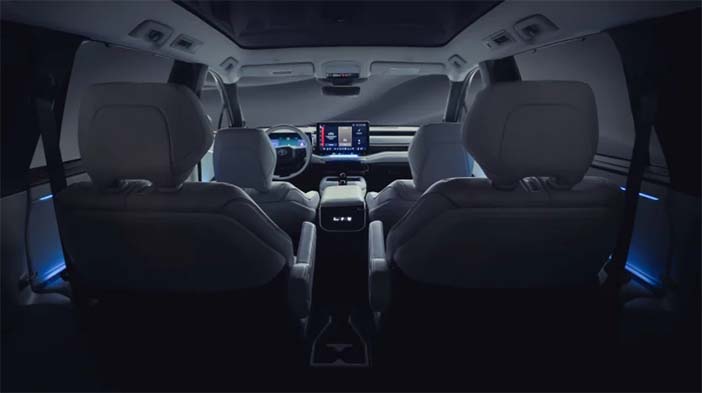
+++ TOYOTA has announced it will unveil a big, new 7-seat SUV on 10 February, a car we’re expecting will go after the Kia EV9 and Volvo EX90. However, it’s unlikely to be coming to Europe any time soon. The first teaser for this mysterious mammoth SUV was released just a week ago and showed little more than a lightbar and a boxy rear end. The latest image shows a clear, very Volvo-like interior featuring 2 large displays, a 2-spoke steering wheel and what appears to be a row of buttons along the dashboard. The interior of the version in the pictures includes seating for 6, with 2 sets of captains chairs like you can have in the Kia EV9. The as-yet-unnamed SUV will go on sale in the US market as an all-electric alternative to the popular Grand Highlander; a family-focused SUV that features a pure petrol or hybrid-assisted engine. As a result, expect this new BEV model to focus on the same priorities as its ICE cousin, including a versatile interior and spacious third row. This new EV was previewed at the end of 2021 as a thinly veiled concept alongside a variety of other BEV models. Using that show car as a guide, the production model will continue Toyota’s current design language, albeit on a much larger scale. The thin headlights and sleek front bumper will likely remain, with a small low-mounted air intake and possibly a contrasting bonnet. The more dramatic angle is sure to be the rear end, though, defined by that double lightbar (similar to the one on the European-focused Toyota CH-R+) with bulging wheel arches and large windows. As a full-sized 7-seater, expect it to be more than 5 metres long, which should make it the biggest car the Japanese company has ever built on its TNGA-e platform, which also underpins the bZ4X and C-HR+ electric SUVs. However, this could also be a chance for Toyota to increase the battery size to retain a good electric range. The company has no immediate plans to bring the new model over to the UK, though. There’s not a huge variety of 7-seat EVs over here, either, with the whole class consisting of the Kia EV9 and Volvo EX90. Both are incredibly expensive, though, so If Toyota could bring this model over at a reasonable price, it could well appeal to British buyers looking for a spacious family car that’s also tax friendly. +++