
+++ ALFA ROMEO will launch a new family hatchback to rival the Volkswagen Golf in the next few years; its first since the Giulietta was axed in 2020. The new C-segment car will be based on parent company Stellantis’s new STLA One architecture, which it will share with the same-sized, next-generation Peugeot 308 and Opel Astra. The platform, previously known as STLA Medium, is a ‘multi-energy’ structure that can accommodate both electric and combustion-engined drivetrains, and Alfa Romeo said it will offer both to broaden market appeal. Confirmation of the new hatchback comes following the Stellantis investor day presentation last week, at which it outlined an ambitious plan to launch 110 new models globally, across all its brands and with a mix of powertrains, by 2030. During the presentation, Stellantis’s European boss, Emanuele Cappellano, confirmed that Alfa Romeo was developing a new mid-sized SUV to replace today’s Tonale, along with an exclusive new sports car from its Bottega Fuoriserie bespoke division. Now, the company has revealed that those 2 models will be joined by a smaller hatchback. A brief teaser of an unidentified model could be the first look at the new model, which the Italian brand said will “build on icons such as the 147 and Giulietta”. The Tonale successor and the hatchback are expected to share a basic footprint and much of their technology and drivetrain hardware, mirroring the relationship between the hatches and SUVs that Alfa’s sibling brands sell. The electric derivatives will be equipped with 800V hardware for rapid-charging capabilities, while the ICE versions will likely use the same array of mild and plug-in hybrid systems available elsewhere in Stellantis’s arsenal. All could be offered with the STLA platform’s steer-by-wire capability, as previewed recently by the radical Peugeot Polygon concept. Alfa Romeo hasn’t yet given a timeframe for the new models, but the Tonale will be up for replacement in 2027. More precise details on the brand’s mid-term strategy haven’t been given, but it has issued a statement to clarify its plans following the Stellantis presentation: “Looking ahead, Alfa Romeo will leverage Stellantis’s global scale while differentiating its offering to continue developing authentic Alfa Romeos, further strengthening its distinctive positioning as a unique and iconic brand”. The new hatchback, SUV and sports car will be sold alongside the Junior (itself due a refresh soon) with the current Giulia and Stelvio scheduled to end production next year. Alfa Romeo had previously been almost ready to unwrap an electric replacement for the Giulia but put the project on ice last year in response to wavering uptake for premium and sporting EVs. A long-mooted electric Stelvio was expected to be close behind using the same mechanicals. Now the company appears to have gone back to the drawing board entirely on replacements for its 2 premium flagship models, saying only that it’s “studying solutions to continue operating in the D-segment with new interpretations of the current line-up made up of Giulia and Stelvio”. It said it aims to remain “true to its performance-driven DNA while adapting to market evolution” and that any Giulia and Stelvio successors would “leverage flexible platforms”; no doubt the modular STLA architecture that can span from the B- to the D-segment. “Further details will be communicated at a later stage”, it said about potential larger models. +++
+++ The new BYD DOLPHIN G DM-i is the Chinese firm’s first car developed specifically for Europe and will take on both electric and petrol rivals with an unusual plug-in hybrid powertrain. Due to go on sale in Europes this autumn, with pricing tipped to start from under €25.500 in The Netherlands, the new model is a 4.160 mm long supermini that is essentially a sibling to the Dolphin Surf. It will rival the likes of the Fiat 600, Honda Jazz and Seat Arona, but while most rivals feature classic or self-charging hybrid powertrains, the Dolphin G features a full plug-in hybrid powertrain. While BYD hasn’t given full details of the layout of the Super Hybrid system, it’s expected to be related to the system fitted in the Atto 2 DM-i small SUV, commingling a 1.5-litre petrol engine that acts as a generator for an electric motor that drives the front wheels. BYD said the Dolphin G will offer a combined petrol and electric range of more than 1.000 km, with full details to follow when the car is fully launched in June. Notably, the Dolphin G is the first car that BYD has developed specifically for the European market and it’s likely to be produced at the firm’s new plant in Hungary. Executive vice-president Stella Li decided the European B-segment “as one of the most important parts of the market” and wanted the Dolphin G “to redefine what customers can expect from a compact car in the electric era”. The compact PHEV will be the first in a planned range of B- and C-segment models that BYD is developing specifically for Europe, with Li having previously said the “goal is for customers to think of BYD as a European brand”. +++
+++ Trademark databases are where future FERRARI cars go to leak. The Italian automaker has lodged a fresh batch of filings, and the names point to open-top and track-only versions of the F80, a GTO-badged take on the 12Cilindri, and a sharper 296 Challenge Stradale, among others. Not every trademark becomes a car, but a few of these are credible enough to keep an eye on. Starting with the flagship hypercar from Maranello, the F80 might grow into a family of 3 bodystyles. The F80 Targa and F80 Roadster point to an heir to the La Ferrari Aperta and the F50 before it. F80XX and FXX80, meanwhile, fit the template Maranello has used twice before, the Enzo-based FXX and the LaFerrari-based FXX-K, suggesting a 7-figure track-only derivative is at least being considered. Next up is the 12Cilindri, which is already available in Coupe and Spider bodystyles. Still, Ferrari has trademarked the 12Cilindri MM, 12Cilindri MM Aperta and 12Cilindri GTO names, whetting our appetite for the future. As most Ferrari fans know, the MM suffix is a reference to the Mille Miglia race in Italy, and the Aperta suffix points to a drop-top model. As for the GTO (Gran Turismo Omologato), it is pretty much self-explanatory and sounds like the perfect fit to continue the bloodline of the V12-powered 599 GTO, F12 tdf, and 812 Competizione while paying homage to the legendary 250 GTO. Last but not least, Ferrari’s entry-level mid-engined model is not absent from the party. The Italian firm has trademarked the 296 Challenge Stradale, 296 CS, and 296 Challenge Evo names, hinting at new variants for the road and the track. The Challenge Stradale revives the iconic moniker used by the hardcore Ferrari 360 back in the ’00s, giving way to the 430 Scuderia, the 458 Speciale, and the 488 Pista with aero, chassis, and performance upgrades over the base supercars. As for the 296 Challenge Evo, this is most likely an evolution of the racing version that debuted in late 2023. +++
+++ We haven’t heard much from Italdesign since Audi offloaded the company last year, but they’ve quietly unveiled the ITALA Automobili 35 at the Museo Nazionale dell’Automobile earlier this month. It resurrects the Itala brand, which was established in 1903 and reportedly went defunct in 1934. Created for DR Automobiles Groupe, the Itala 35 is believed to be a restyled version of GAC’s Trumpchi GS3.
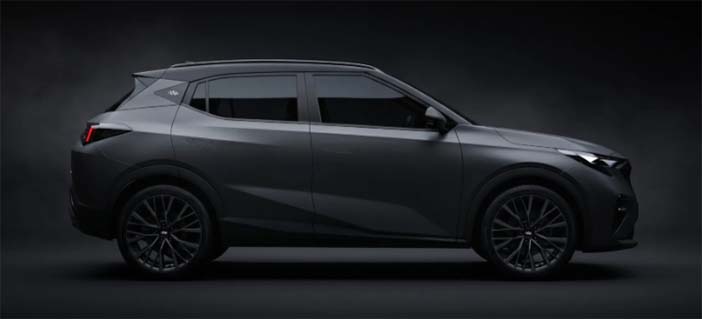
Italdesign was light on specifics, but said they primarily focused on the front and rear ends as they undertook a “complete redesign of all non-structural plastic parts, including bumpers, the upper bonnet fascia, tailgate and spoiler”. Some elements, such as the lighting units, carryover but they’ve been “integrated into the new identity”. Without further ado, the 35 has a large Seat-style grille that is flanked by sweptback headlights and prominent Itala badging. They’re joined by a wide central intake as well as a rounded lower lip. Moving further back, we can see streamlined bodywork and flush-mounted door handles. They’re joined by a rakish windscreen, plastic body cladding and an angular rear window. The interior images show a flat-bottom steering wheel and what appears to be 2 digital displays. We can also see gloss black plastic trim and a minimalist shifter. They’re accompanied by an upholstered dashboard and metal speaker grilles. Italdesign’s Exterior Project Leader, Cristiano Fracchia, said “This was not about developing a vehicle from scratch, but about shaping its visual identity through a measured and coherent approach, one capable of being immediately recognizable, working on an existing structure and several fixed elements, such as the lighting units. This meant relying on design to build a distinct identity by focusing on replaceable components”. Under its Italian costume, the 35 runs a 1.5-liter turbocharged 4-cylinder making 170 hp and 270 Nm, sent to the front wheels through a 7-speed dual-clutch. The 0 to 100 km/h sprint takes 7.5 seconds, top speed is 190 km/h and Itala quotes 6.8 l/100km on the combined cycle. The compact crossover measures 4.410 mm long, 1.850 mm wide and 1.600 mm tall, on a 2.650 mm wheelbase. Cargo room runs from 341 liters to 1.271 liters with the second row folded. The design house went on to note they’ve been tapped to work on 5- and 7-seat Itala models known as the 56 and 61. The former appears to blur the line between compact and mid-size crossovers, while the latter is likely a large SUV. The new Itala 35 is set to go on sale in Italy this September. +++
+++ LOTUS has revealed a new lightweight Emira that aims to offer a “pure expression” of the company’s DNA with improved agility and responsiveness over the standard car. Based on the Emira Turbo, with the Mercedes-AMG 4-pot engine, the new Emira 420 Sport is named for its power figure, which represents a bump of 56 hp over the standard car and 14 hp over the warmed-up SE that arrived last year. Lotus says the car will crack 0-100 kph in 3.9 seconds and achieve a top speed of 295 kph, but more important than its straight-line stats are the dynamic advantages it offers over the regular Emira, with the firm claiming it has “been designed specifically to deliver even more performance both on road, and on track”. The 420 Sport is equipped as standard with the Lightweight Handling Pack, which trims 25 kg off the weight of the standard Turbo (taking it down to 1.421 kg) and boosts downforce by the same amount. It also brings a suite of subtle bodywork modifications in pursuit of optimised aerodynamics and cooling, which, Lotus says, improves track performance without increasing drag. There’s a new front splitter with reshaped vents at the front and a new lip spoiler at the back. The sills have also been extended and the air intakes expanded, which is said to increase airflow to the radiators by up to 15% and improve brake cooling by 10%. “With these upgrades, drivers are able to experience more consistent performance in demanding conditions, particularly on track”, says Lotus. The car also rides 5 mm lower on its uniquely tuned suspension, wears high-performance tyres and comes with bespoke carbonfibre shift paddles that “combine with updated haptics for added responsiveness and engagement”. Buyers can further emphasise the 420’s lightweight remit with an optional carbon styling package that swaps out the splitter, sills, vents, side pods, rear wing and diffuser for carbonfibre items. The 420 Sport also introduces to the Emira range a removable sunroof, to be rolled out as an option across the line-up, and features a louvred rear deck that nods to the old Esprit Turbo. The 420 does not replace any current model in the Emira range, with the 2 existing 4-cylinder variants and the V6 all remaining on sale, but it could be the last new version introduced before the sports coupé swaps its AMG and Toyota engines for a new hybrid V6 developed by Horse Powertrain in the coming years. +++
+++ Those wondering whether MASERATI has a future within Stellantis received an answer. The automaker laid out a new roadmap for the conglomerate that includes a significant investment in new products and technologies, as well as 2 new models for Maserati. Stellantis said in its announcement that it “plans to strengthen the future” of the Italian manufacturer, which will be a “pure luxury brand”. That additional strength will come from two new large E-segment vehicles joining the line-up, but details are scarce. The company said that it will present a more detailed plan for Maserati in December. The brand suffered under Stellantis’ former CEO, Carlos Tavares, with sales collapsing by 57 percent in 2024. Maserati sold just 11.300 cars that year, followed by 11.127 in 2025. Right now, Maserati sells just 3 models: the Grecale, the GranTurismo and the McPura, but there is room for 2 more. The Grecale is the entry-level model, while the GranTurismo is the mid-range. The GrandCabrio is more expensive, while the McPura has the highest starting price. Stellantis provided zero details about Maserati’s 2 new models. Those details will come later, but a recent report suggested Stellantis is working with Chinese automakers to expand the brand’s portfolio. A recent report alleged that Stellantis is in discussions with Huawei and Anhui Jianghuai Automobile to jointly develop new Maserati vehicles. JAC will allegedly provide the R&D and produce vehicles based on Huawei’s tech. Maserati will oversee the design and branding. The venture will result in a vehicle produced in different versions for different markets, with cars sold domestically in China supposedly wearing Maextro badging, a luxury brand with a sedan priced from $100.000. According to the report, development is already underway, so we might see more than just a roadmap for Maserati by the end of the year. +++
+++ NISSAN recently scrapped its $500 million electric vehicle plan in the U.S. to prioritize petrol-powered, truck-based vehicles, including the Frontier. That sounds a lot like Toyota’s playbook with models such as the Tacoma, Tundra and 4Runner. So far, the strategy appears to be working for Nissan, as it was the fastest-growing mainstream brand in the U.S. in the last fiscal year. But interestingly, despite Europe having more favourable market conditions for EVs than the U.S., Nissan is also slowing some of its electrification plans there. Nissan subsidiary Jatco has withdrawn plans to build e-axles in Sunderland, a project that was estimated at about 9 billion yen, or around $56 million at current exchange rates. As a reminder, Nissan is undergoing a restructuring after years of financial struggles, which has also fueled talk of a possible partnership with Honda. That restructuring has already included plant closures and job cuts, and the plan to build e-axles in Europe is just the latest item on the chopping block. For now, Nissan is expected to source the EV drive units from Japan for its European-made EVs. However, Nissan’s EV sales in Europe plunged last year, with Leaf sales dropping 99% to just 87 units, while the Ariya recorded a 44% decline. Those factors ultimately contributed to the automaker’s European market share falling to 2.2% in 2025. It is worth noting that the Leaf is in a model transition phase, with the latest generation adopting a more crossover-like design. Nissan also offers the Micra, a small electric hatchback aimed at meeting Europe’s demand for city cars. That EV lineup stands in contrast to Nissan’s U.S. line-0up, which only includes the Leaf after the Ariya was discontinued following the 2025 model year. It suggests the automaker is still leaning more heavily into EVs in Europe, making the cancellation of the e-axle project look more like a strategic pullback, especially with an all-electric Juke expected sometime in 2027. Nissan is also pursuing electrification efforts in the U.S., though more in the form of hybridization. The automaker’s e-Power hybrid system (a series-hybrid setup in which the wheels are driven solely by electric motors while the engine acts only as a generator) is reportedly on the cards and could eventually be used in models such as the Kicks. +++
+++ The purists can exhale. PORSCHE has no intention of building a fully electric 911 for the foreseeable future, sticking with combustion and hybrid power for the model that more or less defines the brand. The experimentation will happen elsewhere. The next-generation 718 Cayman and Boxster are still on track for battery power, even after internal reviews and program delays threatened to muddy that plan. Both cars will be sold as EVs alongside combustion variants that will sit higher in the range. Daniel Schmollinger, CEO of Porsche Cars Australia, spoke to local media about electrification plans in the sports car segment: “We will go with the 718 electric as the first 2-door electric sports car. The 911 for the moment stays what it is. With the T-hybrid technology, it shows what is possible without a full battery”. Porsche has always positioned the 911 as the last combustion model standing, even in a future where the rest of the lineup went electric. The plan has not changed, though the context around it has. Weaker EV demand has forced Zuffenhausen to walk back its electrification timeline, which only pushes a battery-powered 911 further into the realm of the hypothetical. The T-Hybrid system used in the GTS and Turbo S trims of the 992.2 generation leverages electrification to boost performance without taking on the weight penalty of a battery electric setup. Expect Porsche to follow a similar path for other members of the line-up, while sticking to non-hybrid solutions for iconic models like the GT3 RS. Schmollinger touched upon the subject of the Macan Electric, admitting that initial sales volumes are no match for those of its aging petrol-powered predecessor. The latter will soon bow out of production in Germany, with Porsche stockpiling examples to meet market-specific demand. Nevertheless, the CEO of Porsche Australia attributes the lack of interest for the EV to consumer readiness rather than the vehicle itself: “It’s not a decision against the car, or the Macan as such, it’s a decision against not being ready for electric. That’s totally fine. Everyone needs to choose the technology and the car they’re comfortable with”. The response across the rest of the range is to offer everything. The Cayenne is sold with gasoline, plug-in hybrid, and full electric powertrains, and a hybrid version of the next Macan is in development to run in parallel with the Electric type. It is a portfolio built to absorb whichever direction the market actually moves. Synthetic fuel, the other lever Porsche has been pulling, remains a long way from relevance. Schmollinger admits the technology is “far from mainstream”. He also notes that he drives an electric car himself and that Porsche always expected EV adoption to move at different speeds in different markets, depending on charging networks, policy, and consumer appetite. +++
+++ It’s no secret that the SEDAN have been a dying breed over the last 20 or so years. Automakers killed them off one by one, replacing low-slung 4-doors with an endless procession of crossovers, SUVs and pick-up trucks. Consumers followed, sales charts shifted, and eventually the idea of buying a traditional sedan started to feel almost old-fashioned. Now, though, some industry observers think the pendulum may finally be swinging back. According to analysts and executives, shoppers are increasingly showing signs of what can only be described as SUV fatigue. The numbers help explain why. Cox Automotive data shows compact hatchbacks and sedans averaging around $27.590, while compact SUVs sit at $37.514. Move into midsize territory, and the gap gets even larger: $34.069 versus over $50.000. Data from the first quarter showed compact and midsize hatchbacks and sedans accounting for 14 percent of mainstream purchases, or roughly 1 in every 7 vehicles sold. Unsurprisingly, given the war in Iran, fuel economy also remains a factor. Hatchbacks and sedans typically carry aerodynamic advantages and lower weight penalties than larger SUV. According to Cox Automotive, petrol hatchbacks and sedans can average roughly 10 mpg better combined fuel economy than gasoline SUVs. Younger shoppers appear interested, too. A recent study, published in February 2026, surveyed more than 1.000 teenagers between 14 and 19 years old. The results showed 51 percent imagined themselves driving a hatchback or sedan in the future, with 31 percent picking SUVs and 14 percent selecting pick-up trucks. There is a familiar pattern at work. The SUV-saturated landscape of today was itself a rejection of the hatchbacks, sedans and MPVs generation-X grew up riding in. Each generation tends to want the opposite of whatever filled the family driveway, and for teens raised on crossovers, the SUV now is starting to look like the automotive equivalent of their parents’ hand-me-down taste. Industry voices increasingly sound like people who spent years eating the same meal and suddenly realized they’re ready for something else. Karl Brauer of iSeeCars described consumers and designers as experiencing “SUV fatigue”, while Stellantis design boss Ralph Gilles admitted earlier this year that even he has grown tired of SUVs. Automakers seem to be listening. Jim Farley has repeatedly teased the possibility of future Ford sedans. Reports suggest GM could be considering another Buick sedan. Honda recently showed a hybrid sedan prototype. Even Mitsubishi has reportedly floated a strategic rethink. Nissan’s Infiniti brand is also preparing a return to the segment with a new Q50S sports sedan expected next year. And there may be another overlooked upside. “Right now, so many automakers have exited the sedan space that it could almost be considered a ‘white space’ category; one that new or returning players can join and make a big splash”, Aaron Bragman, Detroit bureau chief at Cars.com told the Detroit Freep. “The stalwarts are still there, like Toyota, Honda, Hyundai, and Kia, but others like Mazda, Nissan, Ford, Chevrolet, Chrysler, all would make news with a return to the segment”. Sedans don’t just cost less and sip less fuel. They also tend to drive better. Lower centers of gravity, less body roll and more direct responses can make them feel more connected to the road than taller crossovers and trucks. That isn’t just enthusiast talk. The more engaged drivers are with the act of driving, the less likely it becomes that piloting a 2-ton machine turns into background activity. Hatchbacks and sedans also tend to attract buyers without trade-ins, partly because their lower prices make them more accessible to first-time or budget-conscious shoppers. Crossovers made driving easier. Hatchbacks and sedans, meanwhile, may quietly help make it more involving. In busy city streets, on highways, and around crowded neighborhoods, that’s not a bad thing. +++
+++VOLVO ’s initial plan to become a fully electric automaker by 2030 once seemed overly ambitious, especially in markets like the United States, where petrol-powered cars still dominate sales. But comments from Volvo’s chief engineering and technology officer, Anders Bell, suggest the company has already moved much further away from internal combustion than many expected. Bell revealed that Volvo no longer operates factories dedicated to producing combustion engines. Bell said combustion engines are “not part of our core technology anymore”, adding that former engine plants have either been sold or converted to produce electric motors. The statement reinforces Volvo’s earlier decision to stop investing in combustion engine development. Even though the automaker still sells hybrids and gasoline-powered models today, its manufacturing strategy now appears heavily centered around EVs. Volvo’s comments come as several European automakers push for softer emissions rules and adjustments to the European Union’s planned 2035 combustion-engine ban. Slower EV demand and concerns about charging infrastructure have caused some manufacturers to reconsider how quickly they can transition away from gasoline-powered vehicles. Volvo, however, seems committed to staying the course. Bell acknowledged that combustion-powered vehicles will remain necessary in the U.S. for the near future, but he said future Volvo hybrids will deliver a more EV-like driving experience. He also confirmed Volvo is willing to rely on outside partners for combustion engine technology rather than restarting internal ICE development programs. European automakers have increasingly warned regulators that forcing a rapid EV transition could hurt competitiveness. Still, some countries already show how quickly the shift can happen. Norway recently reached roughly 96 percent EV adoption in new-vehicle sales, effectively making gasoline-powered cars a shrinking niche. +++